





A polished statement cannot repair a failure stakeholders can still see. For South African leaders, the pressure to respond quickly is real, but speed without diagnosis can deepen doubt. Effective corporate reputation repair strategies start by identifying what has damaged confidence: a communication breakdown, an organisational decision, or both.
It is understandable to want a clear message and a visible response. Yet stakeholders judge more than what an organisation says. They notice whether it accepts responsibility and changes what needs to change. A response that is too narrow can appear evasive, while one that overstates progress can weaken credibility further.
Start by assessing the source and scope of reputational harm. Then match practical action to stakeholder concerns and organisational responsibility, and identify credible signs that confidence may be returning. Stakeholder insight, clear communication governance and ongoing measurement help keep the response grounded in evidence rather than assumption.
Key Takeaways
- Separate a burst of negative attention from a sustained loss of confidence by looking for patterns in stakeholder feedback and organisational evidence.
- Choose corporate reputation repair strategies that fit the harm. An explanation alone may not address concerns that require corrective action or direct engagement.
- Give executives clear ownership and decision rights so public communication reflects what the organisation is prepared to do.
- Set a baseline before acting, then review stakeholder response and evidence of organisational change to guide the next step.
- Assess attention, engagement and stakeholder action separately. Visibility alone does not show that confidence is returning.
Why corporate reputation repair starts with diagnosing the loss of trust
A sharp rise in criticism can put leaders under pressure to respond before they understand what has happened. But negative attention alone does not prove that stakeholder confidence has been broadly or permanently damaged. First establish what the evidence shows, who has been affected and whether the organisation’s actions contributed to the concern.
Corporate reputation repair is the work of addressing damaged stakeholder confidence by aligning organisational action and communication with the concerns that caused the harm. Unlike routine reputation management, which focuses on understanding and shaping perceptions over time, repair responds to a specific breach or loss of trust. The right corporate reputation repair strategies depend on the cause, not simply the volume of public criticism.
What has actually damaged stakeholder confidence?
Consider several possible explanations before settling on an account. The issue may involve conduct, service delivery, governance, leadership decisions or communication. A poorly explained decision can intensify concern, but clearer messaging alone will not resolve a service failure or address conduct stakeholders consider unacceptable.
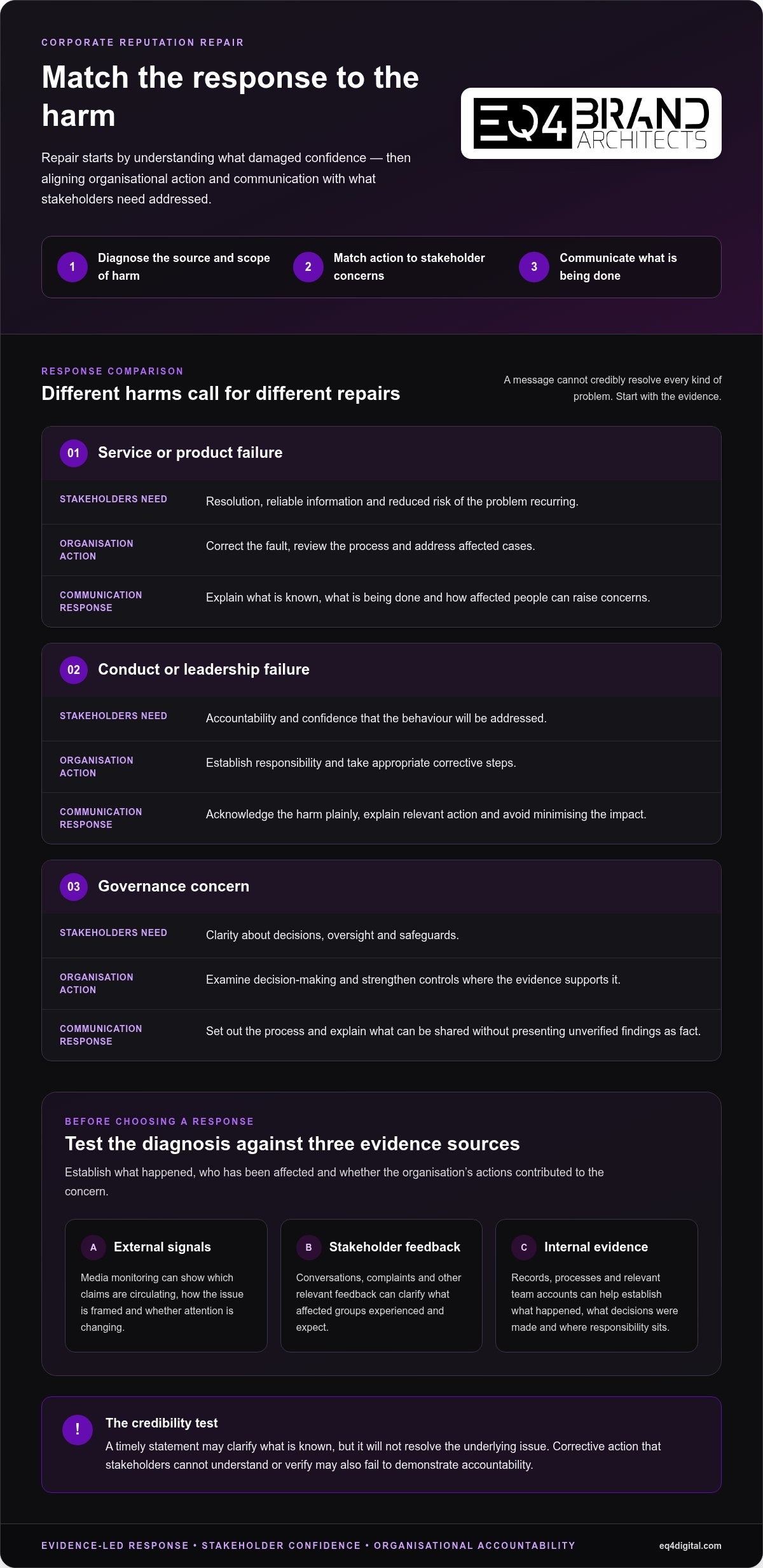
Test the initial account against three kinds of evidence:
- External signals: Media monitoring can show which claims are circulating, how the issue is being framed and whether attention is changing.
- Stakeholder feedback: Direct conversations, complaints and other relevant feedback can clarify what affected groups experienced and what they expect the organisation to address.
- Internal evidence: Records, processes and accounts from relevant teams can help establish what happened, what decisions were made and where responsibility sits.
Then distinguish direct impact from wider concern. Employees may need clarity about workplace decisions; customers may need a service problem resolved; funders, communities or public bodies may need an explanation of governance or commitments. These are diagnostic prompts, not assumptions about any organisation. Broader reputation management also involves understanding how perceptions are formed. Repair requires testing those perceptions against the specific harm and the organisation’s role in it.
When is reputation repair different from crisis response?
Crisis response deals with immediate priorities: establishing verified facts, limiting further harm and communicating responsibly as the situation develops. Reputation repair has a longer horizon. It asks whether the underlying concern has been addressed, whether affected stakeholders can see meaningful change and whether communication continues to reflect what the organisation is doing.
The two can overlap, but they are not interchangeable. A timely statement may clarify what is known without resolving the issue that caused distrust. Corrective action that stakeholders cannot understand or verify may also fail to demonstrate accountability. Leaders need clear ownership and consistent decisions as the response moves from immediate communication to sustained action. For a broader view of ongoing reputation work, see the corporate reputation management guide.
Repair cannot be guaranteed. Stakeholders will judge the organisation’s actions, their relevance and their consistency over time. Diagnosis helps leaders respond proportionately, avoid treating every criticism as the same problem and focus effort on what affected people need addressed.
Which corporate reputation repair strategies fit the cause of the damage?
The response should follow the evidence, not pressure to issue a statement quickly. A service failure calls for a different remedy from a misleading public claim or a governance concern. One message cannot credibly address every kind of harm, and communication cannot substitute for fixing a substantiated organisational failure.
Choose the response according to the harm experienced and the organisation’s responsibility for it. This comparison connects the issue to what stakeholders need and what the organisation can credibly do.
Service or product failure
Stakeholder need: Resolution, reliable information and reduced risk of the problem recurring.
Organisational action: Correct the fault, review the process and address affected cases.
Communication response: Explain what is known, what is being done and how affected people can raise concerns.
Conduct or leadership failure
Stakeholder need: Accountability and confidence that the behaviour will be addressed.
Organisational action: Establish responsibility and take appropriate corrective steps.
Communication response: Acknowledge the harm plainly, explain relevant action and avoid minimising the impact.
Governance concern
Stakeholder need: Clarity about decisions, oversight and safeguards.
Organisational action: Examine decision-making and strengthen controls where the evidence supports it.
Communication response: Set out the process and explain what can be shared without presenting unverified findings as fact.
Conflicting or incomplete information
Stakeholder need: A dependable account and updates as facts emerge.
Organisational action: Verify information, preserve relevant records and assign responsibility for establishing the facts.
Communication response: Distinguish what is confirmed from what remains under review. State when further information will be provided if that timing is known.
Match the response to responsibility and impact
Where responsibility is established, put corrective action and clear accountability first. Where information is incomplete or contested, avoid premature conclusions. Explain what is known, how the organisation is establishing the facts and what affected stakeholders can expect next. Tailor engagement to the people directly affected, listen to their concerns and avoid promises the organisation cannot support.
Repair may require several responses at once: direct engagement to understand impact, a transparent explanation of decisions, operational correction and evidence over time that change is taking hold. A statement alone cannot repair a substantiated failure.
Why communication without operational change can deepen distrust
If leaders announce a change that operational teams cannot deliver, or describe accountability that decision-makers have not approved, stakeholders may see a gap between words and conduct. Align the executive responsible for the issue, the teams who must act and communications leaders before making public commitments. Agree what will change, who owns it and what evidence can be shared.
Communication should make organisational action understandable, not disguise its absence. Strategic judgement and execution need to work together. The strategic PR agency selection guidance can help leaders consider how advice, stakeholder insight and delivery fit together.
How to implement a corporate reputation repair strategy in South Africa
A repair plan needs more than a sequence of messages. It needs an accountable decision process that connects what the organisation knows, what it will change and how affected stakeholders will be kept informed. For South African organisations, that process must reflect the different relationships people may have with a business, public institution, state-owned entity or community programme.
Build a response sequence leaders can govern
Use a clear sequence, with an executive owner who can resolve delays and escalate decisions when new evidence changes the response.
- Establish the facts. Record what is verified, what remains uncertain, the evidence supporting each point and who is responsible for resolving open questions. Keep interpretation separate from confirmed information.
- Map affected stakeholders. Identify who experienced direct impact, who has a decision-making or oversight relationship to the issue, and who needs a reliable update. Note their concerns, preferred channels and any access considerations relevant to engagement.
- Agree the action. Set out the organisational response, accountable owners and intended timing. Define who can approve corrective action, stakeholder engagement and public messaging, and how urgent or disputed decisions will be escalated.
- Communicate with discipline. Explain what is known, what the organisation is doing and what remains unresolved. Present commitments as commitments, not completed outcomes, and distinguish forecasts from established facts.
- Review the evidence. Check whether agreed actions have happened, whether affected stakeholders have received a meaningful response and whether new information requires a change in approach. Record decisions so the organisation can explain why its position has shifted, if it does.
Stakeholder mapping should shape response priorities and communication channels. People most directly affected may need a different action and a different way to receive information from those following the issue at a distance.
Make engagement relevant to South African stakeholders
South African organisations may communicate across different language preferences, levels of digital access, institutional relationships and local contexts. Do not make assumptions about an entire community. Establish what is relevant to the issue by listening to affected people and using appropriate, trusted channels where those relationships already exist.
A digital update may work for some stakeholders but be insufficient for people who need a direct conversation or an accessible explanation. Choose channels according to audience needs and the sensitivity of the issue, then keep key information consistent across them. In public-sector and state-owned settings, consider the organisation’s specific governance and accountability context rather than relying on private-sector assumptions.
Before communicating about obligations or formal processes, verify applicable South African requirements through authoritative primary sources and involve the appropriate organisational advisers. This helps prevent a reputational response from creating avoidable legal or governance risk.
Keep an accessible record of decisions, approved messages and outstanding actions. This gives teams a shared reference when updates are adapted for different audiences and helps prevent changes in wording from creating conflicting expectations.
How to measure reputation repair and choose the next strategic step
Measurement is useful when it helps leaders decide what to do next, not when it produces a reassuring score. Before reviewing results, agree what evidence would justify continuing the current response, changing it or escalating the issue. This prevents teams from selecting whichever indicator looks most favourable after the fact.
Which indicators show credible progress?
Choose measures that reflect the original harm and the stakeholders affected. A service concern might call for reviewing repeat complaints and whether people have received a resolution. A governance concern may require evidence that agreed oversight changes have been implemented. Pair operational signals with stakeholder feedback and relevant media context, and record where the evidence is incomplete.
Keep attention, relevance, engagement depth, stakeholder action and organisational value distinct. High reach or positive coverage may show that a message travelled, but neither proves that people’s concerns have been addressed. A change in feedback may also have other causes, so describe what the evidence indicates without claiming that a particular communication activity produced the change.
Use the evidence to decide what happens next
At each review, compare the evidence with the decision criteria agreed at the outset. If the intended organisational change has not happened, prioritise that gap. If delivery is complete but stakeholders remain unclear about what changed, refine the explanation or provide more accessible evidence. If the signals conflict, investigate the difference before making a broad claim about progress.
Document the decision, the evidence behind it and what will be assessed at the next review. This creates a practical learning record and helps leaders distinguish a temporary shift in attention from a material change in stakeholder experience. Adjust the response as evidence develops, and communicate progress only to the extent that it can be substantiated.
Make the next step one your stakeholders can recognise
Repair is not a communications milestone to announce. It is an ongoing test of whether organisational decisions meet the expectations they helped shape. Make accountability visible in the work itself, then keep listening closely enough to recognise when stakeholder needs or risks change. Corporate reputation repair strategies can therefore inform more than a response to immediate scrutiny: they can support stronger relationships and more intentional decisions over time.
EQ4 Brand Architects advises on reputation strategy, issues management, stakeholder risk, response messaging, monitoring and measurement, bringing senior strategic communications advice together with creative execution. The aim is a coherent approach in which communication reflects organisational action and progress is assessed with care, not overstated.
If your organisation is responding to a loss of confidence or strengthening its engagement with stakeholders, discuss a reputation or stakeholder challenge with EQ4 Brand Architects.
Frequently Asked Questions
How long does it take to repair a corporate reputation?
There is no dependable fixed period for corporate reputation repair. The pace depends on what happened and whether people experience meaningful change. Rather than set a public recovery date, leaders can agree review points tied to operational milestones, such as completing a remedy or checking whether affected people received a response. Changes in coverage may reflect a news cycle, not a change in confidence, so assess more than visibility alone.
Can a corporate reputation be repaired after a serious trust breach?
It may be possible, but no communication plan can guarantee that stakeholders will restore their confidence. The organisation needs to address the specific breach and show that its response is consistent over time. If a commitment was not met, for example, leaders should be ready to explain what prevented delivery, what has changed and how progress will be evidenced. The judgement ultimately rests with those affected, not with the organisation alone.
Should an organisation apologise when its reputation is damaged?
An apology is appropriate when it reflects established facts and the organisation’s responsibility. It should identify the harm plainly and avoid vague expressions of regret that leave stakeholders unsure what is being acknowledged. Pair it with action the organisation can deliver. If key facts are still being established, explain what is known and how the organisation is addressing the uncertainty, rather than speculating or making commitments it may not be able to meet.
How can leaders tell whether reputation repair is working?
Compare later evidence with a baseline tied to the original concern, and make sure you are comparing like with like. Feedback from people directly affected, for instance, is more useful for assessing their experience than general online sentiment. Review whether the same concerns continue to arise, whether responses are reaching the intended stakeholders and whether agreed remedies are being completed. Record gaps and limitations. A favourable media story alone does not establish restored confidence.
What is the difference between reputation repair and reputation management?
Reputation management is the ongoing work of understanding stakeholder experience and guiding how an organisation communicates and behaves. Repair is a focused response to a specific loss of confidence. Routine feedback monitoring may help identify emerging concerns; if a particular decision damages trust, repair requires addressing that issue directly. Once the immediate harm is being addressed, learning from it can inform the organisation’s ongoing reputation management.