





A brand image problem calls for diagnosis before redesign. Fixing a brand image problem starts with understanding what has damaged confidence, who is affected and whether the gap lies in perception, organisational behaviour or both. That assessment shows whether the right response is to correct a specific issue, rebuild trust over time or make a more fundamental change.
It is understandable to want a visible response quickly, especially when customers, employees, partners or the public are asking questions. But a new identity or carefully worded statement will not resolve a problem rooted in how the organisation acts. Across South Africa, where stakeholders bring varied experiences and expectations, a credible response must be clear, consistent and grounded in what the organisation can genuinely change.
This article explains how to assess the severity of the issue, address responsibility or misinformation, and compare customer expectations with organisational reality. It also sets out when gradual brand renewal may be appropriate and when a more fundamental revival is needed, so the response is proportionate to the damage and credible to the people whose confidence matters.
Key Takeaways
- Assess the extent of the damage by looking at who is affected, what has changed and whether confidence is at risk.
- Choose gradual brand renewal when the organisation is changing direction; reserve a major revival for deeper, structural issues.
- Compare what stakeholders expect with what the organisation consistently delivers to identify where trust needs attention.
- Respond to misinformation with clear, credible communication, and take ownership when the organisation is responsible for the problem.
- Align your response across leadership, employees and public messaging, then use stakeholder confidence and meaningful action to assess progress.
Assessing the severity of a brand image problem
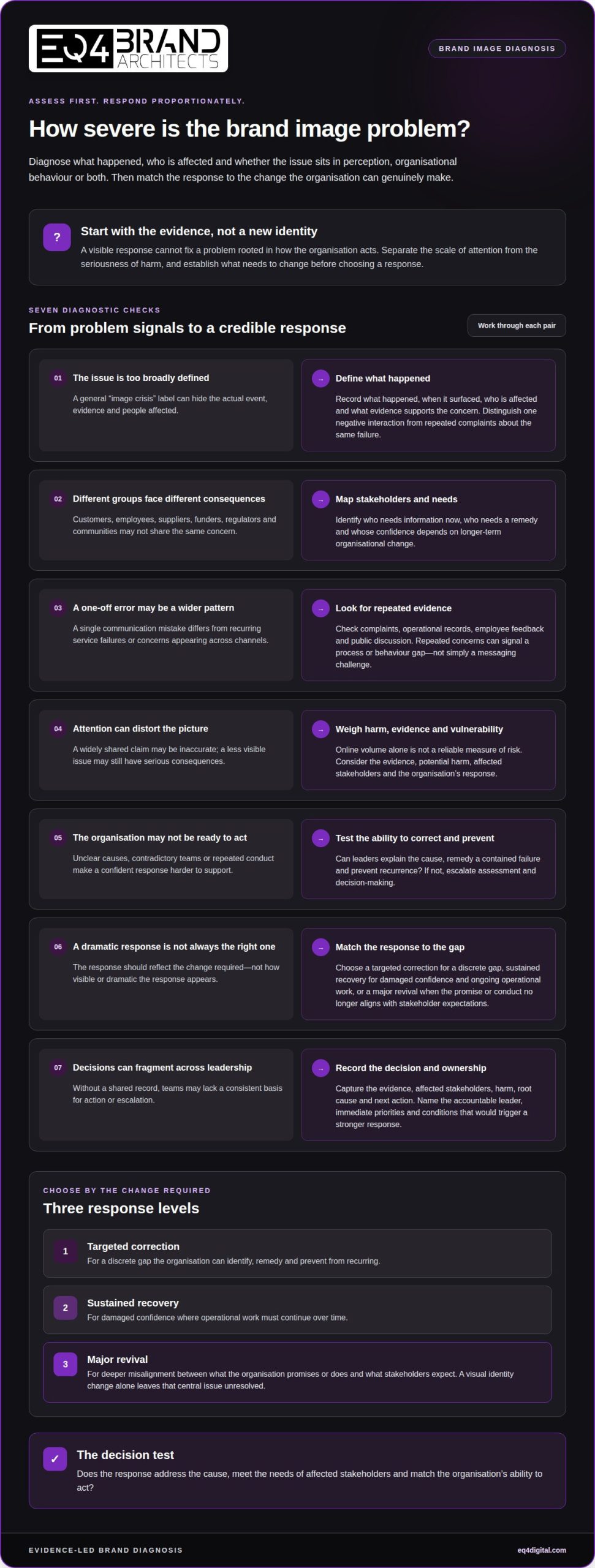
Assess severity before deciding whether the organisation needs a focused correction, sustained recovery or fundamental change. This gives leaders a proportionate basis for fixing a brand image problem.
- Define the issue before treating it as a broad image crisis. Record what happened, when it surfaced, who is affected and what evidence supports the concern. A negative comment about one interaction differs from repeated complaints about the same service failure. In South Africa, the Consumer Protection Act 68 of 2008 addresses misleading consumer representations; defamation is governed by common law. The facts determine which rules may be relevant.
- Map the stakeholders experiencing the problem and the consequences for each group. Customers may be dealing with a faulty product, while employees may be fielding questions about leadership conduct. Suppliers, funders, regulators and communities may have different concerns. Identify who needs information now, who needs a remedy and whose confidence depends on longer-term organisational change.
- Assess whether the issue is isolated, recurring or embedded in organisational behaviour. Look for patterns in complaints, operational records, employee feedback and public discussion. A single communication error may call for a correction; repeated service failures point to a process problem. When the same concern appears across channels, treat it as evidence of a wider gap, not simply a messaging challenge.
- Separate the scale of attention from the seriousness of harm. A widely shared claim may be inaccurate, while a less visible issue may have serious consequences for the people affected. Consider the evidence, potential harm, stakeholder vulnerability and organisational response. Online volume alone is not a reliable measure of risk, and limited visibility does not mean the issue can wait.
- Test whether leaders can explain the cause and commit to corrective action. If the organisation can identify a contained failure, remedy it and prevent recurrence, a focused response may be appropriate. If leaders cannot establish what happened, teams contradict one another or the issue reflects repeated conduct, escalate assessment and decision-making. Fixing a brand image problem requires a response that matches the organisation’s ability to act.
- Classify the response by the change required, not by how dramatic it appears. A targeted correction suits a discrete gap; sustained recovery suits damaged confidence and continuing operational work. A major revival may be needed when the organisation’s promise or conduct no longer aligns with stakeholder expectations. Changing visual identity without addressing that misalignment leaves the central issue unresolved.
- Create a concise decision record covering the evidence, affected stakeholders, harm, root cause and next action. Name the accountable leader, immediate priorities and the conditions that would trigger a stronger response. This gives executives a shared basis for decisions and helps explain why the organisation chose correction, recovery or deeper change.
Comparing customer expectations with business reality
Use customer research to identify where expectations differ from actual experiences. Compare what people expect with what the organisation delivers, then prioritise changes that can restore confidence.
- Define the expectation you want to test before gathering feedback. Turn broad claims such as “trusted” or “responsive” into observable experiences: clear information, consistent service, reliable follow-through or respectful treatment. Ask customers what they expected at a specific point, such as making a complaint or receiving an update. This gives the research a practical focus instead of producing general impressions that are difficult to act on.
- Gather evidence from customers who have encountered different parts of the organisation. Interviews can reveal why an experience fell short; surveys can help identify recurring themes across a wider group. Review complaints, service feedback, customer correspondence and relevant public comments alongside research responses. Research can expose perception problems by showing where stated expectations and reported experiences diverge, and which concerns recur across interactions.
- Compare each expectation with evidence of what the organisation actually does. If customers expect timely updates, examine how updates are handled during delays, not only under normal conditions. If they expect straightforward explanations, review the language used in customer communications. Include frontline employees’ observations: they can identify where internal processes make the promised experience difficult to deliver.
- Distinguish a communication gap from a delivery gap before deciding what to change. When the organisation performs consistently but customers misunderstand its offer, clearer explanations may help. When the experience itself falls short, changing campaign language will deepen the mismatch. For example, an organisation promising easy access should address confusing processes as well as explain its service more clearly.
- Prioritise gaps according to their effect on trust, frequency and the organisation’s ability to address them. Record the evidence, the stakeholder group affected, the operational cause and a realistic corrective action. Avoid promising immediate change where systems or staff practices must first improve. In South Africa, customer groups may use different languages and channels; research should make space for those differences without treating any community as having one shared expectation.
- Turn findings into commitments teams can deliver and stakeholders can recognise. Give each action an owner, a way to report progress and a clear explanation of what will change. If the expectation gap points to the need for a more tangible public experience, Brand Activations can express the intended promise through a relevant audience interaction.
This comparison can identify the changes needed to rebuild customer trust. Set achievable timeframes for correcting the brand problem, and avoid commitments the organisation cannot meet.
Standing by a brand when it is not at fault
When evidence shows the organisation is not responsible, respond with a clear position rather than silence or speculation. Protect credibility by addressing the claim, explaining the relevant values and keeping public statements consistent.
- Establish what can be verified before responding publicly. Separate the original claim from commentary, opinion and material that may have been altered or taken out of context. Record where the claim appeared, what it says and which audiences may have seen it. A false claim about a service failure, for example, calls for a different response from criticism of the organisation’s values.
- Decide whether a response will clarify the issue or amplify it. Assess the claim’s accuracy, reach among relevant stakeholders, potential consequences and likelihood of further circulation. If the allegation has reached a small audience, a direct explanation to those affected may be more proportionate than a prominent public statement. Avoid repeating harmful wording unnecessarily.
- State the organisation’s position in plain language. Explain what is inaccurate, provide context that supports the correction and identify the values guiding the response. An organisation facing a false allegation about its treatment of suppliers, for instance, can describe its actual position and relevant practices without attacking the person who raised the claim.
- Choose a credible spokesperson with the authority and knowledge to address the issue. A senior leader may be appropriate when the allegation concerns organisational conduct; a subject specialist may explain a technical claim more clearly. Give the spokesperson agreed facts, boundaries and key messages. Ensure employees and customer-facing teams can refer to the same accurate explanation.
- Use reliable news sources or Public Relations (PR) support when misinformation or disinformation threatens wider reputational harm. Share evidence and a concise explanation through channels that reach affected stakeholders. Keep records of published statements and corrections, and do not present unverified details as established fact. A measured response can correct the record without turning every post into a public dispute.
- Invite credible customer or community voices to contribute only when their experience is genuine and participation is voluntary. User-generated content can show how people experience a brand, but it should not be scripted or presented as proof of claims it cannot establish. Monitor stakeholder questions after responding, correct any remaining misunderstandings and update the explanation if new evidence changes the picture.
- Keep the response aligned across statements, media engagement and direct stakeholder communication. If the organisation says it values transparency, explain what information supports its position and what remains under review. Avoid defensive language, personal attacks and claims of certainty beyond the evidence. Consistency in tone and facts helps stakeholders distinguish a considered response from a reactive argument.
Acknowledging and addressing the issue
To repair its image, an organisation should acknowledge what happened, make amends and address the cause. It should communicate honestly and consistently, and promise only actions it can deliver.
-
Acknowledge the issue
Address the issue directly once the organisation understands what happened and who was affected. Name the specific failure, explain its impact and accept responsibility when the organisation is at fault. Avoid defensive language, blame-shifting and vague expressions of regret. If a faulty product reached customers, for example, acknowledge the risk and explain how affected customers can get support.
-
Address the issue
Pair every public acknowledgement with corrective action that tackles the cause. Stop the behaviour or process that created the problem, assign an accountable owner and set achievable milestones. If a product defect has reached customers, assess the defect, risk and applicable obligations, then determine an appropriate remedy. Refunds, replacements or gifts can help restore goodwill among customers directly affected by the problem.
- Choose an apology that matches the harm and the organisation’s responsibility. A useful apology is specific, sincere and connected to what will change; it should not make excuses or blame customers. If the organisation caused a service failure, it can acknowledge the inconvenience, explain the remedy and tell affected people how to access it. Do not minimise their experience.
- Decide whether to communicate proactively or pause public activity before a relaunch. Consider the urgency of stakeholder questions, the seriousness of the harm and whether the organisation has meaningful corrective information to share. Silence can leave an information gap, while a premature announcement can weaken trust. Set a clear communication sequence for customers, employees, partners and the media.
- Keep messages aligned across leadership, customer service and public channels. Agree on the verified facts, the action under way and the next update, then equip relevant teams to answer questions consistently. If a customer-facing team promises a remedy that operations cannot provide, the gap can compound the original damage. Explain what has changed without implying that every consequence has been resolved.
- Show progress through evidence, not declarations of recovery. Report completed corrective actions, explain delays and communicate revised timeframes when circumstances change. If an organisation is replacing a faulty item, for instance, explain the process and how affected customers will receive updates. Review recurring concerns and adjust the response when stakeholders identify gaps. Consistency over time gives people a basis to judge whether actions match statements.
Keep the problem, the people affected and the corrective action connected. When the organisation is responsible, it should take ownership and make amends rather than leave customers to guess whether their concerns were heard. An honest apology should match the mistake; corrective action should address its cause.
Choose a communication approach based on the circumstances, and align public messages with the action under way. Do not suggest the issue is settled unless corrective work supports that message. Clear communication helps customers understand what the organisation accepts responsibility for and what it is doing in response.
.
Assessing the severity of a brand image problem
Assess severity before deciding whether the organisation needs a focused correction, sustained recovery or fundamental change. This provides a proportionate basis for fixing a brand image problem, rather than reacting to public attention alone.
- Define the issue precisely before treating it as a broad image crisis. Record what happened, when it surfaced, who is affected and what evidence supports the concern. A negative comment about one interaction differs from repeated complaints about the same service failure. Warren Buffett is quoted as saying that destroying an identity can take only 5 minutes; a fast-moving issue still needs disciplined assessment.
- Map the stakeholders experiencing the problem and the consequences for each group. Customers may be dealing with a faulty product, while employees may be fielding questions about leadership conduct. Suppliers, funders, regulators and communities may have different concerns. Identify who needs information now, who needs a remedy and whose confidence depends on longer-term organisational change.
- Assess whether the issue is isolated, recurring or embedded in organisational behaviour. Look for patterns in complaints, operational records, employee feedback and public discussion. A single communication error may call for a correction; repeated service failures point to a process problem. When the same concern appears across channels, treat it as evidence of a wider gap, not simply a messaging challenge.
- Separate the scale of attention from the seriousness of harm. A widely shared claim may be inaccurate, while a less visible issue may have serious consequences for the people affected. Consider the evidence, potential harm, stakeholder vulnerability and organisational response. Online volume alone is not a reliable measure of risk, and limited visibility does not mean the issue can wait.
- Test whether leaders can explain the cause and commit to corrective action. If the organisation can identify a contained failure, remedy it and prevent recurrence, a focused response may be appropriate. If leaders cannot establish what happened, teams contradict one another or the issue reflects repeated conduct, escalate assessment and decision-making. Fixing a brand image problem requires a response that matches the organisation’s ability to act.
- Classify the response by the change required, not by how dramatic it appears. A targeted correction suits a discrete gap; sustained recovery suits damaged confidence and continuing operational work. A major revival may be needed when the organisation’s promise or conduct no longer aligns with stakeholder expectations. Changing visual identity without addressing that misalignment leaves the central issue unresolved.
- Create a concise decision record covering the evidence, affected stakeholders, harm, root cause and next action. Name the accountable leader, immediate priorities and the conditions that would trigger a stronger response. This gives executives a shared basis for decisions and helps explain why the organisation chose correction, recovery or deeper change.
EQ4 Brand Architects
EQ4 Brand Architects helps organisations connect reputation, stakeholder confidence and communication with the actions needed to address a brand image problem. Its senior strategic advice supports leaders in choosing a proportionate response, aligning messages and turning corrective priorities into a coherent communications approach.
When an issue involves public scrutiny, Reputation Management and Public Relations (PR) can support clear, consistent engagement. Communication Strategy can align internal decisions with what stakeholders hear, while Brand Activations can bring an intended brand promise to life through relevant audience experiences. The right mix depends on the cause of the issue and the changes the organisation is prepared to make.
If your organisation is weighing its response or recovery priorities, contact EQ4 Brand Architects to discuss the challenge.
Make the next decision count
Fixing a brand image problem does not end when attention shifts elsewhere. The next task is to make the organisation’s stated values visible in everyday choices, from leadership communication to the experiences of customers and employees. That consistency gives stakeholders something tangible to assess, rather than another promise to weigh.
Set a clear internal direction: what will change, who is responsible and how leaders will know whether the change is happening. Focus on actions that matter to stakeholders and organisational trust. If priorities shift, explain why; if progress stalls, address the cause before issuing a new public message. Credibility grows through decisions that hold up over time.
When the response involves complex stakeholder pressures or competing organisational priorities, an experienced strategic communications partner can help bring the work into focus. Contact EQ4 Brand Architects to discuss the challenge and consider a considered path forward.
Frequently Asked Questions
How do you diagnose a brand image problem?
Diagnose the issue by comparing what stakeholders say with the experiences and messages shaping their views. For each concern, record the claim, where it appeared, supporting evidence, affected audience and likely organisational impact. Repeated comments about unclear billing, for example, may point to a customer communication issue, not a need for a new visual identity. This helps leaders choose the right response.
How should a company respond to negative reviews and public criticism?
Respond calmly, address the point raised and avoid debating the reviewer. A useful reply recognises the person’s experience, corrects factual errors without hostility and offers an appropriate way to resolve individual details privately. A service provider can acknowledge a missed appointment publicly, for example, then discuss account information directly with the customer. Keep replies consistent across platforms, and use recurring criticism to identify issues that need organisational attention.