





A crisis can worsen when the response moves faster than the facts. Knowing how to manage a PR crisis means assessing the potential harm and reach, establishing what is known and coordinating clear communication with affected stakeholders. When safety is at risk, protecting people comes before protecting reputation. South African organisations may also need to account for different stakeholder expectations and operating contexts.
When media coverage or online discussion starts to build, the pressure to respond immediately is understandable. A useful response is prompt, accurate and empathetic, with the people affected at its centre. This helps leaders make decisions without letting urgency turn into speculation or inconsistent messaging. It also connects public statements to the organisation’s actions, rather than treating communication as a substitute for resolving the underlying issue.
This article explains what crisis PR involves and how to assess an issue’s severity, including the roles of employees, customers, communities, media and other stakeholders. It covers preparation for fast-moving coverage and common mistakes, such as silence, premature claims and fragmented messaging. You’ll find a practical framework for making sound decisions, coordinating communication and responding carefully as circumstances develop.
Key Takeaways
- Set an organisational stance that is accurate, compassionate and consistent with what is known.
- Agree roles between the crisis PR team and organisational leaders so decisions and communication have clear owners.
- Assess severity by considering potential harm, how quickly the issue is spreading and which stakeholders can shape its impact.
- Prepare messages and monitoring processes that help the organisation respond coherently as coverage develops.
- Avoid silence, speculation and fragmented messaging, which can deepen stakeholder concern during a crisis.
What is public relations crisis management?
Public relations crisis management aligns decisions, actions and communication when an incident threatens people, service delivery or stakeholder confidence. A professional helps leaders establish a clear organisational stance, then coordinate communication as the situation develops.
POPIA and other applicable South African laws can affect how personal information is handled, what may be disclosed and whether notification duties apply after a data breach. Before communicating, establish the organisation’s relevant obligations with privacy and legal advisers. Avoid exposing personal information, and distinguish verified facts from unconfirmed claims.
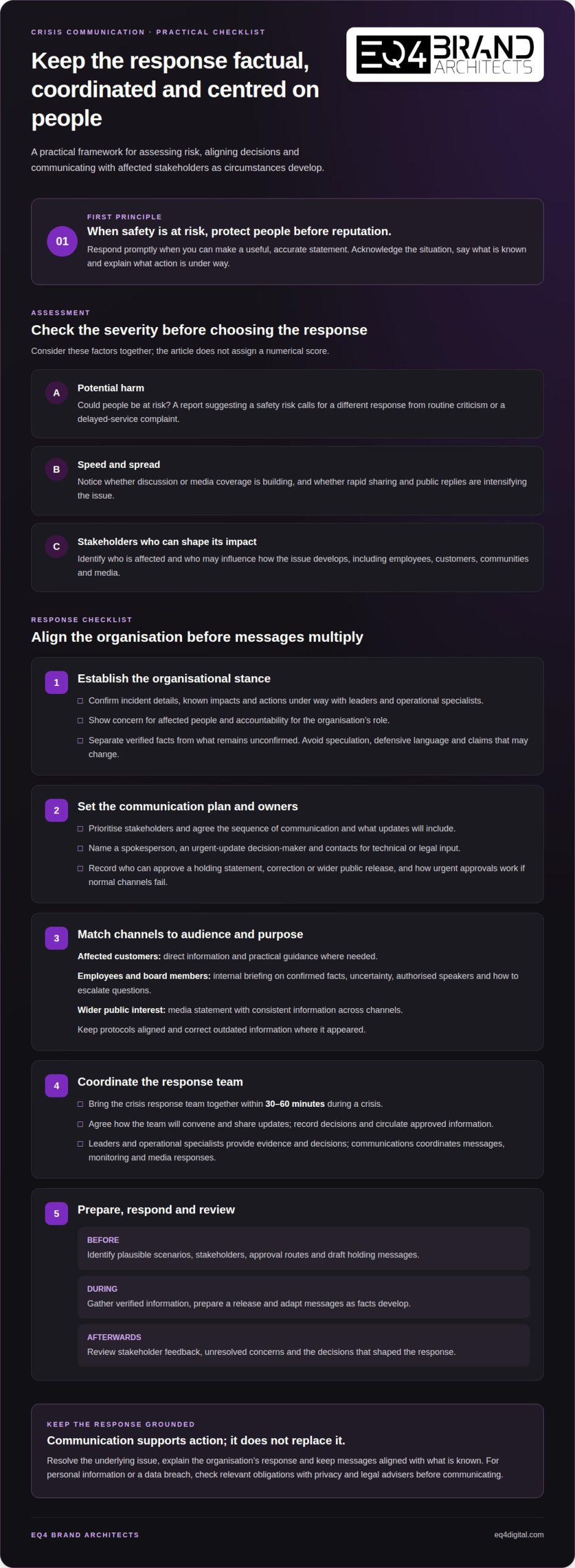
Respond publicly as soon as the organisation can make a useful, accurate statement. Acknowledge the situation, explain what is known and describe the action under way. Don’t wait for every detail if people need guidance now.
-
Establish the organisational stance
Work with leadership to establish what the organisation can responsibly say. Leaders should provide verified incident details, operational decisions, known impacts and the action being taken. The position should show concern for affected people and accountability for the organisation’s role. Avoid defensive language, speculation and claims that may change as facts emerge.
-
Set the communications strategy
Turn that position into a strategy: identify priority stakeholders, set the communication sequence, agree who approves messages and define what updates will include. The organisation supplies operational facts, decision-makers and access to relevant specialists. Crisis management focuses on controlling the incident; crisis communication explains the response and its implications to people affected.
-
Choose crisis communication channels
Match each channel to its audience and purpose. A direct message may serve affected customers, while a media statement addresses wider public interest. Staff may need an internal briefing before information reaches external audiences. For example, a hospitality service disruption may require consistent updates at the venue and through customer channels, alongside practical guidance on service recovery. Keep protocols aligned, and correct outdated information where it appeared.
-
Communicate with employees and board members
Ask the professional to prepare a clear internal briefing for employees and board members before external media communication, where circumstances allow. Explain what is confirmed, what remains under investigation, who is authorised to speak, and how questions should be escalated. Employees need useful guidance for their roles, not a script that conceals uncertainty. Board members need the facts and decision points to provide oversight without creating conflicting public messages.
How is a social media crisis different from crisis PR generally?
A social media crisis can intensify through rapid sharing and public replies, while a wider PR crisis may involve operational, employee, customer and media communication. A professional team connects these responses so stakeholders receive consistent information across channels.
- Map responsibilities before an incident occurs. The organisation identifies its decision-makers, operational leads and subject specialists; the communications partner defines how their information reaches the response team. For example, a service disruption may require input from operations, customer support and communications. A social media lead can flag emerging questions, but should not make operational promises or accept responsibility on the organisation’s behalf.
Agree how the team will convene and share updates. A crisis response team should be assembled within 30-60 minutes during a crisis. The partner can coordinate a secure online workspace or physical centre, record decisions and circulate approved updates. That structure helps the organisation respond across public and internal channels without relying on fragmented messages or informal chat threads.
- Ask the partner to plan before, during and after the crisis. Before an incident, the team identifies plausible scenarios, stakeholders, approval routes and draft holding messages. During the response, it gathers verified information, prepares a release and adapts messages as facts develop. Afterwards, it reviews stakeholder feedback, unresolved concerns and the decisions that shaped the response.
Social media needs particular attention because posts can prompt immediate questions from customers, employees and community members. Distinguish a serious issue from routine criticism by examining its substance, spread and potential harm. A complaint about a delayed service, for instance, calls for a different response from a report suggesting a safety risk. Identify who can assess the difference and escalate the issue.
- Set clear roles and approval protocols with the organisation. The communications partner can coordinate message drafting, channel monitoring and media responses; leaders and operational specialists provide evidence and approve decisions within their authority. Name a spokesperson, a decision-maker for urgent updates and a contact for technical or legal input. Record who can approve a holding statement, correction or wider public release.
Define a practical route for urgent approvals, including how to reach decision-makers if normal channels fail. Keep current approved messages available to the response team. This reduces the risk of an employee posting an outdated statement or executives giving conflicting accounts. It also preserves a record of what the organisation knew and communicated at each stage.
- Address the problem directly and adjust the response as evidence changes. If the organisation caused harm, its communication should acknowledge the impact, explain the action under way and avoid shifting blame. A communications partner can help distinguish an apology from an unverified admission, while ensuring the wording reflects the organisation’s actual decisions and conduct.
Monitor replies, media coverage and stakeholder concerns, then report patterns to the response team. If customers repeatedly ask about access to a service, for example, clarify the practical steps in the next update. If a release contains an error, correct it through the channels where it appeared. Track whether questions are being answered and whether further action is needed, not attention alone. For support with crisis communication planning, bring the challenge into a discussion with a strategic communications partner.
Assessing crisis severity and influential voices
Assess the severity and scope of a crisis by examining potential harm, affected stakeholders, operational impact and how the issue is spreading. This helps leadership decide what needs attention first and provides a basis for proportionate action. Revisit the assessment as reliable information develops instead of treating an early view as final.
-
Classify potential crisis severity
Rank plausible crises against the organisation’s exposure, rather than treating every negative mention as a major event. A working framework can group issues as low, moderate or high severity, with escalation criteria based on potential harm, disruption and stakeholder concern. These categories are practical decision aids, not universal labels. Define the response required for each category.
Provide incident reports, service information, customer complaints and relevant operational context. A local delay with a clear remedy may remain low severity; repeated failures or possible harm call for closer assessment. Scenario planning should account for supply interruptions, service disruption, legal challenges and product recalls. Don’t classify an issue by online volume alone: a smaller discussion may still involve serious consequences.
-
Assess severity and scope
Ask the professional to establish what happened, who is affected, whether the situation is continuing and what action is under way. The assessment should distinguish verified facts from allegations, identify geographic or service impacts, and consider whether customers, employees or communities face immediate consequences. A service outage at one site, for example, differs in scope from a disruption affecting several locations.
An organisation might set a 20% drop in brand sentiment over 24 hours as a trigger to investigate a potential crisis, but it should validate that threshold against its own baseline and evidence. Treat the signal as a prompt, not proof of harm; compare it with complaints, operational records and credible reporting. Leaders deciding how to manage a PR crisis need an assessment that reflects both evidence and human impact. Reclassify the issue when new facts change the level of risk.
-
Identify influential voices
Map who is discussing the incident and whose response may shape stakeholder confidence. Relevant voices could include affected customers, employees, community representatives, journalists, regulators or sector bodies. Assess their connection to the issue, the audiences they reach and the information they may contribute. Follower counts alone don’t establish credibility, expertise or influence.
Compare each group’s concerns with the organisation’s evidence and response. Employees may report a workplace impact while customers describe service disruption; these are distinct concerns that require coordinated attention. Track whether trusted community voices, subject specialists or public officials raise new information. This helps prioritise engagement and identify when the initial assessment needs revision. Understanding whose trust is at stake is central to how to manage a PR crisis with sound judgement.
Preparing for fast-moving social media coverage
Prepare leadership to respond with verified information, clear approval routes and messages suited to each audience. A communications partner can help address misinformation, criticism and hostile media questions by distinguishing evidence from speculation and correcting inaccuracies without escalating the exchange.
-
Prepare the media strategy
Prepare a media strategy that connects social media, news coverage and direct stakeholder communication. Identify likely questions, audiences, approved messages, spokespersons and escalation routes. For a suspected data breach, for example, separate confirmed facts from details still under investigation, and explain how affected people will receive practical updates.
Prepare holding statements, FAQs and customer-support guidance before an incident, then adapt them to verified facts. Agree who approves a release and what information requires specialist input. Don’t publish a template unchanged: a message that overlooks the actual impact can undermine trust and create further questions.
-
Monitor media and social media
Ask the partner to monitor news coverage and social media for changes in volume, tone, key claims and stakeholder concerns. A 300% increase in brand mention volume may signal emerging issues, but volume alone doesn’t establish severity. The team should assess what people are saying, whether reports are credible and whether the organisation has evidence to respond.
Use findings to inform leadership decisions and update messages. If customers repeatedly ask whether a service is available, answer that directly in the next update. Track emerging claims, unanswered questions and corrections across channels. The purpose is to understand the issue and guide action, not to treat impressions or attention as proof of resolution.
-
Prepare and train spokespeople
Have the partner prepare the designated spokesperson for interviews, briefings and difficult follow-up questions. Rehearse the core message, the facts that can be shared, and how to explain what remains under investigation. Use realistic scenarios, such as a journalist asking whether leadership knew about a service failure before it became public.
Preparation should help the spokesperson listen, answer directly and avoid speculation or defensive language. Practise moving from an unverified claim to what the organisation can confirm without evading the question. Agree when the spokesperson should pause and seek expert input. Leaders must ensure their public comments match operational decisions and the organisation’s actual response.
-
Handle misinformation and hostile questions
Have the partner assess a disputed claim before recommending a correction. Compare it with available records, identify what is inaccurate and decide which audience needs a response. A concise correction should state the verified information and explain its relevance. Avoid repeating a harmful allegation unnecessarily or attacking the person who raised it.
For hostile media questions, prepare a direct response grounded in evidence, acknowledge legitimate concerns and explain the next action. If new facts change the position, issue a correction through the channels carrying the earlier message. The golden hour can be shorter than 60 minutes as digital coverage moves quickly, so agreed protocols help teams respond promptly without sacrificing accuracy.
Common crisis-management mistakes
Preventable response failures can deepen reputational harm. These steps help leaders identify weak decisions, assign corrective action and document what the organisation learns.
- Don’t wait for an incident to decide who leads. Without an agreed response team, operational facts, approvals and public messages can fall between departments. Before a crisis, document decision-makers, spokesperson responsibilities, escalation routes and how to contact them. Include relevant leaders and specialists, not only the communications function.
Test the protocols against a plausible scenario, such as a service disruption or product recall. Check whether the team can find current contact details, identify who approves a holding statement and explain how employees receive updates. A plan that exists only as a document, but isn’t usable by the people named in it, won’t guide effective action.
- Don’t let silence or a rushed apology replace a considered response. A delayed statement can leave employees, customers and media relations teams without information, while a premature claim may later need correction. Acknowledge the issue, state what is verified and explain the next action. If facts are still emerging, say what the organisation is doing to establish them.
Take responsibility for the organisation’s actions where the evidence supports it. Avoid defensive wording, blame-shifting and broad promises operations cannot deliver. For example, if a service failure is under investigation, explain the immediate steps to support affected customers before claiming the issue is resolved. Ensure the response reflects decisions leaders have actually authorised.
- Don’t confuse online attention with resolution. A rise in mentions can signal an emerging issue, but it doesn’t show by itself whether people are safer, service has recovered or concerns have been addressed. Monitoring should identify the claims being shared, the stakeholders raising them and the questions still unanswered.
Use that evidence to guide action. If customers keep asking how to access a disrupted service, provide clear instructions and update them as circumstances change. Record recurring questions, corrections and stakeholder feedback. Measure whether the response addresses relevant concerns and supports necessary action, rather than treating reach or impressions as proof of success.
- Don’t allow separate teams to give separate accounts. Employees may hear one explanation, media another and customers a third. Establish a shared source of approved facts, assign responsibility for updates and record significant decisions with their rationale. This helps the organisation correct inconsistencies and understand how its position developed.
After the immediate response, review the timeline with operational leaders and communications staff. Identify where approvals stalled, which stakeholder questions were missed and whether monitoring informed decisions. Assign an owner to each improvement, update the relevant protocols and rehearse the revised process. A review should lead to specific changes, not simply a document filed after the crisis.
EQ4 Brand Architects: Reputation Management
EQ4 Brand Architects helps organisations bring strategic judgement and clear communication to reputation challenges. Its Reputation Management, Public Relations (PR) and Communication Strategy work can support leaders when an issue threatens stakeholder confidence, requires coordinated communication or exposes gaps in existing response protocols.
The focus is to connect organisational decisions with what employees, customers, communities and other stakeholders need to know. Where appropriate, Brand Activations can support purposeful engagement as part of a wider communications approach. This is a considered next step when internal teams need senior guidance alongside practical communications execution, rather than isolated messages that may not address the underlying issue.
If your organisation is managing a reputational challenge, contact EQ4 Brand Architects to discuss the communications support you need.
Make readiness part of leadership practice
Knowing how to manage a PR crisis is about more than responding to a live incident. It also means ensuring leadership can make clear decisions, communicate them responsibly and apply what the organisation learns afterwards. Treat preparedness as part of organisational governance, not as a communications document that sits unused until pressure rises.
Consider where decision-making could stall: unclear authority, competing priorities or uncertainty about who speaks for the organisation. Addressing those points before a crisis can help align communication with operational action and stakeholder needs.
EQ4 Brand Architects works with organisations on reputation challenges and public relations. Discuss your communications challenge with EQ4 Brand Architects, and take a considered next step towards a more deliberate response.
Frequently Asked Questions
What is a PR crisis?
A PR crisis is an event or allegation that threatens an organisation’s reputation and demands a considered response. It may arise from operational failures, leadership conduct, public criticism or a service problem. The defining issue is not simply negative coverage, but whether stakeholders need answers, action or reassurance from the organisation. For example, an unresolved customer complaint becomes more serious when it reveals a wider service failure.
What is the difference between crisis management, PR crisis management and crisis communication?
Crisis management coordinates the organisation’s response to the underlying event; PR crisis management addresses its reputation and stakeholder relationships; crisis communication conveys relevant information to affected audiences. These functions should work together. If a service fails, operations may restore it, PR teams manage external and stakeholder concerns, and crisis communication explains the impact and response. Treating communication as a substitute for operational action can weaken trust.
How can a professional monitoring service guide decisions before and during a crisis?
Before an incident, monitoring can establish what stakeholders discuss routinely, making unusual changes easier to recognise. During a crisis, a communications partner can organise coverage and public comments by topic, source and stakeholder group. Leaders can use those patterns to identify unanswered concerns, emerging claims or groups needing direct information. Monitoring informs judgement; it cannot independently establish whether a claim is true or an issue resolved.
How can a professional crisis PR partner help an organisation reduce the risk of a PR crisis?
A communications partner can help leaders identify vulnerabilities before they become public problems. This may include reviewing how decisions are approved, how employees receive operational updates and how customer complaints reach senior decision-makers. A recurring complaint, for instance, may reveal a service issue that needs operational attention as well as clearer communication. The aim is to surface risks, clarify ownership and support timely action, not to promise that every crisis can be prevented.
How can transparency improve the handling of media inquiries?
Transparency helps journalists understand what the organisation can verify, what it is doing and where information remains incomplete. A useful response addresses the question directly, separates confirmed facts from speculation and explains when further information will be shared. If personal or commercially sensitive details cannot be disclosed, explain why without obscuring the wider issue. Clear, consistent answers reduce avoidable ambiguity and help media relations remain constructive under scrutiny.
How does a professional prepare and use an initial holding statement?
A holding statement is a short, approved response for use while the organisation establishes the facts. It can acknowledge awareness of the incident, express concern where appropriate, describe immediate action and explain how updates will follow. Avoid assumptions about cause, responsibility or impact. When verified information changes the picture, replace or update the holding message rather than leaving an interim response circulating as the final account.
How can an organisation assess the effectiveness of professional crisis PR support?
Assess effectiveness against the response objectives agreed with leadership, not media volume alone. Review whether priority stakeholders received relevant information, key questions were answered and communications reflected operational decisions. Consider the quality and consistency of coverage alongside stakeholder feedback and actions taken. After the incident, record what worked, where approvals or information flows stalled and which changes have been assigned to an accountable owner.
What immediate support can a professional crisis PR partner provide during a PR crisis?
A communications partner can help set communication priorities, organise verified information and prepare clear responses for media, employees and affected stakeholders. They can also support spokesperson preparation, coordinate message approvals and identify questions requiring input from operational or specialist teams. In a serious incident, leaders should first ensure urgent operational and safety needs receive attention. Communications support should remain aligned with the organisation’s actions and decisions.