





A chief executive’s reputation can shape how employees, customers, investors and other stakeholders interpret an organisation’s decisions. CEO reputation management services can bring together listening and risk assessment, executive positioning, considered media engagement and a plan for emerging issues. The aim is not simply to increase visibility, but to align a leader’s public profile with the organisation’s purpose, conduct and priorities.
That distinction matters in South Africa, where leaders answer to diverse stakeholders and a CEO’s words and actions can become part of the organisation’s wider story. A sound approach starts by understanding what audiences are saying and need to know, then sets communication priorities, channels, responsibilities and measures. This article explains what the work can involve, how an engagement is structured and how consistent executive communication can support credibility and customer trust. It also explains when strategic support can help and what to expect from a reputation management process.
Key Takeaways
- Assess a CEO’s search presence and online mentions as part of ongoing reputation monitoring, not only during a crisis.
- Build an executive profile around the organisation’s purpose, leadership priorities and the issues stakeholders care about.
- Distinguish personal reputation work from company-wide reputation management while keeping the two aligned.
- Connect executive communication to stakeholder confidence and organisational credibility, rather than measuring visibility alone.
- Use a structured professional engagement to set priorities, coordinate responses and learn from audience feedback.
1. What does reputation management for individuals include?
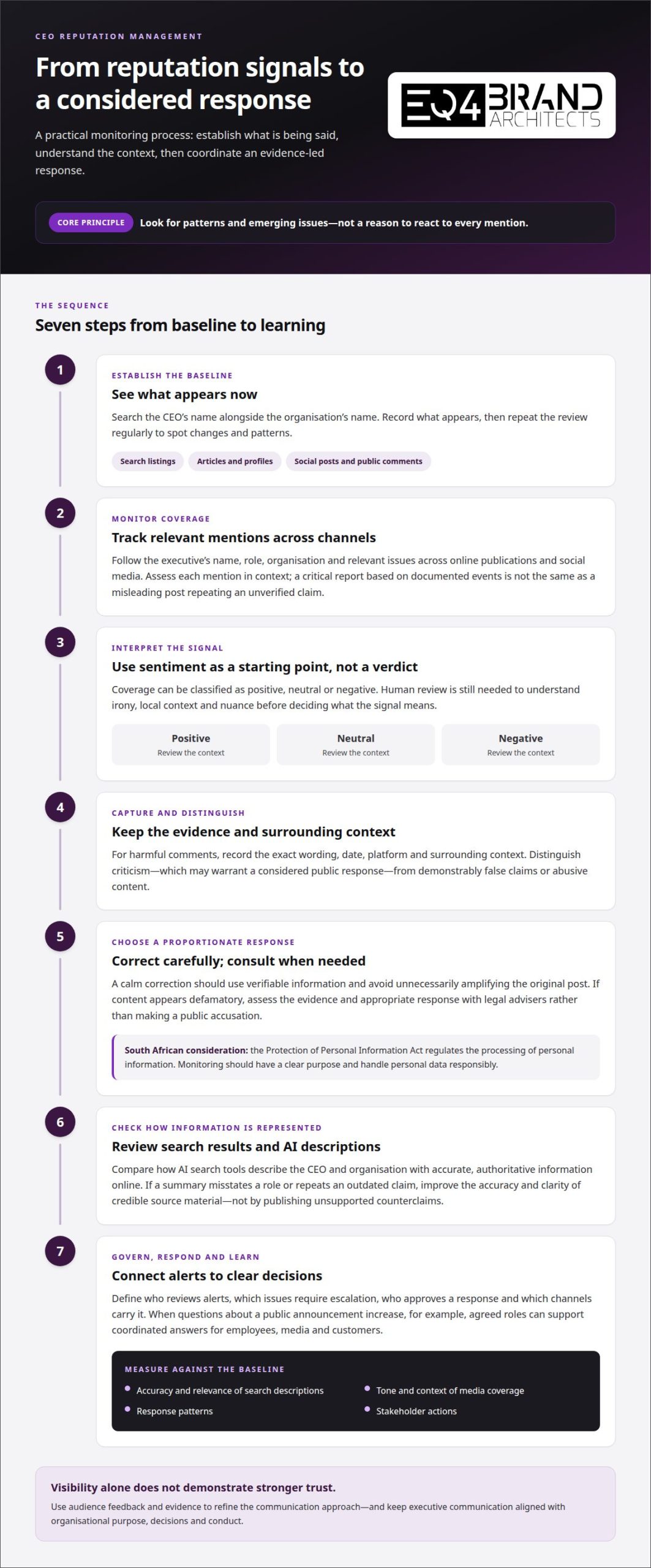
For a chief executive, reputation monitoring starts with a baseline. Search the CEO’s name alongside the organisation’s name and record what appears. Repeat the review regularly, noting changes in articles, profiles, social media posts and public comments. The purpose is to identify patterns and emerging issues, not to react to every mention.
Monitoring also covers news and media coverage. A team can track the executive’s name, role, organisation and relevant issues across online publications and social media, then assess the context. A critical report based on documented events needs a different response from a misleading post repeating an unverified claim. Sentiment analysis can help classify coverage as positive, neutral or negative, but human review is needed to understand irony, local context and nuance.
When harmful comments appear, first record the exact wording, date, platform and surrounding context. Distinguish criticism, which may warrant a considered public response, from demonstrably false claims or abusive content. A calm correction should rely on verifiable information and avoid unnecessarily amplifying the original post. If content appears defamatory, assess the evidence and appropriate response with legal advisers rather than making a public accusation.
South African privacy and defamation considerations affect monitoring and response. The Protection of Personal Information Act regulates the processing of personal information, so monitoring should have a clear purpose and handle personal data responsibly. Defamation concerns require careful assessment of a statement’s meaning and context; the Constitutional Court’s decision in Le Roux v Dey illustrates the importance of context in evaluating allegedly defamatory material. Reputation teams should involve legal advisers before seeking removal or issuing a formal response.
Online descriptions increasingly extend beyond conventional search listings. Teams can review how AI search tools describe a CEO and organisation, then compare those descriptions with accurate, authoritative information online. If an AI summary misstates a leadership role or repeats an outdated claim, improve the accuracy and clarity of credible source material rather than publishing unsupported counterclaims.
Monitoring supports crisis preparedness when signals are connected to decisions. A practical process defines who reviews alerts, which issues require escalation, who approves a response and which channels carry it. For example, a sudden increase in questions about a public announcement may call for coordinated answers for employees, media and customers. Agreed roles help reduce delays when attention intensifies.
A strategic team can track relevant mentions, identify gaps and develop accurate, useful executive content for appropriate channels. It can assess coverage themes and audience reactions, then refine the communication approach. Measure results against a baseline: the accuracy and relevance of search descriptions, the tone and context of media coverage, response patterns and stakeholder actions. Increased visibility alone does not demonstrate stronger trust.
2. How Online Reputation Management Works?
Personal branding gives an executive’s public profile a clear, credible shape. It connects the leader’s expertise, values and communication style to the organisation’s purpose. For example, a chief executive discussing responsible growth should share perspectives grounded in the organisation’s actual decisions and conduct. That alignment helps audiences understand what the leader stands for, rather than encounter disconnected statements across channels.
Search authority grows through useful, consistent material. An executive profile, media interviews, industry articles and original commentary can each explain the leader’s role and expertise. The aim is not to publish everywhere. Choose channels where stakeholders already seek information, then ensure every contribution is accurate, relevant and connected to the same leadership priorities.
Search results reflect the quality and relevance of available information. A well-maintained corporate leadership page, for instance, can clarify a CEO’s responsibilities and provide reliable background for journalists, employees and investors. Thoughtful articles can add depth on specific subjects. This approach favours substance over manufactured praise: authoritative coverage should reflect real experience, verifiable positions and the executive’s actual contribution.
Company-funded executive branding needs clear governance. The organisation can define its communication objectives, audiences, approval process and boundaries, while the CEO contributes judgement and a distinct voice. A practical plan might set themes around industry expertise, organisational priorities and stakeholder concerns. It should also identify sensitive subjects that require consultation before publication. This keeps personal expression credible without detaching the executive profile from corporate accountability.
Investors may consider leadership communication alongside an organisation’s strategy, decisions and performance. Executive visibility alone cannot establish confidence. A CEO’s public contributions are most useful when they help stakeholders understand the organisation’s direction and the reasoning behind its choices.
Trust and credibility depend on consistency between public messages and organisational behaviour. If a CEO speaks about transformation, for example, audiences may look for evidence in decisions, progress updates and stakeholder experience. A strong personal brand cannot substitute for that evidence. It can, however, make organisational priorities easier to understand and give leadership a coherent way to explain them.
Measure progress against agreed objectives. Track whether priority audiences engage with relevant content, media coverage accurately reflects the executive’s expertise and stakeholders take useful actions, such as seeking a briefing or engaging with an initiative. Compare these indicators with the starting position and refine topics or channels when results show a mismatch. Follower growth or positive mentions alone cannot establish stronger credibility.
3. CEO reputation versus traditional online reputation management
Traditional online reputation management often centres on an organisation’s name, products, service experience and public response. Executive reputation adds a distinct focus: the chief executive’s judgement, conduct and leadership profile. The two intersect, but they call for different questions. A complaint about a service points to an organisational issue; the CEO’s response may also shape how audiences assess accountability and leadership.
That difference affects priorities. Organisational reputation work may focus on customer feedback and brand descriptions, while executive work considers leadership credibility, public positions and relationships with employees, investors, media and other stakeholders. A CEO’s profile should support the organisation’s purpose without replacing its institutional voice. Shared messages need coordination, while the executive’s perspective should remain recognisable and grounded in their role.
Neglect can leave an information gap. If an executive profile is sparse or outdated, people searching for the leader may rely on third-party descriptions. A useful diagnostic is to map the CEO’s public profile across corporate biographies, professional platforms, interviews and relevant coverage. Identify outdated roles, inconsistent descriptions and missing context, then prioritise accurate updates that help audiences understand the executive’s remit.
Audience insight can guide the profile’s focus. Review media themes, employee feedback and stakeholder questions to identify recurring concerns. If employees ask how a restructuring affects teams, for example, leadership communication should address the rationale and practical implications. Track which topics prompt substantive questions or follow-up, then refine the format and emphasis. Attention alone cannot show whether the message answered the audience’s concern.
A professional online persona should connect the CEO’s individual judgement with the organisation’s purpose. The corporate mission can inform themes, while the executive’s experience gives contributions a distinct perspective. A leader discussing transformation, for instance, can explain decisions and trade-offs, then connect those statements to organisational action. This creates a more credible profile than broad claims of expertise without supporting context.
External engagement is most useful when it has a clear purpose. A CEO might contribute to an industry discussion, explain a strategic decision to employees or respond to investors’ questions. Each setting calls for different detail, but the underlying position should remain consistent with the organisation’s actions. Visibility for its own sake can distract from the issues stakeholders need leadership to address.
Assess the profile against its original purpose. Consider whether executive information is accurate, coverage reflects the intended areas of expertise and stakeholder feedback points to greater understanding. Use those observations to adjust topics, channels or approval processes. The goal is a coherent public presence in which the CEO’s words, conduct and organisational context reinforce one another.
4. Protecting company credibility and customer trust
CEO reputation and company credibility are closely connected, but public statements alone cannot establish trust. PwC’s Global CEO Survey found that 91% of CEOs consider trust, and the ability to earn and maintain it, critical to their company’s future success. For leaders, that makes consistency between stated values and organisational decisions a practical reputation concern.
Aligning a CEO’s values with company values means connecting public commitments to observable conduct. If a leader speaks about fair treatment, for example, employees and other stakeholders may compare that message with workplace experiences and organisational choices. A communications plan should connect leadership messages to evidence, explain trade-offs honestly and avoid claims the organisation’s actions cannot support.
Public scrutiny can also influence customer decisions. Edelman’s Trust Barometer reported that 60% of consumers will buy from or boycott a brand based on social or political issues. A CEO’s position on a contested issue may affect how the company appears to customers and employees. Before communicating, leadership should consider the issue’s relevance, affected audiences and the organisation’s actions.
Reputational damage can have commercial consequences, although a single event does not determine company performance. Deloitte’s Reputation@Risk survey found that 41% of companies experiencing reputational damage faced a loss of revenue. The finding makes it prudent to assess reputational risk alongside other business risks, then identify which stakeholders, decisions and operations could be affected.
When negative coverage emerges, a credible response needs more than a polished statement. Establish what happened, what is known, who is affected and what the organisation is doing. For example, if a public announcement prompts employee concern, internal communication should address the practical impact before external messaging implies certainty. Clear ownership and consistent updates help prevent conflicting accounts from weakening trust.
Search results can shape how people first interpret a leader and the organisation. An inaccurate profile or unresolved story may appear alongside company information, influencing perceptions before direct engagement. The response should be proportionate: correct factual errors through appropriate channels, provide clear authoritative information and address underlying issues where they exist. Suppressing legitimate criticism can further undermine credibility.
Assess progress through stakeholder understanding and action, not visibility alone. Track whether key audiences understand the company’s position, whether questions receive consistent answers and whether concerns persist in employee, customer or investor conversations. Compare those signals with the original risk and communication objectives. This helps leaders distinguish a temporary increase in attention from a meaningful change in trust or business conditions.
5. Working with professional reputation management services
A professional engagement should begin with a clear organisational objective, not a promise of favourable coverage. The CEO, board and communications lead can agree which stakeholder relationships matter, what risks need attention and which decisions the work should inform. For example, an organisation preparing for a major policy announcement may need consistent executive communication for employees, investors and media.
In South Africa, strategic communications consultancies, public relations agencies and specialist reputation advisers undertake this work. It can include executive positioning, media relations, issue response and monitoring. The useful distinction is scope: advice should connect activity to organisational priorities, rather than treat mentions or publicity as outcomes in themselves.
Once objectives are clear, establish a baseline and governance. This can include reviewing the CEO’s public profile, relevant coverage, stakeholder concerns and existing approval routes. Agree who provides subject expertise, who approves sensitive messages and who communicates during an emerging issue. Clear responsibilities help prevent conflicting statements from the executive and organisation.
A working plan should identify audiences, messages, channels and decision points. If a chief executive is addressing investors about a strategic change, for instance, the message should reflect approved company information and anticipate reasonable questions. Employee communication may need different detail and timing. The central position stays consistent, while each channel serves its audience.
Professional support should also build organisational capability. The communications team can apply agreed response principles, escalation routes and message guidance after the engagement. This reduces reliance on improvised decisions when negative attention grows. It also helps teams distinguish routine critical coverage from an issue requiring executive involvement.
Measurement should connect communication activity to audience response and organisational priorities. Reporting might assess whether coverage accurately reflects the CEO’s position, which themes recur in media and stakeholder feedback, and whether priority audiences take relevant next steps. The review should explain what changed, what remains unresolved and what the team will adjust. Raw mention counts or reach cannot establish trust or business value.
Before work begins, align on decision rights, access to information, confidentiality and reporting expectations. A board may need visibility of material risks, while the executive team needs timely advice and clear actions. These arrangements make the engagement useful in routine communications and during a crisis, without confusing reputation work with control over public opinion.
For a structured discussion about executive reputation priorities, start a conversation about reputation management.
EQ4 Brand Architects: Reputation Management
EQ4 Brand Architects helps organisations address executive reputation as part of wider communication priorities. Its Reputation Management and Communication Strategy work can support leaders facing inconsistent messages, heightened scrutiny or a need to strengthen stakeholder confidence. Public Relations (PR) can contribute to how leadership perspectives are communicated, while Brand Activations can bring organisational commitments to life through relevant audience experiences.
Start with a clear view of the issue: which audiences are affected, what they need to understand, and how the CEO’s profile connects to the organisation’s purpose and actions. From there, communication can become more intentional, coordinated and measurable, rather than fragmented or purely reactive.
If your organisation is considering executive reputation support, contact EQ4 Brand Architects to discuss the challenge and the communication priorities involved.
Make executive reputation part of the organisation’s decisions
Treat executive reputation as an organisational responsibility, not a communications task reserved for moments of pressure. Agree who owns decisions, how leadership communication connects to company conduct and which stakeholder signals should prompt a response. This gives the CEO, board and communications team a shared basis for action.
The value of CEO reputation management services lies in connecting those decisions to a considered, sustained approach. Activity should serve a defined purpose, reflect the organisation’s realities and be assessed against meaningful audience response. This helps leaders move beyond reactive messaging towards communication that supports confidence and informed engagement.
For South African organisations managing complex stakeholder relationships, an external strategic perspective can help clarify priorities and bring communication into closer alignment. The right conversation starts with the challenge, the audiences affected and the organisational outcome at stake.
Contact EQ4 Brand Architects to discuss how executive reputation connects to your organisation’s wider communication priorities.
Frequently Asked Questions
What does reputation management for individuals include?
This includes understanding how a person is represented across public channels and responding appropriately when that picture is inaccurate or incomplete. For a newly appointed chief executive, for example, teams may review biographies, professional profiles and past interviews to ensure role details are current. They can then plan what information to update, who approves changes and how future public statements align with the executive’s responsibilities.
How does online reputation management work?
The process starts by defining the reputation issue and the audiences involved, then setting priorities for communication and response. If a business announcement prompts questions from employees, the team can identify what information is missing, prepare accurate answers and coordinate internal and external messaging. Later, it reviews stakeholder responses and unresolved questions, using those observations to adjust the approach rather than treating publication as the finish line.
How does AI affect executive reputation?
AI-powered search tools may summarise information about executives from material available online, but summaries can omit context or include outdated details. If a profile describes a former role as current, the organisation can update its authoritative biography and related public information. Leaders should avoid entering sensitive information into AI tools without considering confidentiality, and assess AI-generated descriptions against reliable source material.
Why does personal reputation matter?
Personal reputation can affect how colleagues, partners and stakeholders interpret someone’s judgement and credibility. For a CEO, that perception can shape whether employees raise concerns openly or prospective partners feel confident engaging. Reputation is built through conduct as well as communication, so a leader’s response to difficult questions may matter more than a carefully written profile. Consistent, evidence-based communication helps people assess the person fairly.
Why is CEO reputation important?
A CEO is a visible representative of an organisation, so stakeholders may read the leader’s decisions as signals about company priorities. During a merger, for example, employees may look to the chief executive for a clear account of what is changing and why. A credible response can support understanding; a gap between public statements and organisational action can intensify uncertainty among staff, customers, investors and other stakeholders.
What do CEO reputation management services include?
CEO reputation management services can include strategic advice, media and online monitoring, executive positioning, content planning, stakeholder communication and issue preparedness. The scope should reflect the organisation’s priorities. A newly appointed CEO might need a clear public profile and an introduction to key audiences, while a leader facing scrutiny may need coordinated issue assessment, response planning and follow-up communication. Measurement should relate to audience understanding and action.
How do CEO reputation management services compare with general online reputation management?
General online reputation work often centres on an organisation, product or customer experience. Executive reputation work adds the CEO’s leadership, judgement, public profile and stakeholder relationships. For example, a company-wide service issue may require operational updates, while the chief executive’s role is to explain accountability and decisions. The approaches should connect, but their audiences, messages and approval responsibilities may differ.
What risks should CEOs consider when responding to negative online content?
A rushed response can repeat a harmful claim, disclose confidential information or give a dispute greater visibility. Before replying, establish what the content says, whether it is factual, who has seen it and what response would serve affected stakeholders. Avoid personal attacks and unsupported allegations. For potentially defamatory material, preserve relevant records and obtain appropriate legal advice before making public claims or requesting removal.