




A change can be strategically sound and still weaken staff confidence before implementation begins. A communication plan for organisational change needs to do more than announce decisions: it should help people understand why change is happening, what it means for their work and where they can raise concerns.
That takes more than a polished launch message. Leaders need to understand how different groups will be affected and how prepared they are to act, then shape communication around those realities. When people are uncertain about roles, systems or priorities, a steady stream of generic updates is unlikely to answer the questions that matter to them.
This article sets out how to build a practical plan: define communication objectives, identify audiences, develop clear messages, and choose appropriate channels and timing. It also explains how to assess impact and readiness, create space for feedback, and measure whether communication is supporting understanding and adoption. The aim is a coherent approach that connects organisational direction with employees’ experience of change.
Key Takeaways
- Set communication objectives around the decisions, understanding and actions the change requires.
- Map who will be affected, what they need to know and which leaders or managers can speak credibly to their concerns.
- Choose channels and a realistic calendar that make updates consistent while giving employees ways to ask questions and share feedback.
- Align communication with practical support, such as training and resources, and measure understanding as well as engagement and adoption.
- Assess impact and readiness before setting the approach, then adapt messages and timing as the change and stakeholder responses evolve.
What Exactly is Change Management Communication?
Change management communication connects organisational decisions with the people expected to understand and implement them. In South Africa, the Labour Relations Act 66 of 1995 requires consultation before dismissals for operational requirements; section 189A contains additional provisions for large-scale retrenchments.
-
Address employee questions about change
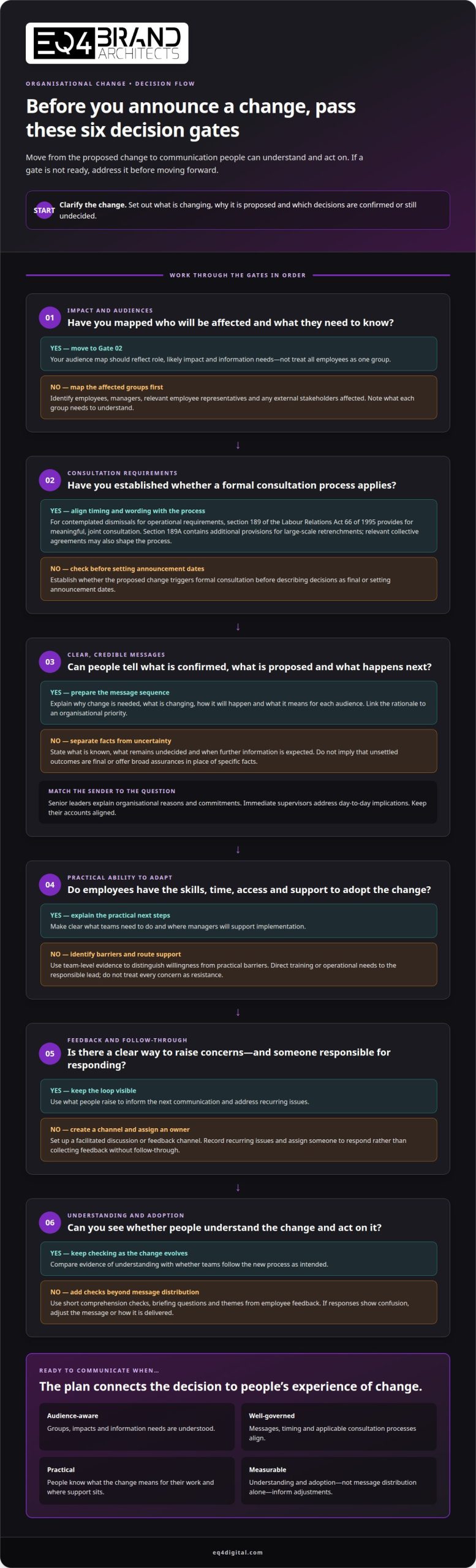
Explain what is changing, why it is happening and what remains undecided. Describe the current and intended future states using relevant workplace details, such as reporting lines, systems or responsibilities. Make sure messages distinguish confirmed decisions from proposals. Avoid presenting a project update as an answer to personal questions about how someone’s work may change.
-
Map stakeholders and gather feedback
Identify affected groups and the people who represent or influence them. Include employees, managers, recognised trade unions or other employee representatives where relevant, as well as external stakeholders affected by the change. Give people a clear way to raise concerns, such as a facilitated discussion or feedback channel. Record recurring issues and assign someone to respond, rather than collecting feedback without follow-through.
-
Identify consultation requirements
Establish whether the proposed change triggers a formal consultation process before setting announcement dates or describing decisions as final. Under section 189 of the Labour Relations Act, consultation on contemplated dismissals for operational requirements must be a meaningful, joint process with affected employees or their representatives. Section 189A provides additional provisions for large-scale retrenchments. Relevant collective agreements may also shape the process.
- Assess whether employees have the motivation and practical ability to adapt. Understanding the rationale does not necessarily mean people have the skills, time, access or managerial support to adopt a new process. Use team-level evidence to distinguish willingness from barriers, then direct training or operational needs to the responsible lead. Avoid treating every concern as resistance.
- Measure whether communication supports understanding and action. Use short comprehension checks, questions raised in briefings and themes from employee feedback. Compare these with evidence of adoption, such as whether teams follow a new process as intended. If responses show confusion, adjust the message or how it is delivered. Message distribution alone does not demonstrate understanding.
Communication plan objectives, audiences and key messages
Set objectives, audiences and messages in sequence so communication supports organisational priorities and employees’ practical decisions. A plan for communicating organisational change should clarify what each group needs to understand, who should explain it and what action should follow.
-
Define objectives and audiences
Decide what communication must achieve: explain the rationale, build understanding of the proposed change or prepare teams for a new process. Then identify each audience by role, likely impact and information needs. For example, a project team may need implementation details, while employees using a new system need to know how their daily tasks will differ.
Make each objective observable, such as whether people can explain the reason for change or identify their next step. Build the plan from objectives to audience groups, then to messages, credible senders, channels and timing. Avoid treating all employees as one audience or using message distribution as proof of understanding.
-
Connect messages to organisational purpose
Link the change to a clear organisational priority, such as improving service, strengthening sustainability or responding to operational risk. Explain how the proposed change supports that priority and what may happen if the organisation maintains its current approach. Leaders should describe the rationale consistently, using evidence and language employees can understand.
Build a sequence of messages: why change is needed, what is changing, how it will happen and what it means for each audience. Executives and senior leaders are well placed to explain organisational reasons and commitments. Immediate supervisors can better address day-to-day implications. Check that each sender’s account aligns with the central rationale.
-
Tailor messages to job security concerns
Address employment implications directly whenever a change may affect job security. Leaders should explain what is known, what remains undecided and when employees can expect further information. Use relevant, specific facts rather than broad assurances, and do not imply that outcomes are settled if they are not.
Separate the organisation-wide rationale from individual implications. Managers can explain how proposed changes relate to teams, while sensitive personal matters call for appropriate private conversations. Prepare consistent answers to concerns about roles, reporting lines or working processes. Ensure messages reflect the applicable consultation process and do not present communication as a substitute for it.
-
Prepare messages for difficult changes
Before announcing an unexpected or difficult change, align leaders on the rationale, confirmed facts, employee impact and immediate next steps. Prepare a holding statement of two or three sentences before the first briefing, especially for restructuring or system changes affecting jobs or monitoring. Keep it factual and avoid speculation.
Deliver the announcement through credible leaders, then make space for questions and direct follow-up. If an answer is not available, explain what is being considered and how updates will be shared. Use the change communication plan to keep messages consistent across audiences and channels.
Planning communication channels and editorial calendars
The most effective channels suit the audience, message and response required. Build the calendar around change milestones, pairing clear updates with practical opportunities for employees to discuss what those updates mean.
-
Select channels for communication needs
Match each communication task to a suitable channel. Use an all-hands meeting for a significant announcement, manager one-to-ones for team-specific questions, and an intranet post for reference material employees may need later. Email can distribute a formal update; messaging platforms can support timely reminders. Check who can access each channel and avoid relying on a single method for critical information.
-
Combine communication channels
Use more than one channel when employees need both a clear announcement and a chance to respond. For example, senior leaders can introduce an initiative at an all-hands meeting, managers can discuss local implications, and an intranet post can hold the key messages. Keep the facts consistent across formats while adapting the detail and tone to the discussion.
- Build an editorial calendar around milestones such as announcement, consultation, training and implementation. For each entry, record the audience, purpose, message, sender, channel and owner. Add the date or milestone that triggers publication, along with any required approval. This helps communication keep pace with operational activity instead of sending updates before teams can act on them.
- Set a cadence employees can anticipate. For instance, schedule regular progress updates and state when the next one will arrive, even if there is no major development. Provide a route for questions between updates, such as a manager discussion or a dedicated internal channel. Avoid filling the calendar with messages that repeat old information without clarifying what has changed.
- Review the calendar as the initiative develops. Check whether messages reached the intended groups, whether employees understood the information and whether unanswered questions are accumulating. If shift patterns or access make an online briefing unsuitable, add a team discussion or written summary. Adjust the channel mix when feedback shows that people are not being reached effectively.
Integrating communication with a change management plan
Communication supports change management when it is tied to decisions, responsibilities and practical support. Plan it alongside the work needed to help employees adopt the change, rather than treating messages as the entire intervention.
-
Recognise the limits of communication plans
Connect each message to an action, owner or support mechanism in the wider change plan. Communication can build awareness and explain the rationale, but it cannot give employees the ability to use a new system or process. In ADKAR terms, communication may support Awareness, Desire and Knowledge; practice, resources and reinforcement help address other needs.
Check that managers have the time and authority to support teams, and that training is ready before implementation. If employees understand a change but lack access or skills, sending more updates will not remove the barrier. Record the issue and assign it to the operational or change lead who can act.
-
Set a manageable communication cadence
Agree on a rhythm linked to project milestones, such as approval, consultation, training and implementation. Tell employees when the next update will arrive, then keep that commitment even if progress is limited. Frequent, open communication is identified by Prosci as a contributor to project success, but frequency should serve a clear purpose rather than create noise.
Set an internal standard for responding to employee questions or feedback within 48 hours. Assign a named owner to monitor responses, identify urgent issues and route them for action. If a milestone shifts, update the calendar and explain the change instead of allowing silence to create uncertainty.
-
Review examples, benefits and pitfalls
Use a practical test: for a new digital process, pair the announcement with training, manager guidance and a way to report access problems. This links communication to ability and action. Change management helps coordinate these elements, clarify responsibilities and connect individual adoption to the intended organisational outcome.
Watch for common pitfalls: announcing a decision before the relevant engagement, giving inconsistent explanations across teams, or measuring message distribution instead of understanding. Review feedback, comprehension and progress towards the change’s objectives. Adjust the plan when employees identify a real barrier, while keeping leaders accountable for decisions and support.
Assessing change impact and organisational readiness
Readiness is not a general feeling of support; it is the organisation’s capacity to deliver a specific change. Assess impact, leadership commitment and practical constraints before deciding what communication and support each group needs.
- Start with the strategic case. Define the outcome the change must achieve and how it supports organisational strategy. For a new service model, specify what should improve for service users and which operational decisions will enable that result. If leaders cannot explain the link between the change and its goal, employees are unlikely to see why the effort matters.
- Map the impact across roles and operations. Trace how the change affects responsibilities, workflows, systems, locations and stakeholder relationships. A new digital process may alter how frontline teams capture information and how managers review it. Record where disruption, additional workload or dependencies may arise, then identify who owns each impact.
- Research readiness using evidence from the workplace. Combine interviews, team discussions, employee feedback and operational information. Ask whether people understand the rationale, trust the direction, have the skills and resources required, and can make time for the change. Compare responses across functions and locations; an overall positive response can conceal a team facing significant practical barriers.
- Test executive involvement and alignment. Ask senior leaders to explain the purpose, expected outcomes, risks and their own role in implementation. Compare their accounts for consistency, then establish who will make decisions and resolve obstacles. Visible executive commitment matters most when leaders follow through, explain trade-offs and give managers the authority to support affected teams.
- Review earlier change efforts. Examine where previous initiatives gained traction and where adoption stalled. Look for patterns such as unclear ownership, limited training, inconsistent leadership messages or insufficient capacity. Use those lessons to identify risks in the current effort, rather than assuming past resistance reflects unwillingness; the underlying issue may be workload, capability or confidence.
- Turn findings into communication decisions. Prioritise groups by impact and readiness, then match each need to a response: clearer rationale, manager briefings, practical guidance or skills support. Set measures for understanding, feedback and progress towards the target outcome. To align this assessment with an actionable change communication strategy, discuss the challenge with EQ4 Digital Communications.
EQ4 Brand Architects: Communication Strategy
EQ4 Brand Architects may be a relevant next step when change is strategically important but communication feels fragmented, reactive or disconnected from employees’ experience. A senior communications adviser can help connect the organisation’s purpose, stakeholder concerns and practical actions, so leaders are not relying on isolated announcements to carry the change.
Its Communication Strategy offering can help shape the approach by clarifying the communication objectives, audiences, messages, roles and measures that support the change. This is especially useful when several teams are communicating at once, leaders need a coherent explanation of why change is necessary, or employees need different information at different stages. The strategy should reflect the change’s real impact, not simply describe project activities.
Change can also create reputational exposure if stakeholders hear conflicting explanations or experience a gap between what the organisation says and what it does. Reputation Management can help organisations consider trust and perception risks as part of the communication response. This may be relevant when a change affects service delivery, organisational identity or confidence among employees and external stakeholders. It keeps reputation connected to decisions and behaviour, rather than treating it as a separate communications exercise.
Public Relations (PR) can support clear engagement with external audiences when organisational change has implications beyond the workforce. The communications approach should establish which stakeholders need information, who is best placed to speak and how external messages align with internal communication. Brand Activations may also make a change tangible through an intentional experience, where participation or interaction suits the initiative. These offerings work best when they serve the strategy, not as standalone activities.
EQ4 Brand Architects is worth considering when leaders need strategic judgement alongside joined-up communication delivery, particularly across complex stakeholder environments. A useful starting point is to assess the change’s purpose, affected audiences, known risks and decisions still being shaped. This can help establish whether Communication Strategy, Reputation Management, PR or Brand Activations are relevant to the challenge.
For a change that calls for clearer, more connected communication, contact EQ4 Brand Architects to discuss the challenge.
Make the next change a more deliberate one
Organisational change continues after the announcement. As decisions develop and employees encounter new realities, communication needs to stay connected to what the organisation is doing, not just what it intended to do. A plan for communicating organisational change should therefore be a working instrument that evolves as the impact becomes clearer and the organisation learns from its stakeholders.
The next step is to identify where your current approach needs greater alignment. Perhaps different teams are telling different versions of the story, leaders need support to communicate with confidence, or stakeholder trust needs careful attention during a significant transition. Naming the challenge clearly gives decision-makers a stronger basis for action and keeps communication purposeful.
EQ4 Brand Architects can discuss how a strategic communications approach may fit your change, audiences and organisational priorities. Contact EQ4 Brand Architects to start a considered conversation about your next step.
Frequently Asked Questions
What is an organisational change communication plan?
It is the operational document that governs how change-related information is prepared, approved, shared and maintained. Beyond setting out messages, it can record who owns each decision, which version is current and how urgent issues are escalated. For example, a manager receiving a late change to implementation timing needs a clear way to obtain approved wording, rather than relying on an outdated presentation.
What should a change communication plan include?
Alongside its core schedule, include practical controls that keep information usable: a decision log, a current source for approved material, version dates and an escalation route for questions requiring specialist answers. Note any accessibility or language needs relevant to the audiences. For example, a manager briefing pack can identify which content is approved for sharing and where employees can find the latest supporting documents.
Who are the key audiences and stakeholders in an organisational change?
Look beyond people whose roles change directly. Include groups whose work depends on the changed process or whose decisions affect its implementation. If a public body changes how it handles service requests, for example, the review may include frontline staff, teams receiving escalations and people relying on the service. This view of dependencies can reveal audiences an organisational chart alone might miss.
How often should employees receive updates during organisational change?
Set a planned rhythm, then add a separate update when a material decision or implementation change affects employees. The interval should reflect how quickly facts are changing and how soon people need to act. If there is no new decision, an update can still confirm when information will next be reviewed. Avoid promising a precise answer before the organisation can provide one responsibly.
How can you measure the effectiveness of change communications?
Establish a baseline before communication begins, then test whether understanding shifts as the change progresses. Use a small set of consistent questions about the rationale, implications and required next action, and compare responses across affected groups. A useful check is whether employees can apply the guidance to a realistic work situation, not merely recognise a phrase from a presentation. Review findings alongside operational adoption data.
What are common communication risks and mistakes during organisational change?
A practical risk is that several versions of a message circulate after a decision changes. Reduce this risk by assigning an owner to approved materials, marking superseded versions and giving managers a clear escalation route. Before release, test the message against difficult but plausible questions, including what happens if a milestone moves. This can expose ambiguity early and reduce improvised explanations that undermine confidence.