





In professional services, expertise alone rarely explains why an organisation should choose one firm over another, or pay more for its work. A B2B brand positioning strategy makes that value clearer by connecting the firm’s capabilities to a meaningful place in the market. Without that clarity, even strong work can be hard to distinguish; conversations may narrow to scope, credentials or fees before a prospective client understands the broader value. The challenge is not simply to sound different. It is to communicate a credible reason to be considered, in language that reflects the work the firm can genuinely deliver.
That distinction matters when leaders need growth without relying on price concessions, or when a firm’s reputation does not reflect the quality of its work. Positioning gives decision-makers a way to examine what the organisation wants to be known for, what supports that claim and how it can matter to clients. This article explains how to shape that foundation, assess its potential commercial value and apply it to professional services. The focus is on practical choices for South African organisations, where a clear and credible position can help the right audiences understand why the firm is relevant.
Key Takeaways
- Assess your organisation’s value from the buyer’s perspective, including the different stakeholders involved in choosing a professional services partner.
- Clarify how distinctive positioning can shape pricing conversations and consideration, without treating brand alone as a guarantee of commercial results.
- Build the strategy around proven strengths, relevant buyer outcomes and a clear explanation of why your offer is different.
- Look for differentiation rooted in how your organisation works and the trust it builds, not just claims competitors can easily repeat.
- Connect positioning to consistent communication so that professional services buyers encounter the same credible story across key touchpoints.
What is B2B brand positioning and why does it matter?
Positioning defines the value customers associate with an organisation and the context in which they choose it. It becomes useful when customers recognise that value in real interactions, not only in a positioning statement.
-
How a professional researches customer segments
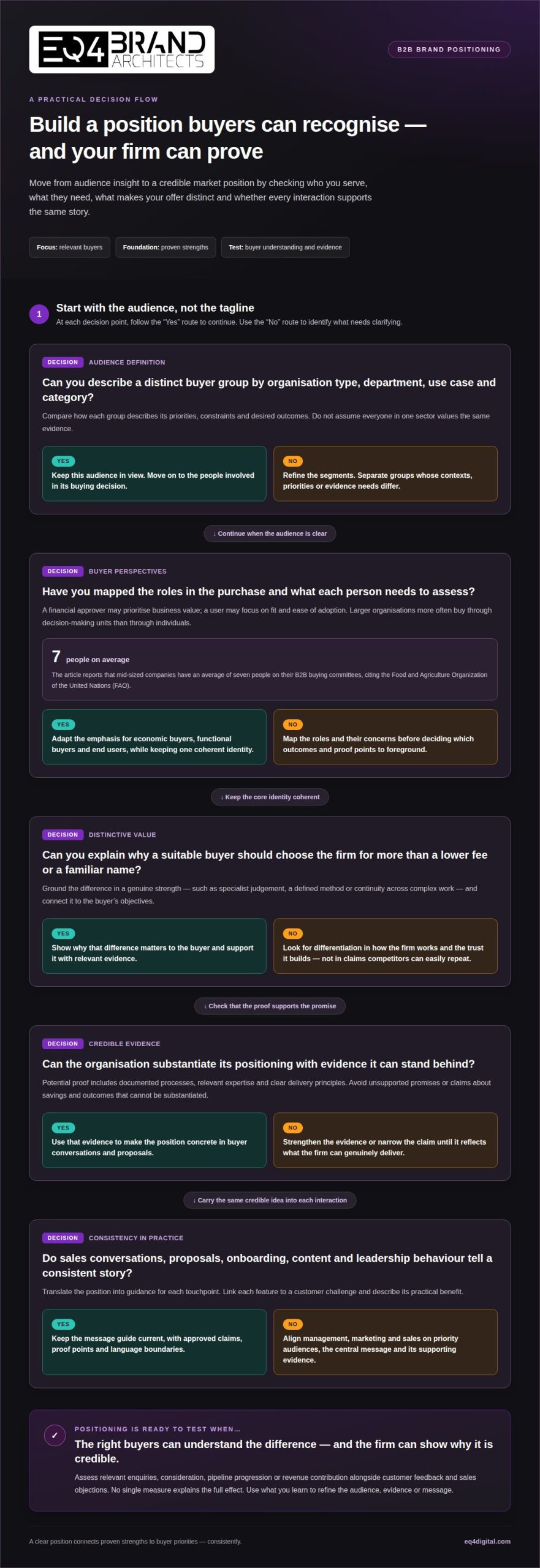
Segment customers by organisation type, target department, use case and category. Then examine how each group describes its priorities, constraints and desired outcomes. A supplier serving manufacturers and public institutions, for example, needs to understand their different procurement contexts and expectations. Compare customer language with internal assumptions, and avoid treating everyone in a sector as one audience. Distinct segments may value different evidence.
-
How a professional understands buyer perspectives and motivations
Map the roles involved in a purchase and the concerns each person brings. The Food and Agriculture Organization of the United Nations (FAO) notes that larger organisations more often make buying decisions through decision-making units than individuals. Mid-sized companies have an average of seven people on their B2B buying committees. A financial approver may prioritise business value, whilst a user may focus on fit and ease of adoption.
-
How a professional adapts positioning to industry, company size and role
Adapt the emphasis to each buyer’s context while keeping the core identity coherent. Industry shapes which problems and terminology feel relevant; organisation size can influence decision processes; and buyer roles bring different priorities. A finance leader may need a clear business case, while an operational lead may focus on implementation. Positioning should address economic buyers, functional buyers and end users without trying to speak to all of them in the same way.
-
How a professional maintains consistency across customer interactions
Translate the positioning into guidance for sales conversations, proposals, onboarding, content and leadership behaviour. Link each feature to a customer challenge and explain its practical benefit. For instance, if a reporting feature helps teams see project status, describe how that visibility supports their work. Check that every interaction reflects the same identity and credibility. Common risks include generic claims, unsupported promises and inconsistent messaging that leaves customers unsure what the organisation stands for.
Branding’s potential effect on price and market share
Distinctive positioning can make value easier to recognise in commercial discussions. Its influence depends on whether the organisation’s offer, evidence and customer experience support the message.
- Connect distinctiveness to buyer value. Identify why a suitable buyer should choose the organisation for reasons beyond a lower fee or familiar supplier. A professional firm might point to specialist judgement, a defined method or continuity across complex work. Explain how that difference supports the buyer’s objectives, then substantiate it with evidence such as documented processes, relevant expertise or clear delivery principles. Avoid claims about savings or outcomes you cannot support. This gives sales teams a firmer basis for discussing value than broad promises do.
- Align messaging across the go-to-market funnel. Develop a marketing strategy that carries the same core idea from initial awareness through evaluation and sales conversations. An introductory campaign might establish a firm’s specialist focus; a proposal can then show how that expertise applies to a prospective client’s needs. Give each channel a clear role and adapt the detail to its format. Check that the headline, website explanation and sales discussion do not suggest different levels of capability. Inconsistent messaging can create doubt just as buyers assess risk.
- Build alignment between management, sales and marketing. Agree on priority audiences, the central message and supporting evidence before teams produce materials. Management sets direction, marketing makes it visible, and sales tests its relevance in live discussions. For example, if the organisation emphasises a close working relationship, proposals should show how that relationship shapes the work. Maintain an internal message guide with approved claims, proof points and language boundaries. This supports consistency while allowing teams to respond naturally to each opportunity.
- Test the proof and refine the work over time. Measure whether the position is associated with more relevant enquiries, stronger consideration, pipeline progression or revenue contribution. Interpret those signals alongside customer feedback and sales objections; no single metric explains the full effect. If prospects understand the offer but remain unconvinced, strengthen the evidence or clarify the buyer outcome. If suitable prospects rarely recognise the organisation, reassess audience and channel choices. Review findings with management, sales and marketing so changes improve the strategy, not just campaign activity.
How does a professional build a positioning strategy for a B2B company?
A professional turns customer insight and proven strengths into a clear internal guide. The process defines the category, the buyer problem and the organisation’s distinct standing.
-
How a professional defines B2B brand positioning
Define positioning as internal direction for how the organisation should be understood and chosen. Specify the category, intended buyer, use case and meaningful difference. For example, describe a firm as a specialist partner for a particular operational challenge, rather than simply a provider of professional services. Treat the positioning statement as a decision-making guide, not public-facing copy or a slogan.
Ground every claim in what the organisation has demonstrated. A position built around hoped-for capabilities risks creating expectations that delivery cannot meet.
-
How a professional defines buyer jobs and friction
Map the progress a buyer is trying to make, then identify what is getting in the way. Open Strategy Partners recommends asking what benefit a feature creates and what challenge prevents customers from gaining it already. For example, a reporting feature may help a team make informed decisions, while fragmented information creates friction.
Distinguish the buyer’s practical task from concerns about financial, professional or operational risk. Use those findings to describe a relevant problem and outcome, not just a list of features.
-
How a professional defines a company’s brand values
Identify values through decisions and behaviour, rather than choosing appealing words in isolation. Review how leaders set priorities, how teams handle difficult trade-offs and what customers experience during delivery. For example, a stated commitment to transparency should show in how recommendations, limitations and progress are communicated.
Translate each value into a proof point and a communication implication. This gives the brand a credible character and helps teams express its identity consistently.
-
How a professional defines what the brand is not
Set boundaries around the work, audiences and claims the organisation will not pursue. A firm known for specialist advice may decide not to present itself as a low-cost, all-purpose supplier. Such boundaries help sales and marketing teams avoid messaging that attracts unsuitable enquiries or misrepresents delivery.
Test each boundary against customer needs and organisational capability. The aim is focus, not dismissing alternatives or making unsupported claims about competitors. Clear exclusions help prevent the position from becoming generic.
Finding differentiation that competitors cannot easily copy
Distinctiveness starts with a customer-relevant difference, not a louder claim. A professional tests that difference against alternatives, evidence and the organisation’s ability to deliver.
-
How a professional researches the market, competitors and trends
Map the category, customer needs and visible market signals before shaping the position. Review competitor websites, proposals, service descriptions and campaigns to identify recurring promises, such as speed, expertise or personal service. Then examine customer feedback and sales objections for unmet needs. Do not treat a trend as proof of demand; test whether it affects buyer choices and whether the organisation can respond.
In South Africa, research should account for differences between sectors, regions and audiences. Language preferences can affect whether messaging feels clear and relevant, so assess the words customers use in actual decision-making contexts.
-
How a professional assesses competitive alternatives
List what buyers might choose instead, including direct suppliers, internal teams, doing nothing or postponing a decision. A consultancy competing for a transformation brief, for example, may face an internal team’s capacity plan as well as other consultancies. Compare alternatives by outcomes, risks, effort and credibility, not just service labels. This reveals the true competitive context and the problem buyers need solved.
Check which differences matter to buyers and which are merely visible. A claim such as “tailored service” offers little advantage unless the organisation can explain what it adapts and how that changes the experience.
-
How a professional uses positioning to build competitive advantage
Choose a difference rooted in strengths customers value and the organisation can demonstrate repeatedly. This might be a distinctive method, specialist understanding or a carefully governed way of working. Build campaigns around that evidence, connecting the message to relevant proof such as a clear process or documented expertise. Avoid copying competitors’ language, even when it is widely used.
For South African organisations, assess whether language choices reflect the intended audience and whether sector-specific requirements affect claims or supporting evidence. Keep the positioning recognisable across audiences, while adapting examples and emphasis to context. Review feedback and sales conversations to see whether buyers understand the difference and consider it relevant.
Professional services brand positioning
For professional firms, the service can be intangible until clients experience it. Positioning must make expertise, judgement and the working relationship clear before an appointment.
- Make the expertise tangible. Identify the specific decisions or work clients trust the firm to handle. A tax advisory practice, for example, might explain how it helps finance leaders interpret complex information and plan with confidence. Describe the work in terms clients recognise, not just internal job titles or technical credentials. The aim is to make the firm’s value understandable before a prospective client experiences its service.
- Show how the client experience becomes distinctive. Professional services are shaped by people, methods and judgement, so examine how the work is delivered. A consultancy might distinguish its approach through clear decision records, direct access to senior advisers or structured knowledge transfer. These points matter only when they reflect actual practice. Connect each to a client outcome, such as better-informed decisions or greater continuity, and support it with credible evidence.
- Clarify the relationship the firm offers. Buyers assess more than technical competence; they also consider confidence, communication and the consequences of a poor decision. Define what clients can expect at key moments, from the first discussion to recommendations and implementation. For example, a firm may be known for explaining complex options in plain language. That promise should be evident in proposals, meetings and follow-up, not confined to a campaign.
- Express the position clearly across the client journey. Ensure the firm’s website, credentials, proposals and senior conversations communicate a coherent value. A prospective client should understand who the practice serves, which problems it addresses and why its approach is relevant. Test this with actual client feedback and sales discussions. If people remember only a broad category, refine the message; if they recognise the specific value, build campaigns that reinforce it.
In South Africa, professional firms may engage corporate, public-sector and social-impact audiences with different decision contexts. Keep the core identity steady while adapting examples and language so each audience can see relevant outcomes. Positioning becomes credible when the promise, professional conduct and client experience align.
EQ4 Brand Architects: Communication Strategy
EQ4 Brand Architects can help when a positioning decision needs to become a coherent communications direction, rather than a statement that sits unused. Its Communication Strategy connects the organisation’s purpose and audience priorities to clear messages, responsibilities and action. This is relevant when leadership, sales and marketing describe the organisation differently, or when communication feels reactive across teams and touchpoints.
Start by clarifying the organisational challenge, such as entering a market, explaining a changed direction or strengthening confidence among key stakeholders. Then align the central narrative with audience needs and the evidence available to support it. This gives teams a shared reference for decisions while allowing messages to reflect different audiences’ concerns and contexts.
When the challenge involves trust or a gap between intended identity and public perception, Reputation Management can bring those issues into strategic focus. Positioning needs to match how the organisation behaves and communicates, not only how it describes itself. That connection matters when reputation affects stakeholder confidence, relationships or the organisation’s ability to explain its contribution clearly.
Public Relations (PR) can carry a well-grounded position into relevant public conversations. The strategic starting point is the organisation’s narrative, its proof and the audiences it needs to reach. This helps ensure that external communication supports the intended position instead of creating disconnected claims. PR is most useful when the organisation needs a considered approach to its public profile and reputation.
When the strategy calls for direct audience experience, Brand Activations can give people a way to encounter the organisation’s message. The experience should express the positioning through a relevant idea and clear audience interaction, rather than operate as an isolated event. For instance, an activation introducing a service should make its purpose and value understandable to the people it is designed to reach.
These capabilities can help organisations move from fragmented, inconsistent communication towards a more intentional system. The starting point may be a positioning question, a reputation concern or the need to bring a strategic narrative to life. The right work depends on the organisational challenge, the audiences involved and the evidence that can credibly support the message.
Contact EQ4 Brand Architects to discuss your brand positioning or communications challenge.
Frequently Asked Questions
B2B Branding: What Does The Term Brand Mean In Industrial Markets?
In industrial markets, a brand is the set of associations buyers hold about a supplier beyond its products or technical specifications. It can include confidence in delivery, service, expertise and how issues are handled. For example, two suppliers may sell comparable equipment, yet buyers may favour the one they believe will communicate clearly during a disruption. A brand is the meaning and expectations attached to the supplier.
How Do You Know If Your Positioning Strategy Is Effective?
Effective positioning helps the right prospects recognise the organisation’s relevance and describe its value accurately. Look for evidence in customer conversations: do prospective clients understand what the organisation does, and do suitable enquiries reflect its intended audience? Review proposal feedback, sales objections and reasons for shortlisting or rejection. If people repeatedly misunderstand the offer or compare it only on price, revisit the message, proof or audience focus.
Industrial Branding: What Effects Does Brand Have On Most Industrial Buying Decisions?
A brand can influence whether a supplier is considered and how much confidence buyers place in its claims, but its effect varies by purchase. For a routine replacement part, specifications and availability may dominate. For a complex service that affects operational continuity, perceived reliability and support may matter more. Treat brand as one influence among technical fit, commercial terms, risk, relationships and organisational requirements, not the sole reason for selection.
What goes into your value proposition?
A useful value proposition connects a defined audience with a problem, a relevant outcome and a credible reason to choose the organisation. It should make clear what changes for the buyer, not merely describe features. For example, a logistics provider might explain how its service improves visibility across a delivery process, then support that claim with evidence. Keep the statement specific enough to guide proposals and sales conversations.
What is B2B brand strategy?
B2B brand strategy is the set of choices that shape how an organisation is understood by business audiences and how it expresses that value consistently. It connects purpose, audience priorities, positioning, identity and communication decisions. For example, a firm entering a new sector may need to clarify which expertise transfers and what evidence makes it relevant. The strategy gives leadership and teams a shared basis for decisions.
What should B2B marketers focus on during planning season?
Planning should begin with organisational priorities and the audience behaviours marketing needs to influence. Review which sectors and accounts matter, what sales teams hear from prospects, and where current communications create confusion. Then agree on the central message, the evidence available to support it, channel roles and measures tied to business objectives. A plan grounded in these decisions is more useful than a calendar built around activity alone.
What are the key steps to develop a B2B brand positioning strategy?
Start by gathering customer and sales insight, then clarify the priority audience and its decision context. Identify the problem the organisation can address, the outcome it can credibly support and the alternatives buyers consider. Shape a distinct position around demonstrated strengths, then turn it into practical guidance for communications and sales. Finally, review customer understanding and commercial signals, refining the position when evidence shows a mismatch.
How do you identify and segment B2B target audiences and buying committees?
Group organisations by relevant characteristics such as sector, operating model, use case and department, then identify the roles involved in decisions. A procurement lead, technical specialist and executive sponsor may assess the same proposal differently. Map each person’s priorities, influence and concerns, and note where interests overlap or conflict. This allows communication to address shared value while giving each role the evidence it needs.