





A new identity can attract attention, but it cannot resolve unclear positioning or inconsistent communication on its own. A useful rebranding strategy framework links the reason for change to a distinctive brand position, shared internal understanding and a launch that works across the organisation.
It is reasonable to expect a rebrand to make an organisation more recognisable and relevant. The harder work is ensuring employees, leaders and stakeholders understand what is changing, why it matters and how to express the brand in practice. Without that alignment, a fresh visual identity can leave the underlying confusion untouched.
This article explains how to define a rebrand’s purpose, distinguish the organisation in its market and build employee alignment before launch. It also shows how to connect strategic decisions to brand expression, prepare teams to communicate consistently and assess whether the change is making a meaningful difference.
Key Takeaways
- Audit how consistently the brand is expressed across key touchpoints before deciding what needs to change.
- Define differentiation around the organisation’s credible strengths and the priorities of the audiences it needs to reach.
- Build employee understanding before launch so teams can express the brand consistently in their work.
- Connect the rebrand to the organisational change it needs to support, rather than treating it as a visual refresh alone.
- Use a clear strategic brief to guide creative decisions and direct resources towards the work with the greatest organisational value.
How do you build internal alignment before launching a rebrand?
Build the new identity on audience research and a clear position, then test early visual and verbal directions with target audiences. Before launch, align employees on what is changing, why it matters and how to express the brand.
Brand foundations and audience research
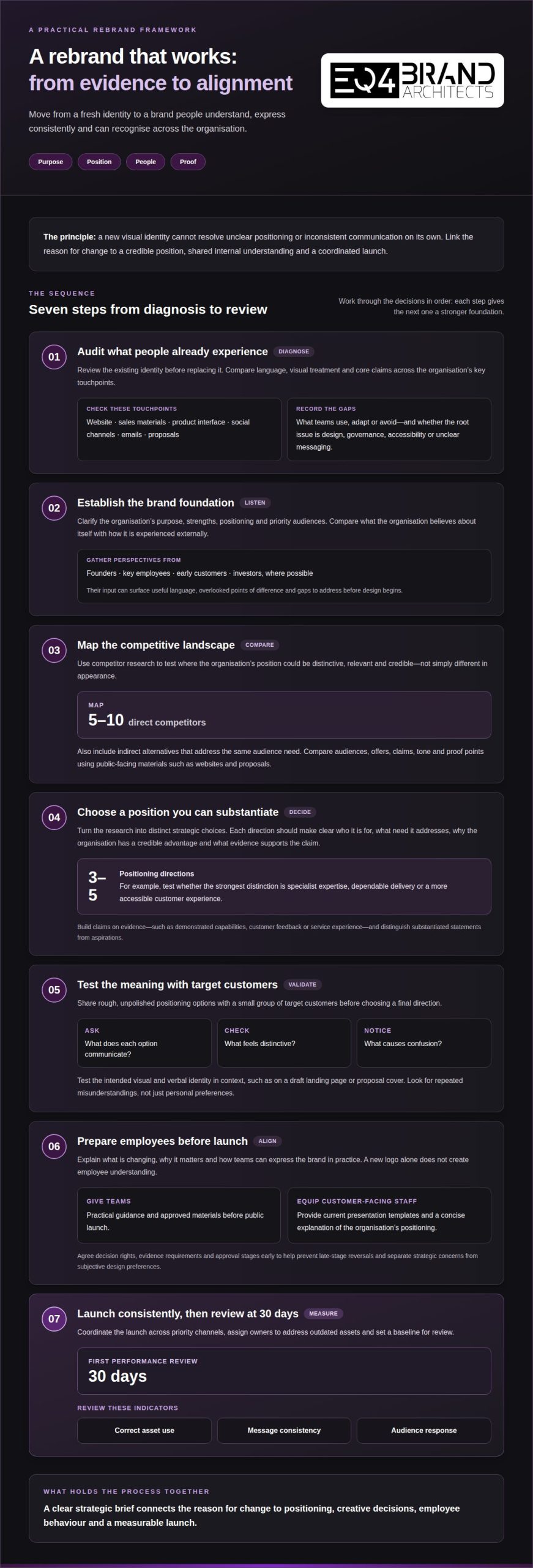
A brand foundation defines the organisation’s purpose, strengths, positioning and priority audiences. It matters because a new visual identity cannot resolve confusion about what the organisation offers or why stakeholders should trust it. Interview founders, key employees and early customers to compare internal beliefs with external experience. Where possible, include investors. Their perspectives can reveal valuable language, overlooked differentiation and gaps that need attention before design begins.
Strategic platforms and evidence-backed messaging
A strategic brand platform turns that foundation into a usable position, promise and set of messages. Leaders, employees and communicators need a shared basis for decisions. Build claims on evidence, such as demonstrated capabilities, customer feedback or service experience, and distinguish substantiated statements from aspirations. Then brief creative development against the approved platform so visual choices reinforce the intended meaning rather than introduce competing signals.
Audit the existing identity across the organisation before replacing it. Review the website, sales materials, product interface, social channels, emails and proposals. Compare the language, visual treatment and core claims at each touchpoint. A proposal, for example, may describe a specialist service while the website presents a broad offer. Record inconsistencies, as well as what teams use, adapt or avoid. This helps identify whether the issue is design, governance, accessibility or unclear messaging.
Test with customers before selecting a final direction. Show a small group of target customers rough, unpolished positioning options, then ask what each communicates, what feels distinctive and what causes confusion. Test the intended visual and verbal identity in context, such as on a draft landing page or proposal cover. Look for repeated misunderstandings, not just personal preferences. Refine the direction if feedback reveals a mismatch between intended meaning and audience interpretation.
Bring in a brand strategy consultant or agency when the organisation lacks the capacity to research, align decision-makers or translate strategy into a coherent identity system. This can be especially useful during organisational change, a merger, an audience shift or persistent disagreement about positioning. Agree decision rights, evidence requirements and approval stages at the outset. That structure helps prevent late-stage reversals and allows executives to distinguish strategic concerns from subjective design preferences.
Employee alignment requires more than announcing a new logo. Explain the rationale, give teams practical guidance and equip them with approved materials before public launch. For example, customer-facing staff need current presentation templates and a concise explanation of the organisation’s positioning. Coordinate the launch across priority channels, then assign owners to address outdated assets. Set a baseline and review performance at 30 days, using indicators such as correct asset use, message consistency and audience response.
Strategic positioning and competitive differentiation
Positioning defines the place an organisation intends to occupy in its audience’s mind. Competitive analysis tests whether that position is distinctive, relevant and credible.
Research and competitive discovery
Discovery combines audience insight, organisational evidence and competitor research to establish a sound positioning foundation. Assumptions about customer priorities can lead to messaging that sounds familiar but misses the real decision. Examine customer language, service experience, proposals and feedback, then compare the findings with leadership’s intended identity. The difference can reveal a gap between what the organisation promises and what audiences actually recognise.
Mapping the competitive landscape
A competitive landscape map shows how relevant organisations present their value and where meaningful distinctions may exist. Map five to ten direct competitors, then examine their audiences, offers, claims, tone and proof points. Include indirect alternatives that address the same audience need. This wider view helps decision-makers spot crowded territory, overlooked expectations and positions the organisation can credibly own.
Competitor analysis and differentiation
Competitor analysis compares audience promises with observable evidence, not just logos or colour palettes. Review websites, proposals and public-facing materials for repeated claims, proof and language. Then identify strengths competitors cannot claim in the same way. Differentiation matters when it gives an audience a clear reason to choose, trust or engage. A distinctive position must be relevant to stakeholders and supported by organisational behaviour.
Translate the findings into three to five distinct positioning directions. Each should identify the intended audience, the need addressed, the organisation’s credible advantage and the evidence behind it. A service provider, for example, might test whether its strongest distinction is specialist expertise, dependable delivery or a more accessible customer experience. Treat these as strategic choices, not interchangeable slogans. The selected direction should guide identity, messaging and future decisions.
For a B2B organisation, build a positioning matrix around decision-maker priorities. Map each audience type to its primary concern, evaluation criteria and the brand’s credible response. A finance leader may need evidence of value, whilst an operational leader may prioritise delivery confidence. The same organisation can express one coherent position through different proof points. This makes materials more relevant without fragmenting the brand into competing promises.
Before finalising a logo, consider how the target audience should perceive the brand. Test whether proposed visual and verbal cues support the chosen position. Then set strategy-linked measures, such as message recall, qualified enquiries or stakeholder understanding. These help distinguish attention from meaningful response and show whether the positioning is clear enough to guide action.
Building internal alignment and employee buy-in
Employees judge a rebrand by what it changes in their working lives, not only by its public identity. Their buy-in depends on whether the new direction feels credible, relevant and possible to put into practice.
Engaging internal stakeholders
Employee buy-in grows when people can see how the new direction connects to their responsibilities. A brand promise can create friction if it conflicts with everyday processes. Explore practical implications with people in different roles. For instance, does a revised service promise match current customer support? Use employees’ observations to surface tensions for leadership, rather than asking them to endorse a decision without understanding its consequences.
Pay attention to concerns about what the change might mean. A new position could be interpreted as rejecting existing expertise or organisational history. Leaders can address this by explaining what the organisation intends to carry forward and what it plans to change. A shift towards a more accessible public voice, for example, need not diminish technical credibility. Clarifying the distinction helps employees understand the new direction without seeing it as a repudiation of their work.
Planning the internal rollout
An internal rollout turns agreed brand principles into choices employees can apply. Alignment shows up in decisions, not merely in positive reactions to a launch. Leaders can clarify how the brand should guide service priorities, recruitment language or responses to stakeholder concerns. These practical applications make the strategy relevant beyond communications and marketing.
Give managers a clear role in connecting the brand direction to local decisions. A team responsible for public enquiries, for instance, may need to work out how a new promise affects response practices. A useful discussion asks what the promise requires, where current practice supports it and which decisions need escalation. This creates accountability without expecting every team to interpret the brand independently.
Training employees for the change
Training helps employees exercise judgement within the brand’s direction. It is not simply instruction on using new assets. This matters when teams must adapt the same principles to different situations. Use realistic scenarios, such as explaining a changed organisational role to a long-standing partner or responding to a customer whose expectations differ from the revised offer.
Assess whether employees can apply the principles, not whether they can repeat a slogan. Ask managers to discuss examples during routine work reviews, then note where the guidance supports decisions and where it leaves uncertainty. If teams interpret a promise differently, clarify the principle or decision boundary. This turns employee insight into a practical way to strengthen organisational consistency, while keeping responsibility for the brand with leadership.
What does successful rebranding actually involve?
Rebranding supports business transformation when the organisation’s identity reflects a substantive change in its role, offer or direction. In South Africa, changing a company name and protecting a trademark are separate processes, so neither should be treated as a design decision alone.
Rebranding to support transformation
Rebranding can make organisational change clearer to customers, employees and other stakeholders. Its value depends on whether their experience matches the new identity. If a service provider changes its offer, for example, customers should encounter the same clear explanation in service interactions and public communication. A new visual identity cannot, by itself, make operational practice reflect the stated change.
Consider a rebrand when a substantial change makes the existing identity misleading or difficult to apply. This may follow a merger, a new organisational mandate or a shift in the audiences served. Before committing to a launch, leadership should distinguish a strategic change from a presentation problem. If the organisation’s role remains sound but its materials look inconsistent, updating them may address the issue without changing the brand’s core direction.
Prepare for major changes by mapping decisions and dependencies that affect stakeholders. A merger, for instance, may require clarity about which organisation’s name, offer and commitments will continue. Set measures tied to the reason for change, such as stakeholder understanding or employee confidence in explaining the new role. Review these alongside operational evidence so a change in perception is not mistaken for a change in delivery.
Company name and trademark changes
In South Africa, a company changes its registered name by following the applicable amendment process under section 16 of the Companies Act 71 of 2008 and filing the required documents with the Companies and Intellectual Property Commission (CIPC). Where a special resolution is required, the company must approve it before filing. A registered company-name change does not itself register a trademark.
Trademark protection is a separate CIPC process under the Trade Marks Act 194 of 1993. A proposed mark should be searched and assessed for the goods or services and classes for which protection is sought; an application must then be filed with CIPC. For example, adopting a new trading name does not alone establish that the name is registered as a trademark. Build these legal steps into launch planning, and have South African legal advisers assess the organisation’s specific company and intellectual-property position.
What is a Rebranding Strategy?
A rebranding strategy connects the organisation’s vision to its positioning, identity, messaging and implementation. It sets the decisions that guide creative development, resource planning and stakeholder engagement.
Strategy development and creative briefs
Strategy development turns research and leadership decisions into a clear direction for the rebrand. Creative teams need more than a request for a new logo. A useful brief explains the business reason for change, priority audiences, desired perception, distinctive position and evidence supporting key claims. It also defines practical requirements, such as where the identity will appear and which decisions need approval.
Start with the decision the rebrand must support. A business expanding its services, for example, may need to clarify its offer without losing recognition among existing customers. The strategy should explain what remains, what changes and why. The creative brief then translates the direction into criteria for evaluating concepts, including audience relevance, clarity across channels and consistency with the organisation’s intended reputation.
Set governance before design begins. Name the decision-makers, agree who provides specialist input and establish how feedback will be consolidated. Without that structure, stakeholders may give conflicting direction, extending approval and weakening the work. A practical sequence moves from strategic approval to creative exploration, review against agreed criteria, refinement and sign-off. This keeps subjective preferences from displacing the original business purpose.
Budget and resource planning
Budget and resource planning estimates the people, time and production needed to deliver the agreed scope. It matters because a visual identity is only one part of implementation. A planning model allocates 20% to research, 15% to strategy, 35% to design and 30% to launch. Treat these proportions as a planning reference, then adjust them to the organisation’s priorities and required work.
Map costs against deliverables rather than a single design line. Research, strategy, identity development, guidelines, asset production, employee preparation and launch activity each require decisions and ownership. A company with several public-facing services may need more adaptable materials than one with a single offer. Internal capacity matters too: staff time, approval responsibilities and operational updates all affect the resources required.
Build the budget around priorities and dependencies. Identify essential launch touchpoints first, then schedule lower-priority updates according to available capacity. Customer proposals and the website, for example, may need coordinated changes, while archived presentations can follow later. Keep a clear record of assumptions, owners and approvals. This gives leadership a basis for managing scope as priorities or organisational needs change.
Finally, connect spending to intended outcomes. Set measures before launch, such as employee adoption, stakeholder understanding or the quality of relevant enquiries. Pair each measure with an owner and review point. This allows leadership to assess whether the rebrand supports its stated vision, rather than treating completed assets as proof of success.
EQ4 Brand Architects: Communication Strategy
EQ4 Brand Architects helps organisations connect rebranding decisions to communication strategy, stakeholder confidence and reputation. Turn to EQ4 when the organisation’s direction has changed, but its messages and audience experience remain fragmented or inconsistent.
Its communication strategy work can align the rebrand with organisational purpose and the needs of priority audiences. Reputation Management and Public Relations (PR) help shape how the change is understood, whilst Brand Activations can bring the new direction to life through audience engagement. The right mix depends on the rebrand’s purpose, stakeholders and launch requirements.
If your organisation is considering a rebrand or preparing for launch, contact EQ4 Brand Architects to discuss the communication challenge.
Make the next decision count
A rebrand becomes meaningful through the choices that follow its launch. Keep the organisation’s intended direction visible in everyday decisions, from how leaders explain priorities to how teams respond to stakeholder concerns. Consistency helps the new identity earn credibility through experience, not appearance alone.
Use your rebranding strategy framework as a working reference when priorities shift. If a proposed campaign, partnership or service change does not fit the position, pause and examine the gap before communicating it. That discipline gives the organisation room to evolve without losing the clarity it has established.
For organisations preparing a change or seeking a more coherent way to communicate it, a conversation with EQ4 Brand Architects can help clarify the strategic challenge and a practical next step. Contact EQ4 Brand Architects to discuss what your organisation needs from its next phase of brand and communication.
Frequently Asked Questions
What is brand transformation?
Brand transformation is a practical shift in how an organisation is understood and experienced, not just a change in appearance. Assess whether decision-making, service behaviour and stakeholder communication support the organisation’s intended role. If a public institution promises simpler access, for example, examine the actual steps people must take to use its services. Consider the promise and the experience together.
What’s the difference between rebranding and brand refresh?
There is no single universal boundary between these terms; organisations use them differently. As a practical distinction, a refresh usually describes a narrower scope, while rebranding signals broader changes to the organisation’s identity or strategic expression. Define the scope in the project mandate rather than relying on the label. Specify which elements may change, which must remain recognisable and what decisions require leadership approval.
When do you know it’s time to rebrand your business?
A useful decision point is when the current brand creates recurring friction in important organisational choices. Teams may struggle, for example, to explain a new partnership or assess whether a proposed service fits the organisation’s identity. Before commissioning creative work, record the decisions the existing brand cannot support. If the difficulty is limited to a particular channel or document, address that issue first rather than widening the project unnecessarily.
What is a rebranding strategy framework?
A rebranding strategy framework is a decision tool that keeps project choices connected to their purpose. A useful framework includes the business rationale, decision owners, scope boundaries, evidence requirements, approval points and measures of progress. It can also record material decisions and the reasons behind them. That record helps new project participants understand why a direction was selected, rather than reopening settled questions without new evidence.
What are the key steps in a rebranding strategy?
Keep the work connected through clear handovers, with each stage producing an agreed output for the next. The creative team, for example, should receive an approved direction and defined evaluation criteria, not conflicting comments from separate stakeholders. Before moving on, document the decision, its owner and any unresolved dependency. This makes governance visible and helps leaders spot when a project is drifting beyond its agreed scope.
How do you decide whether a company needs a rebrand or a brand refresh?
Test the current brand against a real organisational decision, such as entering a new market or changing a service model. Ask whether the existing name, identity and audience promise can support that decision without contradiction. If the underlying direction still fits, a narrower refresh may be appropriate. If the decision changes what the organisation stands for or offers, assess whether broader strategic change is needed.
How do you research customers, competitors, and brand perceptions before rebranding?
Separate what people say from what they do. A stakeholder may describe an organisation as helpful, for instance, while their actions show uncertainty about which service to use. Compare feedback with observable interactions and note conflicting evidence. When reviewing competitors, distinguish their stated promises from the proof in their public materials. This gives leaders a more grounded basis for decisions than treating every comment as equally conclusive.
How do you define brand positioning, purpose, values, and messaging during a rebrand?
Give each element a distinct governance role: purpose explains why the organisation exists; values guide conduct; positioning clarifies its intended distinction; messaging gives people language to express it. Assign an owner to each major public claim and identify the evidence supporting it. This helps prevent polished messaging from becoming detached from organisational practice, particularly when several teams communicate on the organisation’s behalf.