




A crisis response needs a clear, dependable place for people to find current information, not more noise. A dark site in crisis comms is a website or page prepared in advance and kept unpublished until an organisation activates it to share crisis updates in one central location.
When information changes quickly and stakeholders need answers, scattered posts and inconsistent messages can obscure what is happening. A dark site gives audiences a reference point and helps the organisation keep updates focused and aligned.
This article explains how a dark site supports crisis communication, what information it can hold and how scenario planning prepares it for different events. It also covers how clear, timely updates can support stakeholder confidence, and why the site must form part of a wider response.
Key Takeaways
- Prepare holding statements and clear approval roles before a crisis, so the first response can be timely and coordinated.
- Use a central update point to help audiences find consistent information across communication channels.
- Plan for different crisis scenarios, including how stakeholder needs and available channels may change.
- Build trust by communicating what is known, acknowledging unanswered questions and explaining what happens next.
- Review how updates are governed and received, then use those insights to strengthen the organisation’s crisis response.
How does crisis communication work?
Crisis communication connects operational decisions with timely, approved messages for people affected by an incident. It works best when responsibilities and information flows are agreed before pressure builds.
Prepared statements and response plans
A response plan sets out how an organisation gathers facts, makes decisions and approves communications during an incident. A holding statement can acknowledge an event while teams establish what happened, what is affected and what action is underway. Drafts should use fields for facts that may change, rather than assume a cause or impact. Name alternates for approval roles so an unavailable decision-maker does not leave staff unsure who can authorise publication.
For example, a communications lead can prepare a draft for a service interruption, then work with the operational lead to add verified details. Disclosure responsibilities depend on the incident and sector; a dark site does not replace applicable obligations or review by relevant legal and compliance advisers.
Continuity and communication channels
Business continuity planning connects communication decisions with the people responsible for maintaining essential operations. Manage internal and external messages separately: employees may need instructions about duties or workplace arrangements, while external audiences need information relevant to their relationship with the organisation.
If a facility closes, for example, staff may need guidance on reporting or alternative arrangements, while customers need to know how services are affected. The communications process should also account for a website or staff channel becoming unavailable, with an agreed alternative for each audience.
Dark sites and crisis webpages
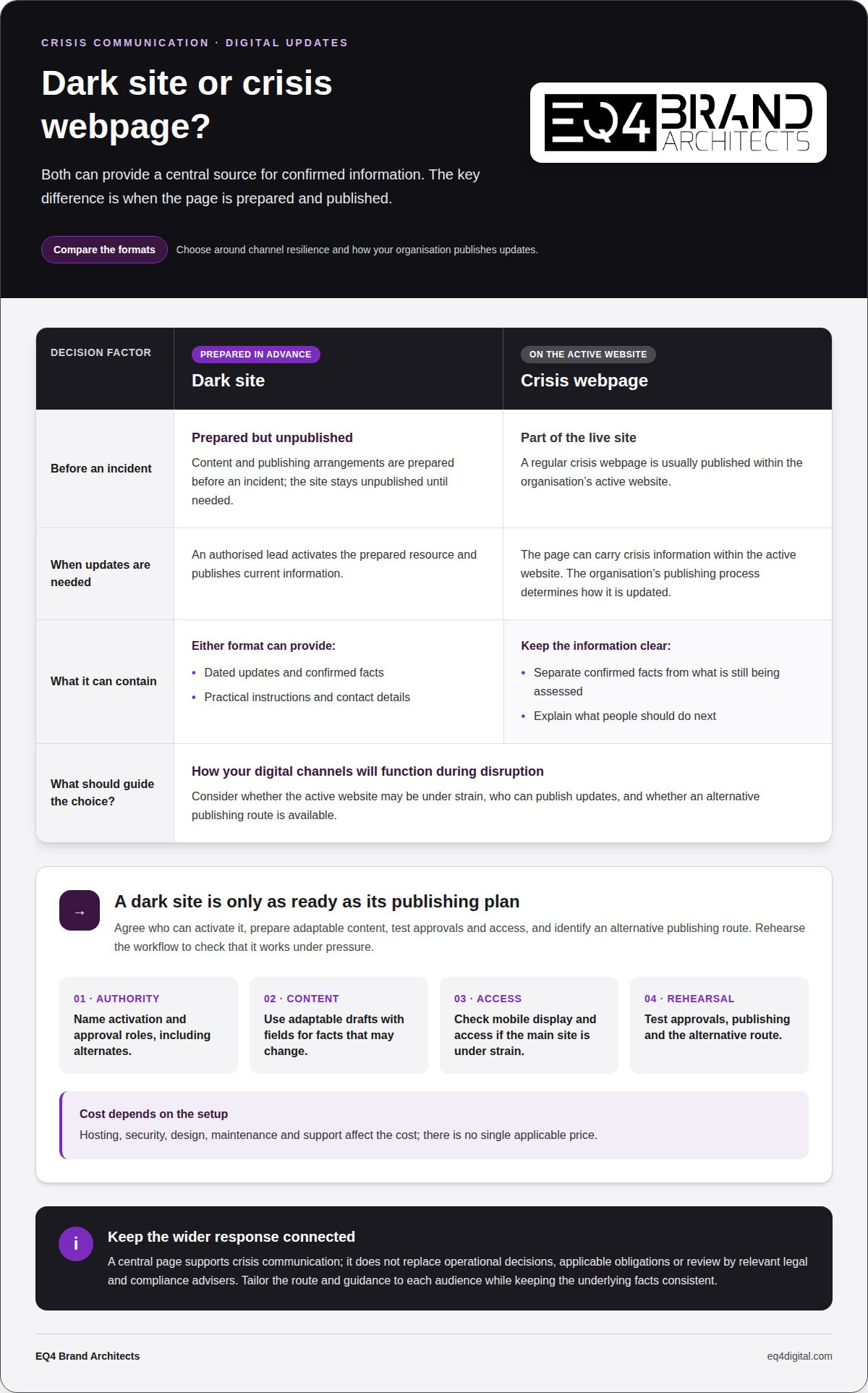
A regular crisis webpage is usually published within an organisation’s active website. A dark site, by contrast, is prepared before an incident and kept unpublished until needed. Either format can carry dated updates, confirmed facts, practical instructions and contact details. The right choice depends on how the organisation’s digital channels function during disruption.
For a hypothetical transport operator, a crisis page might explain a route interruption and passenger options. Content should distinguish what is confirmed from what is still being assessed, and avoid exposing confidential or personal information. No named South African organisation is being presented as an example here.
Dark-site preparation and infrastructure
Preparation means agreeing who can activate the site, drafting adaptable content and testing the publishing workflow. Authorised people need to be able to update pages, display them clearly on mobile devices and retain access if the organisation’s main site is under strain.
Hosting, security, design, maintenance and support requirements affect the cost, so there is no single applicable price. A rehearsal should test access, approvals and an alternative publishing route. This reveals whether the setup works under pressure, rather than merely appearing ready.
Directing audiences to a central source for updates
During a crisis, audiences need to know which information applies to them and what action to take. Once authorised, the organisation can signpost the dark site through relevant channels, directing each audience to the guidance it needs.
A central hub for crisis updates
How does a dark site work during a crisis? An authorised lead publishes the prepared resource, then communication channels direct audiences to relevant information. A social media post, for example, can identify the affected service and point people to specific guidance instead of asking them to interpret a broad announcement.
Make the route easy to follow. Use consistent page titles and clear labels so a link shared in a message tells readers what they will find. Organise updates by issue or audience need, and distinguish the latest status from earlier information. People arriving from different posts can then reach the same current guidance.
Messages should do more than repeat a link. Explain why the audience may be affected, what to do now and where to find more detail. If customers need to check a service, for example, identify that service and link directly to its update rather than sending everyone to a generic landing page.
Messaging for different audiences
Stakeholder mapping identifies who needs information, what decisions they face and which concerns require a response. Employees, customers, suppliers and community stakeholders may all be affected by one event, but their practical questions will differ. Tailor the emphasis and call to action while keeping the underlying facts consistent.
Consider a hypothetical disruption affecting deliveries. A supplier message might clarify scheduling and operational contact routes; a customer message might explain how to check an order. Neither should expose internal operational details or imply conflicting versions of the facts. Use plain language, explain necessary technical terms and make the next step explicit.
South African organisations should consider language preference, accessibility and uneven digital access when choosing channels and shaping messages. A digital update may need a concise summary or a direct communication route for stakeholders who cannot readily use the site. Match the format to the audience, then assess whether people understood what applies to them, not just whether they saw a post.
Visual hierarchy can help readers identify the right update quickly. Clear headings, readable layouts and recognisable labels support that task, especially on mobile screens. Graphic Design can contribute to an accessible information layout, while approved content and audience needs determine what the page communicates.
Scenario planning for worst-case outcomes
A dark site is most useful when its content reflects plausible crisis scenarios rather than a single imagined emergency. Scenario planning helps leaders consider how an incident could affect operations, employees and external stakeholders, then prepare communication for each likely situation.
Start by identifying risks relevant to the organisation’s activities, locations and stakeholder relationships. Assess each scenario by considering both its severity and its probability. A low-probability event with severe consequences may still need a prepared response, particularly if it could disrupt essential services or put people at risk.
For a hypothetical organisation, a site outage, a safety incident and a supply interruption would call for different audience instructions. The immediate message might explain what is affected, who should take action and where verified updates will appear. Later content could address operational changes, support arrangements and what remains under investigation. These are planning examples, not claims about specific South African organisations.
For each scenario, decide which facts can be prepared in advance and which must await verification. A draft can provide structure, but should not assume the cause, scale or impact of an event. Identify who can approve activation, who confirms operational facts and who prepares public wording. This keeps urgent publication tied to evidence and authority.
Plan for escalation as well as containment. Ask what changes if an incident affects another site, continues longer than expected or draws new stakeholder concerns. Consider whether disruption might continue beyond 12 weeks; a prolonged scenario may require a different update rhythm, employee guidance and practical information for affected communities. The purpose is to anticipate communication needs, not predict precisely how an event will unfold.
Leadership should test how the response works under pressure. A simulation can present a developing scenario in stages: an incident report, a service impact, then conflicting accounts. At each stage, participants decide what is verified, who needs an immediate message and whether the prepared site content still applies. The exercise can expose unclear approval roles or missing stakeholder information before a real event does.
After the exercise, record decisions that caused delays, questions employees could not answer and information external audiences needed. Use the findings to revise scenario content, approval routes and activation criteria. Keep the plan usable as operations, risks and stakeholder expectations change; otherwise, prepared messages may not fit the crisis that occurs.
Transparency, trust and message tone
Trust depends on the gap between what an organisation says and what stakeholders experience. A dark site should distinguish confirmed facts, actions underway and unanswered questions. After a service interruption, for example, state which service is affected, what action is underway and when the next update is expected. Do not claim a cause before the investigation supports it.
Transparency does not mean publishing every detail. Separate shareable information from personal, confidential or operational material that could cause harm. If the organisation cannot answer a question yet, acknowledge it and explain what it is establishing. Silence can leave concerns unaddressed; speculation can undermine credibility when later facts differ.
Match the tone to the human consequences of the event. A safety incident calls for direct, respectful language, not promotional phrasing or defensive explanations. Acknowledge the impact on people before describing the process. If the organisation made an error, state what happened, take responsibility where appropriate and explain corrective action without treating intention as evidence of improvement.
Social media can bring questions and criticism into public view, but a short post rarely carries the full response. Use it to recognise the issue and direct people to detailed, dated information. Keep facts consistent across channels while adjusting length and emphasis for each audience. Screenshots can circulate after a post changes, so publish only wording approved for external use.
South African organisations may communicate with stakeholders who prefer different languages or have uneven access to digital channels. One audience may need clear English; another may need translated information or a direct community update. Choose formats and channels for the people affected, not just the organisation’s usual publishing habits. Accessible language and practical instructions make messages easier to act on.
Useful updates explain what is known, what is being done, who may be affected and where to seek assistance. Avoid broad assurances such as “everything is under control” while the situation remains fluid. Specific, verifiable actions give leaders and communications teams a more credible basis for communication than statements of confidence alone.
Assess whether communication serves stakeholders by reviewing their questions, the accuracy of shared information and whether people understand the actions required. If the same concern persists across social media, calls and media enquiries, the update may need clearer wording or a more direct response. Trust rests on consistency, candour and visible follow-through, not tone alone.
Crisis management
A dark site is one part of crisis management, alongside operational decisions, staff coordination and stakeholder communication. Leaders need to protect people, sustain critical functions and ensure public updates reflect the organisation’s actions. If operational teams change a service or safety procedure, communications must use the same verified position. This helps prevent conflicting instructions and outdated statements.
Set out who can authorise publication, approve changes and provide confirmed operational information. A decision matrix can name the approver, operational lead and communications lead, with an alternate for each role. Define how urgent decisions proceed when someone is unavailable. Rehearse the process with a scenario such as a cyber incident or disruption to a public-facing service.
Digital tools can support coordination, but they do not replace judgement or clear responsibilities. Test whether authorised people can access publishing systems, approve changes and maintain records while other teams manage the incident. Include a fallback if a platform becomes unavailable. This can expose reliance on one person, device or channel before it complicates a live response.
Coordinate public posts with the organisation’s approved response, and pause unrelated social media content if it could distract from critical information. Check each post against the decision matrix and consider how it may appear in a screenshot without context. Every public message should reflect the approved position and avoid creating a competing account of events.
Set the frequency of employee updates according to what has changed and what staff need to do. Early in a crisis, employees may need updates multiple times a day; as the situation stabilises, updates can move to once a day or less often. Group verified developments into useful briefings rather than sending messages with no new instruction or decision.
Decide whether a development warrants a response by assessing its credibility, consequences and relevance to affected people. A confirmed safety instruction, service change or correction may require an immediate update; a minor comment without practical consequences may not. Recording the rationale helps leaders and communications teams apply consistent judgement across shifts and channels.
After the incident, review approval delays, recurring stakeholder questions, inaccurate public information and whether people understood required actions. Update the plan quarterly, including roles, channels and scenario content. Organisations strengthening their reputation management approach can use these findings to connect crisis decisions with stakeholder confidence and organisational trust.
Because a crisis requires quick action to limit damage, teams may need to act before all information about its trigger is available; distinguish confirmed instructions from details still being checked. More than 60% of organisations use digital crisis management tools to accelerate their response, according to the Business Continuity Institute’s Emergency and Crisis Communications Report 2025. Keep the plan usable by updating it quarterly, and map suitable communication channels to each audience, with alternatives ready if preferred channels are unavailable.
For social media, clear crisis updates must be published for public release in strict alignment with the organisation’s social media strategy and decision matrix. In the early stages, update employees multiple times a day if needed, ensuring each message reflects what is known and what staff should do.
EQ4 Brand Architects
EQ4 Brand Architects helps organisations connect crisis communication with reputation, stakeholder confidence and clear decision-making. Turn to the team when updates feel fragmented, roles are unclear or a planned dark site needs to sit within a wider communications strategy.
Its work can bring together communication strategy, public relations and reputation management so that channels, messages and response decisions support a coherent organisational approach. This is particularly relevant when a crisis affects multiple stakeholder groups or requires careful coordination between leadership and communications teams. The focus is not simply on publishing a page, but on making communication purposeful, audience-aware and aligned with organisational priorities.
If your organisation is reviewing its crisis communications or preparing for a high-stakes issue, contact EQ4 Brand Architects to discuss the challenge.
Make crisis readiness part of organisational practice
A dark site has value when it reflects how an organisation makes decisions under pressure. Treat it as part of governance and reputation readiness, not simply a digital asset. The question of what a dark site is in crisis communications matters less than whether its activation, content and oversight fit the organisation’s real response.
A useful next step is to bring communications, operational leadership and relevant decision-makers together to assess that fit. Consider how the approach supports stakeholder confidence and organisational priorities, and where clearer coordination could reduce uncertainty. EQ4 Brand Architects brings strategic communications together with reputation management, public relations and brand activations, helping organisations address connected communication challenges with intention.
If you’re reviewing your crisis communications or planning for a future issue, contact EQ4 Brand Architects to discuss the challenge and a considered way forward.
Frequently Asked Questions
Why is it important?
A dark site gives an organisation a prepared way to publish incident-specific information when its usual communications are under pressure. During a major service interruption, for example, people may encounter outdated screenshots or conflicting explanations. A designated crisis page gives staff and stakeholders a reference point for the organisation’s current position while operational teams focus on the response. Its value depends on accurate content and a clear activation decision.
What is a dark site in crisis communications?
A dark site in crisis communications is a website or page prepared in advance and published when a relevant incident occurs. “Dark” describes its unpublished status before activation, not restricted access afterwards. The term does not prescribe a technical format: an organisation may prepare a dedicated site or a page within an existing digital environment. The right structure depends on the audience, incident and publishing approach.
What are the risks and limitations of using a dark site?
A dark site does not replace applicable obligations or legal and compliance review. It may also be difficult to use if digital channels are unavailable or the main site is under strain. Keep confidential and personal information out of its content, and test an alternative publishing route.