





The agency with the most impressive media list may not be the right partner. Finding a strategic PR agency South Africa organisations can trust starts with looking beyond confident pitches. Assess how well an agency understands your priorities and turns them into purposeful communication.
Agency claims can be difficult to compare. Strategy may sound compelling on paper, yet the link between media relations, reputation and outcomes can be unclear. Scope, collaboration and retainer expectations matter too. A strong partnership needs to work in practice as well as in principle.
This guide offers a practical way to assess strategic fit, capabilities and accountability. You’ll find questions to ask about how strategy informs execution, how progress is evaluated and what to clarify in a proposal. It also compares project-based engagements and ongoing retainers, so you can brief potential partners with confidence and agree on useful next steps.
Key Takeaways
- Check whether a strategic PR agency South Africa option starts by understanding your organisation’s priorities, audiences and reputation needs.
- Look for a clear link between objectives, proposed work, responsibilities and ways to evaluate progress.
- Compare project-based work and retainers by scope, continuity, flexibility and governance. Neither model is automatically better.
- Prepare a focused brief covering objectives, audiences, sensitivities, decision-makers and practical constraints before reviewing proposals.
- Consider whether services such as PR, reputation management, communication strategy and media monitoring fit your brief.
What should a strategic PR agency in South Africa do?
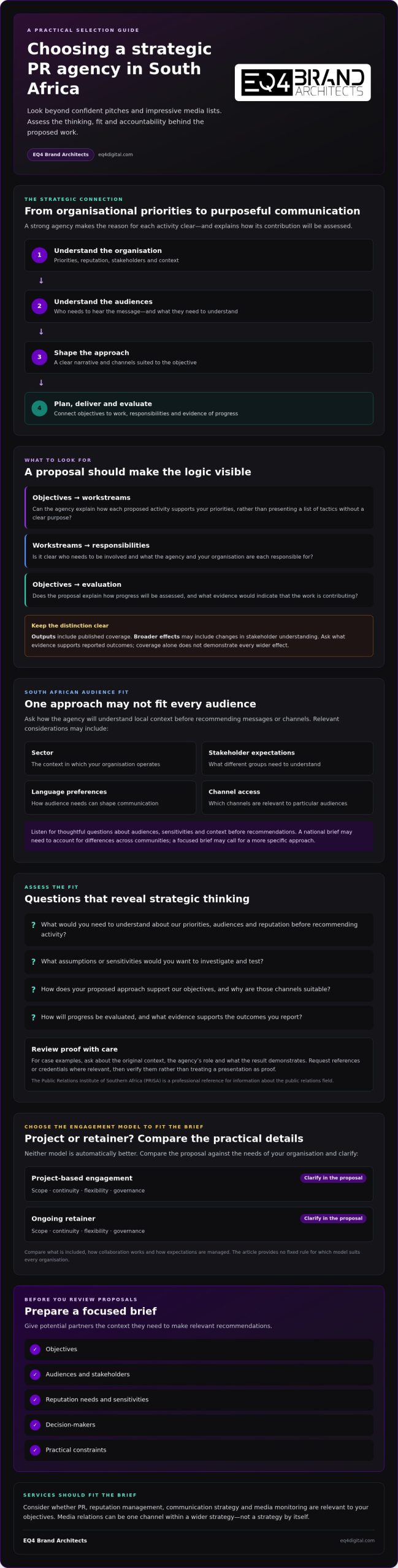
A strategic PR agency should connect what an organisation needs to achieve with the messages, audiences and communication activity that can support those aims. It should first understand the organisation’s priorities, reputation, stakeholders and context, then recommend an approach. Strategic PR turns organisational objectives into planned, audience-aware communication, with a clear reason for each activity and a way to assess its contribution.
This involves more than issuing press releases or supplying media lists. Publicity can be useful, but activity without a defined audience or purpose may not address the underlying need. Public relations includes communication and relationship-building, so effective counsel considers more than the immediate opportunity to secure coverage. PR may support visibility, stakeholder understanding, reputation and trust, but no agency can guarantee how audiences, journalists or other stakeholders will respond.
How does strategic PR differ from media relations alone?
Media relations is one possible channel within a wider communications strategy, not a strategy by itself. A considered approach connects audience insight to a clear narrative, chooses channels suited to the objective and sets out how progress will be evaluated. Depending on the brief, this may involve media engagement, reputation management, communication planning or other relevant activity. The right mix depends on the organisation, its audiences and the situation, not on a standard list of tactics.
What should a South African PR strategy account for?
South Africa’s audiences are not interchangeable. Sector, stakeholder expectations, language preferences and access to particular channels can all affect how a message is received. A national brief may need to account for differences across audiences and communities, while a focused brief may call for a more specific approach. Ask how an agency will understand those differences before it recommends channels or messaging. The aim is communication that feels relevant and considered, rather than one approach applied everywhere.
When assessing a strategic PR agency South Africa-wide, listen for questions before recommendations. A credible partner will want to know who needs to hear the message, what they need to understand and which practical or reputational sensitivities should shape the work. Those answers help you judge whether the proposed activity has a clear purpose and fits your organisation’s needs.
Which criteria reveal whether a PR agency is strategically aligned?
A polished proposal can still miss the mark if it starts with tactics before understanding your organisation. Look for an agency that asks about business priorities, audiences, reputation concerns and existing communications, then explains how those factors inform its recommendations. For a strategic PR agency South Africa organisations can work with confidently, the reasoning should be as clear as the proposed activity.
Alignment is easier to assess when a proposal links each objective to workstreams, responsibilities and evaluation methods. If the aim is to improve stakeholder understanding, for example, ask what activity could support that aim, who needs to be involved and what evidence would indicate progress. Be cautious of activity lists that do not explain why the work matters or how it relates to your priorities.
How can you test an agency’s strategic thinking?
Ask candidates how they would investigate your brief before recommending activity. Do they explore assumptions, audience needs and possible sensitivities, or move straight to channels? Ask them to explain the reasoning behind their approach and how it supports your objectives. You are not looking for a complete strategy in an initial discussion. You are looking for thoughtful questions, sound reasoning and a willingness to test and refine assumptions.
What evidence should you request from a PR agency?
Relevant case examples can help if the agency explains its role, the original context and what the reported result demonstrates. Ask how progress was evaluated and what evidence supports claimed outcomes. Distinguish outputs, such as published coverage, from broader effects, such as changes in stakeholder understanding. Request references or credentials where relevant, and verify them rather than treating a presentation or claim as proof. The Public Relations Institute of Southern Africa (PRISA) is a useful professional reference when checking information about the public relations field.
To compare agencies consistently, assess each against the same checklist. Use a simple rating, such as “clear”, “partly clear” or “unclear”, and note the evidence behind your assessment:
- Discovery: Did the agency ask about your priorities, audiences, reputation and existing communications?
- Strategic rationale: Can it explain how its recommendations connect to your objectives?
- Delivery clarity: Are workstreams, responsibilities and collaboration expectations defined?
- Evaluation: Are the proposed measures relevant to the objective, and is it clear how progress will be reviewed?
- Evidence: Do examples explain the context, the agency’s contribution and the support for reported outcomes?
Compare your notes as well as the ratings. Any gaps can guide a follow-up discussion, especially if a proposal depends on assumptions you have not confirmed. If communication strategy is part of your brief, you can also review EQ4’s communication strategy approach as one point of comparison.
How do PR agency services, teams and engagement models compare?
Start with the work your brief requires, then compare agencies on their ability to deliver it. A long service list is not automatically an advantage. Each capability should have a clear role in the agreed objectives. Ask who will lead the work, who your day-to-day contact will be, what specialist input is available and how responsibilities will be coordinated. This helps you evaluate the proposed team and working relationship, not just the menu of services.
For a strategic PR agency South Africa organisations are considering, an integrated offer is useful when it supports a coherent response to the brief. PR, reputation management and media listening and monitoring may inform one another. Communication strategy can guide the work, while brand activations or creative production may be relevant if the objective calls for them. EQ4 Brand Architects offers these capabilities alongside design and production services. The right fit depends on your needs, not the number of services listed.
Is an integrated PR agency the right fit for your brief?
Choose breadth with intention. If your priority is a defined media relations project, ask whether the agency can provide the right counsel and delivery for that scope. If your brief also involves corporate reputation management South Africa organisations need to address, consider whether coordinating those capabilities through one partner would make the work more connected. Ask which services are essential, which are optional and how each would support the objective.
If strategic communications and creative capabilities are relevant to your needs, EQ4’s approach is one option to assess alongside other proposals.
Should you choose a project or retainer engagement?
A project may suit a defined, time-limited communications need. A retainer may be more appropriate when you need ongoing counsel and continuity. Neither model is inherently better. Compare the scope, decision-making and review arrangements in each proposal. This table provides a starting point for that discussion.
| Consideration | Project-based work | Retainer |
|---|---|---|
| Scope | Usually centred on an agreed piece of work or defined brief. | Set around an ongoing scope and agreed priorities. |
| Continuity | Focused on the project period. | Can support a continuing working relationship. |
| Flexibility | Changes may require a scope discussion. | Priorities can be reviewed within the agreed scope. |
| Governance | Clarify milestones, approvals and project close-out. | Clarify regular planning, approvals and progress reviews. |
Before agreeing to either model, confirm what is included, who approves the work, how priorities are handled and how progress will be discussed. These details help both sides understand the scope and manage the engagement.
What should you ask before appointing a strategic PR agency?
A clear selection process helps you compare proposals on more than presentation style. Before approaching a strategic PR agency South Africa organisations are considering, align internally on what the work needs to address, who will make decisions and what practical limits the agency should understand. You do not need every answer in advance, but a shared starting point makes proposals more useful and comparable.
What belongs in a strategic PR agency brief?
Set out the business context, communications challenge and audiences you need to reach or understand. Include relevant history, existing materials, internal stakeholders, known sensitivities and practical constraints such as approval steps or timing. Describe the outcomes you hope to support, while leaving room for the agency to question assumptions and recommend an approach. Avoid prescribing tactics before you have discussed strategy.
How should you assess proposals and presentations?
Give each candidate the same objectives and core information, then compare how well its recommendations respond to your brief. Ask who will lead the work, how the team will collaborate with yours, who approves communications, what reporting will cover and how changes to scope or priorities will be handled. Check whether the proposal reflects your organisation’s context or relies on generic agency language.
Use this shortlist process to move from internal alignment to a considered appointment:
- Agree internally: Confirm the communications challenge, intended audiences, desired outcomes, decision-makers and practical constraints.
- Prepare the brief: Share relevant background, existing communications, sensitivities and known approval requirements. Focus on the need, not a preselected tactic.
- Compare proposals consistently: Check each against the same objectives, scope, responsibilities and evaluation expectations. Note where recommendations respond specifically to your brief and where you need clarification.
- Discuss delivery: Ask about the proposed lead contact, team collaboration, approval processes, reporting and how changes will be agreed. Clarify what is included and what would require a separate scope discussion.
- Confirm the fit: Before appointing, make sure both sides understand the intended work, respective roles and how progress will be reviewed. Resolve open questions before agreeing to begin.
A useful final discussion should leave you clearer, not simply more impressed. Ask candidates to explain the reasoning behind their recommendations, what they still need to learn and how they will work with your decision-makers. Their answers can show whether the proposed partnership is collaborative and grounded in your organisation’s needs.
If you are shaping a communications brief, read more about EQ4’s communications approach.
How can EQ4 Brand Architects support a strategic PR partnership?
Once you have set your selection criteria, consider whether an agency’s capabilities match your brief and whether its approach feels collaborative. EQ4 Brand Architects provides strategic communications and creative services, including public relations, reputation management, communication strategy, brand activations, and media listening and monitoring. Its approach blends emotional intelligence with intentional strategy, working with clients to develop brand direction, campaign strategy and creative direction for engaging audiences.
For organisations considering a strategic PR agency South Africa-wide, fit should depend on the needs of the work, not the length of an agency’s service list. You might need PR aligned with reputation priorities, or monitoring to inform communication planning. An integrated partner may be relevant when several capabilities need to work together, but breadth alone is not a reason to appoint an agency.
When might EQ4’s integrated capabilities be relevant?
If your brief extends beyond media relations, EQ4’s combination of communication strategy, PR, corporate reputation management in South Africa and monitoring may be worth exploring. Creative services can also support a communications need when they have a defined role. For example, branding and design, animation, web design or video production may be relevant when the brief calls for specific creative material. Each capability should connect to an agreed objective. There is no need to include every service or assume a preset package is right for your organisation.
Ask how the proposed work would fit together, which capabilities are essential, who would coordinate them and how their contribution would be reviewed. EQ4’s approach combines emotional intelligence with intentional strategy, providing a starting point for a conversation about scope and fit.
What happens in an initial agency conversation?
Bring the foundations of your brief: your objectives, audiences, current communications challenges, known sensitivities and the scope you have in mind. You do not need a finished solution. Sharing what you know, and where you are still uncertain, gives the agency room to understand the context and discuss possible next steps.
Project-based work or an ongoing retainer may be considered in light of the needs identified. The appropriate model depends on the scope, continuity required and ways of working you agree together. Use the conversation to clarify responsibilities, approvals and how progress will be discussed, then consider whether the proposed relationship is a practical fit.
To explore the fit for your brief, contact EQ4.
Choose a partner with purpose and clarity
The right agency should do more than recommend activity. Look for a clear connection between your objectives, the work proposed and how progress will be reviewed. A well-prepared brief and consistent questions can help you compare strategic fit, team responsibilities and working arrangements.
When assessing a strategic PR agency South Africa organisations can partner with, consider whether its capabilities match your needs rather than choosing breadth for its own sake. EQ4 Brand Architects offers PR, reputation management, communication strategy and media listening, alongside creative and production capabilities that may be relevant to a brief.
Ready to discuss your communications needs and whether EQ4’s approach and scope fit? Start a conversation with EQ4.
Frequently Asked Questions
What does a strategic PR agency do?
A strategic PR agency connects an organisation’s objectives with planned communication for relevant audiences. It may develop messaging, advise on channels, manage media relations, support reputation priorities and monitor coverage or conversation. The agency should explain why it proposes each activity and how progress will be reviewed. Publicity may form part of the work, but strategy gives it direction and helps shape communication around the organisation’s context.
How do I choose a strategic PR agency in South Africa?
Choose a strategic PR agency South Africa organisations can work with by comparing how candidates understand your needs, justify recommendations and define accountability. Share the same core brief with each agency, then assess whether its proposal connects your objectives to scope, responsibilities and evaluation. Ask who will lead the work, how your team will collaborate and what evidence supports relevant claims. A considered conversation can also help you assess the working relationship.
What is the difference between a PR agency and a communications agency?
A PR agency generally focuses on public relations activities such as media relations and reputation management, whilst a communications agency may cover a broader mix of planning and communication capabilities. The terms can overlap, so do not rely on the label alone. Review the services, expertise and proposed scope. Ask how the agency would address your challenge, which capabilities are relevant and how different activities would support a shared objective.
How much does a strategic PR agency cost?
The cost depends on the agreed scope, complexity, required capabilities and whether the work is project-based or ongoing. Rather than comparing headline fees alone, ask each agency to specify what is included, who will work on the account, how work will be approved and how changes are handled. Request a proposal in South African rand that separates the agreed services and any exclusions, so you can compare like with like.
Is a PR retainer better than a project-based engagement?
Neither model is automatically better. The right choice depends on the work you need. A project-based engagement may suit a defined, time-limited brief, whilst a retainer may fit ongoing communications support and counsel. Compare each option by scope, continuity, flexibility and governance. Before agreeing, clarify deliverables, roles, approval processes and how priorities or scope changes will be discussed.
How can you measure whether a PR agency is effective?
Measure effectiveness against objectives agreed before work begins. Depending on the brief, useful indicators may include outputs such as relevant media coverage, or evidence of progress towards broader aims such as audience understanding or reputation priorities. Ask the agency to explain its evaluation approach, reporting cadence and what the measures can and cannot demonstrate. Do not treat activity counts alone as proof of business impact. Review results in the context of the original objective.
What should I include in a brief for a PR agency?
Include the business context, communications challenge, intended audiences and outcomes you hope to support. Share relevant history, existing materials, known sensitivities, internal stakeholders, decision-makers and practical constraints such as approval requirements. Explain what is already in place and where you need advice. Avoid prescribing tactics too early. A useful brief gives the agency enough context to question assumptions and recommend an approach suited to your organisation.