





A longer service list doesn’t necessarily make a stronger creative partner. For organisations seeking a creative agency for corporate clients South Africa-wide, the more useful question is whether an agency can connect business priorities with clear, consistent communication across audiences and channels. When strategy, creative work and production sit in separate silos, even polished output can feel fragmented.
Agency capabilities can be difficult to compare. A broad list may describe an integrated strategic partner, or a production specialist focused on particular deliverables. The distinction matters when decision-makers need creative work to serve defined organisational objectives. This guide compares integrated and specialist agency models, their capabilities and working approaches. It also explains how reputation management, PR, activations, design and media production can support a more intentional approach. Use the criteria ahead to clarify what your organisation needs, where collaboration could bring greater coherence, and what a purposeful next step might look like.
Key Takeaways
- Identify how reputation, audience trust and brand expression should shape your organisation’s creative brief.
- Trace how strategy, creative direction and delivery can work together towards a shared communication objective.
- Compare integrated agencies and specialist partners across strategic breadth, creative capabilities and coordination to see which model suits your needs.
- Use a practical framework to assess a creative agency for corporate clients South Africa-wide, from strategic thinking to collaboration expectations.
- Explore how EQ4 Brand Architects brings emotional intelligence and intentional strategy together across reputation management, PR, activations, design and production.
What corporate clients need from a creative agency in South Africa
Corporate communication rarely sits within a single campaign. An organisation may need to explain a change to employees, strengthen trust with customers, update business partners and respond to media interest, all while maintaining a recognisable brand. The work should reflect the organisation’s purpose and reputation, as well as the expectations of each audience.
A corporate creative agency brings strategic communication thinking together with creative development and execution, shaping work around an organisation’s objectives, audiences and brand. Agencies differ in how they combine these disciplines. Some focus on specific outputs, while others connect strategy, communication and production. Start by defining what the work needs to achieve, rather than comparing agencies by the number of services they list.
The right capabilities depend on the brief. An organisation addressing a reputation concern may prioritise media listening, clear messaging and public relations. One introducing an initiative may need a communication strategy, design or an activation. Internal expertise and capacity matter too. A team with strong communications leadership may need defined creative support, while a leaner team may value a partner that can connect disciplines and coordinate delivery.
How corporate communication needs differ from a single campaign brief
A campaign has a defined focus and set of deliverables. Corporate communication is often ongoing: messages evolve as the organisation changes, and different teams may need to explain related ideas over time. Employees may need context and practical guidance; customers may need reassurance or a clear explanation; partners and media may need information shaped for their relationship with the organisation.
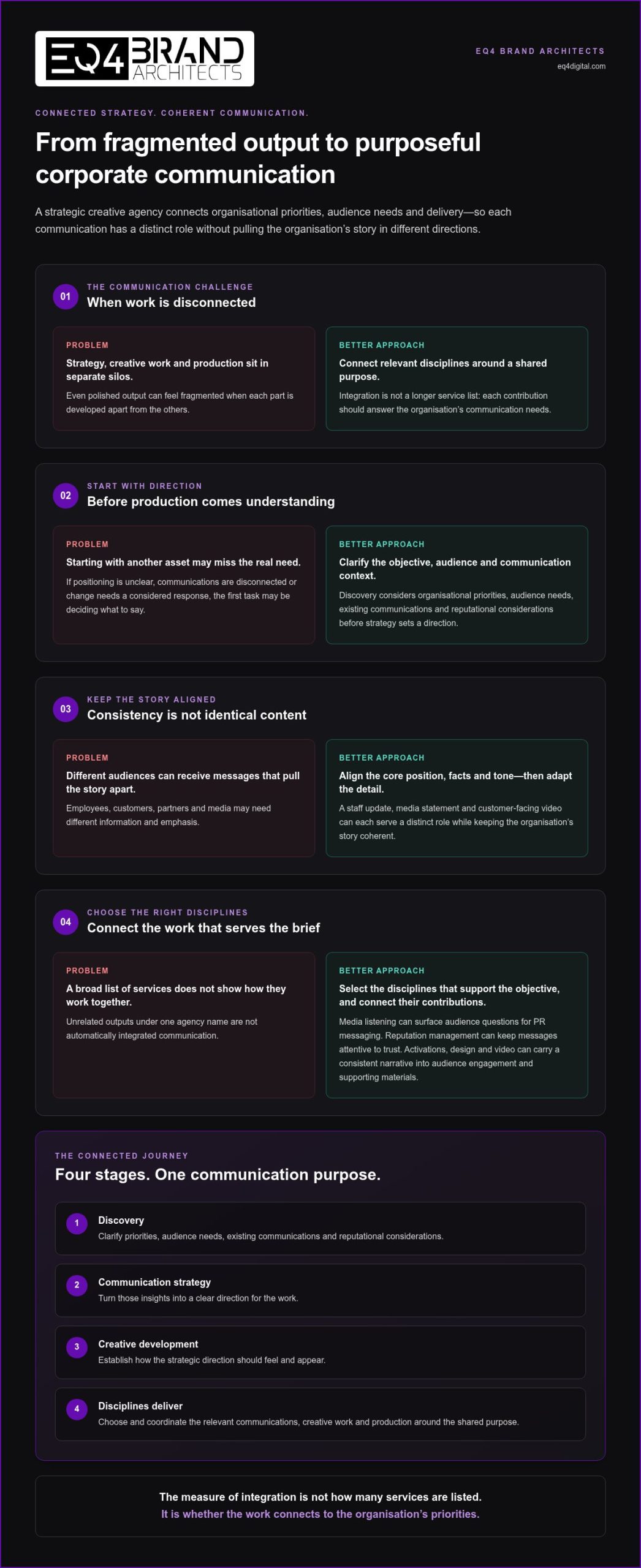
Consistency doesn’t mean sending everyone identical content. It means keeping the core position, facts and tone aligned while adapting the detail, format and emphasis for each audience and channel. A staff update, media statement and customer-facing video can each have a distinct role without pulling the organisation’s story in different directions. Agreeing on key messages and communication priorities gives internal teams and creative partners a shared foundation.
When a creative agency can add strategic value
Strategic support can be valuable when an organisation’s positioning feels unclear, communications have become disconnected, or a significant change calls for a considered response. The first need may not be another asset. It may be deciding what the organisation should say, who needs to hear it and how communication should express its priorities. Strategy sets that direction; production turns it into relevant materials, such as design, video or public relations activity.
Reputation management helps organisations understand and address the perceptions surrounding them, rather than treating each message as an isolated task. Clear strategic direction can connect reputation considerations with PR, audience communication and creative execution. Organisations looking to explore that discipline in more depth can consult this corporate reputation management guide.
For organisations searching for a creative agency for corporate clients South Africa-wide, the distinction between strategic direction and individual deliverables offers a practical first test. The broader context of an advertising agency also helps explain how agencies may take on different functions. Corporate fit depends on how those functions answer the organisation’s specific communication needs.
How a strategic creative agency connects thinking, communication and execution
Connected work starts before production. The organisation’s objective, audiences and communication context shape the strategy. That strategy then guides creative direction, channel choices and delivery. Each discipline has a distinct role, but every part of the work should contribute to a shared purpose. Integration means connecting relevant services around that purpose, not simply placing unrelated services under one agency name.
When strategy and execution are connected, corporate communication becomes more coherent because every activity is shaped by the same organisational priorities, even when each audience receives content suited to its needs.
What integration looks like across corporate disciplines
A practical journey usually begins with discovery: clarifying the organisation’s priorities, audience needs, existing communications and reputational considerations. Communication strategy turns those insights into a direction for the work. Creative development establishes how that direction should feel and appear, before the relevant disciplines shape and deliver the communications.
Integration doesn’t mean using every discipline. It means choosing the right ones and connecting their contributions. For example, media listening can surface audience questions that inform PR messaging, while reputation management can help keep those messages attentive to trust. A brand activation can create direct audience engagement, while design and video production carry a consistent narrative into supporting materials.
Animation, visual effects, sound design and web design each bring different strengths to creative delivery. Their value depends on the communication task: animation may help explain an idea, while sound and visual craft can shape a video’s experience. Ask whether each proposed discipline strengthens the central message, rather than adding deliverables for their own sake.
How strategy shapes creative work and measurement
Start with three questions: What organisational objective does this work serve? Which audience matters most? What should that audience understand, feel or do as a result? The answers define the intended communication outcome and give creative teams a clear basis for choosing the message, tone and format.
Creative direction translates those priorities into content people can engage with. A complex organisational change might call for clear written information for employees alongside a visual explanation for another audience. The formats differ, but the underlying facts and intent remain aligned. This is how a creative agency for corporate clients South Africa can support connected communications without making every message identical.
Measurement should distinguish activity from effect. Evidence that a video was produced, a media statement distributed or an activation delivered confirms what happened; it doesn’t, by itself, show whether the objective was achieved. Define relevant indicators in advance, such as audience understanding or engagement, and interpret them against the purpose of the work. The right measures depend on the objective, so avoid treating output counts as proof of broader impact.
EQ4 brings emotional intelligence and intentional communication together across strategy, communications and media production. Explore EQ4’s strategic creative capabilities as you consider what an integrated approach could contribute to your organisation.
Integrated agency or specialist partner: which model suits your corporate needs?
The choice isn’t simply between more services and fewer. An integrated agency brings several connected disciplines into a coordinated approach; a specialist partner focuses on depth in a particular area. Both can serve corporate needs well. The better fit depends on the brief’s scope, how closely its workstreams need to align, and how much coordination your organisation can manage.
Match the agency structure to the brief: choose connected disciplines when communication needs to work as a whole, and focused expertise when a defined requirement calls for depth.
| Comparison | Integrated agency | Specialist partner |
|---|---|---|
| Strategic breadth | May connect communication strategy with several related disciplines. | Typically concentrates its thinking on a specific discipline or challenge. |
| Creative range | Can bring different creative and production capabilities into one programme. | Offers focused expertise and craft within its chosen area. |
| Coordination | Related workstreams can share direction, with coordination shaped around the engagement. | May work directly with your team or alongside other partners. |
| Engagement structure | May suit a defined project or ongoing collaboration, depending on the work. | Can also support a project or ongoing need, with scope centred on its discipline. |
When an integrated creative agency may be the better fit
Consider an integrated approach when a brief spans communication strategy, PR, creative development and production. An organisation introducing a major change, for instance, may need core messaging, media communications and supporting creative materials to reinforce one another. Shared direction can connect these workstreams and reduce gaps between what each communicates. Fit depends on the objectives and coordination required, not the agency’s size or the number of services it lists.
When specialist expertise may be the better fit
A specialist partner can make sense when the requirement is clearly bounded and depends on depth in one discipline, such as producing a particular animation or developing a focused PR approach. The brief may already have a clear strategy, internal owner and coordination process. In that case, a concentrated contribution can meet the need without widening the scope unnecessarily. Specialist and integrated partners can also complement each other, with a focused expert contributing to a broader programme.
In practice, the models aren’t always exclusive. A corporate team might use an integrated partner to shape a connected communication programme, then involve a specialist for a particular technical or creative requirement. A specialist engagement may also be the right starting point before related needs emerge. Assess a creative agency for corporate clients South Africa-wide against the actual brief: how many disciplines must work together, how much strategic direction is needed, and who will coordinate the work. This keeps the decision grounded in organisational fit rather than assumptions about which model is universally best.
A practical framework for assessing creative agency fit
A useful comparison begins with your organisation, not an agency’s credentials page. Define the communication challenge, the audiences who matter and the outcome you want before weighing strategic thinking, creative capability or working style. This gives your team a consistent basis for assessing a creative agency for corporate clients South Africa-wide, rather than being swayed by a long service list or broad promises.
Build a brief that makes agency comparisons meaningful
Start with the business context and what communication needs to address. Then clarify audience priorities, the desired outcome and the boundaries of the work. A brief doesn’t need to prescribe every creative choice, but it should give prospective partners enough context to make considered recommendations and explain how their approach connects to your objectives.
Use this sequence to shape the brief and assess potential fit:
- 1. Set the objective. Describe the organisational challenge and the change communication should support, such as improving understanding of a new initiative or strengthening stakeholder confidence.
- 2. Name the audiences and outcomes. Identify who needs to understand, feel or do something, and clarify what a useful communication outcome would look like for each group.
- 3. Separate essential disciplines from optional outputs. Decide whether the brief needs strategic direction, PR, reputation management, design, video production or another capability. Distinguish what is necessary to meet the objective from formats that may simply be helpful.
- 4. Map responsibilities. Note the internal stakeholders, who approves decisions, how feedback will be gathered and who coordinates related work. This helps reveal whether the engagement needs a focused contribution or connected support.
- 5. Define the working structure. Indicate whether the need is for a specific project or ongoing collaboration, and set expectations for communication, reporting and decision points.
Assess strategic fit, creative judgement and working style
Look beyond polished claims. A meaningful recommendation should respond to your stated challenge, explain why particular audiences and disciplines matter, and show how the proposed work supports the desired outcome. Relevant examples can reveal clarity, craft and audience awareness. Consider whether the reasoning behind the work is as compelling as its finished form.
Assess the relationship in practical terms too. Will the proposed approach work with your internal approval process? Are feedback responsibilities and reporting expectations clear? A capable creative partner should be able to discuss trade-offs and adapt the work to the brief, rather than rely on a standard list of deliverables. If PR is central to the requirement, the strategic PR agency selection guide offers a more focused lens for that decision.
With objectives, audiences and working expectations clearly set, your team can compare proposals on relevance and thoughtfulness, not volume alone. To explore how strategy and creative disciplines can be brought together for your organisation, discuss your communication needs with EQ4.
How EQ4 brings corporate strategy and creative communication together
For organisations comparing agency models, EQ4 connects strategic communication and creative execution. Its approach combines emotional intelligence with intentional strategy, recognising that corporate communication needs to make sense for the organisation and the people it needs to reach. The focus is to connect clear thinking with creative choices that serve the brief.
A connected offer spanning strategy, reputation and creative delivery
Each capability has a distinct role. Communication strategy sets direction; public relations supports how an organisation communicates with audiences and media; reputation management focuses on the perceptions surrounding the organisation. Media listening and monitoring provide insight into what people are discussing, helping inform communication decisions alongside the organisation’s objectives and context.
Creative disciplines give the strategy an appropriate form. A brand activation creates an opportunity for direct audience engagement, while graphic design, web design and video production can express messages through visual or audiovisual content. Animation, visual effects and sound design bring further creative possibilities when they suit the task. Not every project needs every capability. The right combination depends on the audience, the objective and the communication challenge.
This breadth is useful when related workstreams need a shared direction, but it doesn’t mean every brief should expand into a larger programme. EQ4 brings relevant disciplines together around the communication need, rather than treating a longer list of outputs as the measure of strategic value. For corporate teams seeking a creative agency for corporate clients South Africa-wide, connected work should feel purposeful, not simply extensive.
Start a considered conversation about your organisation’s needs
A useful discussion begins with the context behind the brief. What is your organisation working towards? Which audiences need to be considered, and what communication challenge is shaping the work? Sharing the channels, internal stakeholders and capabilities already in place can also help clarify where a creative partner may contribute.
EQ4 tailors engagements to client requirements through bespoke projects or monthly retainers. The appropriate structure depends on the work and the nature of the ongoing need. A defined project may call for a focused engagement; connected communication priorities may benefit from a continuing relationship. In either case, the starting point is understanding the brief and shaping a relevant approach, not assuming a standard package or promising a particular outcome.
If your organisation is weighing its next communication priority, share the objectives, audience considerations and context behind it with EQ4. A conversation can help bring the need into focus and explore how strategy, reputation, PR or creative delivery might fit together. Discuss your corporate communication needs with EQ4.
Give your next communication priority a clear starting point
Begin the next agency conversation with one useful question: what should be clearer, stronger or more connected for your organisation after this work? Naming that priority gives strategy and creative decisions a shared reference point, while leaving room to shape the right approach as the discussion develops.
For organisations considering a creative agency for corporate clients South Africa-wide, EQ4 brings emotional intelligence to intentional communication strategies, with capabilities spanning strategy, PR, reputation management, creative development and production. The focus is on understanding your context and shaping an engagement around what your organisation needs, whether the work is a defined project or an ongoing relationship.
Bring your objectives, audience considerations and current communication challenge into the conversation. A considered first discussion can help you explore a purposeful way forward, without needing every detail resolved in advance.
Start a conversation with EQ4 about your corporate communication needs. Your next step can be thoughtful, practical and shaped around the work that matters to your organisation.
Frequently Asked Questions
What does a creative agency do for corporate clients?
A creative agency helps corporate teams turn organisational priorities into communication people can understand and engage with. Depending on the brief, this may involve shaping a message, developing visual materials or producing video for an internal initiative. For a creative agency for corporate clients South Africa, the work should account for the organisation’s audiences and context, rather than treating creative output as decoration separate from its purpose.
How is a creative agency different from a marketing agency?
The distinction depends on the agency’s focus, as the terms can overlap. A creative agency often concentrates on communication strategy, creative direction and making the work, while a marketing agency may focus more broadly on planning how an organisation reaches and engages audiences. Some agencies combine these roles. For example, a company may need a clear narrative and film production rather than a plan centred on customer acquisition.
Should a corporate client choose an integrated agency or a specialist?
Choose according to the scope and coordination demands of the work. A specialist may suit a contained requirement, such as producing a particular video asset, especially when the strategy is already established. An integrated partner may be useful if several connected disciplines need shared direction. The models can work together too: an organisation might coordinate a wider communications programme and bring in specialist expertise for a defined element.
What should a corporate creative agency proposal include?
A useful proposal should show that the agency understands the challenge, audiences and intended communication outcome. Look for a clear rationale for the recommended approach and relevant disciplines, along with proposed deliverables, responsibilities, approval points and reporting expectations. It should also clarify the engagement structure and assumptions shaping the scope. These details help internal decision-makers compare proposals on strategic relevance, not just the volume of outputs described.
How can a company measure the impact of creative agency work?
Decide what evidence would indicate progress towards the objective before work begins. For employee communication, this might include whether staff understand a change, assessed through appropriate feedback. For a media initiative, the organisation could review relevant coverage and message accuracy. Track delivery separately, such as whether agreed materials were completed. Output records show activity, while outcome measures help assess whether communication made a meaningful difference.
Can a creative agency support corporate reputation and public relations?
Yes. Reputation management and public relations help an organisation consider how it is perceived and communicate with stakeholders and media. These disciplines may be relevant during organisational change, when responding to emerging concerns, or as part of ongoing communication planning. EQ4 provides reputation management and PR alongside communication strategy and media listening and monitoring, bringing organisational priorities and audience context into communication decisions.
How are creative agency projects and retainers structured?
Projects are shaped around a defined brief, with scope and deliverables tailored to the work. A monthly retainer can suit continuing communication or PR needs that require ongoing support. The right structure depends on the organisation’s priorities, the disciplines involved and how sustained the work needs to be. EQ4 offers bespoke project engagements and monthly retainers, shaped around client requirements rather than a one-size-fits-all package.