





A strong brand idea can lose impact when strategy, visual design and campaign assets are developed in separate lanes. The brief becomes harder to carry consistently across channels, and important decisions may be interpreted differently at each stage. A brand design and production agency South Africa businesses partner with should connect those disciplines, from the first strategic choices through to finished work.
Polished creative is only part of the picture. You also need to understand how an agency will interpret your brief, consider your audiences and stakeholders, and keep a clear direction as the work develops. An integrated approach brings planning and making into closer conversation, while allowing the disciplines most relevant to the project to lead at each stage.
This article explains what an agency can contribute across strategy, design and production, what to expect from a collaborative project process, and how integrated delivery compares with separate suppliers. It also explores how EQ4 brings strategic communications together with creative direction and production, tailoring the approach to the brief rather than assuming every project needs every discipline.
Key Takeaways
- See how strategic direction, design craft and production execution each contribute to a coherent brand experience.
- Follow the steps that move a brief into finished assets, with audience needs and South Africa’s cultural and language diversity in view.
- Compare an integrated agency, a design-only partner and separately commissioned specialists to identify a model suited to your brief.
- Use a practical framework to assess a brand design and production agency South Africa organisations can work with, from how it interprets your brief to how it delivers.
- Discover how EQ4 brings communication strategy and creative capabilities together, tailoring the disciplines to the project.
What does a brand design agency in South Africa do?
A brand design and production agency connects an organisation’s objectives with communications made for real audiences and channels. It helps define what the brand needs to say, how that idea should look and feel, and how to turn it into finished materials. For a brand design and production agency South Africa businesses work with, the scope might include communication strategy, graphic or web design, and production disciplines such as animation, video, visual effects or sound.
These roles are related, but they are not interchangeable. Strategy clarifies the message, audience and direction. Design gives that direction a visual form. Production turns approved creative into usable assets. The brief, audience and intended channels determine which disciplines belong in the work. A focused identity project may need a different mix from a campaign spanning several formats.
Integrated brand production means carrying creative intent consistently across the materials a brand puts into the world.
Where strategy, design and production meet
Communication strategy establishes the purpose of the work: who it needs to reach, what the audience should understand and what the organisation needs to express. These decisions give creative development a useful frame, so visual choices support the message rather than compete with it.
Graphic, web and motion assets can then express the same central idea in different ways. A web page may need clear structure and useful navigation, while an animated piece or video relies on movement, sound and pacing. The formats differ, but shared creative direction helps the work feel connected. A branding agency can play a role in creating and launching a brand; integrated production extends that thinking into communications that bring its intent to life.
Once the creative direction is approved, production turns it into campaign materials suited to their intended use. Each asset should be considered as part of the broader communication, not as an isolated deliverable. The foundations of identity matter here too, including the choices explored in this branding and design guide.
When does a business need an integrated agency?
An integrated approach can help when a brief spans formats, audiences or communication touchpoints. For instance, an organisation may need one message expressed through a web experience, graphic assets and a motion-led campaign. Each element has its own practical demands, but all need to reflect the same underlying direction.
Continuity is especially valuable when strategic decisions need to guide execution throughout a project. Shared creative direction gives collaborators a common reference for audience context, tone and visual choices as work moves between formats. It also helps teams discuss revisions and resolve differences between the brief and the developing assets.
Not every project needs every discipline. The aim is to bring together the capabilities the brief calls for, with enough connection between planning and making to keep the original intent clear in the final work.
How does a brand idea move from brief to production?
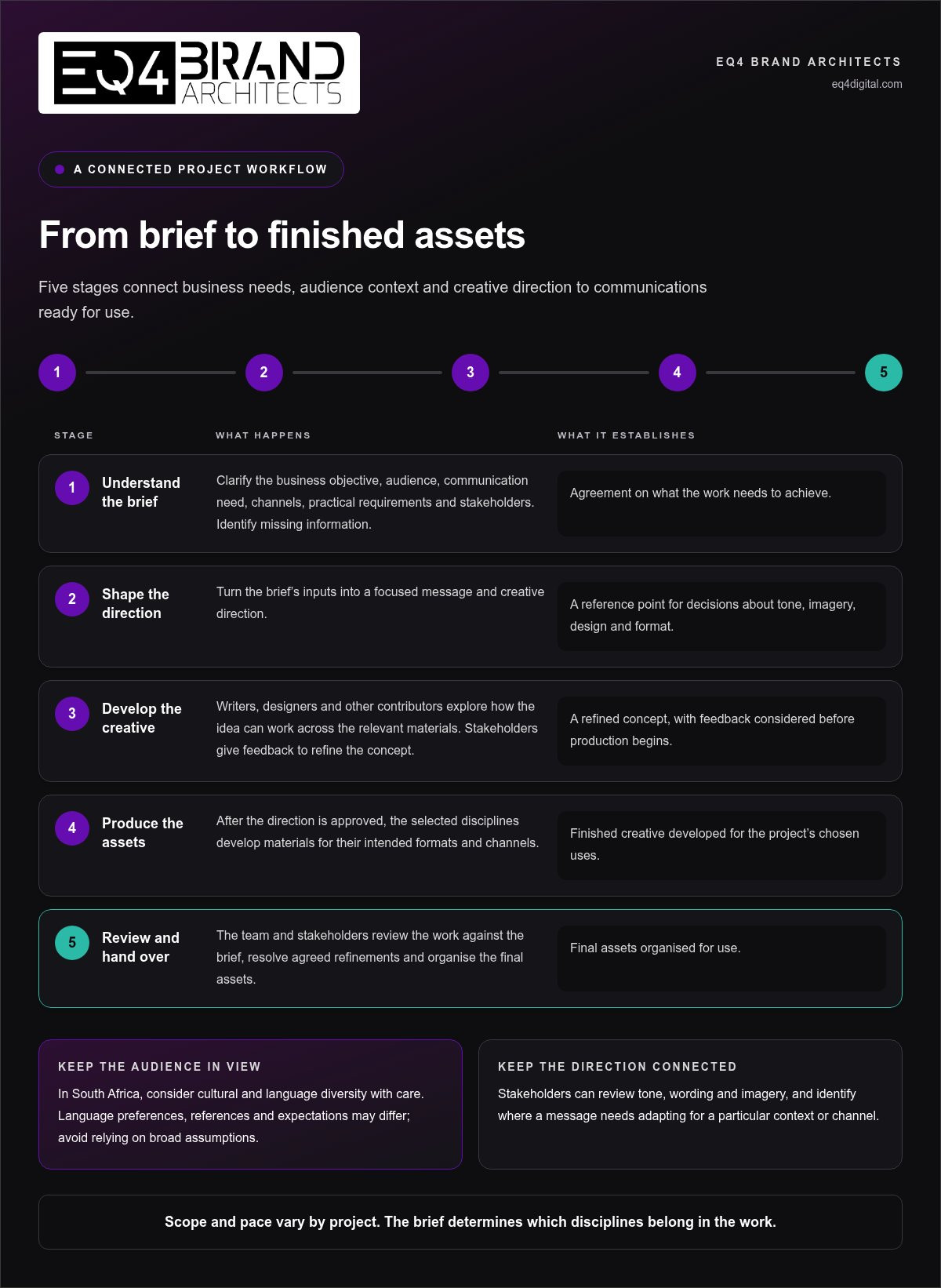
A considered workflow gives the creative team a clear route from the organisation’s needs to finished communications. It also gives stakeholders meaningful opportunities to contribute, so feedback can strengthen the work without pulling it away from its purpose. The scope and pace vary by project, but the stages often follow this sequence:
- Understand the brief. Clarify the business objective, audience, communication need, channels, practical requirements and stakeholders involved. At this stage, identify missing information and agree what the work needs to achieve.
- Shape the direction. Turn those inputs into a focused message and creative direction. This gives the team a reference point for decisions about tone, imagery, design and format.
- Develop the creative. Writers, designers and other contributors explore how the idea can work across the relevant materials. Stakeholder feedback helps refine the concept before production begins.
- Produce the assets. Once the direction is approved, the selected disciplines develop materials for their intended formats and channels.
- Review and hand over. The team and stakeholders review the work against the brief, resolve agreed refinements and organise the final assets for use.
From audience insight to creative direction
A useful brief connects business objectives with audience context and communication needs. Who needs to understand the message? What should they take away? Where will they encounter it? Clear answers help the team develop a central idea that writers, designers and production specialists can interpret consistently, without turning the project into a full brand identity exercise.
In South Africa, relevance also means considering cultural and language diversity with care. Audiences may have different language preferences, references and expectations. The creative direction should reflect the people it is intended to reach rather than rely on broad assumptions. Stakeholders can review tone, wording and imagery, and identify where a message needs adapting for a particular context or channel.
From approved design to usable assets
Production choices should follow the needs of the work. Graphic design may shape campaign materials; web design may organise information for an online experience; animation, VFX, sound design and video production may support a moving or audio-led piece. Not every brief calls for every discipline. Format, channel and audience all influence what needs to be made and how it should function.
Production decisions should stay connected to the approved creative direction, so each finished asset carries the intent of the original idea. Feedback and approvals are collaborative stages, not fixed timings. Stakeholders contribute at agreed review points, while the creative team explains how decisions relate to the brief. At handover, clear organisation helps the people using the assets understand which materials are intended for which channels.
If you’re considering how strategy and execution can work together for your brief, you can explore EQ4’s approach to creative and strategic communications.
Integrated agency or separate specialists: which model fits the brief?
The right delivery model depends on how closely connected the work needs to be. A discrete design task may call for a focused partner, while a brief linking strategy, design and several production formats may benefit from shared creative direction. Compare the models against the needs of the project rather than assuming broader scope is always better.
| Consideration | Integrated agency | Design-only partner | Separate specialists |
|---|---|---|---|
| Strategic continuity | Strategy and execution can be considered together. | Focuses on design within the direction provided. | Depends on how clearly the brief and direction are shared. |
| Coordination | Disciplines are aligned within a connected approach. | Coordination may be needed for work beyond design. | The organisation coordinates handovers across contributors. |
| Creative ownership | Direction can connect multiple outputs. | Centres on design choices and deliverables. | May be distributed across specialists. |
| Suitable scope | Connected, multi-format briefs. | A defined design deliverable. | Distinct specialist requirements commissioned separately. |
The distinction is practical, not absolute. An integrated approach can still be carefully scoped, and separate specialists can work from a common direction when responsibilities and handovers are clear. The key question is how much continuity the brief needs, from its first strategic decisions to its final materials.
When integrated delivery supports consistency
Integrated delivery can suit a project where one creative direction needs to carry across, for example, a website, campaign graphics and a video. Coordinated disciplines can work from the same audience understanding and message, reducing the risk of gaps between strategy and execution. EQ4 brings communication strategy together with PR, graphic and web design, animation, visual effects, sound design and video production, drawing on the capabilities that fit the brief. This can suit organisations seeking a brand design and production agency South Africa businesses can work with across connected communications.
When a focused scope is the better fit
If the need is a single, clearly defined design deliverable, a narrower engagement may be more appropriate than a broad production mix. EQ4 tailors project scope to the organisation’s needs rather than treating every discipline as essential. Where the question is how identity applications stay visually coherent, visual branding systems offer a useful lens for considering consistency across materials.
Before settling on a model, map the deliverables, the channels they must serve, who will guide creative decisions and how collaborators will share feedback. If several formats need to feel like expressions of one idea, continuity may be central to the brief. If the scope is contained, a focused approach may matter more. A clear view of these needs helps shape an engagement proportionate to the work.
How to assess a brand design and production agency for your organisation
Agency fit is about more than an impressive portfolio or a long list of capabilities. You’re assessing whether a team can understand the organisation’s needs, make considered creative decisions and carry them through to useful deliverables. The right agency fit depends on the brief, the audience and the delivery required.
Use these five areas to assess a brand design and production agency South Africa organisations are considering:
- Understanding: Does the team listen closely, clarify the communication challenge and reflect your audience and organisational context accurately?
- Strategic clarity: Can it explain the message and creative direction it recommends, and how those choices serve the brief?
- Craft: Does the work show care in its visual, written or production details, as well as a clear connection to its purpose?
- Collaboration: Are stakeholder input, feedback and approvals built into the process, with clear points for discussion?
- Delivery: Are the proposed deliverables and relevant disciplines connected to the channels and intended use of the work?
A wide capability range need not mean an unfocused approach. What matters is whether each discipline has a clear role in the brief. A team might explain why a project calls for graphic design and video production, or why a narrower design scope better suits a contained need. Look for the reasoning behind the recommendation, not simply the number of services named.
Assess strategic and creative alignment
EQ4 begins by understanding business needs before shaping communication and creative direction. To assess alignment, consider whether the agency can connect its concept to the audience, the message and the context in which the work will appear. For a South African audience, cultural and language context can influence how wording, imagery and tone are received. Strong creative choices have a rationale, not just visual appeal.
Ask how the proposed direction responds to the brief and how the team will keep that intent visible as the work develops. A clear explanation helps stakeholders discuss the idea constructively, rather than relying on personal preference alone.
Assess production readiness and collaboration
Production readiness starts with shared expectations: what the work must achieve, which deliverables are in scope, who provides feedback and where approvals sit. EQ4 can bring relevant design, PR, brand activation and production disciplines into a tailored project scope. Where reputation or media relations shape the communication challenge, the strategic PR agency guide adds useful context to that assessment.
Consider whether the agency can explain how its proposed deliverables relate to the brief and how collaboration will work at review points. A clear scope supports focused conversations and gives stakeholders a shared basis for considering changes. It also helps distinguish essential expertise from capabilities that are not needed for this particular project.
If your organisation is shaping a connected creative brief, explore how EQ4 can bring strategy and execution together.
How EQ4 brings brand design and production together
EQ4 Brand Architects is a strategic communications and creative agency serving businesses nationally across South Africa. Its work brings communication strategy and creative execution into the same conversation, helping organisations consider what they need to communicate alongside how that intent can be expressed and produced.
For a brand design and production agency South Africa organisations are considering, breadth matters when it serves a clear purpose. EQ4’s capabilities include communication strategy, public relations (PR), reputation management, brand activations, graphic and web design, animation, visual effects (VFX), sound design and video production. The brief determines which disciplines come together. A web-led project, for example, may need a different combination from a communication initiative shaped by reputation or public engagement needs.
A connected set of capabilities, shaped around the brief
Strategic communications can clarify the audience, message and context before creative work takes shape. From there, design and production capabilities can be brought into scope according to the materials the organisation needs. Graphic design may support visual communications, while animation, VFX, sound and video can contribute to work intended for moving-image or audio formats.
Some briefs also call for PR, reputation management or a brand activation alongside creative production. These disciplines can contribute a broader communications perspective when the audience relationship, public conversation or live engagement is central. They are not automatic additions. EQ4 tailors the approach so each selected capability has a role in the work, rather than treating a broad range of services as a fixed package.
This joined-up perspective can help keep strategic intent in view as creative choices develop and materials are produced. It also creates space to discuss how different outputs relate to one another, while allowing each format to meet its own communication needs. The aim is a considered fit between the challenge, the audience and the work, not a predetermined set of deliverables or promised business outcomes.
Start a conversation about your project
A useful first conversation can begin with three things: the communication challenge you’re addressing, the audience you need to reach and the deliverables you have in mind. It also helps to share relevant context, such as the channels involved, existing materials and stakeholders who will contribute to decisions. These details give the discussion a practical starting point.
EQ4 works through bespoke project contracts or monthly retainer agreements. The appropriate structure depends on the scope of the work and whether the organisation needs support for a defined project or ongoing communications needs. From there, the next steps can be shaped around the brief, including which capabilities are relevant, what the work needs to produce and how collaboration will be organised.
If you’re exploring a brand or communications project, start by sharing the challenge, audience and intended deliverables. This gives EQ4 a clear basis for discussing a suitable scope and direction.
Give your next brand brief a clear direction
Your next step does not need to be a fully formed campaign plan. Start with the question your organisation needs to answer, the people you need to reach and what you want them to understand or feel. That gives a creative partnership a meaningful place to begin, with room to shape the right scope as the work becomes clearer.
For organisations considering a brand design and production agency South Africa, the value lies in keeping creative choices connected to communication intent. EQ4 brings strategic communications into conversation with design and production, with engagements shaped as bespoke projects or monthly retainers according to the work and ongoing needs.
Bring your audience, challenge and early ideas into the discussion. Start a conversation about your brand brief and explore a considered next step with EQ4. A clear direction gives purposeful creative work a stronger starting point.
Frequently Asked Questions
What does a brand design and production agency do?
A brand design and production agency helps an organisation turn its communication needs into creative work ready for its intended use. For example, a launch might call for a visual concept, a web page and supporting video, each serving a different audience interaction. The agency helps those outputs relate to the same purpose. This goes beyond creating a logo or making an individual asset in isolation.
How is a brand design agency different from a production agency?
A brand design agency usually develops visual concepts and design materials, while a production agency focuses on making approved creative in formats such as video or animation. In practice, responsibilities can overlap. A useful distinction is where the project needs creative input: when shaping the idea, when making it, or across both. Clarifying this helps set expectations for feedback and creative decision-making.
Can one agency manage both brand design and video production?
Yes. EQ4’s capabilities include graphic and web design, animation, visual effects, sound design and video production, alongside strategic communications. For a video brief, useful starting details include the intended audience, key message, where the video will appear and any related visual materials. Sharing these details can help the creative and production work respond to the same communication purpose, without assuming every project needs every available discipline.
How do you brief a brand design and production agency?
Start with the outcome you need, the audience you want to reach and the communication challenge behind the project. Then note the channels, likely deliverables, key stakeholders and who will approve decisions. Existing brand materials or background information can provide useful context too. You do not need to supply a finished concept; a clear account of the need gives the agency a basis for developing a suitable creative direction.
How much does a brand design and production agency cost in South Africa?
There is no single fee that suits every brief, because the proposed scope depends on the creative and production work required. A defined project and ongoing communications support involve different considerations. EQ4 works through bespoke project contracts or monthly retainer agreements, shaped around the work. To establish an appropriate scope, describe the intended deliverables, channels and communication needs rather than starting from an assumed package.
Why does an integrated brand design and production process matter?
An integrated process gives teams a shared reference for decisions as creative work moves between formats. For example, if a campaign message changes during development, connected strategic and creative oversight can help assess what that means for its graphics, web content or video. Integration does not require a large project. Its value is in keeping work coherent when several outputs need to relate to one another.
Does an agency need to understand South African audiences?
Yes, audience context can shape how people interpret language, imagery and tone. A brief intended for different communities across South Africa should identify the audiences that matter, their relevant language preferences and the channels through which they will encounter the work. This gives the creative team a clearer basis for discussion and review. It can also help stakeholders spot assumptions that may not suit the audience the communication is meant to reach.