





A polished origin story can still ring hollow if a brand’s everyday actions tell a different story. For a brand storytelling agency South Africa, the challenge in 2026 is not simply to find a compelling line. It’s to help organisations build narratives that feel credible, culturally aware and consistent wherever people encounter them.
If your messaging feels generic or disconnected across channels, you may be looking for a clearer thread between what your brand says and what it does. Audiences encounter AI-assisted content, short-form video and stories shared by creators and communities. In that environment, polish matters less than coherence, relevance and proof.
This article explores the forces reshaping brand storytelling in South Africa and what makes a narrative easier to trust and remember. We’ll look at how human judgement and cultural understanding can guide the use of AI, why organisational behaviour needs to support the story, and how to align narrative planning with channels and communications goals. Use it as a practical starting point for making your brand’s voice more considered, connected and distinctly its own.
Key Takeaways
- Distinguish a strategic brand narrative from a one-off campaign, brand biography or stream of content.
- Use a clear point of view and observable actions to help audiences judge whether your brand’s story feels credible and distinctive.
- Treat 2026 storytelling trends as prompts for research, not rules to apply without considering your audiences and objectives.
- Clarify your communications objective, research your audiences and shape the narrative before choosing channels and measures.
- When assessing a brand storytelling agency South Africa, ask how it approaches research, strategy, creative development and evaluation.
What does a South African brand storytelling agency do?
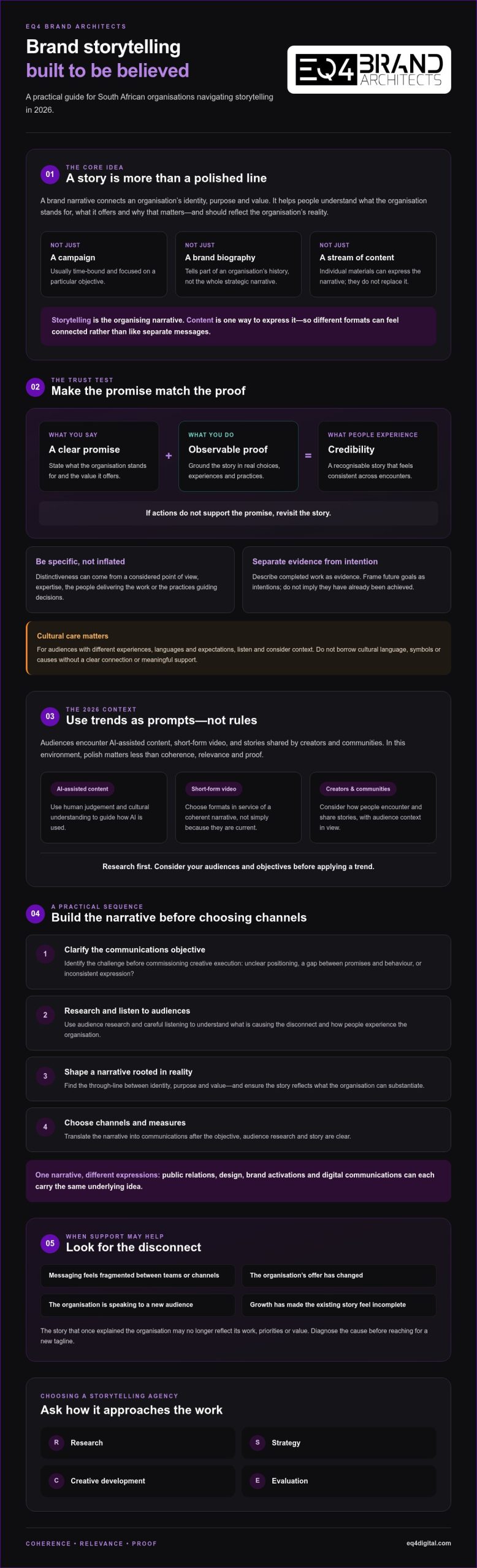
Brand storytelling is the coherent expression of an organisation’s identity, purpose and value. It helps people understand what the organisation stands for, what it offers and why that matters to them. The narrative should reflect the organisation’s reality and account for how its audiences understand, experience and respond to it.
A brand storytelling agency South Africa should help an organisation find and articulate that through-line, then translate it into communications. The work goes beyond writing a slogan or polishing an origin story. It connects strategic choices to creative execution, so audiences can recognise the same underlying idea across public relations, design, brand activations and digital communications.
A campaign is usually time-bound and focused on a particular objective. A brand biography tells part of an organisation’s history, while content production creates specific materials. All can express a larger narrative, but none replaces the strategic work of deciding what the organisation wants to mean to people. For the story to feel credible, its claims also need to match observable behaviour, not just attractive language.
How is brand storytelling different from content marketing?
Think of storytelling as the organising narrative and content as one way to express it. Content marketing provides a broader context for creating and sharing useful material. A brand narrative can help make those materials feel connected rather than like separate messages.
Hypothetical example: A South African organisation focused on making everyday services easier to access might express that idea in a public relations announcement, clear visual design for an activation and helpful information on its website. The formats differ, but the narrative gives each a shared purpose.
When might an organisation need storytelling support?
Look for signs such as fragmented messaging between teams or channels, a changed offer, or an organisation speaking to a new audience. Growth can also make an existing story feel incomplete: what once explained the organisation well may no longer reflect its work, priorities or value.
Before commissioning creative execution, identify the communications challenge. Is the issue unclear positioning, a gap between promises and behaviour, or inconsistent expression? Audience research and careful listening can help distinguish the cause. From there, a brand storytelling agency can help shape a narrative and connect it to communication strategy, PR and considered creative work, rather than reaching for a new tagline too soon.
What makes a brand story credible, distinctive and memorable?
A strong narrative doesn’t depend on grand claims. It gives audiences a clear reason to believe what an organisation says and a recognisable perspective they can connect with. For South African organisations speaking to people with different experiences, languages and expectations, that takes more than choosing inclusive words. It calls for listening, context and care in how the story is expressed.
A credible brand story connects a clear promise to observable proof, then communicates both consistently. Use this as a practical test: if the organisation’s actions don’t support its promise, the story needs revisiting. Consistency doesn’t mean repeating identical wording everywhere. It means that public statements, everyday interactions and creative choices feel like expressions of the same underlying commitment.
How do you make a brand story feel authentic?
Begin with what the organisation can substantiate: the choices it makes, the experiences it can describe accurately and the commitments it is prepared to honour. Don’t borrow cultural language, symbols or causes simply because they feel current. If the organisation can’t explain its connection to them or demonstrate meaningful support, that reference may weaken trust rather than build it.
Separate what’s already true from what the organisation hopes to do. Describe completed work as evidence; frame future goals as intentions, using clear language that doesn’t imply they’ve already been achieved. A brand storytelling agency South Africa can help teams examine these distinctions before shaping the narrative, so creative expression doesn’t outrun the facts.
How can a brand stand out without exaggerating?
Look for distinction in real specifics: a considered point of view, the expertise behind the work, the people who deliver it or the practices that guide decisions. “We care about people” is hard to remember on its own. A precise account of what the organisation does differently, and why, gives audiences something tangible to understand and assess.
Then test the story with people who represent the audiences it’s meant to reach. Ask what they think the organisation does, what they remember and which parts feel unclear or unconvincing. Their responses can reveal where familiar marketing phrases have obscured the meaning. A communications strategy can keep the narrative purposeful, while PR, design and production give it considered expression across different touchpoints. Organisations looking to connect those elements can explore communications strategy and creative execution as part of a wider storytelling approach.
Which brand storytelling trends are shaping South African communications in 2026?
Trends can help teams ask better questions, but they aren’t universal instructions. In South Africa, shifts in technology and media use are changing where people encounter brand messages. How those messages earn trust still depends on the organisation and its audiences.
The South African Social Media Landscape Report 2026 reports that 73% of South African organisations use AI in marketing and 72% use ChatGPT for content creation. Those figures indicate that AI-assisted content is part of the communications mix, not that every audience wants more automated messaging. The strategic question is where AI can support efficiency without flattening the human judgement, lived context and distinctive point of view a narrative needs.
Meanwhile, DataReportal’s 2026 figures indicate that 98.4% of internet users in South Africa access the web via a mobile device. A story may need to work across mobile-first digital experiences, public relations, design and activations, with each expression suited to its context. Consistency doesn’t mean posting the same copy everywhere. It means adapting the expression without losing the central idea.
A genuine narrative shift changes what a brand consistently says and does; a short-lived content format only changes how one message is delivered. Short-form video, for example, may be useful, but it isn’t a strategy by itself. Look for lasting changes in audience expectations, organisational behaviour or communications practice before rebuilding a narrative around a momentary format.
Why are proof and organisational behaviour central to brand stories?
People may compare public claims with what they experience in service interactions, see from leadership or hear about workplace behaviour. That doesn’t mean every audience responds in the same way, or that one incident defines an organisation. It does mean broad promises can be harder to trust without clear evidence behind them.
Use specific, verifiable examples to show how a stated value informs decisions or actions. Media listening and audience research can help identify which claims invite questions, what people recognise and where a mismatch may exist. A brand storytelling agency South Africa should treat those findings as signals to investigate, not assume they represent everyone.
How can brands reflect South Africa’s varied audiences respectfully?
South African audiences aren’t a single, uniform group. Language, lived experience and cultural context can shape how people interpret a phrase, image or reference. Research the audiences a communication is intended to reach, involve relevant voices in its development and review creative choices before publication. That care helps teams create work that feels considered rather than borrowed, while preserving a coherent narrative across channels.
How can teams turn brand storytelling trends into a practical approach?
Use trends as prompts for investigation, then build a process around your organisation’s communications objective. A useful sequence is to clarify the objective, research audiences, define the narrative and activate it across relevant channels. This keeps creative decisions connected to a clear purpose instead of chasing a format simply because it’s popular.
Start by deciding what the communication needs to achieve. Is the priority to build awareness, improve understanding, support reputation or encourage engagement? Research can then explore what intended audiences already know, what they need to understand and which language or channels feel relevant. These findings give the narrative a foundation and help teams decide which creative expressions are appropriate.
How should a team develop its brand narrative?
Bring together the organisation’s purpose, audience needs, distinguishing perspective and available evidence. Shape these into a central narrative that explains what the organisation stands for and why it matters. Adapt the emphasis and format for each audience and channel while keeping the central idea recognisable. Agree who reviews, approves and maintains the narrative, so it can evolve as the organisation changes without losing coherence.
Activation might connect public relations, design, brand activations and digital communications. For more context on how these efforts fit within wider organisational messaging, see this corporate communications agency guide.
How can a team assess whether storytelling is working?
Choose measures before launch and match them to the objective. Outputs describe what the team produced or delivered; outcomes indicate what changed for audiences. A communications plan might track whether key messages appeared in agreed materials, then assess whether audience understanding or perceptions shifted. The right indicators depend on the goal, so don’t treat reach or attention as proof of trust.
Combine suitable quantitative indicators with feedback, research and qualitative listening. Media listening and monitoring can help teams notice recurring questions, reactions and changes in conversation, but those signals need interpretation. A burst of attention doesn’t necessarily mean people understood or believed the story. Nor should teams claim direct commercial results without evidence connecting the communications activity to those results.
A brand storytelling agency South Africa can help connect narrative planning with communications strategy and creative execution, while keeping objectives and evaluation in view. If your team is ready to align its story with its communications, explore EQ4’s communications and creative services.
When should you work with a brand storytelling agency in South Africa?
Outside support can be useful when internal teams understand the organisation but struggle to agree on how to express it. Fragmented messages, a changing offer, a new audience or limited capacity to coordinate strategy and creative execution can all be signals. An external perspective may help surface assumptions and bring communications, leadership and creative teams around a clearer narrative.
The right time isn’t necessarily when you need a campaign. It may be earlier, while the challenge itself is still unclear. A brand storytelling agency South Africa should seek to understand the communications need before recommending creative work, and explain how the narrative could support wider public relations and reputation priorities. For related guidance, see this strategic PR agency selection guide and corporate reputation management guide.
What should you ask a prospective storytelling agency?
Ask how the agency will learn about your organisation, audiences and communications context, and how that understanding will inform the narrative. Explore how strategy connects to PR, design, production and channel choices. Clarify how evidence is checked, who reviews and approves the work, how feedback is incorporated, and which measures will indicate progress towards your stated objective. The answers should make the process clear, not just the creative concept.
What can an integrated communications partner contribute?
An integrated partner can connect narrative planning with public relations and reputation needs, then use creative and production capabilities to express the agreed strategy. EQ4 Brand Architects is a strategic communications and creative agency serving organisations across South Africa. Its capabilities include communication strategy, PR, reputation management, graphic design, video production, animation, VFX, web design and media listening and monitoring. These disciplines can support a joined-up approach, guided by emotional intelligence and intentional strategy.
Consider whether your challenge calls for strategic clarity, a particular creative capability or coordination across both. If you’re weighing up how to bring those elements together, you can discuss your communications challenge with EQ4 and explore whether collaboration makes sense for your organisation.
Build a story your audiences can believe in
In 2026, strong brand storytelling is less about a polished statement and more about a clear narrative supported by credible actions. It starts with understanding your audiences, defining what your organisation can genuinely stand behind and adapting that story across channels without losing its meaning.
Choosing a brand storytelling agency South Africa organisations can work with means looking beyond creative polish. Consider whether the partner can connect narrative planning with communications objectives and thoughtful execution. EQ4 Brand Architects brings strategic communications together with creative and production capabilities, guided by an approach that combines emotional intelligence with intentional strategy.
Your next step doesn’t need to be a finished brief. Start with the communications challenge you’re trying to solve, whether that’s fragmented messaging, a changing offer or a story that no longer reflects the organisation. Start a conversation about your brand narrative and explore what a more coherent approach could look like. With clarity, evidence and care, your organisation can shape a story that feels relevant and earns trust over time.
Frequently Asked Questions
What does a brand storytelling agency do?
A brand storytelling agency helps an organisation clarify its narrative and express it through relevant communications. Depending on the agency and agreed scope, this may involve audience research, strategy, creative direction and campaign development. Look for a partner that connects creative ideas to audience needs, organisational evidence and clear communications objectives. Storytelling should guide more than a slogan or isolated piece of content: it should help shape how the organisation communicates across relevant channels.
Why is brand storytelling important for a business?
Brand storytelling can help people understand what an organisation stands for, what it offers and why it matters. A coherent narrative also gives teams a shared reference point for communicating across channels, even when the format or audience changes. Storytelling alone doesn’t guarantee trust or sales. Its value depends on whether the story is relevant, supported by evidence and reflected in the organisation’s behaviour and the experiences it creates.
How do you choose a brand storytelling agency in South Africa?
Start by clarifying your communications challenge, intended audiences and desired outcomes. Then assess how a brand storytelling agency South Africa will research your organisation, develop its narrative and connect strategy to creative work. Ask how the team considers cultural context, handles evidence and feedback, and measures progress. Review examples for the thinking behind the work, not just its visual finish, and distinguish demonstrated capabilities from general promises or directory rankings.
What is the difference between brand storytelling and content marketing?
Brand storytelling is the narrative framework that gives an organisation’s communications direction and meaning. Content marketing is one way an organisation may share useful material with audiences. An article, video or social post can express the brand story, but producing content doesn’t by itself create a distinctive narrative. The story provides the through-line; each content format is an opportunity to communicate part of it in a way that suits its audience and context.
How can you measure brand storytelling?
Choose measures that reflect the objective, such as audience understanding, message recall, relevant engagement or reputation indicators. Set a baseline where possible, then review suitable analytics alongside audience feedback, research and media listening. For example, engagement may help assess interaction, while research can explore what people understood or remembered. No single metric proves that storytelling caused a business outcome, so be careful about attributing sales or other results without supporting evidence.
What makes a brand story authentic?
An authentic brand story reflects what an organisation can substantiate through its decisions, experience and behaviour. Use specific evidence, recognise the needs and context of the intended audience, and avoid claims that exceed what the organisation can deliver. If describing a future commitment, present it as an intention rather than an accomplished result. Authenticity isn’t simply a tone or visual style; people may compare the story with their own experience of the organisation.
Can a brand storytelling agency help with reputation management?
A brand storytelling agency may help align an organisation’s narrative with communications and reputation priorities, depending on its capabilities and the agreed scope. Storytelling alone can’t resolve a reputation issue or replace appropriate action. First understand the underlying concern, verify the facts and decide what organisational changes or communications are needed. EQ4 Brand Architects offers reputation management, public relations and communication strategy, alongside creative and production capabilities that can support communications execution.