





What if a polished logo is the least distinctive part of your brand? If you’re searching for “how to build brand identity South Africa”, the real starting point isn’t colour or typography. It’s understanding what your organisation stands for, who it needs to reach and what matters to those audiences. A coherent identity grows from that strategic foundation, not from visual choices made in isolation.
A brand can look refined yet still feel generic, or lose its character as different teams adapt messages for different channels. In South Africa, relevance also means paying attention to the varied cultural and audience contexts in which your brand appears. Consistency matters, but it shouldn’t come at the cost of connection.
This guide sets out a practical process, from clarifying purpose and audience insight to shaping visual and verbal expression and rolling it out across communications. You’ll see how strategy and design work together, and how to build a recognisable system that stays coherent while responding thoughtfully to real people and contexts.
Key Takeaways
- Learn how to build brand identity South Africa audiences connect with by grounding creative decisions in purpose, audience insight and clear positioning.
- Follow a practical process from organisational clarity to creative direction, so your identity reflects business objectives and audience needs.
- Understand how to create a distinctive visual, verbal and experiential identity that stays recognisable without becoming rigid.
- Plan a thoughtful rollout across priority touchpoints, using guidelines to help teams communicate consistently while adapting to context.
- See how strategy, graphic design, web design and production can work together to express a considered brand direction.
What does brand identity mean for a business in South Africa?
Many organisations begin a branding project with a logo. It’s a visible, tangible asset, but it can’t provide the broader foundation on its own. A logo won’t clarify what the organisation stands for, how it speaks to people or what experience it intends to create. Those choices need to work together, so audiences encounter a recognisable brand rather than a set of unrelated design decisions.
Brand identity is the deliberate system through which an organisation expresses its strategy and character. Put simply: brand identity is the connected expression of strategy, language and design. It can include visual elements, messages, tone of voice and the way an organisation behaves across its interactions. For a broader overview of its components and role in business, see What is Brand Identity?
It also helps to distinguish identity from two related ideas:
- Brand identity: the cues and choices an organisation creates to express who it is.
- Brand image: the impressions people form when they encounter those cues.
- Reputation: the broader judgement that develops through what people experience and hear about the organisation over time.
These ideas influence one another, but they aren’t interchangeable. An organisation can shape its identity, but it can’t dictate every audience response. That distinction matters when considering how to build brand identity South Africa organisations can sustain: make intentional choices, then pay attention to how people understand them.
Brand identity is more than a logo
A logo is one identifying asset within a larger system. Colour, typography, imagery, messaging, tone and behaviour all contribute to recognition. For example, a consistent visual style paired with clear, helpful language can make a service feel familiar across a website, a presentation and a customer interaction. People experience a brand through these moments, not just through a logo file.
Coherence doesn’t mean repeating the same design everywhere. It means making choices that feel as though they belong to the same organisation. When visual cues, language and conduct reinforce one another, audiences have clearer signals about what the brand represents and what they can expect from it.
Why South African audience context matters
A national audience isn’t one group with a single set of references. Communities differ in language, communication preferences, lived experience and the contexts in which they encounter an organisation. Research should help identify which groups matter to your organisation, what they need from it and how they prefer to receive information.
English, isiZulu, isiXhosa or Afrikaans may be relevant choices for particular audiences and touchpoints. But translating a message alone doesn’t demonstrate cultural understanding or guarantee connection. Consider the meaning of the words, the imagery, the setting and the assumptions behind the message. Audience feedback can show whether an identity feels clear and appropriate, or whether it needs a more considered expression. This context gives strategy and creative work a stronger starting point.
How to build brand identity: start with purpose, audience and positioning
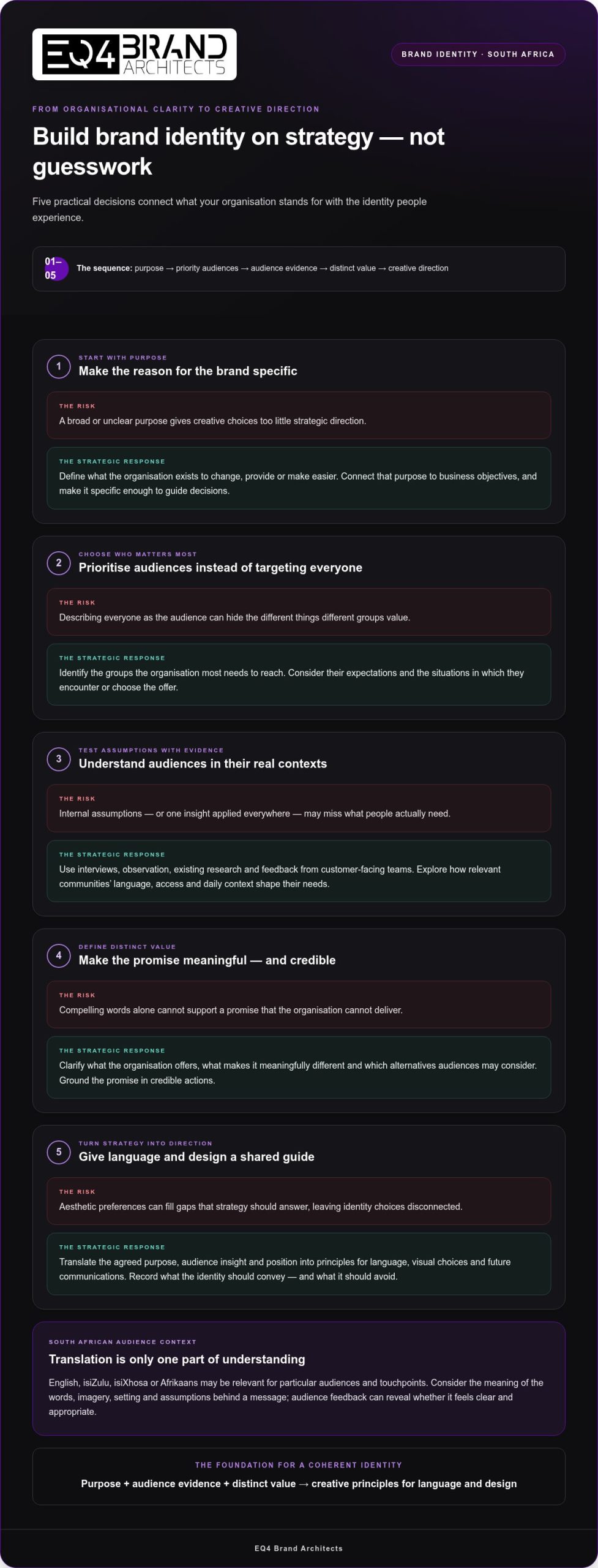
Once you know what an identity needs to express, establish the thinking behind it. A useful approach to how to build brand identity South Africa organisations can apply is to move from organisational clarity to audience evidence, then to positioning and creative direction. This sequence helps prevent aesthetic preferences from filling gaps that strategy should answer.
Begin with a working brief. Record what the organisation wants to change, what it offers, who it serves and what it can credibly promise. The answers should reflect its ambitions and its actual capacity to deliver. EQ4’s branding and design guide offers broader context for connecting these strategic questions with identity work.
- Clarify the purpose. Ask what the organisation exists to change, provide or make easier. Connect that purpose to business objectives, such as earning trust, explaining a complex offer or supporting growth. Keep the answer specific enough to guide decisions.
- Choose priority audiences. Identify the groups the organisation most needs to reach, their expectations and the situations in which they encounter or choose the offer. Avoid describing everyone as the audience. Different groups may value different things.
- Gather audience evidence. Use interviews, observation, existing research and feedback from customer-facing teams to test internal assumptions. In South Africa, consider which communities are relevant to the organisation and how language, access or daily context may shape their needs. Don’t assume one audience insight applies everywhere.
- Define the distinct value. Consider what the organisation offers, what makes it meaningfully different and which alternatives audiences may consider. A distinct promise should matter to people and be supported by credible actions, not just compelling words.
- Translate the strategy into creative direction. Turn the agreed purpose, audience insight and position into principles that can guide language, visual choices and future communications. Record what the identity should convey, as well as what it should avoid.
Clarify purpose and understand priority audiences
Purpose becomes useful when it helps make choices. If an organisation aims to make a complicated service easier to access, for instance, its audience research could explore where people become confused and what information they need first. Separate findings from interpretation: note what people said or did, then distinguish that evidence from the team’s assumptions. The South African Government Branding Guidelines can also serve as a public-sector reference for developing a documented identity approach.
Define positioning before choosing an aesthetic
Summarise positioning through four prompts: who the organisation serves, the category it operates in, the distinct value it offers and the reasons audiences can believe its promise. Compare that intended position with audience expectations and relevant alternatives. Positioning gives identity design a strategic direction by clarifying what the brand must communicate, to whom and why it should matter. Communication strategy and creative direction can then be developed as connected work. EQ4 brings these capabilities together through strategic communications and creative services.
How to shape a distinctive brand identity without losing coherence
With a strategic direction in place, the creative task is to make the brand recognisable and memorable without reducing it to a fixed template. Visual, verbal and experiential choices should express the same positioning, while leaving room to respond to different audiences and channels. This is a practical principle in how to build brand identity South Africa audiences can recognise without making it feel generic or disconnected from their context.
Build a visual and verbal identity system
Think of the identity as a set of related decisions. Logo use, colour, typography, imagery and layout establish a visual language. Tone of voice, key messages and naming conventions shape how the organisation sounds. The choices need to work together. A confident, accessible position, for instance, could be undermined by dense layouts or language that feels distant from the intended audience.
Visual branding principles can help you treat design elements as a system rather than a collection of individual assets. Creative design examples can also show how a central idea takes shape through different expressions. In each case, return to the audience promise: does the choice reinforce what the brand wants people to understand and expect?
Balance consistency with cultural and channel context
Consistency creates recognition, but it doesn’t require identical execution everywhere. A brand may use the same core message across a website and a community event, while adapting the length, language or imagery to suit each setting. Cultural relevance comes from understanding the people and context, not adding decorative references or relying on stereotypes. Brand South Africa offers a wider perspective on national identity and its expression through Nation Branding in South Africa.
Set adaptable rules: define what should remain stable, such as core positioning and visual principles, and what may change to suit the audience or channel. This distinction helps teams use creative freedom without losing a shared direction.
| Useful consistency | Rigid sameness |
|---|---|
| Core messages stay aligned, while wording is tailored to the audience. | One script is repeated even when it doesn’t fit the situation. |
| Visual principles guide different formats and layouts. | Every channel uses the same layout, regardless of its purpose. |
| Imagery reflects the intended audience with care and relevance. | Visual choices rely on familiar clichés instead of insight. |
Before adopting a concept, test it against three questions: is it clear, does it feel distinctive among relevant alternatives, and does it suit the channels where people will meet the brand? Gather feedback from people who reflect the intended audience. Look for confusion or unintended interpretations as well as preference. A considered identity system can hold its shape while adapting to real contexts. EQ4 connects strategy and creative capabilities through brand and communications work.
How to implement and maintain your brand identity across South Africa
A carefully designed identity becomes useful when people can apply it in everyday work. Rollout is not simply a launch announcement. It’s the process of equipping teams and partners to express the brand clearly wherever audiences encounter it. Across South Africa, that means considering how communications work for the different audiences and contexts the organisation serves.
A practical sequence can keep implementation manageable:
- Prepare the essentials. Gather approved logo files, colour and typography specifications, image guidance, key messages and tone principles. Make sure people can find the current versions easily.
- Update priority touchpoints. Start with places that shape important audience interactions, such as the website, presentations and customer communications. Then plan other channels and materials according to their relevance.
- Assign ownership. Name a person or team to maintain the guidance, organise assets and resolve questions about how the identity should be applied. Make responsibilities clear for internal teams and external partners.
- Introduce the system. Walk employees and partners through the purpose behind the identity, where to find assets and how to adapt content appropriately. Allow time for questions, especially from people who use the brand in different ways.
- Review and refine. Collect feedback from audiences and teams, and look for recurring confusion, inconsistent messages or assets that are difficult to use. Make changes deliberately, preserving elements that already support recognition.
Create guidelines people can use
Brand guidance should answer practical questions, not sit untouched in a presentation. Include examples of correct and incorrect logo use, colour combinations, typography, imagery and layouts. Set out approved messages, tone principles and naming conventions, alongside advice for adapting content to different channels or relevant audience contexts. Keep the document easy to locate and write it in plain language, so creative specialists and colleagues outside design can use it with confidence.
Clear brand guidelines help teams express a recognisable identity consistently across channels, while leaving room for thoughtful adaptation. They work best as shared decision-making tools, not inflexible rules. Explain which elements are essential to recognition and where teams can make considered adjustments.
Roll out, learn and refine
Once priority materials are in use, check how they work in context. Ask teams whether they can find and apply the right assets, and listen for audience questions that suggest a message or design is unclear. Review communications across channels for mismatched tone, outdated materials or visual choices that no longer reflect the intended direction.
Refinement doesn’t mean changing the identity whenever someone has a new preference. Look for patterns, assess whether an adjustment would improve clarity and coherence, and retain useful recognition. EQ4 brings brand direction together with design and communications through its strategic and creative capabilities.
How EQ4 Brand Architects connects brand strategy, design and communications
Strategic and creative collaboration can help when an organisation’s purpose is clear internally but difficult to express consistently, when communications have grown across teams without a shared direction, or when an important change calls for a more considered public presence. The aim isn’t to add complexity. It’s to connect what the organisation intends to say with how people encounter it.
EQ4 Brand Architects brings communication strategy, brand development and creative direction together. This gives organisations a connected path from audience understanding and intended positioning to a creative direction that informs messages and design. Strategy clarifies what the identity needs to communicate; design and communications give that direction form across the places people meet the brand.
Connect strategic thinking with creative execution
Audience insight and positioning provide a reference point for creative decisions. They can inform the tone of a message, the character of visual choices and the way information is arranged. Graphic design can express the identity through presentations and other communications, while web design can carry the same considered direction into a digital experience. Each expression should suit its purpose, rather than being copied mechanically from another format.
Production can extend that direction into video, animation or sound where those formats serve the organisation’s communication needs. The connective thread is intention: every creative choice should support the same underlying character, even when the medium changes. This is why communications and design work better as complementary parts of identity development than as isolated deliverables. Strategy gives them shared direction, while creative execution makes that direction tangible.
Choose a thoughtful next step for your organisation
Before starting, take stock of what already exists. Note which parts of the identity people recognise and value, where visual or verbal expression feels inconsistent, and what questions audiences ask repeatedly. Review materials such as the website, presentations and customer communications. This provides a productive starting point without assuming everything needs to change.
Then frame a focused discussion around three questions: What is the organisation trying to achieve? Which audiences matter most to that objective? What change should people understand or experience? Useful answers help define the scope of the work and connect creative decisions to organisational priorities. They also give internal teams a way to contribute context and align around the intended direction.
If your organisation is considering how to build brand identity South Africa audiences can recognise and relate to, start with those questions rather than a predetermined design outcome. EQ4 brings emotional intelligence together with intentional strategy, making space to understand the organisation before shaping how its identity is expressed. Start a conversation about your brand identity.
Make your next brand decision with intention
Choose one audience interaction that matters and ask what you want people to understand, feel or do after it. That question can turn “how to build brand identity South Africa” from a broad search into a practical direction for your organisation. Start with the opportunity in front of you, then consider how the brand’s choices can support it.
Brand identity work is most valuable when strategic thinking and creative execution stay connected. EQ4 Brand Architects brings strategic communications together with creative and design services, including communication strategy, brand development, creative direction and graphic design. A focused conversation about your organisation’s objectives, audiences and intended change can help define a useful starting point.
You don’t need every answer before taking that first step. A clear question and a willingness to look at your brand with fresh perspective can open a more considered path forward. Explore a thoughtful approach to brand identity with EQ4 Brand Architects, and take the next step towards an identity your organisation can express with purpose.
Frequently Asked Questions
Is brand identity the same as branding?
No. Branding is the broader, ongoing work of shaping how an organisation is understood, while brand identity is the set of deliberate expressions used to communicate its character. Think of branding as the work of deciding and acting, and identity as the recognisable signals people meet along the way. The distinction helps when planning a project: decide whether the need is a new identity, a clearer strategy or both.
Can a business refresh its brand identity without changing its name?
Yes. An organisation can update its visual system, messaging or tone while keeping its existing name. This may suit a business whose name is familiar but whose identity no longer reflects its offer or direction. Before changing anything, identify which existing elements audiences recognise and value. A refresh can build on that recognition rather than treating every established cue as something to discard.
How often should a brand identity be reviewed?
There’s no universal review timetable. Set a regular point to assess whether the identity still supports the organisation’s objectives, and bring a review forward if something material changes. A new audience, service, leadership direction or major shift in how the organisation operates may warrant attention. Use evidence from communications and audience feedback to decide whether changes are needed, rather than refreshing the identity simply because it feels familiar.
How can a brand identity work across different South African languages?
Plan language choices around the audiences and situations the organisation needs to serve. A message may need more than direct translation: idiom, formality and terminology can change how it is received. Have adapted content reviewed by people who understand the relevant language and audience context, then check that its intended meaning remains clear. Keep core names and messages recognisable where appropriate, while allowing natural expression in each language.
How do you measure whether a brand identity is working?
Start with the reason for the work and choose measures that reflect it. If the goal is clearer communication, test whether intended audiences understand the offer and can describe it accurately. For recognition, compare audience responses to identity cues over time. You can also review practical indicators such as repeated customer questions, internal use of approved materials and consistency across communications. Interpret measures together, since no single signal tells the whole story.
Who should manage brand identity guidelines inside a company?
Assign one accountable person or team to maintain the guidelines, organise current assets and coordinate decisions. They don’t need to make every creative choice themselves; their role is to help colleagues apply the system and involve the right people in decisions that affect it. Communications, design and customer-facing teams can each flag issues from their work, while a named owner keeps guidance up to date and accessible.
Can a small organisation build a strong brand identity?
Yes. A small organisation can start with a focused set of decisions rather than creating an elaborate system all at once. Clarify the audience, the organisation’s distinct value and the few messages people need to remember. Then apply those choices across the materials used most often. For a team asking “how to build brand identity South Africa”, a deliberate, usable foundation is more valuable than adding elements the organisation can’t maintain.