





A search for “corporate communications agency South Africa” often starts with a practical question: are the messages employees hear, the story customers see and the strategy leaders set all pointing in the same direction? When they are not, it can be harder to build trust and communicate a clear, consistent identity.
If communication feels fragmented across teams and channels, you’re not alone in asking where corporate communications ends and PR or marketing begins. Each has a distinct role, but they work best when they support shared organisational priorities and address different audiences appropriately.
This article explains what corporate communications covers, how a joined-up approach can connect strategy, people and public perception, and what effective practice can look like in South Africa. You’ll also find practical questions to consider before seeking external support, from the capabilities you need to how strategic planning and creative execution can work together. The aim is to help you assess what an agency could contribute and whether that support fits your organisation.
Key Takeaways
- See how corporate communications brings planned, ongoing communication together, rather than relying on isolated announcements or promotions.
- Follow a practical strategy sequence, from understanding organisational context and audiences to choosing channels and reviewing outcomes.
- Clarify the different purposes of corporate communications, PR and marketing, and where their work can overlap.
- Use an activity audit, clear objectives and defined ownership to make communications more coherent and purposeful.
- Learn when a corporate communications agency South Africa may complement internal capacity by connecting strategy with PR, reputation management and creative production.
What do South African corporate communications agencies do?
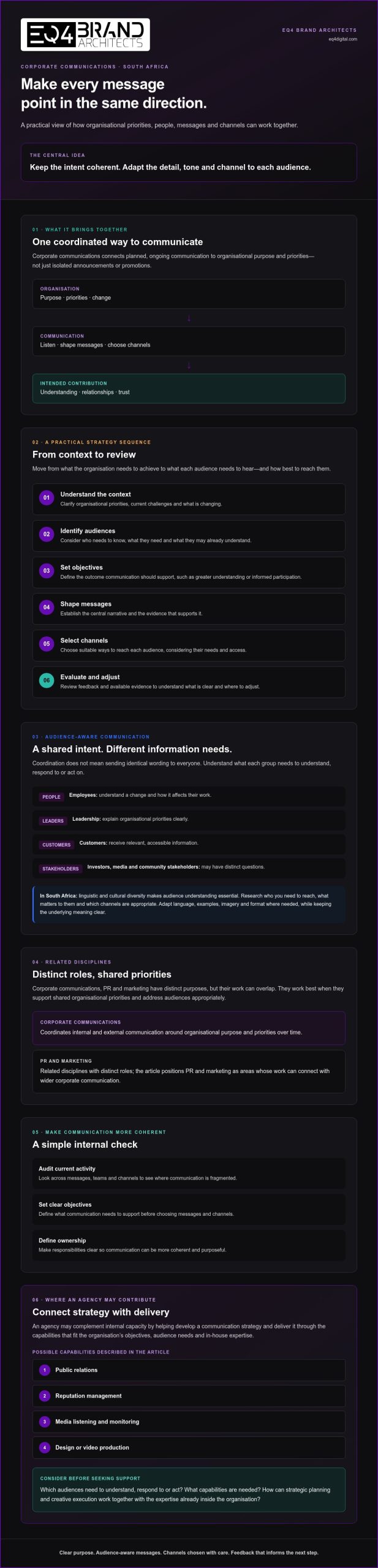
Corporate communications is the coordinated way an organisation communicates with internal and external audiences. Rather than treating each announcement, campaign or employee update as a separate task, it connects communication to organisational purpose and priorities over time.
What is corporate communications? It’s the planned practice of shaping and sharing an organisation’s messages with the people who affect, or are affected by, its work. It involves listening as well as speaking, so communication can build understanding and support relationships. The overview of corporate communication outlines its broad functions, including management, marketing and organisational communication.
A corporate communications agency may help an organisation develop its communication strategy and deliver it through capabilities such as public relations, reputation management, media listening and monitoring, design or video production. The right mix depends on the organisation’s objectives, audience needs and in-house expertise. The aim isn’t simply to produce more messages; it’s to make each one clear, considered and consistent with the organisation’s actions.
Which audiences and responsibilities does it bring together?
Different audiences need different information. Employees may need to understand a change and how it affects their work. Leadership may need a clear way to explain organisational priorities. Customers may want relevant, accessible information. Investors, media and community stakeholders can have distinct questions, too.
Coordination doesn’t mean sending the same wording to everyone. It means keeping the central intent coherent while adapting the detail, tone and channel to each audience. An agency’s scope will vary according to organisational goals, stakeholder needs and the expertise already available internally. Before setting a brief, identify which audiences need to understand, respond to or act on the communication.
Why does the South African context matter?
South Africa’s linguistic and cultural diversity makes audience understanding an essential part of planning. Organisations communicating nationally should research who they need to reach, what matters to those audiences and which channels are appropriate, rather than assuming one message will resonate in every context.
That research can inform choices about language, examples, imagery and format while preserving a recognisable organisational identity. A message may need thoughtful adaptation for different audiences or channels, but its underlying meaning should remain clear. Check specific language, channel and stakeholder considerations with relevant audiences and, where needed, local specialists.
At its best, corporate communications helps employees, customers, partners and other stakeholders recognise a consistent intent in what an organisation says and does. That consistency gives relationships a clearer foundation, without reducing communication to a sequence of announcements or promotions.
How does a corporate communications strategy connect people, messages and channels?
A strategy turns organisational priorities into communication people can understand and act on. It provides a route from what the organisation needs to achieve to what different audiences need to hear, and how best to reach them. Communication strategy connects audience needs, organisational objectives, messages and channels so every communication has a clear purpose.
A practical process usually moves through these steps:
- Understand the context: clarify organisational priorities, current challenges and what is changing.
- Identify audiences: consider who needs to know, what they need and what they may already understand.
- Set objectives: define the outcome communication should support, such as greater understanding or informed participation.
- Shape messages: establish the central narrative and the evidence that supports it.
- Select channels: choose suitable ways to reach each audience, taking account of their needs and access.
- Evaluate: review feedback and available evidence to understand what is clear and where to adjust.
Internal communication is part of this work, not an afterthought. If an organisation changes its priorities, employees need more than a headline announcement. They need a clear explanation of what the shift means for the organisation and how it relates to their roles. Leaders can share context, make space for questions and explain how the change connects to day-to-day work. This helps reduce the gap between organisational strategy and employee understanding.
How should an organisation shape messages for different audiences?
Start with a central narrative that expresses the organisation’s intent, then adapt the emphasis and language for each audience. Employees may need practical implications; customers may need to understand what is changing for them. Audience research, listening and feedback can help test whether a message is relevant, understandable and culturally considered. Keep claims accurate and consistent, and identify content that needs subject-matter or legal review before it is shared. For a deeper look at how credible, culturally aware narratives are being shaped, see how a brand storytelling agency South Africa approaches narrative in 2026.
How do channels and creative formats support the strategy?
Choose channels based on audience, purpose, timing and accessibility, then decide what evidence could show whether they are working. PR may help communicate organisational developments to media; web content can provide a reference point; video, graphic design or animation can present complex information in a more accessible format. Brand activations may create a direct, participatory experience. These formats can work together, but none should determine the strategy by itself.
An agency may bring communication strategy together with capabilities such as PR, design and video production. EQ4 Brand Architects offers strategic and creative communications capabilities to businesses across South Africa. Organisations considering external support can review communication strategy capabilities as one part of their assessment.
Corporate communications, PR and marketing: how are they different?
The three disciplines often work together, but they usually begin with different questions. Corporate communications looks across the organisation’s relationships and reputation; public relations (PR) focuses on relationships with media and other external audiences; marketing typically supports market-facing brand and demand goals. These are practical distinctions, not fixed boundaries. Responsibilities vary between organisations, and the same campaign or piece of content may involve all three.
| Discipline | Typical purpose | Common audiences | Activities and overlap |
|---|---|---|---|
| Corporate communications | Coordinate communication around organisational priorities, identity and reputation. | Employees, leadership, customers, investors, media and other stakeholders. | May bring internal and external communication together, working with PR and marketing on shared messages. |
| Public relations | Build and maintain relationships with media and relevant public audiences. | Journalists, communities, partners and other external stakeholders. | Can include media relations and public narratives, aligned with wider organisational communication. |
| Marketing | Support market-facing brand goals and demand. | Customers, prospective customers and other market audiences. | May use content, campaigns and brand activity, sharing audience insight and messaging with communications and PR. |
Think of corporate communications as a coordinating discipline, not a replacement for the others. A company announcing a new service, for example, might need employees to understand the change, customers to see its relevance and media to receive accurate information. The emphasis and format can differ, while the facts and central intent remain aligned. An agency may help connect this work if its capabilities match the organisation’s needs.
Where does public relations fit within corporate communications?
PR contributes to how an organisation engages with media, shapes public narratives and builds relationships with relevant external stakeholders. Its work is stronger when it reflects the organisation’s broader priorities and does not contradict what employees hear internally. For a closer look at evaluating PR support, see Strategic PR Agency in South Africa: A Practical Selection Guide.
How does corporate communications differ from marketing communications?
Corporate communications tends to consider organisation-wide reputation and stakeholder relationships, while marketing communications tends to focus on audiences in relation to the organisation’s market goals. Both depend on understanding people and communicating a credible brand voice. Content and campaigns may sit across both, so clear objectives, shared planning and agreed responsibilities matter more than assigning every channel rigidly to one team.
Definitions differ between organisations, so clarify responsibilities by asking what each activity is meant to achieve, whom it needs to reach and how it connects to wider priorities. That practical distinction helps teams collaborate without blurring accountability.
How can organisations make corporate communications more coherent?
Coherence doesn’t come from sending more messages. It comes from deciding what communication needs to achieve, who it should reach and how teams will work together. A practical review can help replace disconnected activity with communication that supports organisational priorities.
Use this sequence to create a clearer working approach:
- Audit current activity: gather key messages, channels, approvals and available feedback to understand what is already happening.
- Clarify objectives: connect each communication priority to an organisational need, rather than producing content simply to fill a channel.
- Map audiences: identify who needs to understand, respond to or contribute to the issue.
- Align messages: agree the core information and adapt its presentation to each audience.
- Assign ownership: clarify who develops, reviews, approves and shares each communication.
- Review outcomes: use audience response and other relevant evidence to decide what to maintain or adjust.
Listening should continue throughout this process. Employee questions, stakeholder feedback and media monitoring can reveal uncertainty or changing concerns. Use those signals to reconsider wording, timing or channel choices. They can inform decisions, but they don’t guarantee a particular outcome.
What should a communications audit examine?
Look for repeated or conflicting messages, channels that aren’t reaching their intended audiences, unclear approval steps and feedback that goes unanswered. Compare leadership intent with employee experience and external perception, without assuming that a gap points to a crisis. Note where content, ownership or approvals are unclear, so the team can identify practical changes. Consider relevant legal, governance and privacy questions in context, and verify applicable requirements with appropriate specialists before publication.
How can teams assess whether communications are working?
Begin with the objective. If the aim is understanding, seek evidence that the intended audience understands the key point; if it’s engagement, consider the quality of responses as well as their volume. Distinguish activity, such as messages sent or media coverage, from audience response and any contribution to wider organisational priorities. Choose measures the team can explain and review consistently.
Measure outcomes against objectives, not outputs alone. For reputation-related goals, consider communication activity alongside relevant stakeholder feedback and media insight. The article Corporate Reputation Management in South Africa: A Strategic Guide explores reputation measurement in more detail.
An agency may help audit activity, shape strategy or support reputation management and media listening. If external expertise would be useful, communications support is one option to consider alongside your internal team.
When can a corporate communications agency help bring the strategy to life?
External support can be useful when an organisation has clear communication priorities but limited internal capacity to plan or deliver them, or when a fresh perspective could help teams see where messages and audience experience diverge. An agency may complement an internal team with strategic thinking, specialist communications capabilities or creative production, depending on the brief.
The value lies in coordination. If an organisation is explaining a major change, for example, communication strategy can guide the central narrative, PR can support relevant public and media relationships, and reputation management can help the team pay attention to stakeholder perceptions. Design, web content, animation or video production may help express the same intent in suitable formats. Each activity should serve an agreed objective rather than become a disconnected deliverable.
What should a thoughtful agency partnership include?
Start with attentive discovery: the agency should understand organisational context, audiences, existing activity and the expertise of the internal team. Agree objectives, responsibilities, approval points and a working rhythm before work begins. Ask how strategic recommendations will connect to execution, how audience feedback will inform adjustments and what evidence will be used to review progress. For South African audiences, explore how the approach will account for relevant linguistic and cultural differences without assuming one treatment fits all.
How does EQ4 bring strategy and creative execution together?
EQ4 Brand Architects combines strategic communications with creative and production capabilities. Its listed capabilities include communication strategy, PR, reputation management, media listening and monitoring, graphic design, web design, animation and video production. Which capabilities are relevant depends on the organisation’s objectives and audience needs.
For instance, media listening may help inform a communications brief, while design, web content or video may provide ways to express its key messages. Connecting planning and execution can keep creative choices anchored to the communication purpose. The right partnership should also respect what the internal team already does well and make responsibilities clear.
If you’re considering external support, a conversation about your communication objectives can help clarify what kind of expertise may be useful. Explore a conversation with EQ4.
Bring your organisation’s story into clearer focus
Effective corporate communications connects organisational priorities with the people who need to understand them. A clear strategy helps teams choose relevant messages and channels, while recognising that corporate communications, PR and marketing have distinct purposes and can work towards shared objectives.
For organisations considering a corporate communications agency South Africa, the right support depends on the needs of the internal team and the communication challenges at hand. Look for an approach that links planning to execution, makes room for audience feedback and evaluates progress against clear objectives.
EQ4 Brand Architects brings strategic communications and creative capabilities together, with media listening and monitoring offered alongside communications services. Where the brief calls for this combination, it can connect the thinking behind a message with considered ways to express and assess it.
If you’re reviewing how your organisation communicates, start with the priorities people need to understand and the audiences you need to reach. Explore a conversation with EQ4 about your communication objectives. A more coherent approach can begin with a clear question and a willingness to listen.
Frequently Asked Questions
What does a corporate communications agency do?
A corporate communications agency helps an organisation plan and coordinate communication with its audiences. Depending on the brief, this may include communication strategy, public relations, reputation management, media listening and monitoring, and creative capabilities such as graphic design or video production. The work should connect to clear organisational objectives, rather than simply produce more content. The right mix depends on the organisation’s priorities and the expertise already available internally.
How is corporate communications different from public relations?
Corporate communications is a broad coordinating discipline, while public relations (PR) commonly focuses on relationships with media and other relevant external stakeholders. PR can contribute to public narratives and reputation, while corporate communications considers how communication supports wider organisational priorities and different audiences, including employees. The boundaries aren’t universal: teams may share responsibility for messages, content or campaigns. What matters is agreeing each activity’s purpose, audience and ownership.
Why is corporate communications important for a business?
Corporate communications helps a business explain its priorities consistently to the people who affect or are affected by its work. Employees can better understand organisational direction, while customers, partners and other stakeholders receive clearer information relevant to them. A coherent approach can support trust by reducing conflicting messages and creating opportunities to listen and respond. It doesn’t replace meaningful action, but helps an organisation communicate its intentions and decisions with care.
When should a company work with a corporate communications agency?
A company might consider an agency when internal capacity is stretched, communications feel disconnected or specialist strategic and creative expertise would be useful. Before approaching an agency, clarify the challenge, audiences and outcomes you want to support. Ask how the agency would work with your internal team, connect recommendations to delivery and review audience feedback. External support should complement the organisation’s knowledge, not operate separately from it.
How do you measure corporate communications?
Measure communications against the objective, not just the amount of activity produced. If the goal is understanding, seek evidence that the audience understands the key information; if it’s engagement, review the quality and relevance of responses. Coverage, content published or messages sent can show what was delivered, but don’t establish what audiences took from it. Combine suitable activity measures with feedback, listening and other evidence relevant to the intended outcome.
What should a corporate communications strategy include?
A corporate communications strategy should connect organisational context and priorities with audience needs, objectives, messages, channels and evaluation. It should identify who needs to communicate, who needs to be reached, what each audience needs to understand and how the team will review progress. Clear responsibilities and approval processes help keep activity aligned. The approach should also leave room to adapt language and formats for different audiences while preserving a coherent central intent.
Can a corporate communications agency support both internal and external communications?
Yes, an agency may support internal and external communications when that scope is agreed and matches its capabilities. These audiences need different information, but communication should reflect a consistent organisational intent. EQ4 Brand Architects offers communication strategy alongside PR, reputation management, media listening and monitoring, and creative capabilities. Ask any prospective agency how it will collaborate with internal teams, adapt messages for each audience and use feedback to inform communication.