





You don’t need to answer every online criticism, but silence and a defensive reply can both shape how people see your organisation. Knowing how to respond to online criticism of your brand starts with assessing what was said, who needs to be involved and whether a public reply will help.
It’s understandable to feel pressure to respond quickly, particularly when a complaint is visible to customers, employees or stakeholders. A considered response can acknowledge a genuine concern, correct an important inaccuracy or move a sensitive discussion to a more appropriate channel. Trolling, threats and constructive feedback call for different judgements.
This article explains when to reply, how to review and route a response, and what to do when a comment points to a wider issue. It also considers why your response matters beyond the original exchange: people watching the conversation may use it to assess your organisation’s accountability, consistency and care.
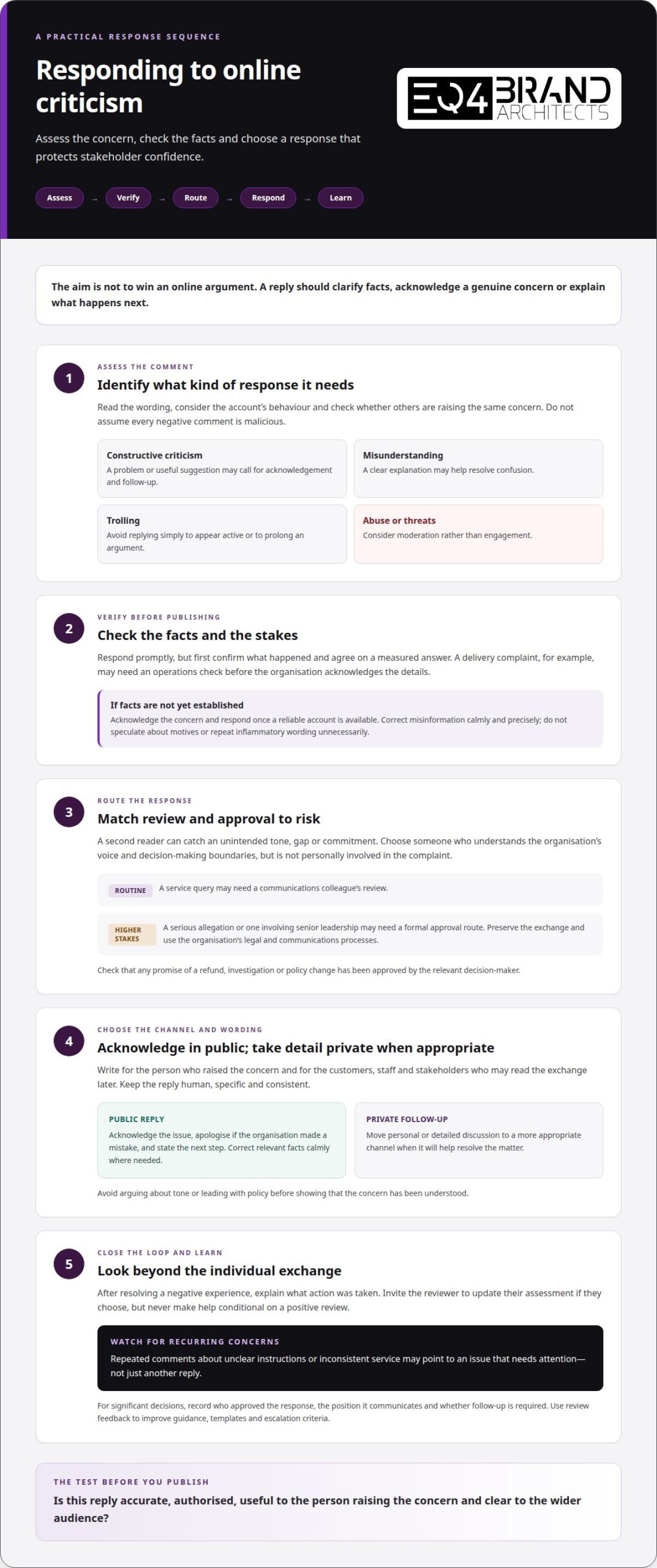
The aim isn’t to win an argument online. It’s to respond clearly and purposefully, protect stakeholder confidence and recognise when criticism offers an opportunity to improve.
Key Takeaways
- Assess the criticism before replying: distinguish a genuine concern from a misunderstanding, provocation or threat.
- Check the facts and have a trusted, level-headed person review sensitive or high-stakes responses.
- Acknowledge the issue publicly, then move personal or detailed discussions to a private channel when appropriate.
- Write for the wider audience as well as the person who raised the concern; a calm, useful reply can shape perceptions of your organisation.
- Look for recurring complaints and use them to identify where communication or the customer experience may need attention.
1. Should you always respond to online reviews?
No. Respond when a reply can clarify facts, acknowledge a service failure or explain what happens next. Don’t answer every provocation just to appear active. A thoughtful response to a negative review can help both the person who complained and the customers or stakeholders reading silently. A rushed, defensive reply can make the original problem look worse.
In South Africa, legal considerations depend on the content of the comment and response. Defamation, privacy and threats raise different concerns, so avoid making legal findings in a public reply. For a serious allegation, preserve the exchange and route it through your organisation’s legal and communications processes before publishing a detailed response.
There’s no single best response time for every negative social media comment. Respond promptly, but first check the facts and agree on a measured answer. For example, a complaint about a delayed delivery may need confirmation from the operations team before you acknowledge what happened. A safety concern or fast-spreading allegation needs immediate escalation through the organisation’s response process.
Assess intent before choosing your words. Constructive criticism identifies a problem or offers a useful suggestion; a misunderstanding may need a clear explanation. Trolling seeks an argument, while abusive or threatening comments may call for moderation rather than engagement. Check the wording, the account’s behaviour and whether others are raising the same concern. Don’t assume every negative comment is malicious.
For a genuine complaint, acknowledge the person’s experience, apologise if your organisation made a mistake, and state the next step. Avoid arguing about tone or quoting policy before showing that you understand the concern. If a reviewer says a staff member gave conflicting information, for instance, recognise the confusion and explain how the organisation will follow up. Keep the reply human, specific and consistent.
When a comment contains false claims or misinformation, correct the relevant facts calmly and precisely. State what is accurate, explain what the organisation is doing, and avoid repeating inflammatory wording unnecessarily. Don’t speculate about the commenter’s motives or turn the exchange into a public debate. If the facts are still being established, acknowledge the concern and respond once a reliable account is available.
Abusive or threatening comments call for a different response from a poor review. Use the platform’s moderation controls to remove abusive or threatening content and block repeat offenders where appropriate. Don’t delete ordinary criticism simply because it is uncomfortable; respectful disagreement can be addressed with a measured reply. Respond to positive reviews too: thank the person and, where relevant, mention what their feedback recognises.
After resolving a negative experience, explain what action was taken and invite the reviewer to update their assessment if they choose. Don’t make a positive review a condition of receiving help. Treat complaints as evidence: if several comments point to unclear instructions or inconsistent service, address the recurring issue. That can improve the experience and give future readers a clearer picture of your accountability.
2. Getting a trusted person to review a response
A second reader can help prevent a response from setting an unintended precedent. Choose someone who understands the organisation’s voice and decision-making boundaries but isn’t personally involved in the complaint. Their role is to assess whether the reply reflects the organisation’s position, not to soften every difficult message or delay an already authorised response.
Give the reviewer the original comment, the draft reply and enough context to understand the decision. Ask them to consider how the exchange may read to different audiences: the person who complained, other customers, staff and stakeholders who see the post later. A message can be accurate yet seem evasive if it answers a narrow detail but misses the concern people are actually discussing.
Make the review proportionate to the risk. A routine service query may need a communications colleague’s review; a public allegation involving senior leadership may require a more formal approval route. Agree who can approve each type of reply before a contentious post appears. Clear governance prevents conflicting voices and gives frontline teams a defined escalation path.
The reviewer should also check whether the proposed response creates an organisational commitment. A sentence promising a policy change, refund or investigation can be interpreted as an official decision. If the relevant decision-maker hasn’t approved that commitment, revise the wording to explain what the organisation can confirm and who owns the next step.
Use review feedback to improve the response system, not just an individual draft. If reviewers repeatedly flag unclear authority or missing context, update approval guidance, response templates or escalation criteria. Templates should offer a reliable structure, not a script that makes every exchange sound identical. Leave room for the facts and audience needs of each situation.
A brief record of significant decisions can support consistency across teams and platforms. Note who approved the reply, what position it communicates and whether follow-up is required. If a similar concern appears later, the communications team can see how the organisation handled the earlier issue without relying on memory or private chat histories.
For teams managing several channels, a shared communications response framework can set approval roles, escalation thresholds and tone principles. The value is not uniform wording; it is a consistent standard for who speaks, what they can commit to and how the organisation remains accountable.
3. Moving sensitive conversations to private channels
A public reply can acknowledge a concern without exposing someone’s personal details. Move the detailed conversation to a direct message, email or phone call if resolving it requires account information, employment details or a careful explanation. Keep the public exchange visible enough to show that the organisation has noticed and is taking the matter seriously.
Use a simple sequence. First, acknowledge the issue publicly in neutral language. Then invite the person to continue privately, naming a suitable channel and explaining what information would help. For example: “We’re sorry this has happened. Please send us a direct message with your reference number so we can look into it.” Don’t ask them to post contact details or account information publicly.
Moving the conversation to another channel should not feel like an attempt to silence criticism. If the person declines, don’t pressure them or repeat the invitation beneath every comment. Continue sharing information that can safely be made public, and clarify what the organisation can address there. Keep the tone consistent across platforms, especially if the same concern appears on Facebook and a review site.
When should negative comments be hidden, deleted or reported? Don’t remove a comment merely because it is critical or uncomfortable. Hide or remove abusive or threatening content, and report it through the platform if it breaches the platform’s rules; block repeat offenders where appropriate. Before moderating serious messages, record the date, account and relevant context.
A phone call can help when written messages are being misread or the issue requires several clarifications. Offer a call as an option, rather than demanding one, and agree who will speak for the organisation. Afterward, send a concise written summary of agreed actions through an appropriate channel. That record helps both sides understand what happens next without disclosing private details.
Protecting privacy does not mean the organisation should disappear from the public conversation. Once the matter is addressed, a brief public update can confirm that contact has been made or the concern handled, provided the person’s details remain protected. For example, “We’ve contacted the reviewer directly and are following up” signals action without describing their account or circumstances.
Some issues need more than a one-to-one exchange. If similar complaints appear across platforms, route them to the teams responsible for the underlying service and communications response. A pattern of questions about unclear notices, for example, may call for a broader explanation. The public reply can support the private resolution while the organisation addresses the source of repeated concern.
4. The effect of review responses on customer decisions
People reading reviews assess more than the score. They look for patterns in service, signs that concerns receive attention and clues about how an organisation behaves when expectations aren’t met. A response adds context to a review, helping readers judge whether the issue seems isolated or points to a wider experience.
That context can influence a decision even when the organisation cannot resolve the original complaint publicly. A clear reply explaining the next step can signal accountability; an unanswered review leaves readers with only one account. The response shouldn’t try to persuade every reader. It should give them a fair basis for assessing how the organisation handles feedback.
Customers also notice whether an organisation responds consistently across review platforms. If it answers only highly visible complaints, its approach may seem selective. A considered response to a range of feedback can show that the organisation takes customer experience seriously, rather than treating replies as a way to manage appearances.
Use reviews to identify where the experience may be falling short. If several people mention unclear collection instructions, for example, examine the information customers receive and the process they follow. Then, where appropriate, describe the practical change in a response. This connects what the organisation says with action that can improve the experience for future customers.
Offer a solution that fits the concern. A delayed order may need a progress update and direct follow-up; confusing instructions may need correction. Explain what will happen next and ensure the responsible team can deliver it. Once the issue is resolved, follow up with the reviewer through the agreed channel. If the outcome can be shared, a concise public update may help readers understand what changed.
Measure effectiveness by looking beyond how quickly a reply was posted. Track whether responses address the concern, agreed follow-ups are completed and the same complaint continues to appear. Compare review themes with customer-service enquiries and operational feedback. Changes in recurring complaints may be more useful than response volume alone.
Make feedback part of the organisation’s learning process. Record the issue, the team responsible, the action taken and any unresolved follow-up. Review those records with the people who shape the customer experience. If a pattern points to unclear guidance, update it and check whether later feedback reflects the change. The aim is a better experience, not simply a more polished reply.
A shared communications response framework can help teams connect public replies with approval, follow-up and learning. That creates a clearer line between what customers read and what the organisation does, while leaving room to respond to the details of each situation.
5. Why responses to criticism affect brand reputation
A review exchange is public evidence of how an organisation behaves under pressure. On social media, a defensive reply can shift attention from the complaint to the organisation’s tone and judgement. A measured response can show accountability without implying that every criticism is accurate or every request will be met.
Ignoring a credible concern leaves other readers to interpret the complaint without the organisation’s perspective. If the issue involves a visible service failure or a gap between stated values and actual conduct, silence can deepen uncertainty. It gives no indication of whether the organisation understands the concern or intends to act.
Arguing creates a different reputational risk. A point-by-point rebuttal may shift the exchange to how the complainant was treated, rather than the issue they raised. For example, a sarcastic correction can make accurate information seem dismissive. Keep the reply factual and proportionate, and don’t turn disagreement into a contest.
Moderation also communicates a standard. Removing ordinary criticism can raise questions about transparency, while abusive or threatening content may warrant moderation. Apply the distinction consistently and retain a record of serious messages. That helps the organisation explain its approach if someone questions why a comment was removed.
Criticism can expose a gap between the reputation an organisation intends to build and people’s experience of it. If comments repeatedly point to unclear communication, compare those concerns with customer-service feedback and identify who can address the cause. A public reply carries more weight when it reflects action beyond the platform.
For senior leaders, assess whether a response is accurate, consistent with organisational values and aligned with what teams can deliver. If criticism signals broader risk, coordinate the organisation’s position across relevant channels. Conflicting explanations from different teams can deepen uncertainty for customers, employees and other stakeholders.
Review recurring themes, outstanding follow-ups and issues that persist despite responses. These signals can help distinguish a communication gap from an operational problem. If reputation concerns are appearing across channels, discuss a reputation response approach.
EQ4 Brand Architects
EQ4 Brand Architects helps organisations bring strategic judgement to online criticism, connecting public responses with reputation, stakeholder confidence and action inside the organisation. When reviews point to recurring concerns, inconsistent messages or reputational risk beyond one customer exchange, a coordinated approach can help move communication from reactive replies towards clearer governance and follow-through.
Its work can bring together Reputation Management, Public Relations (PR) and Communication Strategy, with Brand Activations where audience engagement supports the wider response. The focus is not simply on what to say online, but on how the organisation listens, responds and acts in ways that reflect its purpose.
If online criticism is creating a wider communications or reputation challenge, contact EQ4 Brand Architects to discuss the situation.
Make listening part of how the organisation works
Online criticism can reveal a gap between the experience an organisation intends to create and the one people actually encounter. Treat those signals as part of leadership’s view of organisational health, not as isolated communications tasks. Clear ownership helps teams connect what they hear publicly with decisions about service, policy and stakeholder relationships.
That discipline also helps you decide how to respond to online criticism of your brand in a way that reflects organisational purpose. A reply should be one visible expression of how the organisation listens, learns and acts, not a substitute for addressing the issue behind it.
If your organisation is working through a wider reputation or communications challenge, contact EQ4 Brand Architects to discuss a considered next step.
Frequently Asked Questions
Should you always respond to online reviews?
No. Prioritise reviews that raise a specific service concern, a correctable factual error or an issue other customers may encounter. A short acknowledgement may be enough when a review offers an opinion without requesting action. For positive feedback, a genuine thank-you is useful, but avoid repetitive replies that sound automated. A consistent approach helps teams decide which messages need investigation and which need only a courteous acknowledgement.
How should a brand respond to online criticism?
To decide how to respond to online criticism of your brand, establish what happened before drafting. Address the central point in plain language, acknowledge the impact and state a realistic next action. If the criticism is inaccurate, correct the specific fact without attacking the person who posted it. Keep the reply easy to read on a mobile screen and remove internal shorthand customers or stakeholders may not understand.
When should a brand reply publicly versus privately to a complaint?
Reply publicly when readers need context, such as a correction to general service information or confirmation that the organisation is addressing a concern. Move to a private channel if resolving the matter requires personal details, account records or a longer exchange. A practical approach is to acknowledge the complaint publicly, invite private follow-up, then share a brief public update only if the outcome can be disclosed responsibly.
What steps should a brand follow to respond to online criticism?
Use a clear sequence: record the comment and platform, identify the team responsible for the issue, establish the relevant facts, draft a concise reply and obtain approval proportionate to the risk. After publishing, assign ownership for any promised follow-up. Record the issue and its outcome so recurring concerns can be reviewed alongside customer-service information, rather than treated as isolated posts.
How should South African brands respond to complaints on HelloPeter and social media?
Reply on the platform where the complaint appears, using language suited to that audience while keeping the organisation’s position consistent. On HelloPeter, address the substance of the complaint; on social media, avoid posting personal or account details in a public thread. Don’t assume readers have seen another channel. If the matter is resolved privately, provide a concise public update where appropriate, without disclosing the complainant’s information.