





An executive’s online reputation is not a content clean-up exercise. It is a governance and stakeholder-confidence responsibility, shaped by what people find in search, read in the media and share in public digital conversations. For leaders searching “online reputation management for executives South Africa”, the central issue is how to turn those signals into sound decisions.
That scrutiny can be difficult to manage when personal and organisational messages are fragmented, or when monitoring flags activity without showing what needs a decision. The key question is what a strategic partner should do: bring context to the signals, align response decisions and connect executive communication to organisational priorities.
This guide sets out what a credible programme should cover and how to assess a partner’s judgement, approach and measures. It offers a practical way to consider monitoring, messaging, decision rights and escalation, then define progress in terms of executive credibility and stakeholder confidence, not activity alone.
Key Takeaways
- Assess executive reputation as part of organisational governance and stakeholder confidence, not simply as a matter of online visibility.
- Look for a programme that connects listening and risk interpretation with clear advice, response planning and review.
- Evaluate online reputation management for executives South Africa by the quality of its strategic judgement, stakeholder awareness and decision support.
- Agree objectives, relevant signals, decision rights and escalation routes before a reputational issue demands a response.
- Measure more than attention: consider relevance, engagement depth, stakeholder action and organisational value.
Why executive online reputation management matters in South Africa
An executive’s public profile can shape how stakeholders interpret an organisation’s judgement, priorities and conduct. Executive online reputation management means listening to relevant online conversation, interpreting its context, communicating strategically and responding proportionately. It cannot remove all criticism or control every discussion. Its purpose is to understand what may affect confidence, then decide whether and how to act.
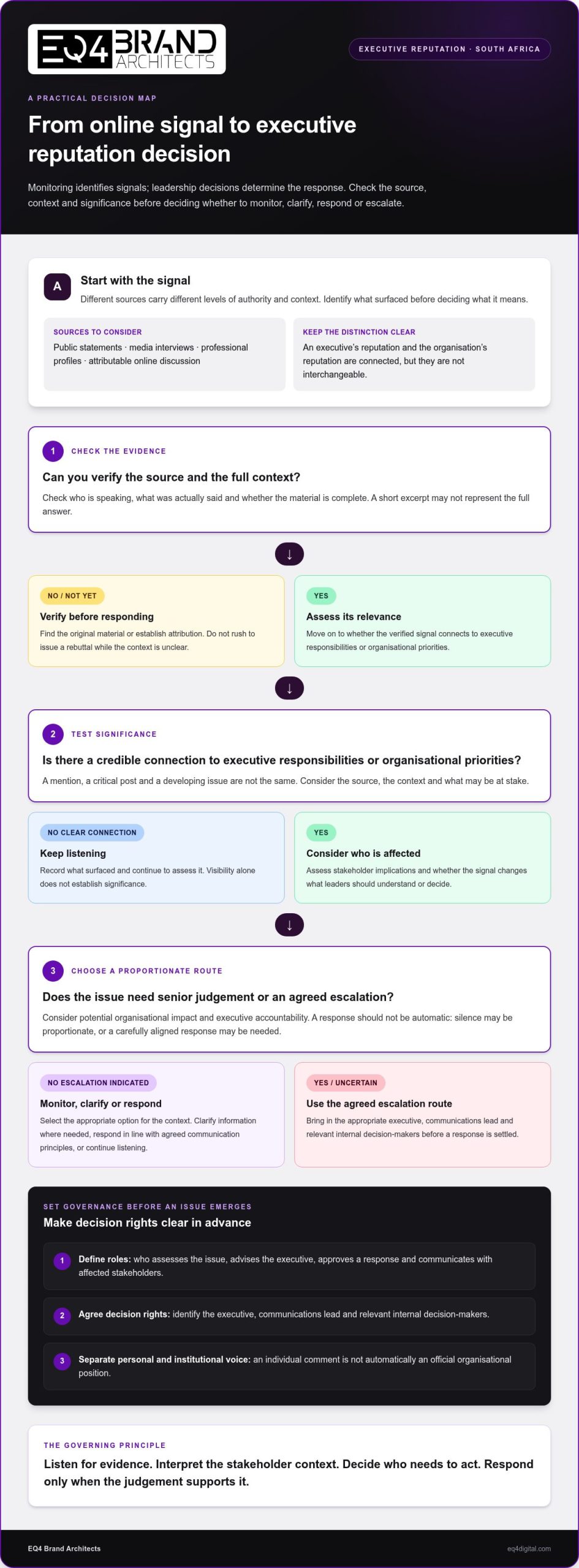
Monitoring identifies signals; leadership decisions determine the response. A mention, a critical post and a developing issue are not the same thing. Teams need to establish who is speaking, what is at stake, whether the conversation connects credibly to organisational activity and which leaders should be involved. That judgement distinguishes useful reputation advice from a stream of alerts.
Executive and corporate reputations are connected, but they are not interchangeable. Corporate reputation reflects an organisation’s wider conduct, experience and communication. Executive reputation relates to how a leader’s own words, decisions and public presence are understood. A leader’s interview may influence perceptions of organisational priorities, for example, but a response should not automatically treat an individual comment as an official corporate position. The distinction matters when deciding who speaks, what can be said and whether a matter requires escalation.
What makes an executive’s digital footprint distinct?
An executive’s digital footprint can include public statements, media interviews, professional profiles and attributable online discussion. These sources carry different levels of authority and context. A prepared interview is not equivalent to a comment attributed to someone without clear evidence. Consider a hypothetical case: a short excerpt from an interview circulates without the full answer. The first step is to check the original material and assess its relevance, not to issue an immediate rebuttal.
For online reputation management for executives South Africa, a useful distinction is between visibility and significance. Record what has surfaced, assess its source and potential stakeholder implications, then decide whether to monitor, clarify, respond or escalate. Silence may be proportionate; so may a carefully aligned response. Neither should be automatic.
Which South African realities should shape the approach?
South African organisations communicate with stakeholders who have varied experiences, languages, expectations and relationships with institutions. The same statement may be read differently by employees, communities, investors, customers, public bodies or media. A sound assessment considers who is affected and why, rather than assuming a single public reaction. It also considers how information may move between media coverage, professional networks and other online conversations.
In public-sector and regulated environments, communication may involve formal approval processes and clear accountability for who can speak on behalf of an institution. Agree those decision rights before a sensitive issue arises: identify the executive, communications lead and relevant internal decision-makers, then set an escalation route. This makes room for a timely response without confusing personal expression with an authorised institutional position.
What effective online reputation management for executives includes
A credible programme turns online activity into a sequence of informed decisions. Listening shows what is being said; interpretation establishes why it matters; advice identifies options; response planning clarifies who does what; and ongoing review tests whether the approach remains relevant. Each stage should connect executive communication with organisational purpose, stakeholder needs and agreed communication principles. Visibility alone is not an objective.
A useful signal is one interpreted against its audience, context and potential consequence. A critical comment from an unknown account may call for observation. A recurring concern raised by employees, customers or the media may point to a wider issue that merits discussion. The distinction is not simply positive or negative sentiment. It is whether the information changes what leaders should understand or decide.
From online signals to strategic advice
Media listening brings evidence into the assessment, but it cannot make the judgement. Agree what the programme will observe, such as relevant public conversations, media coverage and stakeholder signals, and how findings will be shared. This keeps monitoring focused on issues connected to executive responsibilities and organisational priorities, rather than producing undifferentiated alerts.
Interpreted patterns can inform message development, spokesperson preparation and escalation. If coverage repeatedly centres on a particular organisational decision, advisers can assess which audiences are concerned, what information is missing and whether the executive’s existing explanation addresses those questions. The recommendation might be to clarify a message, brief a spokesperson, raise the matter internally or continue listening.
From advice to coordinated executive communication
Before a sensitive issue emerges, agree who assesses it, who advises the executive, who approves a response and who communicates with affected stakeholders. Define which matters can be handled routinely and which require escalation because of potential organisational impact, executive accountability or the need for senior approval. Clear responsibilities reduce the risk of conflicting messages or avoidable delay.
Response messaging should align with the organisation’s established communications while still reflecting the executive’s role and voice. That does not mean every message must sound identical; it means the facts, commitments and principles should not contradict one another. Review planned content, media engagement and other digital activity against that alignment before publication.
Creative and digital execution should follow the agreed strategy. A profile update, explanatory content or media response has value when it serves a defined communication purpose and reaches the relevant audience. The format, channel and content should support both the intended message and stakeholder need.
How to assess an executive online reputation management partner
A partner’s value is not measured by the number of alerts or posts produced. The stronger test is whether they can interpret relevant signals, advise senior leaders and help the organisation make clear, well-governed decisions. For online reputation management for executives South Africa, look for strategic judgement alongside the ability to coordinate communication when action is agreed.
Use the discussion to understand how the adviser would work with your executive, communications team and organisational priorities. Ask for a practical explanation of their approach, rather than relying on broad promises about visibility or sentiment.
Questions that reveal strategic capability
Explore how the adviser builds an understanding of the executive’s responsibilities, audiences, organisational context and reputational exposure. Recommendations should connect to defined communication objectives and stakeholder confidence, not simply seek more attention. Ask how they distinguish a passing mention from a pattern that could affect a relationship, decision or organisational priority.
Clarify how they work alongside internal communications, legal and leadership teams. A useful adviser can explain how each team’s input informs decisions without blurring who owns approval or accountability.
Questions that reveal delivery and accountability
Make the operating model explicit. Ask who interprets monitoring, recommends action, approves messaging and communicates externally. Discuss confidentiality, approval routes and escalation thresholds before an issue arises, including how the adviser coordinates with the executive’s existing responsibilities and availability. Clear answers show whether the proposed support fits how your organisation makes decisions.
Reporting should explain what was observed, why it matters, what action is recommended and who must decide. Agree a cadence that suits the organisation’s needs, and a way to record decisions and their rationale. When stakeholder signals or organisational priorities shift, the adviser should revisit the assessment and adjust the recommendation rather than continue with a fixed activity plan.
Assess the proposed measures with the same care. Volume, reach and engagement can describe activity, but they do not establish whether communication was relevant or useful. Ask how reporting will distinguish attention from meaningful engagement, stakeholder action and organisational value. Measures should relate to agreed objectives, and the adviser should be clear about what the evidence can and cannot show.
- Strategic judgement: Can the adviser explain the context and implications behind a signal?
- Executive counsel: Do recommendations account for leadership responsibilities and stakeholder needs?
- Governance: Are approval, escalation, confidentiality and decision ownership clear?
- Accountability: Does reporting connect evidence to recommendations and agreed measures?
These criteria help distinguish executive counsel from monitoring or content delivery alone. Use them to assess whether a proposed partner can support the decisions your organisation needs to make.
A practical framework for executive reputation governance and measurement
A reputation programme needs a clear purpose and a route from evidence to action. For online reputation management for executives South Africa, use a repeatable cycle: define objectives, map stakeholders, agree relevant signals, set decision rights, review findings and adapt. This supports consistent decisions without treating every fluctuation in online conversation as a change in reputation.
Set objectives, audiences and escalation rules
Start with an executive responsibility or organisational communication priority. The objective might be to improve understanding of a strategic decision, respond consistently to stakeholder concerns or strengthen confidence in a particular commitment. Keep it specific enough to guide choices about what to listen for and what action would be meaningful.
Next, identify the stakeholder groups most relevant to that objective and the questions or concerns they may raise. Agree which sources and themes are in scope, then set thresholds for internal assessment and public response. Name who reviews an emerging issue, who advises the executive and who authorises a public statement. These arrangements should reflect the organisation’s actual approval and accountability processes.
Review progress without promising reputation outcomes
Use measures that show different stages of communication and stakeholder response. Attention indicates whether a topic is being encountered; relevance assesses whether it reaches or concerns priority audiences; engagement depth considers the quality of interaction; stakeholder action records what people do next; organisational value connects those actions to the stated objective. That final link requires care: communication may contribute to an outcome without being its sole cause.
Mention volume and sentiment can help identify patterns, but they are directional evidence, not definitive proof that reputation has improved or declined. A change in volume may reflect a news cycle or a single widely shared item. Sentiment can miss context, irony or differing stakeholder perspectives. Interpret these indicators alongside source, theme, audience and the organisation’s own evidence.
Measurement is useful when it changes a decision, an action or a learning priority. In a regular review, ask what has shifted, which questions remain unanswered, whether the response was appropriate and what should change in the next communication cycle. Record the learning and any unresolved risks, so leaders can distinguish a one-off reaction from an issue that needs sustained attention.
Results depend on context, organisational conduct, stakeholder experience and the quality of available evidence. A measurement framework can support clearer choices, but it cannot guarantee reputation recovery, media coverage, search rankings or business returns. The EQ4 website describes the organisation’s communications and reputation work, including listening, governance and communication objectives.
How EQ4 supports executive reputation management in South Africa
Executive reputation work is most useful when it connects leadership communication to the organisation’s purpose, stakeholder relationships and decision-making. EQ4 Brand Architects combines senior strategic advice with practical communications support, helping leaders move from fragmented responses towards a more intentional, audience-aware approach. The focus is not on managing appearances in isolation, but on understanding what a reputation concern may mean for the organisation and deciding how communication can respond.
An advisory approach grounded in strategy and stakeholder context
EQ4 Brand Architects’ reputation and issues work can bring reputation and stakeholder risk assessment into the wider communications approach. That starts with the executive’s organisational role, the audiences they need to reach and the issues that shape stakeholder confidence. A message intended for employees, for example, may need different context from one prepared for media or external stakeholders, while remaining aligned with organisational priorities.
Listening and monitoring inform that assessment. They can help identify relevant media coverage and public conversation, surface emerging themes and support decisions about whether an issue needs advice or escalation. The value lies in interpretation: signals are considered against audience, context and possible implications, rather than treated as automatic instructions to respond.
From there, EQ4 Brand Architects can support response messaging, spokesperson preparation and media relations, coordinating communication around agreed principles and decision rights. Where execution is appropriate, it should serve the strategy: the format, channel and content follow from what stakeholders need to understand and what the organisation is prepared to communicate. No communication programme can guarantee a particular reputation outcome; results depend on the issue, organisational conduct, stakeholder experience and the decisions made.
A credible next step for decision-makers
Leaders considering online reputation management for executives South Africa can begin by defining the specific challenge: an unclear escalation route, inconsistent executive and organisational messages, limited interpretation of monitoring, or a need to prepare for a sensitive communication. Naming the decision or governance gap helps focus the discussion on practical priorities and appropriate measures.
EQ4 Brand Architects’ wider advisory perspective connects executive reputation with corporate reputation and strategic public relations. The corporate reputation management strategic guide and strategic PR selection guide can support further consideration of those related questions.
When defining the scope of support, focus on the reputation or communication decision your organisation needs to address.
Make executive reputation readiness part of leadership practice
The most useful time to clarify reputation decisions is before a sensitive moment puts them under pressure. Start with one practical question: where do executive communication, stakeholder expectations and organisational approval currently fall out of step? The answer can identify a focused next step, whether that is improving escalation routes, preparing a spokesperson or sharpening how a priority is communicated.
For leaders considering online reputation management for executives South Africa, the aim is not to control every conversation. It is to build the judgement and coordination to respond in a considered, consistent way grounded in organisational priorities. EQ4 connects reputation strategy and risk assessment with issues management, response messaging, monitoring and escalation, alongside communications and creative execution where they support the agreed approach.
If your organisation is ready to address a specific executive reputation or communications challenge, discuss it with EQ4. A clear starting point can help turn uncertainty into a practical plan.
Frequently Asked Questions
Is online reputation management for executives different from corporate reputation management?
Yes. Executive and corporate reputation management are connected, but they address different accountabilities. Executive work concerns how a leader’s professional conduct and communications are understood; corporate work considers the organisation’s wider actions and relationships. For example, an executive’s comment at an industry event may prompt questions about an organisational position. Assess what the leader intended to communicate, then coordinate any clarification with authorised organisational messaging without treating the two reputations as identical.
Can negative online content about an executive be removed?
Sometimes, but removal depends on who controls the content, the platform’s rules and any applicable legal grounds. Do not assume that a critical post can or should be taken down. First preserve the relevant material and assess its source, accuracy, context and potential impact. Depending on what you find, a correction, response, internal escalation or other appropriate action may be more suitable. Get relevant specialist advice where the situation calls for it.
Does executive online reputation management only matter during a crisis?
No. It is an ongoing discipline, not just a crisis response. Regular attention to relevant public discussion can help leaders understand emerging questions before they face a high-pressure decision, though monitoring cannot prevent every crisis. Routine reputation work supports preparation and learning; crisis communications focuses on a specific issue, its implications and the decisions required. For example, a recurring stakeholder concern may merit planned clarification, while a serious allegation may need immediate assessment and escalation.
How long does it take to improve an executive’s online reputation?
There is no reliable universal timeline. The work depends on the issue, available evidence, stakeholder response, the executive’s communication context and actions by third parties. A responsible programme can set review points and examine whether relevant themes, questions or stakeholder actions are changing. That is different from promising recovery by a fixed date. Search positions, public discussion and confidence may shift for reasons beyond the communication programme’s control.
What should a board or executive team approve before starting an ORM programme?
Agree what the programme is intended to support, which executive and organisational responsibilities are in scope, and which stakeholder groups matter most. Decide who can access sensitive information, who assesses emerging concerns, who approves external messages and how decisions will be recorded. The team should also agree what reports will contain and how often they will be reviewed. These arrangements should fit the organisation’s governance and are not a universal legal model.
Which metrics are useful for executive reputation management?
Choose measures that reflect the programme’s objective. These could include recurring conversation themes, the context and quality of relevant coverage, depth of stakeholder engagement, response timeliness or an agreed stakeholder action, such as seeking further information. Volume, reach and sentiment can provide clues, but they do not prove reputation change or organisational value. Review them alongside qualitative feedback and relevant organisational events, then use the findings to adjust priorities or communication.