





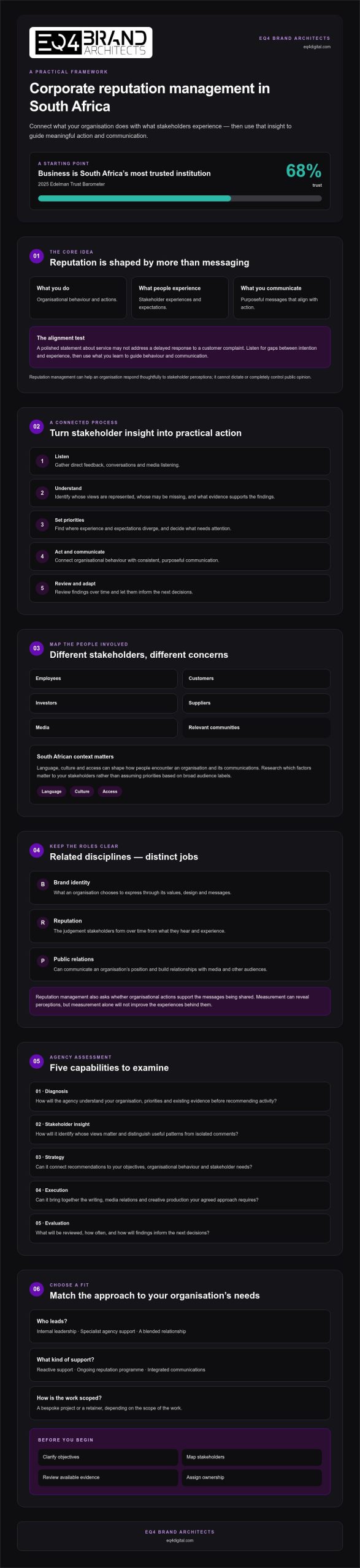
In South Africa, business is the most trusted institution, at 68%, according to the 2025 Edelman Trust Barometer. That trust is an asset, but messaging alone can’t sustain it. Effective corporate reputation management South Africa connects organisational behaviour, stakeholder insight and intentional communication.
When responsibility for reputation is split across leadership and communications teams, stakeholder feedback can be difficult to turn into practical action. And when agency offerings sound similar, it may not be clear which capabilities your organisation actually needs. These challenges call for more than a quick communications fix.
This guide will help you assess your reputation priorities, identify the right agency partner and build a coherent approach to stakeholder communication. You’ll learn how listening and monitoring can inform decisions, how strategy and creative capabilities can support consistent communication, and how to review and adapt your approach over time. The aim is a practical framework that connects what your organisation does with what stakeholders experience.
Key Takeaways
- Understand how organisational actions and stakeholder experiences shape reputation, then use that insight to set meaningful priorities.
- Use a practical checklist to assess an agency’s diagnostic, strategic, communications and evaluation capabilities.
- Compare reactive support, ongoing reputation programmes and integrated communications to find an approach suited to your organisation.
- Prepare for corporate reputation management South Africa by clarifying objectives, mapping stakeholders, reviewing evidence and assigning ownership.
- Decide whether internal leadership, specialist agency support or a blended relationship best fits the scope, including a bespoke project or retainer.
What corporate reputation management means for South African organisations
An organisation’s reputation is shaped not only by what it says, but by what it does and how people experience those actions. For example, a delayed response to a customer complaint may matter more to that customer than a polished statement about service. Effective corporate reputation management South Africa starts by listening for gaps between intention and experience, then using what is learned to guide behaviour and communication.
Reputation management is an ongoing discipline that connects stakeholder insight, organisational behaviour and purposeful communication. It helps an organisation understand how different groups see it, where experience and expectations diverge, and what practical steps to take. Reputation management helps an organisation respond thoughtfully to stakeholder perceptions; it cannot dictate or completely control public opinion. For a foundational overview of what corporate reputation management means, see this neutral introduction to the discipline and its related concepts.
This work overlaps with public relations, but it isn’t simply publicity. PR can communicate an organisation’s position and build relationships with media and other audiences. Reputation management also asks whether organisational actions support the messages being shared. Measurement can reveal perceptions, but a survey or media review alone won’t improve the experiences behind them. Crisis response addresses an urgent issue, whilst sustained reputation work continues before, during and after periods of heightened attention. Each has a role, but none replaces the others.
How corporate reputation differs from brand image and PR
Brand identity is what an organisation chooses to express through its values, design and messages. Reputation is the judgement stakeholders form over time from what they hear and experience. Imagine a company that promises clear communication but leaves suppliers uncertain about payment updates. The promise is part of its brand identity; the supplier’s experience informs their view of the company. PR may explain a change in process, while reputation management considers whether the process and communication together address the concern.
Why South African stakeholder context matters
Start by mapping the groups with a meaningful connection to the organisation: employees, customers, investors, suppliers, media and relevant communities. Their concerns may differ, so one group’s feedback shouldn’t stand in for everyone’s. In South Africa, language, culture and access can shape how people encounter an organisation and its communications. Research which factors matter to your stakeholders rather than assuming priorities based on broad audience labels.
Use direct feedback, conversations and media listening to test assumptions and identify patterns. Ask whose experience is represented, whose may be missing, and what evidence supports your conclusions. This gives leaders and communications teams a stronger basis for deciding what needs attention, who owns the response and how to communicate consistently.
What to look for in a corporate reputation management agency
The right partner brings more than polished writing or access to media contacts. For corporate reputation management South Africa, look for a considered process that starts with your organisation’s context, listens to stakeholders and connects insight to practical communication. A useful agency should be clear about what it will do, who will make decisions and how progress will be reviewed.
Use this checklist to compare how a potential partner approaches the work:
- Diagnosis: How will the agency understand your organisation, current priorities and existing evidence before recommending activity?
- Stakeholder insight: How will it identify whose views matter and distinguish useful patterns from isolated comments?
- Strategy: Can it explain how recommendations connect to your objectives, organisational behaviour and stakeholder needs?
- Execution: Can it bring together the writing, media relations and creative production your agreed approach requires?
- Evaluation: What will be reviewed, how often, and how will findings inform the next decisions?
Local context deserves attention, not guesswork. A University of Pretoria dissertation offers a South African perspective on factors associated with corporate reputation. It can be a useful starting point alongside evidence gathered from your own stakeholders. Explore this research on reputation management in South Africa, then ask how an agency would apply relevant context without assuming every organisation or audience is the same.
Questions to ask before appointing a reputation partner
Ask how the agency will learn about your organisation before proposing communications activity. Find out who will lead the work, how they’ll collaborate with your internal teams and who is responsible for escalating sensitive issues. Request examples of the agency’s process and how it learns from results. Treat case studies as prompts for questions, not proof that the same outcome will follow. Verify claims and clarify what the agency itself contributed.
Capabilities that should work together
Media listening and monitoring can surface relevant conversations, but monitoring alone isn’t a reputation strategy. Ask how insights will shape decisions and what sits outside the proposed scope. PR and communication strategy may support agreed objectives, while graphic design, animation or video production can help make communication coherent across formats. Check which capabilities are included, which are optional and who approves the work.
Transparent scope matters. Agree decision-making roles, deliverables and the reporting approach before work begins, and confirm how emerging issues will be handled. Agency fit depends on your objectives, your stakeholders and your organisation’s readiness to act on what it learns. If you’re assessing a potential scope, review a tailored reputation management approach against those priorities.
How to compare reputation management approaches and evidence
The right approach depends on the issue, the stakeholders involved and whether the priority is immediate or sustained. For corporate reputation management South Africa, compare options by their purpose and limitations, not by the volume of activity they promise. Harvard Business Review’s discussion of changing reputation management approaches offers a strategic perspective on how the discipline has evolved.
| Approach | Purpose and typical activities | Suitable context | Limitations |
|---|---|---|---|
| Reactive communications | Responds to a specific issue through prepared statements, media responses or stakeholder updates. | An urgent, defined event that needs a timely and coordinated response. | Can address immediate questions, but may not resolve recurring concerns or underlying causes. |
| Ongoing reputation programme | Combines regular listening, stakeholder insight, planned communication and review. | A continuing priority to understand perceptions and respond as circumstances change. | Requires clear ownership and follow-through; monitoring and reporting alone aren’t the programme. |
| Integrated strategic communications | Aligns communication activity across channels with organisational objectives and stakeholder needs. | Complex priorities that involve multiple teams, audiences or forms of communication. | Needs internal coordination and agreement on decisions, responsibilities and scope. |
These approaches can complement one another. A reactive response may sit within a longer-term programme, while integrated communications can bring different activities into a coherent plan. But communication alone can’t correct poor service, inconsistent decisions or conduct that conflicts with an organisation’s stated values. If feedback points to an operational problem, leaders need to address the cause as well as explain what is changing.
What useful reputation evidence can show
Separate measures of activity from evidence about perception or relationships. Content produced, media responses issued and reports delivered show work completed; they don’t automatically demonstrate increased stakeholder trust. Depending on the objective, useful evidence might combine stakeholder feedback, relevant themes in media coverage and organisational signals, such as recurring service concerns. Agree the method, baseline and review points before work begins, so findings can be interpreted against a clear purpose rather than selected after the fact.
When monitoring, PR or broader strategy is the better fit
Media listening can identify emerging themes and questions that warrant attention. It can’t decide what an organisation should do or replace action once an issue is identified. PR may be an appropriate channel for communicating decisions and engaging with media, but it’s one possible part of a broader reputation approach. For detailed criteria on assessing monitoring providers, use a media listening agency South Africa selection guide alongside this comparison.
How to prepare your organisation for reputation management
Before choosing channels or commissioning deliverables, get clear on the organisational question you need the work to answer. A grounded starting point helps leaders distinguish evidence from assumption, set useful priorities and make corporate reputation management South Africa part of how the organisation learns and responds, rather than a communications task in isolation.
Use this sequence to prepare:
- Clarify objectives: State the question or concern the work should address. For example, are you trying to understand why a stakeholder group has lost confidence, or prepare for a change that may affect how people experience the organisation?
- Map stakeholders: Identify the people and groups most affected by the issue, and whose perspectives are important to understand.
- Review available evidence: Gather relevant feedback, media themes and internal insights. Note what is missing, and treat untested assumptions as questions to investigate, not established problems.
- Assign ownership: Identify the decision-makers, communications leads and subject experts who need to work together. Include leaders responsible for the policies or services shaping stakeholder experience.
- Agree how you’ll learn: Select a small set of indicators connected to your objectives and available evidence. Set review points to consider what is changing and whether the approach needs adjustment.
Set objectives and establish an honest starting point
Separate an immediate communications issue from a sustained reputation priority. A specific event may call for a coordinated response, clear facts and timely updates. A recurring concern, such as stakeholders repeatedly struggling to access information, may point to a broader experience or trust question that needs investigation and follow-through. The two can overlap, but they require different time horizons. Be precise about what is known, what remains uncertain and what decisions the organisation can make.
Agree ownership, measures and review rhythms
Reputation work is easier to act on when responsibilities are clear. Decide who approves communications, who provides subject expertise and who can address underlying organisational issues. Choose measures that help answer the original question, rather than collecting activity for its own sake. Agree when the team will review findings and adapt its response. Review points support learning, not a promised reputation outcome.
If you’re shaping an initial brief, review a tailored reputation management scope with EQ4. Consider whether your priorities suit a defined project or an ongoing retainer, and what the work should include.
Choosing a corporate reputation management partner in South Africa
The right arrangement depends on the work your organisation needs and its capacity to lead it. Internal ownership may suit a team with the experience and time to coordinate reputation priorities across the organisation. Specialist support can add perspective or capabilities that aren’t available internally. A blended relationship can keep decisions close to the business whilst drawing on external strategic and creative input.
As you consider corporate reputation management South Africa, focus on the fit between a partner’s capabilities and your actual priorities, rather than choosing the broadest service list. Be candid about internal capacity, stakeholder sensitivities and the evidence the partner will be able to review. A well-matched scope should support your organisation’s decisions, not sit apart from them.
What an effective agency relationship should make clear
Before work begins, agree the objectives, responsibilities, deliverables, review points and communication channels. Clarify who provides information, who approves communications and how decisions are handled if priorities change. Discuss constraints early, including limited access to stakeholder feedback or sensitive internal matters. If the brief calls for both strategy and creative execution, establish how those elements connect, who approves the work and what the agreed scope includes.
Engagement models should reflect the shape of the work. A bespoke project may suit a defined piece of work with a clear beginning and end; a monthly retainer may be appropriate for ongoing needs that require continued support. Neither model is automatically better. Scope, responsibilities and review arrangements matter more than the label, so ask what each arrangement includes and how it can adapt if priorities evolve.
A considered next step with EQ4 Brand Architects
EQ4 Brand Architects brings together reputation management, public relations, communication strategy and media listening. Its wider creative capabilities, including graphic design, animation and video production, may also be relevant when the agreed brief requires communication across different formats. The right combination depends on your organisation’s needs, and specific deliverables should be confirmed as part of the proposed scope.
EQ4 works through bespoke projects and monthly retainer agreements, offering options for distinct scopes rather than a single assumed model. When considering a partner, share the context behind your priorities, the stakeholders you need to engage and the kind of support you’re considering.
Turn reputation insight into purposeful action
Strong corporate reputation management South Africa depends on more than polished messaging. It starts with a clear understanding of stakeholder priorities, connects communication to organisational action and creates space to learn as circumstances change.
Define the question your organisation needs to answer, agree who will own the work and choose evidence that relates to your objectives. Then assess potential partners on their judgement, listening and ability to shape a scope that fits your organisation, rather than on activity alone.
EQ4 Brand Architects offers reputation management, public relations, communication strategy and media listening. Depending on the work required, engagement can be through a bespoke project contract or a monthly retainer. The right fit starts with an open conversation about your context and priorities.
Discuss your organisation’s reputation priorities with EQ4 and explore an approach shaped around your needs.
Frequently Asked Questions
What does corporate reputation management include?
Corporate reputation management includes understanding stakeholder perceptions, identifying issues that influence them and aligning organisational action with purposeful communication. Depending on the organisation’s objectives, the work may involve stakeholder insight, media listening, public relations, communication planning and ongoing evaluation. It isn’t simply publicity or a report about what people think. The scope should reflect the questions the organisation needs to answer and the decisions it’s prepared to make.
Why is corporate reputation management important in South Africa?
Corporate reputation management South Africa helps organisations understand how different stakeholder groups experience and judge their actions. Employees, customers, investors, suppliers, media and communities may have different concerns, and language, culture and access can shape those experiences. Rather than assuming one view represents everyone, organisations can use stakeholder evidence to guide considered decisions and communication. This can help leadership teams respond consistently as priorities and expectations evolve.
How do you measure corporate reputation?
Measure reputation by connecting evidence to a defined objective, then reviewing it consistently over time. Depending on the question, this might include stakeholder feedback, recurring themes in media coverage and relevant organisational indicators, such as patterns in customer complaints. Separate activity, such as content produced, from evidence about stakeholder perceptions or relationships. Agree the baseline, methods and review points before work begins, and interpret findings alongside context rather than treating one measure as a complete verdict.
When should a company hire a reputation management agency?
A company may benefit from agency support when it lacks the internal capacity or specialist perspective to understand stakeholder views, shape a communications approach or coordinate reputation work across teams. Support can be useful for an ongoing priority or a defined project, provided the organisation can clarify its objectives and involve relevant decision-makers. Before appointing an agency, consider what expertise is missing, what evidence it can access and who will act on recommendations internally.
What is the difference between reputation management and crisis management?
Reputation management is ongoing work to understand and respond to how stakeholders perceive an organisation. Crisis management focuses on preparing for or responding to a specific serious event. A crisis response may form part of a wider reputation approach, but it doesn’t replace sustained listening, organisational learning or follow-through. Clear communication can help explain a response; it can’t, on its own, resolve the conduct or service issue that may have contributed to a crisis.
How much does corporate reputation management cost in South Africa?
There isn’t one standard fee for corporate reputation management in South Africa; the cost depends on the agreed scope, deliverables and level of ongoing support. Ask agencies to explain what their proposal includes, how responsibilities are divided, and how reporting and review will work. EQ4 Brand Architects engages clients through bespoke project contracts or monthly retainers. Discuss your objectives and requirements directly to establish a suitable scope and associated fees.
How do I choose a corporate reputation management agency?
Choose an agency whose capabilities and working approach match your objectives, stakeholder needs and internal readiness. Ask how it will understand your organisation before recommending activity, who will lead the work and how findings will shape decisions. Clarify deliverables, responsibilities, review arrangements and what falls outside scope. Look for sound judgement and listening as well as communications skills, and verify case-study claims rather than assuming a previous result will be repeated.