





A surge in media mentions may tell you less than one well-understood conversation. Volume can look impressive on a dashboard, but it won’t show whether coverage matters, what’s driving it or how your organisation should respond. If you’re searching for a “media listening agency South Africa”, the key question is how to find a partner that brings context and judgement to the signals.
It’s reasonable to expect more than a stream of alerts or a polished report. Useful listening distinguishes meaningful coverage from background noise, with clear expectations for which channels are monitored, how often findings are shared and when issues are raised.
This guide offers a practical framework for assessing an agency’s approach, understanding what useful outputs should contain, and agreeing scope, responsibilities and next steps. You’ll learn what to ask about methods, reporting and data handling, and how human interpretation can inform communications decisions. The aim is not simply to collect more mentions, but to make listening part of a purposeful reputation and communications approach.
Key Takeaways
- Look beyond mention counts: useful listening interprets relevant coverage and conversations in context.
- Check whether reports answer your organisation’s questions and explain source relevance, context and changes over time.
- When comparing a media listening agency South Africa, consider the questions it asks before recommending a scope or approach.
- Agree your audiences, topics, channels, exclusions and stakeholders, then confirm reporting cadence and escalation arrangements.
- Choose an engagement that fits your needs, whether focused listening or a wider connection to PR, reputation management and communication strategy.
What a Media Listening Agency in South Africa Should Actually Help You Understand
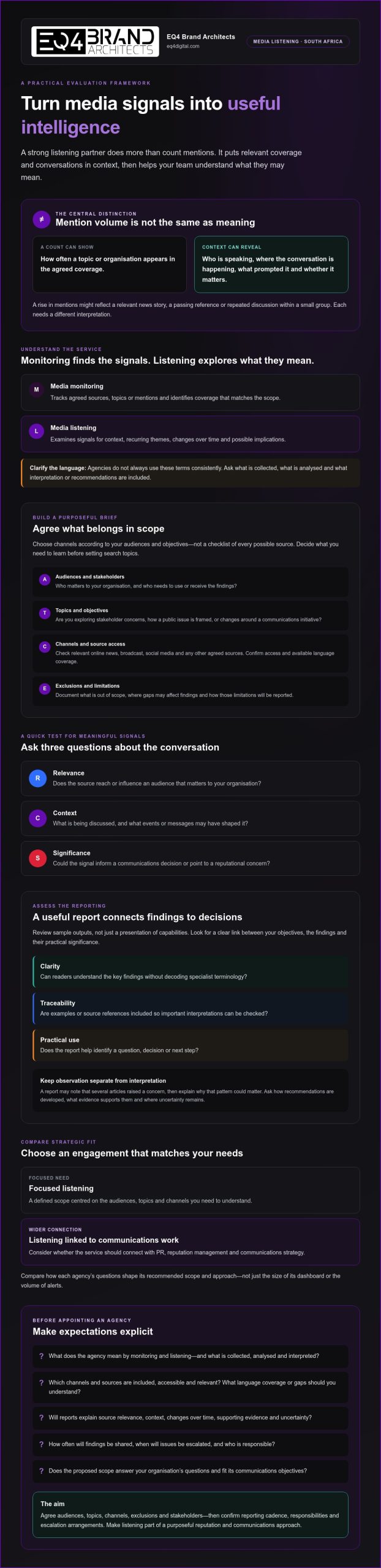
A useful service does more than count how often your organisation is mentioned. It helps you understand who is speaking, where a conversation is taking place, what prompted it and whether it has implications for your communications or reputation. A rise in mentions could reflect a relevant news story, a passing reference or repeated discussion within a small group. Each calls for a different interpretation.
This is the difference between collecting data and developing media intelligence: signals become useful when they’re considered in context and connected to a decision. A media listening agency South Africa organisations assess should explain how its approach will answer your specific questions, rather than treating mention volume as the result.
Media listening versus media monitoring: what is the distinction?
Monitoring generally means tracking agreed sources, topics or mentions and identifying coverage that matches the scope. Listening goes further by examining those signals for context, recurring themes, changes over time and possible implications. Agencies don’t always use the terms consistently, so ask what each means in the proposal. Clarify what is collected, what is analysed and what interpretation or recommendations are included.
Which conversations and channels should be in scope?
Choose channels according to your audiences and objectives, not a checklist of every possible source. Ask whether the proposed scope covers relevant online news, broadcast, social media and any other agreed sources. Confirm which sources are accessible, what language coverage is available and where gaps could affect the findings. Don’t assume a channel is included simply because an agency describes its service as comprehensive.
Before agreeing scope, decide what you need to learn. Are you looking for insight into stakeholder concerns, the framing of a public issue, or how coverage around a communications initiative is changing? Your answers help shape useful search topics and identify which conversations matter. They also reduce the risk of unrelated mentions obscuring signals that deserve attention.
- Relevance: Does the source reach or influence an audience that matters to your organisation?
- Context: What is being discussed, and what events or messages may have shaped the conversation?
- Significance: Could the signal inform a communications decision or point to a reputational concern?
These questions make the scope more purposeful. A considered brief should reflect organisational objectives, priority audiences and communications risks. Document what’s excluded as well as what’s included, and agree how limitations will be reported. That gives your team a clearer basis for interpreting findings and deciding whether to act.
How to Evaluate a Media Listening Agency’s Analysis and Reporting
A report earns its place when it helps someone make a better-informed decision. When assessing a media listening agency South Africa, look beyond attractive dashboards and large mention counts. Ask whether the findings respond to your brief. For example, do they clarify how a public issue is being discussed, or simply list coverage?
What makes a listening report useful to decision-makers?
Look for a clear connection between your objectives, the findings and their practical significance. If an agency supplies sample outputs, review them rather than relying on a presentation of capabilities alone. Check whether the report explains why sources matter, includes references or examples that let you trace an interpretation, and shows how themes changed during the period reviewed.
Useful reporting separates what was observed from what the agency has concluded. A report might state that several articles raised a particular concern, then explain why that pattern could matter. Those are different kinds of statements. Ask how recommendations are developed, what evidence supports them and where uncertainty remains. This makes it easier for your team to assess the findings rather than simply receive them.
- Clarity: Can a reader understand the key findings without decoding specialist terminology?
- Traceability: Are examples or source references provided to support important conclusions?
- Practical use: Does the report help identify a question, decision or next step?
Ask how findings will be shared and discussed. A communications lead may need detail on themes and sources, while senior decision-makers may need a concise view of implications and open questions. Confirm how the agency will adapt its reporting or discussions for the people who need to use the insight. Don’t assume a particular format or cadence is included.
How should an agency explain sentiment and emerging themes?
Ask how sentiment is assessed, what limitations apply and whether people review ambiguous cases. Irony, local context and a changing narrative can make a simple positive, negative or neutral label misleading. Ask for examples of how the agency handles such cases, if available. Theme summaries should show the evidence and context behind a pattern, rather than claiming that one event caused a shift without adequate support.
Use the conversation to assess how openly the agency discusses uncertainty. An honest explanation of what the data can and can’t show is more useful than confident language without a clear basis. If you’re considering how listening might sit alongside PR, reputation management and communication strategy, explore EQ4’s communications approach.
How to Compare Media Listening Agencies on Strategic Fit
The right partner isn’t necessarily the one proposing the broadest scope. Pay attention to the questions an agency asks before recommending what to track and how to interpret it. A thoughtful discussion starts with your organisation’s priorities, audiences and communications concerns, rather than a pre-set package of channels or features.
Does the agency understand your audiences and reputation context?
Notice whether the agency asks who you need to understand and what matters to those stakeholders. A useful discovery conversation might cover your business priorities, existing reputation concerns and the decisions you hope listening will inform. Audiences in South Africa shouldn’t be treated as a single group with uniform interests or behaviours. Discuss which audience distinctions matter to your organisation, and confirm how language, source access and other scope limits will be handled.
Priorities can shift, so ask how the scope could be reviewed if a new concern emerges or your communications objectives change. Clarify whether changes require a new agreement, who can approve them and how they may affect the work. This keeps listening aligned with your organisation’s needs without assuming every new conversation should automatically expand the brief.
Can listening connect with your wider communications work?
Listening can be more useful when findings are considered alongside public relations, reputation management and communications planning. Ask how an observation could inform those decisions and who would interpret it. For example, a pattern in coverage may prompt your team to review how an issue is being addressed. The agency should explain its role in identifying and interpreting that signal, while your organisation remains clear about who decides what action to take.
Before appointing a media listening agency South Africa organisations should establish a practical working arrangement. Agree who receives findings, who discusses them with the agency and which internal stakeholder owns follow-up. A simple outline of responsibilities can prevent an insight reaching a team without anyone knowing whether it needs a response. Understanding how listening connects to corporate reputation management in South Africa can help your organisation decide which capabilities to prioritise and how to structure that relationship.
- Agency responsibilities: Which agreed signals will it track, interpret or raise for discussion?
- Client responsibilities: Who provides context, answers questions and makes communications decisions?
- Shared arrangements: How will notable findings be discussed, and how can either team request a scope review?
Finally, separate confirmed capabilities from items that still need checking. Ask the agency to specify proposed channels, monitoring coverage, reporting cadence and escalation arrangements in the scope. Don’t assume that real-time alerts, sentiment analysis, competitor tracking, crisis response or communications execution are included unless explicitly confirmed. Aim for a clear fit between what the agency can provide, what your team needs and who is responsible for the next step.
What to Ask Before Appointing a Media Listening Agency
A clear brief gives you a better basis for comparing proposals and reduces the risk of mismatched expectations. Work through four steps: define the decisions the listening should inform, agree the scope, review the methodology, then confirm how you’ll work together. This helps a media listening agency South Africa understand what matters to your organisation before recommending an approach.
Which questions should your agency brief answer?
Start with the purpose. What decisions should the work help your team make? You might want to understand stakeholder concerns, follow discussion around a particular issue or inform communications planning. Be specific, then document the audiences, topics and channels relevant to those decisions.
Include practical context in the brief. Note the languages to consider, known sensitivities, topics or sources to exclude, and any existing concerns the agency should understand. Identify who will provide background, who needs to receive findings and who is responsible for deciding whether to follow up. Without those owners, useful observations can arrive without a clear route to action.
- Decisions: What should the listening help your organisation understand or decide?
- Scope: Which audiences, topics, channels and languages matter, and what should be excluded?
- People: Who will brief the agency, use the findings and take responsibility for next steps?
How can you make expectations clear before work begins?
Once the brief is defined, ask the agency to explain how it will approach the work. Review how sources and topics will be selected, how findings will be interpreted and what limitations could affect the results. Ask which proposed capabilities are confirmed and which need further checking. Don’t treat every feature mentioned in a discussion as part of the engagement.
Put the agreed scope and working arrangements in writing. Confirm the deliverables, reporting cadence, discussion points and how urgent observations will be communicated. Agree who contacts whom, how responsibilities are divided and what happens if a source is unavailable or the scope needs to change. These details distinguish an assumed service from an agreed one.
Set review points so the work can be reconsidered as priorities evolve. Discuss how either team can raise a change, who approves it and how the revised scope will be documented. A thoughtful brief makes room for adjustment without leaving expectations unclear. If you’re shaping an approach that connects listening with wider communications priorities, discuss a tailored communications scope with EQ4.
Choosing a Media Listening Agency That Turns Signals into Next Steps
The strongest choice is the agency whose approach fits your communications question, makes the agreed scope clear and explains how it reaches its interpretations. When assessing a media listening agency South Africa, look beyond promises of broad coverage. Consider whether the proposed work can help your team understand relevant signals and decide what to examine or do next.
The right level of support depends on the job. A defined listening brief may be enough to explore a particular issue or understand how a topic is being discussed. If insights need to inform ongoing reputation or public relations decisions, a broader communications relationship may be worth considering. Neither approach is automatically better. Choose according to your objectives, the expertise required and the responsibilities your team is ready to own.
When is a specialist listening engagement the right fit?
A focused engagement may suit a clearly defined question with an agreed audience, topic and timeframe. Before commissioning it, confirm that the agency can access relevant sources and has the expertise and capacity to interpret the brief. Agree what analysis is included, how findings will be shared and who in your organisation will assess any suggested next steps. A narrow scope can still offer meaningful insight when its purpose is clear.
When should listening sit alongside reputation or PR support?
Consider a wider partnership if your organisation expects listening to inform continuing communications decisions rather than answer one contained question. Ask which services are included in the proposed scope and which would need a separate agreement. Listening can inform PR or reputation management, but that doesn’t mean response planning or communications execution is automatically part of the engagement.
EQ4 Brand Architects offers Media Listening & Monitoring alongside public relations, reputation management and communication strategy. These services may be relevant if you’re considering how listening could connect with broader communications work. The suitable scope depends on your objectives and should be discussed rather than assumed.
Use an initial conversation to describe the question you need answered, the audiences and sources that matter, and how your team expects to use the findings. From there, you can clarify what a focused engagement or broader partnership might include, along with any capabilities that still need confirmation. Talk with EQ4 about media listening and explore what scope could suit your organisation.
Make listening a purposeful part of your communications
Choosing a media listening agency South Africa means looking for more than access to coverage. The right fit should bring thoughtful interpretation, a scope shaped around your objectives and clear agreement on how your team will use what it learns.
As you compare options, focus on the decisions you need to make and the people who will act on the findings. Confirm what’s included, how limitations will be explained and whether a focused engagement or wider communications partnership better reflects your needs.
EQ4 offers Media Listening & Monitoring alongside public relations, reputation management and communication strategy, serving businesses nationally across South Africa. Start with an open conversation about your priorities, the questions you need answered and what a suitable scope could involve.
Start a conversation with EQ4 about media listening. With a clear brief and a considered partner, you can turn relevant signals into more confident communications decisions.
Frequently Asked Questions
What does a media listening agency do?
A media listening agency tracks and interprets relevant conversations or coverage within an agreed scope. Depending on the brief, it may identify recurring themes, explain context and present findings to inform communications decisions. For example, a team could use coverage analysis to understand how an issue is being discussed rather than simply count mentions. Before appointing an agency, confirm which sources, channels, languages and outputs are included, how analysis is conducted and what falls outside the service.
What is the difference between media listening and media monitoring?
Providers use the terms differently, so ask each agency to explain its definitions. Monitoring commonly means tracking agreed sources, topics or mentions, while listening often emphasises interpreting their context and significance. Neither label guarantees a particular method or deliverable. Clarify which sources are covered, how findings are analysed and how the proposed work will support your organisation’s decisions before comparing services.
How do I choose a media listening agency in South Africa?
Choose a media listening agency South Africa organisations can work with by first defining the decisions the service should inform. Then compare source coverage, analytical methods, reporting clarity and communication arrangements. Ask how the agency will account for your audiences and organisational context. If a sample is available, review it for clear evidence and useful interpretation. Before appointing, document exclusions, responsibilities and how changes to the scope will be agreed.
Which media channels should a listening agency monitor?
The right channels depend on your audiences, objectives and brief. Possible sources include online news, broadcast media and social platforms, but access and coverage vary between providers. Ask which specific sources are included, what language coverage is available and how limitations will be explained. Confirm whether the scope can be adjusted if your priorities change, and don’t assume one agency covers every channel your organisation may need.
Can a media listening agency help manage a reputation issue?
A media listening agency can help your organisation understand relevant coverage and conversations, but listening alone isn’t automatically crisis management or response support. Ask whether the proposed service includes monitoring, analysis, communications advice or other agreed work. Clarify how notable findings will be raised, who makes decisions and who is responsible for follow-up. If you need reputation or PR support, establish whether that work is included or requires a separate scope.
How often should a media listening agency report findings?
Reporting frequency should suit the purpose of the work, the pace of relevant conversations and the decisions your team needs to make. A brief may call for scheduled summaries, agreed escalation arrangements or both. There’s no single cadence that suits every organisation. Discuss how findings will be shared, how urgent observations will be communicated and what availability is included, then record the arrangements so expectations are clear.
What should I include in a brief for a media listening agency?
Include the organisational question the work should address and the decisions it needs to inform. Specify priority audiences, topics, relevant channels and languages, along with known sensitivities and sources to exclude. Name the internal stakeholders who will brief the agency, receive findings and decide on follow-up. Ask the agency to state its assumptions and limitations, then agree deliverables, communication arrangements, responsibilities and review points before work begins.