





A negative customer review can shape how people judge your organisation before they speak to your team. Knowing what to do after negative customer reviews starts with treating each comment as both an individual concern and a signal about stakeholder confidence. Respond with care, address the specific issue and make only commitments the organisation can keep.
For senior leaders, the challenge is rarely just the wording of a reply. A complaint may expose a gap between stated standards, operational decisions and customers’ actual experiences. Handling it well means understanding the issue, responding constructively and deciding whether it points to a wider risk or service weakness.
Use a consistent process to assess the review, respond appropriately and decide whether a private conversation would help. Then look for recurring feedback, consider the implications for reputation and loyalty, and connect communication decisions to action inside the organisation.
Key Takeaways
- Respond to the concern itself, not just the rating, with a courteous and specific reply.
- Set out a practical next step and move sensitive or complex details into a private conversation.
- Track repeated complaints to identify service or process issues that need attention.
- Use review themes to guide improvements and assess whether customer experience is changing.
- Consider how public responses shape confidence among customers and other stakeholders who read them.
1. Responding quickly to negative reviews
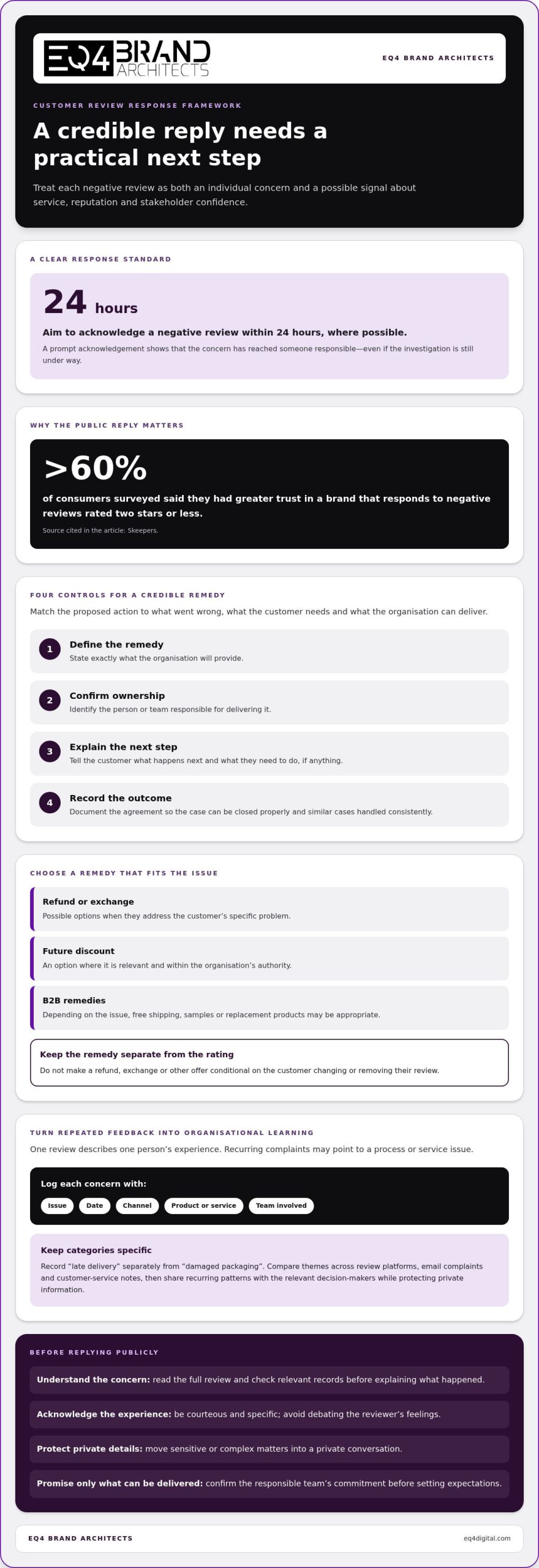
Set a clear internal standard: respond to a negative review within 24 hours where possible. A prompt acknowledgement shows that the concern has reached someone with responsibility, even if the investigation is still under way. Knowing what to do after negative customer reviews means preparing staff to respond consistently, rather than leaving each employee to improvise under pressure.
Before drafting a reply, read the full review and identify its central concern. Separate what the customer experienced from assumptions about why it happened. Check relevant records, speak with the team involved and confirm what can be shared publicly. If a delivery was late, for example, establish whether the delay occurred during dispatch or after handover before explaining the situation.
Listening actively means showing that you have understood the particular issue. Thank the reviewer for raising it, acknowledge the effect on their experience and avoid debating their feelings. If the organisation made an error, say so plainly and explain what you’re doing next. According to Skeepers, more than 60% of consumers said they had greater trust in a brand that responds to negative reviews rated two stars or less.
Remember that a public reply is also read by people deciding whether to engage with your organisation. Keep it courteous and specific, and never disclose personal or account details. If a private conversation would help, provide a named contact and a direct way to reach them. Your process for what to do after negative customer reviews should also clarify who investigates complaints and approves sensitive replies.
How can you tell whether a negative review violates Google review policies? A low rating or harsh opinion alone doesn’t indicate a policy breach. Compare the review with Google’s stated policies, and report it only when you can identify a specific concern, such as apparent spam or content unrelated to a genuine customer experience.
Report or dispute a review when you have a clear, policy-based reason, not simply because you disagree with the criticism. Keep a record of the review and your reason for reporting it. This helps the organisation track the issue and respond consistently if needed.
For fake, abusive or potentially defamatory reviews in South Africa, preserve screenshots and relevant records, report suspected policy breaches through the platform, and avoid escalating the exchange publicly. The European Union describes a fake review as one that doesn’t reflect an actual consumer’s honest, impartial opinion or genuine experience. For serious allegations that may harm your organisation, seek legal advice before making public claims about the reviewer.
2. Offering concrete solutions or compensation
A useful remedy addresses the practical consequence of the complaint, not just the tone of the exchange. Match the proposed action to what went wrong, what the customer needs and what the organisation can deliver. If a service booking was cancelled without a suitable alternative, for example, offer a replacement appointment that meets the customer’s needs rather than an unrelated discount.
Can a business offer a refund or compensation in response to a negative review? Yes. Depending on the issue, a business may offer a refund, an exchange, a future discount, or, in a B2B relationship, free shipping, samples or replacement products. Choose a remedy that is relevant and within the organisation’s authority to provide.
Keep the remedy separate from the public rating. Don’t make a refund, exchange or other offer conditional on the customer changing or removing their review. The aim is to address the problem fairly, not to buy a more favourable public response. Recording the decision also helps staff handle similar cases consistently.
Before committing, check the facts that determine whether a proposed solution will work. Confirm which product or service was involved, what outcome the customer wants, and which team can authorise and deliver the remedy. For a damaged item, an exchange may be more appropriate than a discount on a future purchase. For an interrupted business order, replacing the affected goods may better address the disruption.
- Define the remedy: state what the organisation will provide.
- Confirm ownership: identify the team or person responsible for delivery.
- Explain the next step: tell the customer what action they need to take, if any.
- Record the outcome: document the agreement so the case can be closed properly.
Put the offer in writing, especially when several teams need to act. If a replacement requires the customer to return an item, explain the process and who will coordinate it. If the remedy depends on another department, secure its commitment before promising a delivery date. This reduces the risk of a second disappointment caused by an unfulfilled promise.
After resolving the individual case, consider whether the remedy addresses a wider service weakness. Repeated requests for the same exception may indicate that a process is creating avoidable friction. Share the pattern with the relevant decision-makers, while protecting the customer’s private information.
Where the response needs to align with broader public communication, strategic public relations can help maintain a clear and considered organisational voice.
3. Turning recurring feedback themes into business actions
One review describes one person’s experience; repeated complaints may point to a process problem. Create a shared log for reviews, email complaints and customer-service notes. Record the issue, date, channel, product or service, and team involved. For example, distinguish “late delivery” from “damaged packaging” rather than grouping both as delivery complaints.
Review the log regularly and compare themes across channels. If customers repeatedly mention unclear appointment updates, check the booking messages and the handover between scheduling and service teams. The goal is to find where the customer experience breaks down, not to assign blame based on one comment.
Feedback also reflects expectations and emotions. A customer who has spent time resolving a billing error may feel dismissed if the response addresses only the amount. Someone waiting for an update may value a clear explanation and a named contact. Consider what the customer expected, what happened and whether the process gave them a fair way to raise the issue.
- Group the issue: identify a specific theme, such as unclear charges or repeated delays.
- Find the process: trace the customer journey and identify where the problem occurs.
- Assign an owner: name the team responsible for investigating and acting.
- Set a measure: track whether the same complaint continues after a change.
Acknowledge the concern publicly without assuming every report has the same cause. If several customers describe confusing invoices, say the feedback has been recognised and the billing process is under review. Then share specific examples with the relevant team, removing personal details.
Turn the pattern into a practical action. If customers struggle to find delivery updates, simplify the message and make the next step clearer. If reports point to recurring product quality problems, investigate the affected process rather than relying on apologies. Assign responsibility, record the change and brief staff who handle customer queries.
Measure whether the action addresses the underlying concern. Compare the volume and nature of similar complaints before and after a process change, alongside direct customer feedback. If reports shift from “no update” to “update arrived too late”, the response may need further adjustment. Share findings with decision-makers, then refine the process based on customers’ continuing experiences.
Recurring themes in negative reviews can help businesses identify weaknesses and improve customer experience. When the same product problem appears repeatedly, treat it as a possible sign of an underlying issue and investigate instead of responding to each review in isolation. Look for evidence about where the problem originates, then use customer feedback to decide whether the process or product needs attention. The aim is to learn from the pattern, not dismiss it as a series of separate complaints.
Customer feedback should lead to operational changes that help prevent the same issue from recurring. If a product has ongoing quality problems, it may need improvement before responses to negative reviews can be effective. Businesses can also make product changes in response to legitimate criticism. After making a change, continue listening for reports about the same concern and assess whether the adjustment has worked. If the problem persists, investigate further. A response is more credible when it is accompanied by action on the issue customers raised.
4. How influential are online reviews?
Online reviews can shape whether prospective customers consider an organisation before making direct contact. In a 2022 BrightLocal survey, 79% of consumers said they trusted online reviews as much as personal recommendations. A review thread is therefore more than a private exchange: it can influence expectations among people assessing your business.
Take a complaint offline when resolving it requires account details, a detailed investigation or a sensitive conversation. Keep the public response visible and helpful so the customer doesn’t feel dismissed. Acknowledge the concern, then explain that you’d like to discuss the specifics directly, by phone, email or in person.
For example, a customer might say that a service charge differs from the amount they expected. Reply publicly that you recognise the billing concern and invite them to contact a named team member. Don’t ask them to post account numbers, addresses or other personal details in the review thread.
Use a clear handover so the customer knows what happens next:
- Acknowledge the issue publicly: refer to the concern without repeating sensitive details.
- Offer a direct channel: provide an appropriate contact name and method.
- Continue the discussion privately: listen, establish the facts and agree a practical next step.
Complex complaints need a considered conversation, not a rushed exchange in public comments. A disputed service history, several interactions or a confidential account matter may require a staff member to review records first. Tell the customer who will follow up and what information would help resolve the issue.
Taking the discussion offline doesn’t mean abandoning public accountability. Once the matter has been addressed, post a brief update where appropriate, without disclosing private information. For instance, confirm that you discussed the complaint directly and took steps to address it. This shows other readers that the concern received attention.
Keep records of the public review, private contact and agreed action. If the customer doesn’t respond, don’t publish repeated requests for their details. One composed invitation and a clear way to discuss the issue are more respectful than a public back-and-forth.
After the conversation, check whether the resolution met the customer’s expectations and whether the complaint points to a wider service issue. A private exchange may resolve an individual case, while a recurring concern may need broader operational attention.
5. The impact of reviews on business reputation and loyalty
Reviews influence both immediate choices and the longer-term confidence people place in an organisation. In BrightLocal’s 2021 survey, 77% of consumers said they always or regularly read online reviews when browsing for local businesses, up from 60% the year before. That makes each public response part of the evidence potential customers use to judge how a business treats people.
One negative review rarely tells the whole story. Look for patterns: repeated complaints about missed updates, for example, may signal a gap between the organisation’s promises and customers’ experiences. If the business responds constructively and changes the process, it demonstrates accountability. Ignoring similar concerns may weaken confidence beyond the original reviewer.
Reviews also shape expectations before a customer makes contact. A credible mix of feedback can offer a more balanced picture than a page showing only praise. Customers may have greater confidence when an organisation’s public record includes honest criticism and thoughtful responses.
To assess whether review handling supports reputation and loyalty, track indicators that connect public feedback with customer outcomes:
- Response quality: assess whether replies address the specific concern and explain a next step.
- Resolution: record whether the customer’s complaint was addressed after follow-up.
- Recurring themes: compare complaint patterns over time to see whether operational changes are helping.
- Customer sentiment: ask customers directly whether the response met their expectations.
How can you measure whether your response to a bad review improved customer satisfaction? Ask the customer directly once the issue has been handled, and record whether they consider it resolved. Then compare recurring complaint themes and follow-up feedback over time, rather than treating a changed star rating as proof on its own.
Treat this as a prompt to resolve the underlying issue, not as a promised outcome. A sincere response can support the relationship, but lasting loyalty depends on whether the experience improves.
For organisations facing repeated public criticism or inconsistent responses, discuss your reputation challenge and the communications changes that could help address it.
EQ4 Brand Architects: Reputation Management
EQ4 Brand Architects helps organisations address reputation challenges through strategic Reputation Management, connecting public responses with stakeholder confidence and organisational priorities. Turn to this work when negative reviews are recurring, responses differ across teams, or complaints point to a wider trust issue.
The approach can bring review themes into a clear communications strategy, helping leaders align what they say with the actions customers experience. Public Relations (PR) can support consistent, considered communication, while Brand Activations can help organisations create meaningful engagement with audiences. The right response depends on the issue, the stakeholders involved and the operational changes needed.
If your organisation is facing a difficult review pattern or a broader reputation challenge, contact EQ4 Brand Architects or visit eq4digital.com to discuss the next step.
Make trust part of how you work
A durable answer to what to do after negative customer reviews is to make learning from them part of everyday decision-making. Give teams a clear route to escalate serious concerns, share customer insight with people who can act, and report back on changes. This turns reputation care from a series of isolated replies into an organisational practice.
For senior leaders, the next step is to assess whether public responses, customer service and operational decisions are aligned. If they aren’t, a polished reply won’t resolve the gap. A deliberate approach helps ensure that what the organisation says reflects stakeholders’ experiences, while giving decision-makers a clearer view of emerging risks and opportunities.
EQ4 Brand Architects can support organisations addressing reputation challenges through strategic communications. Contact EQ4 Brand Architects to discuss the challenge your organisation is working through. A thoughtful response can be the beginning of stronger, more consistent relationships.
Frequently Asked Questions
How influential are online reviews?
Online reviews can influence whether potential customers shortlist a business, especially when they have little direct experience to guide them. Readers often assess the detail and consistency of comments, not just the overall rating. A review describing a specific service issue may carry more weight than a general complaint. Consider how the full record, including the organisation’s replies, reflects its standards and customer relationships.
How should a business respond to a negative customer review?
Respond calmly and directly to the customer’s specific concern, without arguing about their experience. Check the facts before explaining what happened, and don’t disclose private account or personal information. If the issue requires investigation, say what the organisation is doing next without suggesting it is already resolved. Keep the reply consistent with the service the business can provide.
How quickly should you reply to a negative review?
Reply once you’ve reviewed the concern, rather than waiting for every detail of an investigation. If the facts are still being checked, post a brief acknowledgement and explain that the appropriate team is looking into it. Follow up with a substantive response when you can. This shows prompt attention without jumping to conclusions, and helps prevent silence from being mistaken for indifference.
How can you take a customer complaint offline and resolve it?
Invite the reviewer to continue through a suitable private channel, such as email or phone, and provide a named contact. Don’t ask them to share personal or account details in the public thread. During the conversation, clarify the outcome they’re seeking, review relevant records and agree who will take the next action. Document the resolution afterwards and close the loop with the customer.
How can businesses learn from negative reviews and prevent repeat complaints?
Compare review themes with complaints received through customer service, email and other feedback channels. This can reveal whether a concern is isolated or part of a wider breakdown in the customer journey. For example, repeated confusion about service terms may point to unclear information before purchase. Assign an operational owner to investigate, make a defined change, and monitor whether the same issue continues to arise.