





A product recall can protect consumers while exposing an organisation to serious reputational risk. Effective public relations for a product recall means coordinating with legal, regulatory and operational teams, then sharing clear, consistent updates with affected customers, employees, retailers and the media. People need to know what is affected, what action to take and where to find reliable updates.
The balance matters: slow or conflicting communication creates room for uncertainty and misinformation, while unverified claims can add risk. This article explains how teams align public statements with verified recall information, monitor public discussion and keep updates useful as facts emerge. It also covers the limits of PR, common messaging risks and ways to review the response and support stakeholder confidence.
Key Takeaways
- Coordinate messages with legal, regulatory and operational teams so public updates remain accurate as the response develops.
- Align communication with retailers and supply-chain partners, giving them clear information to support consistent updates to affected customers.
- Monitor public discussion for misinformation and respond with timely, verified information through an authoritative channel.
- Make recall updates easy to find and keep a record of communications, actions and emerging questions.
- Assess wording for both consumer clarity and legal risk, showing concern for those affected without making unsupported claims.
Part 11: What is the Role of the Public Relations Department in the Product Recall Process?
During a recall, public relations connects verified product information with the people who need to act. Effective public relations for a product recall aligns retailers, suppliers, customers, employees and media around clear, consistent communications.
Retailer and supply-chain communications
PR coordinates recall messages with retailers and supply-chain partners, using product details confirmed by operational teams. Retailers need the same description of affected products and customer guidance as the manufacturer.
Start with a shared notice that identifies the product, explains the issue, states the requested action and gives an approved contact point. Ask distribution and retail teams to share it through their established channels, then record questions and responses. PR supports communication; operations manages distribution and product handling.
Customer and media messaging
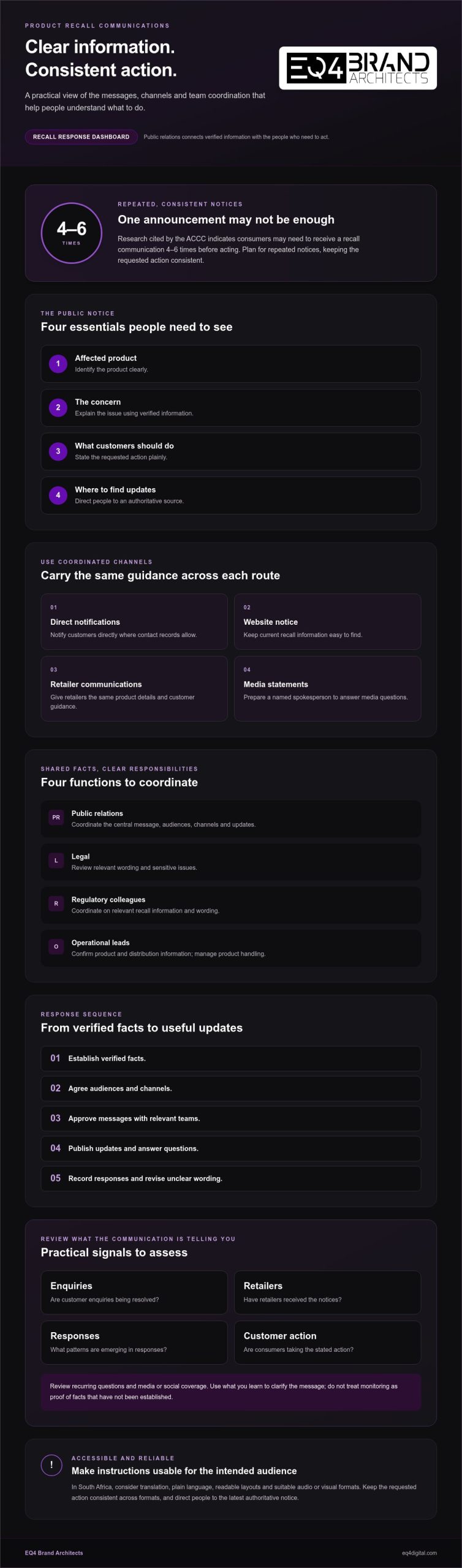
Customer and media messaging should give people clear recall information and practical next steps across channels. A public notice should identify the affected product, explain the concern, tell customers what to do and direct them to an authoritative source for updates.
Use direct customer notifications where contact records allow, alongside website notices, retailer communications and media statements. Keep the message prompt, concise and consistent, and prepare a named spokesperson to answer media questions. Recall communication costs vary with product complexity, audience size, geographic reach, customer-data quality and the channels required.
Research cited by the ACCC indicates consumers may need to receive a recall communication 4-6 times before acting. Plan for repeated, consistent notices, rather than treating one announcement as sufficient.
Accessible recall communications
Accessible recall communications present safety information in formats and language that people can understand and use. In South Africa, consider translation, plain language, readable layouts and appropriate audio or visual formats for the intended audience.
For example, pair a short written notice with a clear visual showing where to find a product identifier. Ask community-facing teams to flag confusing phrases, then revise them before publication. Keep instructions consistent across formats so translation or adaptation does not change the requested action.
Crisis team planning and responsibilities
A recall crisis team should assign decision-making, fact-checking, customer response and spokesperson roles before public communication begins. Establish verified facts, agree on audiences and channels, approve messages with relevant teams, publish updates and record responses.
PR should prepare a central message document and a process for updating it as facts change. Legal and regulatory colleagues review relevant wording; operational leads confirm product and distribution information. This division helps spokespeople respond to media questions and social criticism with verified facts, acknowledge consumer concerns, correct false claims calmly and direct people to the latest notice.
Assess communication effectiveness using practical signals: customer enquiries resolved, retailer receipt of notices, response patterns and whether consumers take the stated action. Review recurring questions and media or social coverage, then revise unclear wording. Documenting these steps shows where communication reached people and where further clarification was needed.
Social media monitoring and misinformation response
During a recall, social media can surface consumer reports, rumours and practical questions before they reach formal channels. A defined monitoring process helps the organisation decide which signals need investigation, which require correction and which reveal gaps in public information. The aim is not to suppress criticism, but to identify relevant information and support informed decisions.
Monitor, assess and escalate
Track product names, model details, common misspellings and descriptions of the reported issue across relevant platforms. Record each post, date, source and claim, then categorise reports as potential injury, product identification, misinformation or general concern. This makes emerging patterns easier to distinguish from isolated comments and gives operational teams specific information to assess.
Preserve screenshots or links to significant posts before they disappear or change. A single post does not prove a widespread fault, but may contain details worth examining. Route reports of harm and new product information to the investigation lead; send media enquiries to the spokesperson. Use monitoring insights to identify confusing wording, not to infer facts the organisation has not established.
First statements and public questions
A holding statement should give people a safe, practical starting point: identify the affected product, state the current action and direct readers to an authoritative source. A customer FAQ can address questions people are actually asking, such as how to distinguish a recalled model from a visually similar item. Label developing information clearly and revise answers when evidence changes.
Respond selectively. Correct a false claim if it could lead people to use an affected product or overlook recall instructions. If a post raises a genuine concern, acknowledge it and explain how the organisation is assessing it. Avoid arguing with individual critics or repeating harmful claims in ways that give them wider visibility.
Coordinate legal and crisis responses
Agree on an escalation route before public criticism intensifies. Monitoring staff can flag posts, technical leads assess product details, legal advisers review sensitive issues and an authorised spokesperson handles public responses. This division helps prevent a hurried social reply from contradicting formal communications or suggesting a cause still under investigation.
Keep a decision record showing which claims were reviewed, what evidence informed the response and why a post received a correction or no reply. Review repeated questions with customer-service and operational teams, then adjust guidance where needed. A media listening approach can help organisations turn public signals into more informed communication decisions.
Coordination between PR, legal, and regulatory teams
Recall decisions involve evidence, regulatory processes and public understanding. A clear coordination model lets teams contribute their expertise without creating competing accounts or delaying necessary decisions.
Regulatory reporting and coordination
Regulatory coordination is the structured exchange of verified information between an organisation and relevant authorities. It matters because reporting, operational decisions and public statements need to reflect a consistent account of the situation.
Appoint one regulatory liaison to manage submissions and incoming requests. Technical leads provide the underlying product evidence, legal advisers assess reporting considerations and PR tracks public implications. Keep a decision record showing the evidence used, who reviewed it, what remains unresolved and which version was shared. This gives the team a traceable basis for future updates.
Separate confirmed findings from working hypotheses in internal records. For example, do not describe a suspected component issue as the established cause until the investigation supports that conclusion. If an authority requests clarification, route it to the relevant evidence owner, record the response and brief decision-makers who rely on it. This helps prevent informal answers from diverging from submitted information.
Legal and regulatory obligations
Applicable obligations depend on the product, the circumstances and the governing regulatory framework. Legal and regulatory specialists should identify the relevant processes; PR should make resulting public information understandable and useful. Communication planning cannot replace required reporting or operational action.
For a South African recall notice, give consumers enough detail to identify the product, understand the concern and know what action to take. Include relevant identifiers, such as a model or batch where applicable, and a clear contact or information route. Requirements depend on the product and situation, so a generic notice should not be presented as a universal legal template.
Use an approval matrix to show which decisions need technical, legal, regulatory or executive review. Define who can approve factual corrections, public wording and changes to the response. When roles are unclear, a minor edit can stall, while a significant change might be published without appropriate review.
Keep a controlled record of each approved notice, its evidence, reviewers and release decision. When reviewers disagree, document the unresolved point and assign someone to resolve it. This preserves accountability and helps leaders distinguish a genuine evidence gap from an approval delay, without using legal caution as a reason to leave consumers without useful information.
Real-time recall information and reporting
The first 48 hours are important for product-recall crisis management, as information can change while teams assess reports and distribution records. A shared reporting view helps leaders distinguish confirmed developments from open questions, assign follow-up and see whether communications are reaching the intended audiences. Without that view, teams may act on different versions of the same situation.
Inform priority audiences and maintain a record
Regulators, retailers and affected customers are priority audiences during a product safety crisis or recall. Record when each group was contacted, what information they received and whether follow-up remains outstanding. Statuses such as “sent”, “acknowledged” or “action required” give decision-makers a clearer picture than a general note that notifications are under way.
Use one live record for product identifiers, evidence status, decisions, questions and owners. Timestamp each change and distinguish new evidence from corrections to earlier records. For example, if a distribution report changes the affected product range, the log should show who validated the revision and which teams need the updated information.
Keep online information current
Make the recall notice easy to find on the organisation’s website and label it with its latest update date. Keep it on a stable page rather than relying only on social posts that can quickly move down a feed. This gives customer-service staff, retailers and journalists one reference point for answering questions and sharing updates.
Coordinate online updates with relevant regulators and retailers, keep copies of notices and record where each version appeared. If a refund or other remedy is part of the response, keep its instructions current alongside product-identification details. A named page owner should check that links work, earlier wording is clearly superseded and contact routes reach the right team.
Report progress, not just publication
Measure more than whether a notice has been posted. Track retailer acknowledgements, customer enquiries by topic, unresolved requests and reported difficulties identifying affected products. These signals show where people may need clearer guidance; page views alone cannot establish whether consumers understood or acted on the message.
Give leaders a concise update separating completed actions, open issues and decisions needed. For example, report that a retailer received a revised notice but has not acknowledged it, rather than marking the task complete when it was sent. Review the record as information changes, retain earlier versions and assign owners to outstanding work. This supports assessment of communication coverage and improvements to future reporting.
Product recall risks and liability
A recall can address a product safety concern, but the organisation’s response may create separate reputational risks. A product issue does not, by itself, prove that production processes or safety protocols were ineffective. The communication challenge is to act on verified information, show concern for affected people and avoid claims unsupported by evidence.
Common public relations mistakes include delaying a clear update, minimising consumer harm, giving conflicting explanations, speculating about the cause and making promises the organisation cannot keep. These choices can undermine confidence and give inaccurate claims more room to spread. If retailers and customers receive different descriptions of an affected product, for example, they may struggle to identify whether their item is included.
Balance candour with legal review
Organisations may worry that an apology or explanation could be read as an admission of liability. Legal review should assess that risk while communications teams keep essential product and consumer guidance understandable. Acknowledge reported inconvenience or harm, state verified facts and avoid assigning a cause before the investigation establishes it.
Use a disciplined review sequence: technical teams validate product details, legal advisers assess sensitive wording and an authorised spokesperson approves public statements. Record the evidence, decisions, notice versions and customer or retailer communications. This allows the organisation to explain how its position developed instead of relying on recollection after the response.
Prepare for operational and reputational exposure
Recall risk extends beyond public criticism. Organisations may need to manage customer enquiries, retailer coordination, product handling, investigation costs and potential claims. Keep records of recall-related costs and actions, including communications with customers, distributors, users and the public. These records can support insurance processes and claims involving responsible suppliers or component manufacturers.
Preparation makes those responsibilities easier to coordinate. Maintain a recall plan that identifies decision-makers, information owners, spokespersons and approval routes. Regular mock recalls can expose gaps in product traceability, customer records or escalation procedures before a live incident tests them. Financial impact assessments and consideration of recall insurance or reserve funds can also inform organisational readiness.
Protect trust through accountable action
A prompt voluntary recall can demonstrate concern for consumers, but communication must match operational action. When an organisation announces a safety measure, relevant teams need to know who owns it, how progress will be tracked and how updates will reach affected audiences. After the recall, review customer questions, response records and process changes to identify practical improvements.
For organisations strengthening recall readiness, discuss a reputation and crisis communications challenge with a strategic communications adviser.
EQ4 Brand Architects: Reputation Management
EQ4 Brand Architects helps organisations align reputation management with clear, coordinated communications when a product recall puts stakeholder confidence at risk. Its Public Relations (PR) and Communication Strategy support leaders in shaping consistent messages, clarifying responsibilities and responding to changing concerns. Where public understanding needs support, Brand Activations can form part of a broader, purposeful engagement approach.
Seek strategic communications support when teams are working from fragmented messages, public questions are escalating or the organisation needs a considered plan beyond the initial announcement. The task is not simply to issue statements. It is to connect communication decisions with consumer needs, organisational action and stakeholder confidence over time.
If your organisation is preparing for a recall or strengthening its reputation response, contact EQ4 Brand Architects to discuss the challenge.
Make recall readiness part of organisational practice
Trust depends not only on how an organisation responds, but also on what it learns and changes afterwards. Treat recall readiness as an ongoing governance capability: review decision rights, test whether teams can access current product information and check that communication responsibilities remain clear as suppliers, channels and audiences change. Include these questions in risk discussions to identify gaps before a product issue demands urgent decisions.
For senior leaders, the next step is to connect public relations for a product recall with wider risk planning and organisational learning. A post-incident review should identify where decisions slowed, which stakeholder needs were missed and what process changes could reduce friction next time. Assign owners to those actions and revisit them through existing risk and communications governance rather than leaving lessons in a report.
EQ4 Brand Architects can help organisations consider how communication supports stakeholder confidence and purposeful action. Discuss your recall communications and reputation priorities with EQ4 Brand Architects, and take a considered step towards stronger organisational readiness.
Frequently Asked Questions
How should a brand handle a product recall?
Put consumer safety and clear decision-making ahead of image management. Bring operational, legal and communications leads together, agree who can approve action and keep one record of confirmed product details. For example, if customer reports identify a product variant missing from the initial scope, route that evidence to the investigation lead before changing public guidance. Then assess whether staff, distributors and service teams can answer questions consistently.
How should a crisis response run in the first hour, day and week?
Use the first hour to establish decision-makers, assess immediate safety reports and agree what can be stated accurately. During the day, coordinate staff, retailer and customer updates, and log new evidence. Over the following week, review recurring questions, progress and unresolved issues, then refine communication. These are planning intervals, not universal legal deadlines; the product, risk and applicable regulator’s process determine the actual response.
What does a crisis communications plan contain?
A useful plan sets out who declares an incident, who approves messages, how subject experts verify facts and who speaks publicly. It should also include an escalation route, stakeholder contact categories, message templates, a record-keeping method and a process for correcting outdated information. Test the plan with a scenario, such as a retailer receiving a customer complaint before the central team confirms which product is affected.
What is a Product Recall PR Plan and why do companies need it?
A Product Recall PR Plan is a prepared framework for communicating with people affected by a suspected or confirmed product issue. It helps an organisation avoid starting from scratch under pressure by clarifying roles, audiences, approvals and update processes. It should connect communication planning with operational investigation, not replace it. Review the plan when products, distribution routes or internal responsibilities change.
What is crisis PR?
Crisis PR is the strategic management of communication during an event that threatens stakeholder confidence, organisational reputation or public understanding. It involves assessing audiences, preparing accurate messages, advising spokespeople and responding as information develops. During a recall, the aim is not to make criticism disappear. It is to help people understand the issue, the organisation’s response and where to find reliable information.
What kinds of crises does crisis PR cover?
Crisis PR can support communication about product safety concerns, service failures, operational disruption, leadership conduct, cyber incidents or public criticism. The response depends on the event and affected stakeholders. A product concern may require clear customer guidance, while operational disruption could call for updates to employees, suppliers and service users. One template will not suit every situation.
How should companies coordinate recall communications with the National Consumer Commission and other regulators?
Identify the relevant regulator for the product and sector, then appoint a lead to coordinate evidence, correspondence and updates. For the National Consumer Commission or another applicable authority, keep public messages aligned with verified information shared through the appropriate regulatory process. Record submissions, requests and decisions, and ensure operational, legal and communications teams use the same current facts.
Which channels are most effective for reaching customers during a product recall?
The right channel mix depends on how customers bought the product and whether the organisation can identify them. Use direct email or SMS where reliable customer records allow targeted notices, alongside retailer communications, a prominent website notice and media updates for broader awareness. Monitor questions by channel. If people cannot find product-identification details or instructions, revise the message and distribute a clearer version.