





What is the value of proactive reputation management if it cannot prevent every crisis? It helps your organisation understand stakeholder concerns, make considered decisions and respond with greater clarity when pressure rises. Listening tools can surface concerns, but a stream of alerts does not tell leaders what to prioritise, who needs to hear from them or what action to take.
That tension is familiar to senior teams. Reputation work can become fragmented, with monitoring, stakeholder engagement and communication operating on separate tracks. Across South Africa, organisations answer to stakeholders with different experiences, priorities and ways of accessing information. Consistency and sound judgement matter, but criticism cannot always be prevented, and preparation should not promise that it can.
This article explains how proactive and reactive reputation work complement each other, and how listening can inform practical preparation and more intentional communication. It offers a way to connect stakeholder needs to decisions, build readiness into everyday communication and assess progress through relevant indicators, not attention metrics alone. The aim is a coherent approach that supports confidence without mistaking silence for trust.
Key Takeaways
- Distinguish ongoing reputation work from crisis response, brand promotion and isolated online review activity.
- Give listening a clear purpose by assigning ownership, setting escalation routes and using context to prioritise signals.
- Use proactive reputation management to connect stakeholder insight with intentional communication and practical preparation, without expecting it to prevent every crisis.
- Assess communication activity, stakeholder response and organisational readiness separately. Choose indicators that reflect meaningful action rather than attention alone.
- Connect reputation management with stakeholder advisory, PR and communication strategy to bring senior advice and practical execution together.
What proactive reputation management means, and what it cannot promise
Proactive reputation management is the planned, ongoing work of listening to stakeholders, communicating with intention and preparing for issues so an organisation can build and sustain confidence over time. It is not a promise that criticism or disruption can be avoided.
Crisis response addresses a specific incident and the decisions required as it unfolds. Reputation management is broader: it considers how an organisation’s conduct, communication and relationships shape stakeholder expectations before, during and after an issue. It is not simply brand promotion or a routine of replying to online reviews. This wider perspective is also explored in How to Build a Resilient Corporate Reputation in the Age of Digital Scrutiny.
Proactive and reactive reputation management serve different purposes
Both forms of work belong in a credible organisational approach. Preparation helps teams recognise emerging concerns, understand who is affected and establish how decisions will be made. Response addresses the situation that has occurred, including legitimate criticism that planning cannot erase.
- Proactive: Before an incident, teams listen for stakeholder concerns, clarify roles and prepare decision routes and communication principles.
- Reactive: During or after an incident, accountable leaders assess the facts, decide what action is appropriate and communicate with affected stakeholders.
Ownership may shift as an issue develops, but it should be clear who assesses signals, who escalates them and who has authority to act. Preparation can reduce avoidable surprises. It cannot guarantee a crisis-free future or make negative feedback less valid.
Reputation forms through repeated organisational signals
Stakeholders form expectations from what an organisation does as well as what it says. Decisions about service, employment, procurement, public commitments and community engagement all send signals. When communication matches conduct, people have a clearer basis on which to assess the organisation. When actions and claims diverge, confidence can weaken.
A headline, review or social media exchange may influence perception, but none represents an organisation’s entire reputation. The pattern across repeated interactions matters, as does how different stakeholders experience the organisation. Leaders should therefore consider whose views are visible, whose are missing and where experiences differ.
How proactive reputation management becomes an ongoing communication system
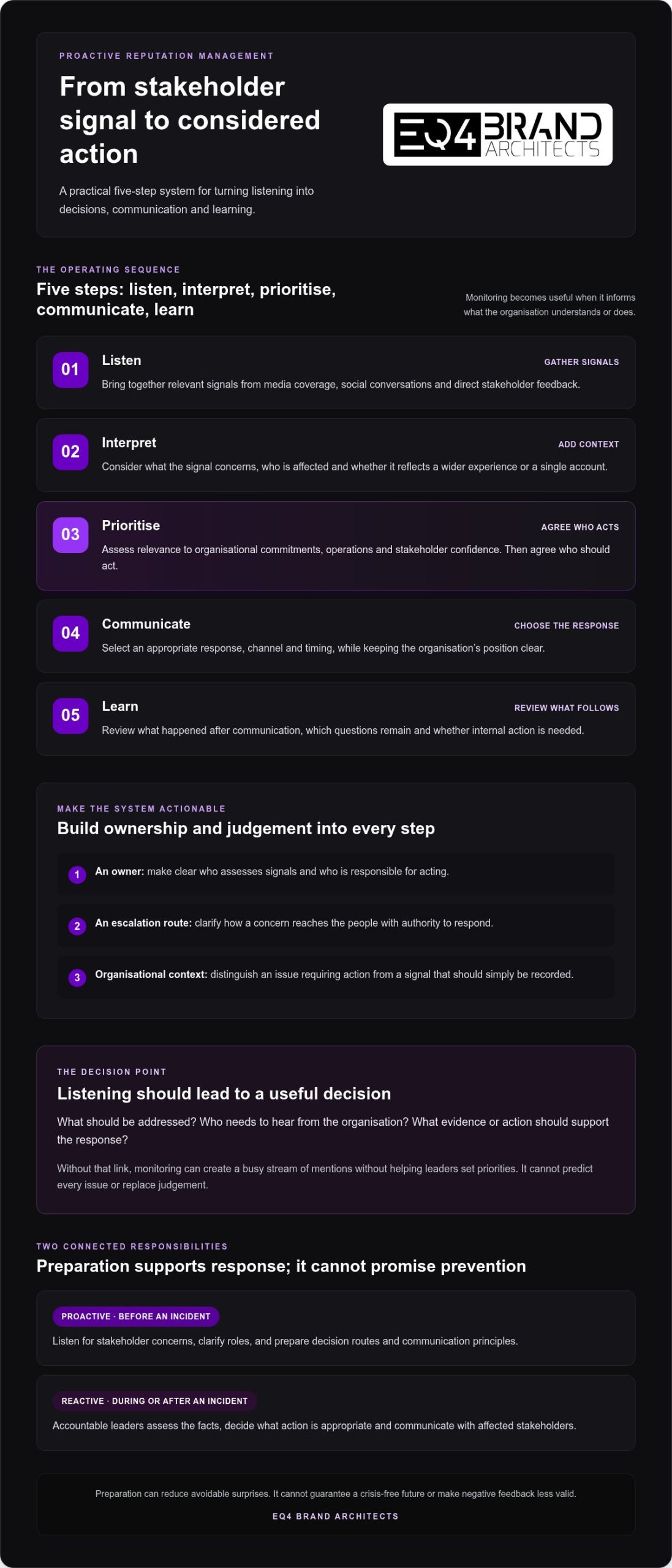
Monitoring becomes useful when it changes what an organisation understands or does. A practical system connects five steps: listen, interpret, prioritise, communicate and learn. Each step needs an owner, an escalation route and enough organisational context to distinguish an issue requiring action from a signal that should simply be recorded.
- Listen: Gather relevant signals from media coverage, social conversations and direct stakeholder feedback.
- Interpret: Consider what the signal concerns, who is affected and whether it reflects a wider experience or a single account.
- Prioritise: Assess its relevance to organisational commitments, operations and stakeholder confidence, then agree who should act.
- Communicate: Choose an appropriate response, channel and timing, keeping the organisation’s position clear.
- Learn: Review what happened after communication, what questions remain and whether internal action is needed.
Listening matters when it informs a decision: what to address, who needs to hear from the organisation and what evidence or action should support the response. Without that link, monitoring can produce a busy stream of mentions without helping leaders set priorities. Clear escalation routes also prevent signals from sitting with a team that lacks the authority or context to respond.
Turn media listening into useful intelligence
Media coverage, social conversation and direct stakeholder feedback can reveal different parts of an issue. A single post may describe an individual experience; recurring concerns across channels may point to a broader question that deserves attention. Record the substance of each signal, its source, the audience affected and any connection to current decisions or commitments. That context helps shape communication priorities, though monitoring cannot predict every issue or replace judgement.
Build an intentional narrative across communication
Set a clear organisational position, support it with evidence and adapt the explanation to each audience’s needs. Employees may need operational detail, while community stakeholders may need to understand practical implications. PR and owned channels can clarify actions and provide consistent information, even when the emphasis differs. Creative assets can make information easier to understand, but design and production cannot compensate for unclear commitments or unsupported claims.
EQ4’s reputation and communications advisory connects listening with strategic decisions and coordinated communication, shaped around stakeholder needs and organisational priorities. Explore EQ4’s reputation and communications advisory.
How to measure proactive reputation management and recognise its limits
Preparation can reduce avoidable surprises, but it cannot prevent every criticism or guarantee positive media coverage. A useful evaluation asks whether communication is helping the organisation understand stakeholder concerns, respond with greater clarity and improve its readiness to act. For proactive reputation management, separate what the team does from how audiences respond and whether the organisation is prepared.
| Measurement area | What to examine | What it can’t show alone |
|---|---|---|
| Communication activity | Listening reviews, stakeholder briefings, messages issued and issues escalated through agreed routes. | Activity or volume doesn’t prove that communication was relevant or understood. |
| Audience response | Recurring concerns, media themes, stakeholder questions and evidence that people understand the organisation’s actions. | Responses may reflect only some audiences or a particular moment; they don’t guarantee lasting confidence. |
| Organisational readiness | Clear ownership, workable approval routes and consistent decisions during scenario exercises or real issues. | A successful exercise can’t account for every unexpected event or operational constraint. |
Set a baseline before changing the approach, then review the same indicators consistently. Choose measures that relate to an organisational objective, such as clarifying a service change or addressing repeated stakeholder questions. Reach and impressions may describe attention, but they need context: did the right audience engage, understand the information or take a relevant next step?
Choose indicators that inform a decision
Track whether concerns recur, how media coverage frames an issue and what questions stakeholders continue to ask. Where message understanding matters, use feedback or follow-up questions to identify what remains unclear. Review whether owners and escalation routes are understood in relation to the decisions the organisation needs to make. Interpret results in context and apply the same method over time.
Use preparation and response to support learning
Even a prepared organisation needs procedures for events that do not fit the plan. Scenario exercises can test who gathers facts, who approves communication and whether teams explain decisions consistently. After an issue or exercise, record what caused uncertainty, then adjust listening priorities, responsibilities and communication planning. The aim is not a perfect score. It is a clearer basis for action next time.
EQ4’s research, listening and measurement work helps organisations examine communication indicators, stakeholder signals and readiness. Learn about EQ4’s reputation measurement approach.
How EQ4 can shape a proactive reputation management approach
Reputation work is strongest when strategic advice and delivery are connected. EQ4 Brand Architects is a senior strategic communications, brand, reputation and stakeholder adviser that also supports execution. The work starts with the questions shaping stakeholder confidence, then connects the decisions to communication activity. The aim is to move from disconnected monitoring and messaging to a considered approach with organisational priorities, audiences and decisions in view.
Connect listening, strategy and execution
Media listening can identify patterns and questions that warrant attention. Interpreted alongside stakeholder insight and organisational context, those signals can inform communication strategy, issues management and relevant PR activity. A coherent position does not require identical wording for every audience. It means messages remain grounded in the same organisational actions and evidence while addressing different needs across channels.
Creative and production work can support that strategy by making information clearer and more accessible. Content, design, video and digital experiences should help audiences understand the organisation’s actions. They cannot replace substance or resolve a gap between what an organisation says and does.
Start with the organisation’s real communication challenge
A useful starting point is to identify the audiences whose confidence matters, the perceptions or questions that need attention, and the decisions communication should support. Then map existing listening practices, internal ownership, escalation routes and communication routines. This reveals where information is being gathered but not acted on, or where teams need a more consistent basis for decisions.
When setting PR priorities, assess how each activity relates to organisational objectives, audience needs and available evidence. The right approach depends on the communication challenge, not on a predetermined package.
EQ4 Brand Architects structures reputation and communications engagements as bespoke projects or monthly retainers, according to the organisation’s needs. Scope and activity are shaped around the work, without promising a particular reputation outcome. If your organisation is reviewing how it listens, communicates or prepares, discuss your reputation challenge with EQ4 Brand Architects.
Make trust part of the next decision
The next useful step need not be a new campaign. It may be a leadership conversation about where stakeholder expectations and organisational decisions are not yet aligned. Choose one concern that deserves attention, ask what the organisation is doing about it, and consider how people affected can understand that action. This gives communication a clear purpose and keeps reputation work grounded in organisational reality.
Proactive reputation management is not about controlling every perception. It is about making thoughtful choices visible and learning when they fall short. That takes consistency across leadership, operations and communication, especially when pressure to respond quickly is high.
If your organisation is reviewing its reputation, stakeholder engagement or communication approach, start a conversation with EQ4 about your priorities.
Frequently Asked Questions
What is proactive reputation management?
Proactive reputation management is the ongoing work of understanding how organisational decisions and communication affect stakeholder perceptions, then responding thoughtfully before concerns intensify. Unlike crisis response, which deals with a specific event already unfolding, it can include reviewing how a planned service change may affect customers or employees and preparing clear explanations in advance. It informs decisions; it does not guarantee that stakeholders will agree.
Can proactive reputation management remove negative media coverage?
No. Reputation work cannot guarantee that negative coverage will be removed or suppressed. If reporting contains a factual error, an organisation can assess the evidence and pursue an appropriate correction or right of reply, but editorial decisions remain outside its control. A more constructive focus is to address the underlying issue where possible, provide accurate information and make relevant actions clear to affected stakeholders.
How long does it take to build stakeholder confidence?
There is no fixed timetable. Confidence depends on the issue, stakeholders’ previous experiences, the organisation’s actions and whether communication remains credible over time. For example, explaining a new service process may resolve immediate uncertainty, while rebuilding confidence after a failure may require sustained operational changes and follow-through. Set realistic expectations, track stakeholder feedback against a baseline and review whether concerns are changing rather than promising a deadline.
Is proactive reputation management only for large organisations?
No. Its scale can reflect the organisation’s responsibilities, resources and exposure to stakeholder scrutiny. A community organisation might need a clear way to hear concerns from participants and explain changes to a programme; a public institution may need coordinated communication across multiple audiences. The principle is the same: understand whose confidence matters and make communication proportionate, consistent and connected to real decisions.
What role does leadership behaviour play in organisational reputation?
Leadership behaviour gives stakeholders evidence of what an organisation values. A public commitment carries more weight when leaders assign responsibility, make decisions consistent with it and explain setbacks honestly. For example, if executives say staff concerns matter, the organisation’s actions should show how those concerns are considered. Communication can make leadership choices understandable, but it cannot substitute for conduct that supports the words.
Can an organisation have different reputations with different stakeholders?
Yes. People judge an organisation through their own experiences, expectations and points of contact. Employees may assess leadership and workplace culture, while customers focus on service and community partners consider local effects. These perspectives can differ without being contradictory. Comparing feedback by audience can help leaders see where experiences diverge, whose concerns are less visible and whether one communication approach is missing important context.