





The first response to damaging coverage should not automatically be a public statement. For South African organisations, deciding how to handle negative media coverage means weighing the facts, the issue’s significance and the people affected, often under pressure to act quickly. A rushed response can create fresh questions; silence can leave stakeholders without information they need.
Start by asking what the coverage reveals about the organisation, its decisions or its relationships with stakeholders. This helps distinguish a factual error from a legitimate concern, and a short-lived media issue from a broader risk to confidence.
A useful response begins with a clear process: verify what is known, identify what remains uncertain, decide who needs information and choose whether to engage publicly or privately. Then monitor whether the response is addressing the questions that matter.
Key Takeaways
- Assess the issue’s significance to the organisation and its stakeholders, rather than judging risk by the headline alone.
- Verify facts, clarify uncertainty and assign an owner to each detail before responding.
- Match the response to the evidence, whether that means seeking a correction, providing context, acknowledging a concern or not commenting publicly.
- Set clear approval and spokesperson roles so employees, stakeholders and media receive consistent information.
- Measure more than reach. Track accuracy, stakeholder questions and relevant actions to understand whether understanding is changing.
How negative media coverage can affect an organisation and its stakeholders
Negative media coverage can include criticism of a decision, a factual error or an allegation that has not been established. These situations call for different responses. Treating them as interchangeable can make an organisation appear defensive, overlook a legitimate concern or claim more certainty than the evidence supports.
Assess the substance, not just the headline’s tone. A sharply worded report may have limited relevance to the organisation’s stakeholders. A measured story about governance, service delivery or community impact may prompt questions leaders need to address. Possible consequences depend on who is paying attention and what they may do next. Employees may seek clarity; partners may ask about continuity; investors or public bodies may need further information. Treat these as risks to assess, not outcomes to assume.
Negative attention alone does not establish reputational damage. A more useful signal is how affected stakeholders interpret the issue and respond. This keeps the organisation focused on understanding and action, rather than the volume or tone of coverage. A broader crisis communication overview can provide background, but the organisation’s facts and stakeholder relationships should guide its assessment.
What makes a media report materially significant?
Consider the outlet, the audience it reaches, the prominence of the report and whether it continues to circulate across channels. Then identify which stakeholders may encounter it and what decisions or questions it could raise. A report may have limited wider attention yet matter directly to employees if it concerns workplace conditions.
Separate verifiable information from interpretation, opinion and unresolved allegations. Record what the organisation can confirm, what it disputes and what it does not yet know. This establishes what requires action and where further fact-finding is needed.
Why South African organisational context matters
The same report can have different implications for employees, communities, public institutions, partners and investors. Consider which relationships are directly affected, what each group needs to understand, and whether language, access or local history shapes how the issue is received. Avoid assuming a stakeholder group will respond as one. Listening to people closest to the issue can surface concerns that a media scan alone will not reveal.
A practical first step is to record the report’s central claims, the evidence available for each and the stakeholders most likely to need clarity. This gives leadership and communications teams a shared starting point. Media listening and monitoring can show where coverage appears and how it develops, but it is one input into the assessment, not a measure of stakeholder confidence on its own.
How to assess negative media coverage before choosing a response
A disciplined assessment gives leaders a shared basis for action before anyone drafts a public statement. The aim is not to defend the organisation reflexively or answer every report. It is to establish what can be verified, what the issue could mean for the organisation and its stakeholders, and whether a response is needed now.
A practical triage sequence for senior leaders
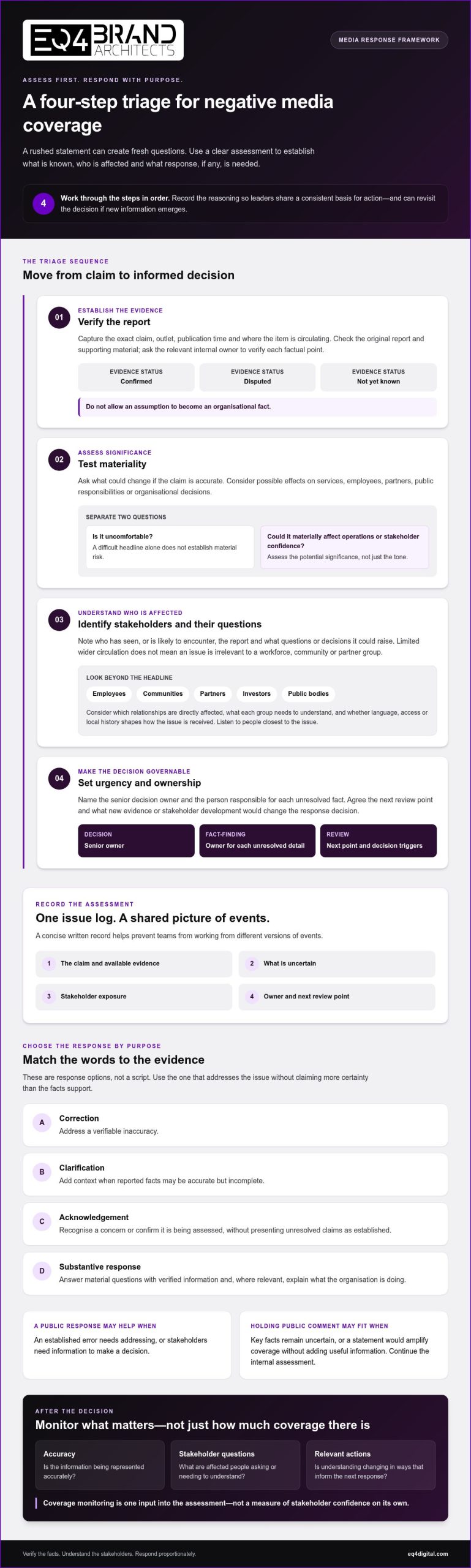
Work through these four steps in order and record the reasoning. A written assessment makes the decision easier to communicate and revisit if new information emerges.
- Verify the report. Record the exact claim, outlet, publication time and where the item is circulating. Check the original report and supporting material, then ask the relevant internal owner to verify each factual point. Mark information as confirmed, disputed or not yet known. Do not allow an assumption to become an organisational fact.
- Assess materiality. Consider what could change if the claim is accurate, including possible effects on services, employees, partners, public responsibilities or organisational decisions. Distinguish an uncomfortable issue from one that could materially affect operations or stakeholder confidence.
- Identify affected stakeholders. Note who has seen, or is likely to encounter, the report and what questions or decisions it could raise. A story may have limited wider circulation yet matter directly to a workforce, community or partner group.
- Set urgency and ownership. Name the senior decision owner, the person responsible for each unresolved fact and the next review point. Agree what new evidence or stakeholder development would change the response decision.
A concise issue log is usually enough to capture the claim, evidence, uncertainty, stakeholder exposure, owner and next review point. It helps prevent teams from working from different versions of events.
When to respond, clarify or hold
Choose the communication action according to its purpose. A correction addresses a verifiable inaccuracy. A clarification adds context when reported facts may be accurate but incomplete. An acknowledgement recognises a concern or confirms that it is being assessed, without presenting unresolved claims as established. A substantive response answers material questions with verified information and, where relevant, explains what the organisation is doing.
Not commenting publicly can be appropriate when coverage has limited stakeholder relevance or a statement would amplify it without adding useful information. Respond when an established error needs addressing or stakeholders need information to make a decision. If key facts remain uncertain, hold public comment while continuing the internal assessment. External silence need not mean internal inaction. Reassess if the report spreads, new evidence emerges or stakeholder questions change. The response should follow the strength of the evidence and the level of stakeholder risk, not pressure to speak first.
For leaders shaping a consistent decision process, reputation and communications advice can help connect evidence, stakeholder priorities and response choices.
How to choose a response that is accurate, proportionate and credible
A response should address the issue stakeholders need resolved, not simply push back against an uncomfortable story. The right choice depends on what the evidence supports, what affected people need to know, how quickly a decision is required and whether speaking publicly would give limited coverage a larger audience. Apply the same criteria to each option so the decision is reasoned rather than driven by pressure to sound decisive.
Match the response to the issue
Correct a demonstrable error with precise, supportable information and identify the specific point that is wrong. If the facts are accurate but important context is missing, add that context without implying the report is false. Acknowledge a genuine concern, and describe action only when the organisation can substantiate what it has done or will do.
An apology is appropriate when established facts support it and the organisation can speak honestly about its accountability. It should not replace an investigation or promise action that has not been agreed.
Use this response matrix as a decision aid:
- Accuracy: Is there a verifiable error? If so, consider a correction. If facts are accurate but incomplete, consider adding context. If a claim is unresolved, state what is being reviewed or hold public comment.
- Stakeholder need: Do affected people need information to make a decision or understand an impact? If so, prioritise a clear response for them, whether or not a public statement is warranted.
- Urgency: Could waiting leave a material question unanswered or disrupt an organisational responsibility? If urgency is low and evidence is incomplete, continue assessing before publishing.
- Amplification: Would a public response reach people who need the information, or draw wider attention to coverage with limited relevance? Weigh the value of clarification against that risk.
The matrix does not dictate a single answer. It makes trade-offs visible and helps leaders explain why they chose to correct, contextualise, acknowledge, apologise or make no public comment. A decision not to comment should still have an owner and a reason, and should be reconsidered if facts or stakeholder needs change.
Build a message that can withstand scrutiny
Keep the message direct: lead with the verified point, explain why it matters to affected stakeholders, then state what action is under way. Use plain language and distinguish established facts from an ongoing review. Avoid speculation, sweeping assurances and defensive wording that shifts attention away from the issue.
Prepare the spokesperson for likely questions, including what is not yet known. Agree which facts they can confirm, what requires further review and how updates will be handled. This supports consistency without removing the spokesperson’s judgement. Credibility comes from saying only what the organisation can support, then acting in line with it.
Strategic reputation and communications advice can help connect response choices with stakeholder priorities.
How to coordinate media, leadership and stakeholder communication
A sound response can lose credibility if different parts of the organisation communicate different versions of events. Before publishing, establish who owns the facts, who approves the message and who is authorised to speak. Clear roles give leaders a route for decisions and help employees and stakeholders receive consistent, relevant information.
Align internal teams and external messages
Agree responsibilities before drafting. Operational teams verify what happened, the communications lead shapes the message and a named senior decision-maker approves it. Identify who will respond to media enquiries and who will contact affected stakeholders directly. If legal, governance or other specialist input is needed, define its role in the review so the approval process does not become an unowned delay.
Where timing and circumstances permit, brief affected employees and managers before external communication. Explain what is confirmed, what remains under review and where questions should be directed. This reduces the risk that staff learn material information through a public statement or have to interpret coverage without guidance.
Use one verified factual record, then adapt communication to each audience. A media response may need a concise explanation; employees may need to understand operational implications; a directly affected stakeholder may need a private conversation. Keep the facts aligned, but tailor the emphasis, detail and channel to the audience. Repeating the same statement everywhere can leave important questions unanswered.
- Before release: confirm the approved wording, spokesperson, decision owner and next update point.
- At release: coordinate media responses, employee briefings and direct stakeholder contact so no group is overlooked.
- After release: log material updates, new evidence and changes to approved messages, with dates and ownership.
Prepare spokespeople and stakeholder engagement
Prepare the spokesperson for likely questions and challenging follow-ups. Rehearse how to return to the central verified point, explain the action being taken and state clearly when information is not yet available. The spokesperson should not speculate to fill silence or make assurances beyond the organisation’s evidence and authority.
Map who needs direct engagement, not only who may see the coverage. Employees, partners or communities directly affected by an issue may need a conversation or tailored briefing rather than a public statement alone. Media listening can identify recurring questions and shifts in coverage, but it cannot replace listening to stakeholders themselves. Broader corporate reputation management considers how decisions, relationships and communication affect confidence over time.
To coordinate a response across leadership, media and stakeholder channels, discuss your communications challenge with EQ4 Brand Architects.
How to measure the response and prepare for the next media issue
A response is not successful simply because coverage has slowed or a statement has attracted attention. Assess it against objectives set before communication began: was information accurate, did priority stakeholders receive answers, and were decisions made and communicated as intended? These measures help leaders distinguish activity from progress without claiming that communication alone caused a change in reputation or behaviour.
Evaluate more than volume or sentiment
Use media monitoring to track how the issue is being reported and whether key facts remain accurate. Review coverage themes, relevant outlets and audiences, corrections or clarifications, and how the story changes over time. Reach and impressions can indicate potential exposure, but not whether people understood the message or acted on it. Pair attention measures with evidence of engagement and organisational relevance.
Record stakeholder feedback through suitable channels, such as direct enquiries, employee briefings or partner conversations. Note recurring questions, unresolved concerns and whether people have the information they need to make a decision. Compare these findings with the original response objectives, distinguishing observations from interpretation.
- Accuracy: Are material facts represented correctly in the coverage reviewed?
- Engagement depth: What questions or concerns are stakeholders raising, and are they changing?
- Action: Have relevant stakeholders taken a step that matters to the issue, such as seeking clarification or following an agreed process?
- Organisational value: Were communication milestones met, decisions understood and priority relationships supported?
Turn the incident into stronger readiness
Once immediate decisions are complete, review what was known at each point, when key decisions were made, which approvals took time and where teams lacked a shared understanding. The purpose is to improve readiness, not assign blame. A dated record of decisions and material updates can help distinguish an unavoidable wait for evidence from a preventable coordination gap.
Use the review to update escalation routes, message architecture and spokesperson preparation. Clarify who verifies operational facts, who approves communication and how stakeholder questions feed into decisions. If the issue exposed a wider gap between organisational conduct and public understanding, connect the communication review to broader corporate reputation management rather than treating coverage as an isolated event.
EQ4 supports strategic planning, response communication, media listening and measurement. For organisations reviewing their approach, those capabilities can connect immediate response decisions with longer-term reputation and stakeholder priorities.
Make readiness part of the response
The next media issue may begin with a different concern, but the organisation can carry forward a stronger way of making decisions. Treat each incident as an opportunity to connect leadership judgement, stakeholder understanding and measured action, rather than relying on improvised responses under pressure.
Readiness depends on more than having a statement prepared. It means understanding how communication supports organisational purpose and relationships, and having the expertise to adapt as facts and stakeholder needs become clearer. EQ4 combines senior strategic advice with communications and creative execution, drawing on capabilities in reputation and issues, PR and media relations, stakeholder advisory, and media listening and measurement.
Frequently Asked Questions
What should an internal media-issue log include?
Keep a dated record of the report, relevant versions or links, internal decisions, assigned owners and outstanding actions. Note where information came from and distinguish confirmed details from interpretation. This gives leadership a reliable reference if coverage changes or the issue is reviewed later.
Should employees respond to journalists independently?
Set a clear route for media enquiries so employees know where to direct requests. This is not about preventing staff from raising concerns. It helps avoid unintentional disclosure of confidential information or inconsistent statements made without full context. Managers should know how to escalate questions promptly.
How should an organisation respond to criticism on social media?
First establish whether the comment raises a genuine service or stakeholder concern or simply expresses a view. If a reply would help, keep it factual and relevant to the person’s issue. Move sensitive details to a suitable private channel, and avoid arguing publicly or repeating harmful personal information.
What should leaders include in a board or executive update?
Give decision-makers a concise account of the issue’s organisational relevance, what has changed since the last update, unresolved questions and any decisions required from them. Separate evidence from assessment and make clear which actions are under way. This supports oversight without circulating unverified claims as fact.
Should an organisation preserve the original coverage?
Yes. Keep an internal copy or record of the original item and relevant updates, alongside the date and source. Online material can change or become harder to locate. A record supports accurate comparison over time and gives the organisation a reliable reference for its review.
How can teams avoid repeating the same media issue?
Look beyond the communications process. Review whether the underlying concern points to an operational, governance or stakeholder relationship issue that needs attention. Assign an owner to each agreed organisational action and track its progress, so learning from coverage informs practice rather than ending with a revised response plan.
If your organisation is facing a media issue or reviewing its approach, discuss your reputation or communications challenge with EQ4.