




What if the first sign of a merger’s direction is not the new name, but what employees, customers and partners hear from people they already trust? Managing brand reputation during a merger takes more than announcing a combined identity. Silence can invite assumptions, while conflicting messages from the two organisations can leave stakeholders unsure about what will change.
If you are weighing what to say, who needs to hear it and when, that uncertainty is understandable. Stakeholders want to know how the deal may affect their work, service, relationships or confidence in the organisation. A strong communication approach gives leaders and teams a clear, consistent way to address those concerns without claiming certainty where decisions are still taking shape.
This guide sets out a practical approach to protecting stakeholder confidence before, during and after a merger. It covers how to identify reputation risks early, align messages across both organisations, plan communication for different stakeholder groups and assess whether people are gaining understanding and confidence. The aim is to replace fragmented updates with a governed communications process that supports sound organisational decisions.
Key Takeaways
- Start reputation planning before the announcement, even if some merger decisions are still evolving.
- Separate identity choices from reputation risks, and assess each brand option against stakeholder recognition, purpose and transition demands.
- Make managing brand reputation during a merger a governed sequence: diagnose risks, align leaders, plan communications, listen and review.
- Give executives and communications teams clear ownership, approval routes and escalation pathways to reduce conflicting messages.
- Measure more than reach: track whether stakeholders understand the changes, engage meaningfully and take actions that support the merger’s objectives.
Why managing brand reputation during a merger starts before the announcement
Leaders face a difficult timing question: stakeholders need clarity, but the organisations may still be working through important decisions. Waiting until every detail is settled can leave employees and customers to fill the silence with assumptions. Communicating too soon, or presenting provisional plans as final, risks creating expectations the organisations may not be able to meet.
Managing brand reputation during a merger means coordinating decisions and communication to protect stakeholder confidence through change. This work starts before the public announcement. Leaders need to understand whose confidence matters, what those stakeholders need to know and which messages both organisations can stand behind. The transaction may be commercial, but people experience its implications through jobs, services, relationships and institutional identity.
Mergers and acquisitions can take different forms and serve different strategic purposes. A general Mergers and acquisitions overview provides background, but communication needs to reflect the circumstances of each deal. In South Africa, organisations should also consider how different stakeholder groups access information, including language preferences and their established relationships with each legacy organisation.
Which stakeholders need clarity first?
Start with a stakeholder map, not a single announcement list. For each group, record its relationship with both organisations, likely concerns and the most appropriate engagement route. Prioritise audiences whose decisions or actions could be affected soon. Identify where a direct conversation is more appropriate than a general update.
- Employees: Likely questions may concern roles, reporting lines, workplace arrangements and timing.
- Customers and suppliers: Clarify what is known about service, points of contact, contracts or continuity. Do not promise changes that are undecided.
- Investors and regulators: Prepare information suited to their distinct interests and the organisation’s communication processes.
- Community stakeholders: Where relevant, consider how the organisations’ presence, commitments or relationships may affect them.
Brief customer-facing teams and managers before broader communication, so they can respond consistently to immediate questions. Direct engagement is especially valuable when a group faces a material change, needs to provide input or is likely to hear about the transaction through another channel first.
What should leaders decide before communicating?
Keep a clear record of what is confirmed, what remains under consideration and what cannot yet be shared. For each unresolved issue, specify who can provide an update and when it will be reviewed. This gives spokespeople a credible response to unanswered questions without encouraging speculation or implying certainty.
Agree executive ownership, communication approvals, spokesperson roles and escalation routes across both organisations. Teams should know who resolves conflicting interpretations and how emerging concerns reach decision-makers. A shared message framework can keep core facts consistent while allowing information to be tailored to each audience.
Reputation management protects stakeholder confidence through decisions and behaviour; visual rebranding changes how the organisation is identified. The distinction matters. A new name or identity cannot, on its own, resolve concerns about leadership, service or the future relationship. Establishing governance before the announcement gives the organisations a steadier basis for communicating as the merger takes shape.
How a merger can change reputation, trust and stakeholder expectations
A merger brings two histories into a new organisational relationship. Employees, customers and partners do not automatically set aside what they know about either organisation. They use those experiences to judge what the combined organisation might do next. A legacy reputation can offer credibility, but it can also carry unresolved concerns. If leaders describe a shared future while decisions or day-to-day behaviour suggest that one organisation’s priorities dominate, confidence may weaken.
Choosing a new name or visual identity will not resolve that risk. Brand identity concerns how an organisation presents and identifies itself. Reputation concerns how stakeholders judge its conduct, decisions and reliability over time. The choices are connected, but they do not have to be made together. A merger could retain an existing identity while addressing concerns about service, leadership or employee treatment through other decisions and communication.
In South Africa, stakeholder perspectives are shaped by varied languages, communities, industries and relationships with institutions. The response from one group should not be treated as a shared view. Managing brand reputation during a merger calls for audience-specific listening, with attention to who is speaking, what they have experienced and which changes affect them. Risks will also vary by transaction, sector, relationship history and the organisational changes that are confirmed.
Where do reputation risks emerge during integration?
Look for friction between public messages and lived experience. If leaders speak about continuity while customers encounter changed service processes, or employees hear conflicting accounts of reporting arrangements, the gap itself can become a source of concern. Similar tensions can arise when leadership visibility drops, suppliers are uncertain about working relationships or partners receive inconsistent updates.
Keep a risk record that distinguishes evidence from interpretation. For each concern, note the stakeholder group, source, date, issue, supporting evidence and confidence level. A direct employee question is evidence that the question exists. On its own, it does not prove a wider breakdown in morale. This distinction helps leaders respond proportionately rather than amplify speculation.
How can leaders distinguish signal from noise?
Combine direct feedback with media listening and relevant organisational evidence, such as recurring service queries or themes raised through established engagement channels. Review patterns over time, rather than focusing on isolated comments. Record whether an issue is growing, recurring across groups or linked to a decision people can identify. Escalate concerns that point to a material mismatch between what the organisation says and what stakeholders experience.
Stakeholder confidence is the degree to which people understand the change, consider the organisation credible and feel able to make informed decisions about their relationship with it. Use this definition to guide listening and response, rather than treating attention or positive sentiment as proof of trust. Regularly compare emerging feedback with the assumptions behind the merger plan. This helps leaders address material gaps before they shape stakeholder expectations.
How to compare merger brand choices without losing stakeholder confidence
A brand decision can signal who belongs in the combined organisation, what it values and how it intends to move forward. Choosing the most familiar or commercially prominent legacy brand may seem straightforward, but familiarity alone does not show whether the choice fits the organisation’s purpose or will earn stakeholder acceptance. Treat identity as a strategic decision informed by evidence, not a shortcut for resolving broader integration questions.
Compare the available routes against the same criteria: recognition among priority audiences, connection to the intended organisational direction, evidence of stakeholder associations and the complexity of transition. Ask what each route preserves, what it may unsettle and what practical changes it would require across customer and employee touchpoints. In South Africa, test assumptions with relevant stakeholder groups rather than treating one audience’s response as consensus.
- Retain a legacy identity: This may preserve recognition and established associations. Consider whether stakeholders connect that identity with the future organisation, or whether it carries perceptions that could constrain the combined direction.
- Endorse a combined identity: Keeping a recognised name while signalling the merger may help communicate continuity and change together. Assess whether the contributions of both organisations are represented credibly.
- Blend elements: Combining names or visual features can acknowledge both legacies, but may create an identity that is harder to explain or apply consistently.
- Introduce a new identity: A fresh name and visual system may express a distinct shared direction. Consider the effort required to build recognition and explain the change to people who rely on existing identities.
What should the merger brand decision account for?
Assess each option against stakeholder experience, not just leadership preference. Gather evidence about the associations employees, customers and partners hold, including which qualities they value and which create concern. Then identify what should remain recognisable during the transition, such as service commitments, trusted points of contact or the organisation’s purpose. These priorities can guide identity development without implying that every operational detail will stay unchanged.
A comparison table can make the decision more disciplined. For each option, record the evidence, potential stakeholder benefits, likely concerns, transition implications and unresolved questions. Note whose perspective is represented and where insight is limited. This helps decision-makers distinguish a defensible choice from one based mainly on familiarity, internal influence or visual preference.
How should leaders explain the choice?
Explain the rationale in terms of confirmed organisational direction and relevance to stakeholders. State what is changing, what is being retained and what remains undecided. Avoid suggesting that a new identity itself guarantees better service or resolves legacy concerns. Those outcomes depend on the organisation’s decisions and conduct, as well as its communications.
A clear explanation also supports wider reputation work. Corporate Reputation Management in South Africa: A Strategic Guide offers a broader frame for connecting identity choices with stakeholder expectations, organisational behaviour and credibility. The brand decision should make the strategy easier to understand, not stand in for it. Use stakeholder evidence to test whether people understand the rationale and can see how the chosen identity relates to the organisation’s direction.
A practical sequence for managing brand reputation during a merger
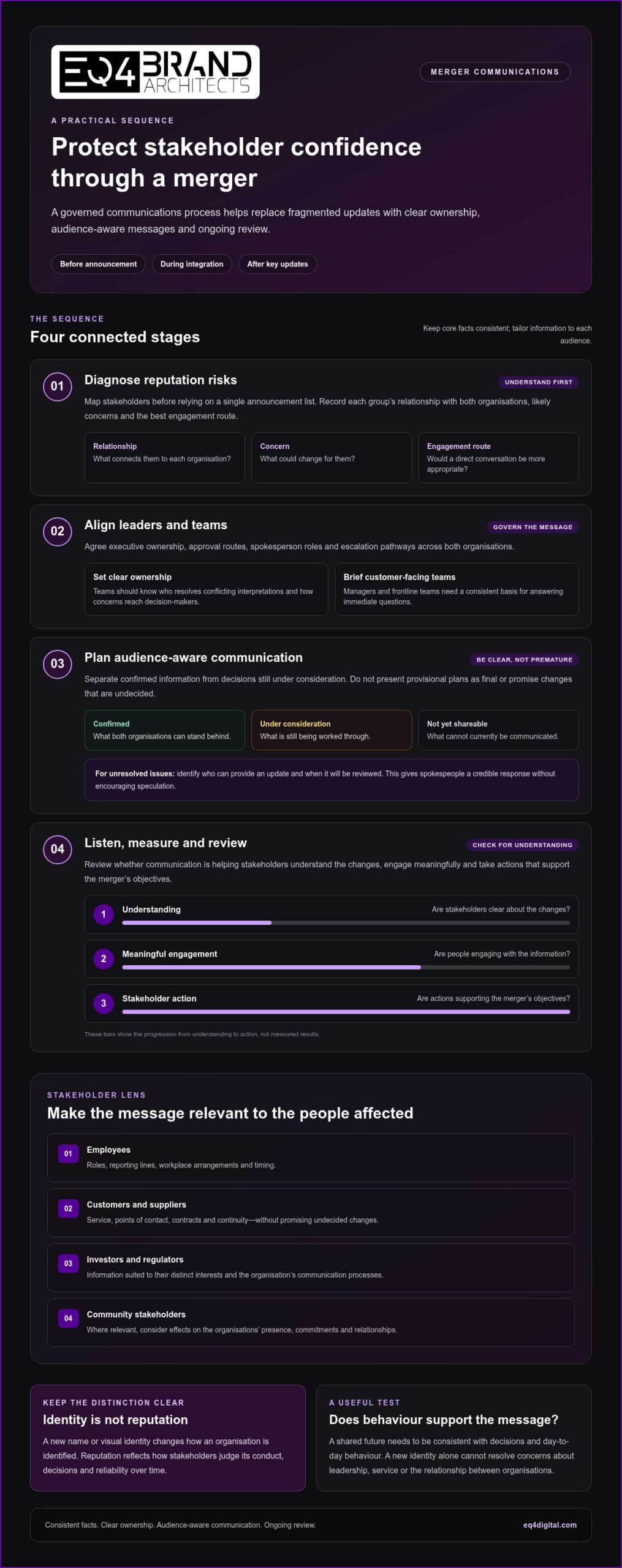
A workable process gives leaders a shared view of risks, decisions and communication responsibilities as the merger develops. The sequence below helps coordinate reputation and stakeholder communication. It is not a substitute for transaction-specific legal, financial or other professional advice. Adapt it to confirmed milestones, operational readiness and the needs of each audience.
- Diagnose: Map priority stakeholders, existing perceptions, likely concerns and known reputation risks. Separate evidence from assumptions, and record which issues need executive attention.
- Align: Agree the intended organisational direction, core messages and what each organisation can accurately say. Resolve contradictions before teams begin communicating independently.
- Plan: Set audience priorities, channels, timing, accountable owners and approval routes. Link communication to confirmed milestones, rather than relying on a fixed calendar that may no longer reflect events.
- Communicate: Share relevant information through channels suited to each audience. Equip managers and customer-facing teams to respond consistently, while being clear about what remains undecided.
- Listen: Gather questions and feedback through direct engagement, established organisational channels and media listening. Look for recurring concerns and gaps between messages and stakeholder experience.
- Respond: Assign responsibility for assessing issues, preparing responses and authorising action. Escalate concerns when they indicate a material risk to trust, relationships or organisational decisions.
- Review: Revisit assumptions, messages and stakeholder priorities as the merger progresses. Use new evidence to refine the plan and inform leaders about what needs attention next.
What belongs in the merger communications plan?
Keep the plan practical and usable. For each priority audience, document what they need to understand, the message that addresses it, the appropriate channel, timing, owner and approval route. Build a message architecture that distinguishes confirmed facts, open questions and likely concerns. Include agreed language for responding when an answer is not yet available.
Coordinate internal and external communication so employees do not learn significant news from customers or media before their managers are prepared to discuss it. The executive team should own strategic direction and key decisions. Communications leads should shape and coordinate messages, with clear approvals for sensitive or changing information. Define escalation routes so urgent issues reach the right decision-maker without creating competing spokespersons.
How should listening and response work?
Set a regular review rhythm suited to the pace of the transaction. Bring together stakeholder feedback, media coverage and relevant operational evidence. Assess who is affected, whether the concern is recurring and what response or decision it requires. Assign responsibility for assessing each signal and specify who can authorise a public response or operational action. Media coordination should sit within this wider governance, rather than operate as a separate activity.
Keep the process useful by documenting decisions and the evidence behind them. When feedback changes the picture, update the relevant message or escalation route and make sure teams across both organisations have the current version. This gives leaders a practical basis for adjusting communications as the merger progresses.
Measure merger reputation progress and decide when to bring in strategic support
Communication activity is not the same as communication progress. A message may reach a large audience without helping people understand what is changing or what they should do next. To assess whether communications are supporting the merger, connect measures to organisational objectives and the questions priority stakeholders need answered.
Set a baseline before evaluating change. Record existing stakeholder concerns, recurring questions, levels of understanding and relevant relationship indicators, using information the organisation can access reliably. Review these at agreed points against the merger’s milestones. This makes it easier to assess whether a shift reflects improved understanding, a new operational issue or simply a change in how feedback is gathered.
Which indicators can help leaders assess progress?
Choose indicators across several levels and interpret them together, rather than in isolation:
- Attention: Note whether priority audiences are encountering the communications. Reach and media visibility show exposure, not understanding or value on their own.
- Understanding: Check whether people can describe the relevant changes accurately and know where to find reliable information. Repeated questions about the same issue may signal a gap in the message or its delivery.
- Engagement depth: Assess the substance of feedback, participation in relevant discussions and concerns raised through direct channels. The quality and context of engagement matter more than volume alone.
- Stakeholder action: Consider whether people take actions relevant to the merger’s objectives, such as using the designated information channel or following a changed process. Interpret actions in context, not as automatic proof of confidence.
- Organisational value: Review whether communication is helping leaders address risks, sustain important relationships and make informed decisions. Link findings to relevant operational or strategic outcomes without claiming communication alone caused them.
Also monitor issue escalation and message consistency across channels and teams. If the same concern is raised repeatedly, identify its source, who is affected and whether an operational decision, clearer explanation or both are needed. Treat findings as evidence for action, not a guarantee of reputation recovery. Outcomes depend on organisational conduct and the wider merger context, as well as communication.
When can an external strategic adviser add value?
Strategic support can be useful when responsibility is dispersed, messages diverge between legacy organisations, stakeholder feedback is not reaching decision-makers or internal teams lack a shared measurement approach. An adviser can help leaders connect reputation priorities, stakeholder engagement, message planning, media listening and measurement within a clear governance structure.
EQ4 Brand Architects combines senior strategic advice with communications and creative execution, connecting organisational decisions to audience-aware communication and practical delivery. Its support can bring reputation and issues, stakeholder advisory, PR, media monitoring and measurement into a coordinated approach. The scope should reflect the organisation’s objectives, risks and internal capacity. Review regularly whether roles remain clear, evidence is informing decisions and measurement is helping leaders adjust their approach.
Keep stakeholder confidence in view as integration progresses
As the merger moves into day-to-day integration, communication should stay connected to the decisions people experience. Each milestone is an opportunity to check whether stakeholders have the information they need, whether commitments are being met and whether emerging concerns are reaching people able to act. This discipline keeps managing brand reputation during a merger connected to organisational behaviour, rather than limiting it to an announcement or identity change.
A useful next step is to identify one upcoming decision with meaningful stakeholder implications. Clarify who needs to contribute, what evidence leaders need and how the organisation will know whether its communication has supported understanding. Where responsibility or insight is fragmented, EQ4 brings senior strategic communications advice together with creative execution across reputation and issues, stakeholder advisory, PR, media monitoring and measurement.
Discuss your merger communication and reputation challenge with EQ4 to consider a clear, audience-aware way forward. Deliberate decisions and communication grounded in stakeholder needs can help your organisation maintain confidence through change.
Frequently Asked Questions
When should reputation planning begin during a merger?
Begin as soon as a merger becomes a serious organisational possibility, before drafting an announcement. Early planning gives leaders time to consider how different outcomes could affect employees, customers and partners, and to prepare communication principles without treating unconfirmed details as settled. Managing brand reputation during a merger at this stage requires appropriate confidential processes and coordination with the organisation’s transaction advisers.
Should both legacy brands remain visible after a merger?
Not necessarily. The right approach depends on the organisations’ purpose, stakeholder recognition and the evidence behind each brand’s associations. A phased transition may be worth considering if people rely on a legacy name to identify a service or relationship. A combined identity may better express a confirmed future direction. Test the options with relevant audiences and consider how names will appear across customer communications, employee materials and partner touchpoints.
How should leaders respond when merger details are not yet confirmed?
Say plainly what is known, what remains undecided and when stakeholders can expect another update, if a timing commitment can be made. For example, explain that service arrangements are under review rather than implying they will stay unchanged. Prepare managers to use the same approved explanation, and give them a route to record questions that need a decision. Do not guess simply to make an answer sound complete.
Who should approve communications during a merger?
Approval should reflect the subject and its risk. Executives should authorise strategic positions and material commitments. Communications leads should check clarity, audience relevance and consistency. Subject-matter owners should verify operational details. Agree these responsibilities in an approval matrix, including who acts when the usual approver is unavailable and which issues need escalation. Handle transaction-specific legal or disclosure requirements with the organisation’s relevant professional advisers.
How can organisations identify stakeholder concerns before they become public issues?
Use several listening routes rather than relying only on media coverage. Invite managers, customer-facing teams, suppliers and engagement leads to log recurring questions, while providing stakeholders with appropriate ways to raise concerns directly. Review patterns by audience and topic, then verify what people report against operational information. A concern raised in one conversation is a prompt to investigate, not proof that it is widespread.
What should leaders do when employees and customers receive conflicting merger messages?
Correct the inconsistency promptly through the channels where each audience received the original information. First establish which statement is accurate, then issue a shared clarification that explains what changes for each group and where to direct further questions. Brief managers and customer-facing teams before the correction goes out, so they can explain it consistently. Record how the discrepancy occurred and adjust approvals or briefing materials to reduce repeat errors.
How can an organisation tell whether stakeholders understand a merger announcement?
Ask people to explain the practical implications in their own words, rather than relying on views, clicks or positive reactions alone. A short employee pulse check, customer-service query review or structured partner conversation can reveal which points remain unclear. Compare responses across priority audiences, note recurring misunderstandings and revise the relevant explanation. Understanding is stronger evidence when people can identify what affects them and where to find reliable updates.