





A post going viral isn’t automatically a crisis, and a quiet complaint can become one. A social media crisis is an online issue that threatens people, operations, stakeholder confidence or organisational reputation and requires a coordinated response. This social media crisis management guide helps leaders distinguish serious risk from routine criticism, then set clear escalation levels and response responsibilities.
When an issue emerges, it is natural to focus on the volume and tone of comments. A more useful test is what the conversation signals: Is someone at risk? Is information spreading that could cause harm? Does the issue point to a wider operational or reputational concern? A social media crisis can damage reputation and contribute to declining sales, so the response matters beyond the platform itself.
This guide sets out a practical approach for South African organisations: define what counts as a crisis, establish escalation triggers, identify who is authorised to decide, and prepare playbooks and holding statements. It also explains how to coordinate updates across teams, communicate with care while facts are being established, and review the response to strengthen future preparedness.
Key Takeaways
- Distinguish routine criticism from an issue that could affect safety, operations, stakeholder confidence or reputation.
- Use social listening to spot unusual shifts in conversation, then assess context and potential impact before escalating.
- Build crisis tiers with clear triggers so teams know when to alert leaders and who has authority to decide.
- Prepare response playbooks and holding statements that communicate what is known, what is being investigated and what happens next.
- Review each response to identify gaps in monitoring, approvals and coordination, then refine the process.
What is social media crisis management?
Social media crisis management is the organised process of identifying and responding to online issues that may affect people, operations or reputation. It connects what audiences are saying with the decisions and actions required across an organisation. Listening and sentiment monitoring can help teams distinguish an isolated complaint from a pattern that signals a wider problem.
-
Listen for Sentiment and Emerging Issues
Track brand names, product terms, executive names and campaign phrases across relevant platforms, not just comments on your own posts. Compare the tone and topics with the usual conversation. For example, a shift from delivery complaints to repeated reports of the same fault may signal an underlying service issue. Treat sentiment scores as prompts for investigation, then review the posts and their context.
Record recurring questions, affected audiences and changes in the language people use. This gives communications and operational teams a clearer basis for deciding whether they are seeing individual dissatisfaction or a developing concern.
-
Monitor Crises, Influencers and Misinformation
Bring monitoring findings into a shared view for communications and operational leads. A crisis command centre can be a designated team, channel and dashboard, not necessarily a physical room. Watch for influential accounts amplifying unverified claims, edited material or inaccurate explanations. Preserve original posts and note where claims are spreading. Address misinformation with verified information, not speculation.
Assess a claim’s source separately from its reach. A prominent account may draw attention to an issue, but visibility alone does not establish whether the allegation is accurate.
-
Track Response Impact and Recovery
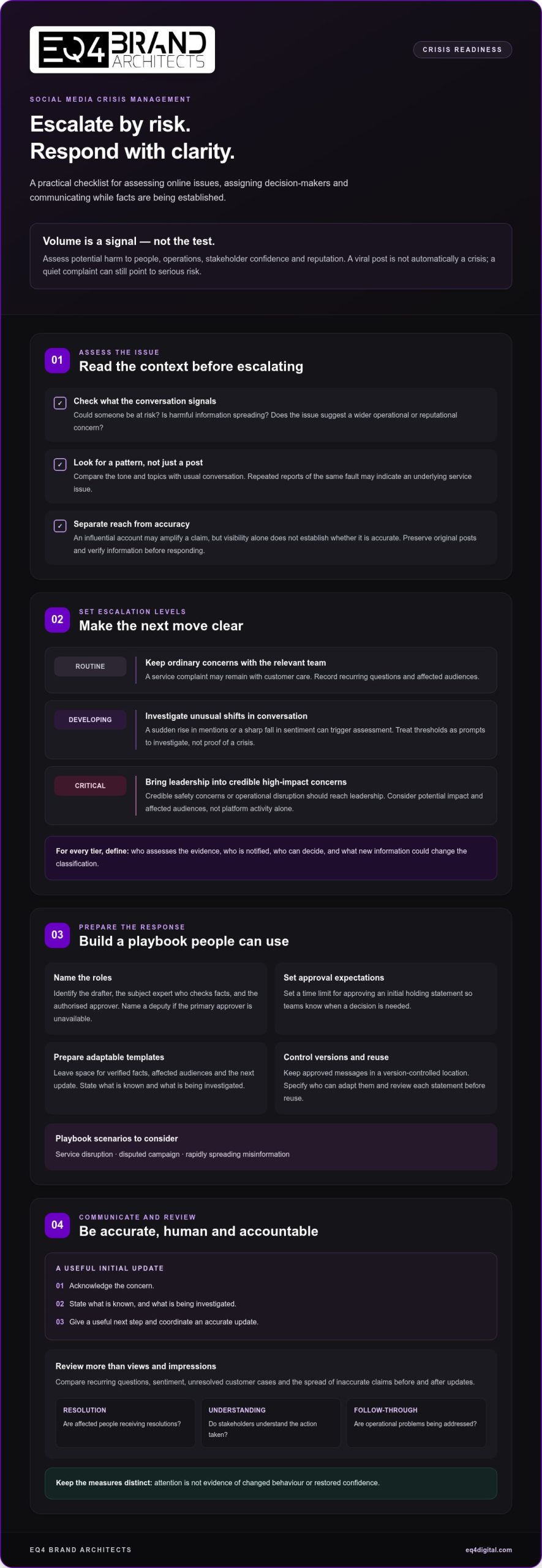
Assess the response beyond views and impressions. Compare recurring questions, sentiment, unresolved customer cases and the spread of inaccurate claims before and after updates. Measure recovery by checking whether affected people receive resolutions, stakeholders understand the action taken and operational problems are being addressed. Keep attention metrics separate from evidence of changed behaviour or restored confidence.
-
Review Response Risks and Requirements
Avoid publishing unverified claims, exposing private details or deleting legitimate criticism simply because it is uncomfortable. In South Africa, POPIA governs the handling of personal information: use it for a lawful purpose, limit it to what is necessary and protect it from unauthorised access. If a security compromise may have exposed personal information, POPIA’s notification requirements apply. The Consumer Protection Act may also be relevant to consumer-facing representations, while cyber incidents may engage the Cybercrimes Act.
After the incident, document what was detected, how decisions were made and which concerns remain unresolved. Reviewing these records can reveal whether monitoring, approvals or operational follow-through need attention, and help refine the response process for future issues.
Listening is useful when it informs sound organisational decisions. Read each post in context, consider who may be affected, and distinguish attention from evidence of harm. This gives leadership a firmer basis for action and helps align public communication with what the organisation is doing.
If your organisation is reviewing how online issues affect its reputation, discuss a communications challenge with EQ4 Brand Architects.
Crisis tiers, escalation triggers and response playbooks
Match the response to potential harm, not simply the volume of negative messages. Each tier should identify who acts, what they can approve and when the issue needs broader leadership attention.
-
Classify Crises and Set Escalation Triggers
Define tiers for routine concerns, developing issues and critical incidents. A service complaint may remain with customer care; credible safety concerns or operational disruption should reach leadership. Set triggers for assessment, such as a sudden rise in mentions or a sharp fall in sentiment. Treat thresholds as signals to investigate, not automatic proof of a crisis.
For each tier, record who assesses the evidence, who is notified and what could change the classification. Consider operational impact and the needs of affected audiences, not just activity across platforms. This helps teams apply consistent criteria across departments and explain why an issue was escalated.
-
Prepare Playbooks, Templates and Approvals
Prepare scenario playbooks for likely risks, such as a service disruption, disputed campaign or rapidly spreading misinformation. Name the drafter, subject expert who checks the facts and authorised approver. Set a time limit for approving an initial holding statement, and name a deputy if the primary approver is unavailable. Templates should leave space for verified facts, affected audiences and the next update.
Keep approved messages in a version-controlled location. Specify who can adapt a template and which changes require fresh approval. Because an old statement may no longer fit as the situation changes, include a review step before reuse.
-
Respond Quickly with Transparency and Empathy
Use the initial response period to establish what happened, protect people and coordinate an accurate update. Acknowledge the concern, state what is known, explain what is being investigated and give a useful next step. If facts remain unclear, say so plainly. Pause scheduled content that could appear insensitive or conflict with the response. A prompt acknowledgement does not require claiming the cause is already known.
-
Address Misinformation and Consumer Concerns
Separate false claims from genuine unanswered questions before responding. Correct specific misinformation with concise, verifiable information, then direct people to the channel where updates will appear. Address consumer concerns rather than arguing with the person who raised them. Move account-specific details to a private channel, while keeping public messages clear about the issue and the action being taken.
- Build review points into the plan so decisions can adapt as facts change. One example schedules an initial response within the first 1-2 hours, fact-finding during the next 2-4 hours, and a public response during the 4-24-hour period. Continue monitoring and adjustment through 24-72 hours. At each checkpoint, review new evidence, audience questions and operational action, then revise messages where needed.
Choosing internal communication channels and decision-makers
Decide who will be involved, which channels they will use and the notification sequence before an incident occurs. A clear internal route helps teams share verified information and coordinate public updates.
-
Assign Decision-Makers and Communication Channels
Name an incident lead, a communications lead and an operational subject expert. Record who can approve a public message, who supplies verified facts and who acts as deputy if the approver is unavailable. Set one internal channel for coordination and one authoritative record for decisions, such as a shared incident log. Avoid parallel message threads that can circulate conflicting versions.
Map the route from monitoring to decision: the person who spots an issue alerts the incident lead, who brings in relevant experts. A campaign complaint may require the campaign owner; a service disruption may require the operational lead. Give each role an agreed notification method, escalation route and responsibility for recording decisions.
-
Secure Accounts and Internal Communications
Enable two-factor authentication on all social media platforms and limit account access to people who need it. Keep access details in an approved, secure system rather than a shared document or chat. Review permissions when staff responsibilities change, and identify who can pause scheduled posts. A compromised account can turn an operational incident into a wider reputation problem.
Use the designated internal channel for sensitive updates, not public replies or informal campaign groups. Tell staff where to report suspicious messages and how to flag a possible account breach. Separate confirmed facts from unverified reports in the incident log so decision-makers can distinguish what happened from what is still being checked.
-
Set Communication and Notification Procedures
Choose the platforms for updates based on where affected audiences seek information. Use the organisation’s established channels for public statements, then direct people there from other active platforms. Social media can provide timely updates and answer common questions, but it should not replace direct communication with employees, customers or stakeholders who need specific guidance.
Set a notification order for the incident lead, communications team, relevant operational experts and leadership. Agree who monitors replies after publication and who routes questions requiring private follow-up. If a campaign is paused, for example, promptly tell the content team and account administrators so scheduled material does not contradict the response.
- Test the process with a tabletop scenario, such as a false post appearing on an official account. Check whether each person received the notification, found the current facts and understood their authority. Record delays, duplicated messages and unclear decisions, then update the contact tree and channel instructions. Revisit the procedure when platforms, account owners or organisational responsibilities change.
Consistent brand voice and holding statements
During a crisis, inconsistent messages can deepen uncertainty across platforms. Prepare language that reflects the organisation’s values and remains accurate as the situation develops.
-
Set the Brand Voice and Draft Holding Statements
Write holding statements in advance for scenarios such as service disruption, safety concerns or a disputed campaign. Each draft should acknowledge the issue, show concern for affected people and state what the organisation is doing. Leave clear fields for verified facts, affected services and the next update. Avoid defensive language, speculation or promises operational teams cannot deliver.
Keep the organisation’s usual tone, but adapt it to the moment. A playful campaign voice may be inappropriate after a serious incident; empathy and plain language should take priority. Ask a colleague outside the drafting team to check whether the statement sounds human, clear and respectful.
-
Manage Social Channels and Brand Tone
Use one approved version of each update, adapting its format, not its meaning, across active channels. A short post on X and a longer Facebook update can share the same facts, action and timing. Pause campaign content that could seem insensitive or distract from essential information. Ensure community managers and executives use the same approved messages.
Give moderators practical guidance for complaints, repeated questions and abusive comments. For example, answer a public question with verified information, then move account-specific details to a private channel. Do not delete reasonable criticism just because it is negative; remove or report content only under a consistent moderation policy.
- Build trust through visible follow-through after the immediate response. Publish updates when promised, explain meaningful changes and acknowledge where the organisation’s actions fell short. About 65% of consumers remain loyal to brands that respond transparently during a crisis. Use that finding as a reason to communicate openly, not as a guarantee of customer retention.
- Reduce post-crisis risk by reviewing the cause, response and audience feedback together. Compare recurring complaints with operational records, then identify whether policy, service delivery or campaign approval needs attention. If a campaign caused harm, explain what will change before returning to routine content. Returning to normal posting quickly should never take priority over addressing the underlying concern.
- Record what changed and who owns each follow-up action. In the review, distinguish communication improvements from operational fixes, assign accountable teams and set a review date. Track whether unanswered questions decline, affected people receive resolutions and stakeholders understand the corrective action. These measures show whether trust-building communication is backed by real organisational behaviour.
Defining a social media crisis
A social media crisis is not simply a post with many comments or an unfavourable reaction. It is a situation where online discussion signals potential harm to people, organisational operations, stakeholder confidence or reputation and requires coordinated decisions. The key question is whether the issue calls for action beyond routine community management.
- Define the consequences that matter. Specify the impacts that require coordinated attention, such as risk to people, interruption to a public-facing service or loss of confidence among key stakeholders. A critical post about a campaign may attract strong opinions without becoming a crisis. A credible allegation revealing a wider organisational failure may need a different response, even if few people have shared it.
- Distinguish dissatisfaction from an organisational issue. A complaint about one delayed delivery may be resolved through customer care. Similar complaints across different channels could point to a recurring service problem. The distinction is not whether criticism is fair or uncomfortable; it is whether the issue suggests a pattern, requires action across teams or could affect people beyond the original complainant.
- Test what is known and what remains an allegation. Record the original claim, its source and any supporting evidence. Check whether the account describes a direct experience, shares second-hand information or repeats content without context. Preserve relevant posts and timestamps for internal assessment. A screenshot or widely repeated claim is not verification on its own.
- Identify affected audiences and their needs. Consider who may be impacted, including customers, employees, suppliers, communities or public-sector stakeholders. Their immediate needs may differ: some require service information, while others need a clear explanation of organisational action. In South Africa, consider whether language, access or platform choice could prevent affected people from receiving or understanding an update.
- Weigh urgency alongside reach. Consider potential harm, credibility, operational consequences and how quickly the situation could change. A low-volume report of credible danger may deserve priority over a widely shared disagreement about tone. Document the evidence and reasoning behind the assessment so teams understand why the issue was escalated or managed through routine channels.
- Reassess when the situation changes. New evidence, additional affected groups or a confirmed operational impact may alter the classification. Assign responsibility for revisiting the assessment as information develops. Record what changed and why. This prevents an early judgement from shaping the response after circumstances have materially shifted.
A useful definition gives teams a shared threshold for action without treating every negative conversation as a crisis. Apply consistent impact-based criteria across channels, and let evidence, affected audiences and organisational consequences guide the decision.
EQ4 Brand Architects: Reputation Management
EQ4 Brand Architects helps organisations bring reputation considerations into communication decisions before, during and after a social media crisis. Its Reputation Management and Communication Strategy work can help leaders clarify audience priorities, align internal decisions and shape a considered response. Public Relations (PR) can support consistent communication with stakeholders beyond social platforms.
Turn to this support when crisis tiers, approval routes or response messages are unclear, or when online criticism signals a wider stakeholder concern. The focus is not simply to post faster; it is to connect public communication with organisational action and protect stakeholder confidence through a coherent approach.
If your organisation is reviewing its crisis communications or reputation approach, contact EQ4 Brand Architects to discuss the challenge.
Make readiness part of your communications practice
A crisis plan earns its value before pressure rises. Treat it as a working decision tool: revisit it when responsibilities change, lessons emerge or a new campaign creates different stakeholder risks. A practical social media crisis management guide should support sound judgement, not replace it. The aim is to help teams recognise when an issue needs attention and respond in a way that reflects the organisation’s responsibilities.
For South African organisations, that readiness also means considering how different stakeholders will receive and interpret a message. Align internal decisions with public communication, and make sure follow-up actions address the concern behind the conversation. If your organisation wants a more intentional approach to reputation and crisis communication, contact EQ4 Brand Architects to discuss the challenge. Thoughtful preparation gives your team a steadier starting point when the next difficult moment arrives.
Frequently Asked Questions
How should brands prioritise comments during a high-volume crisis?
Prioritise comments by potential harm and urgency, not likes or follower count. Address credible safety threats and regulatory concerns first, followed by reports involving vulnerable customers and rapidly spreading misinformation. Next, respond to factual questions affecting many people, then handle individual service cases. Move personal account details to a private channel, while keeping public replies clear about where people can find reliable updates.
What is the 15-20-60-90 rule in crisis communication?
The 15-20-60-90 rule is a set of suggested checkpoints for organising the first 90 minutes of a response, not a universal standard. Teams can use the points to check what is known, confirm who is deciding, prepare an initial update and review whether the response needs to change. Set a task for each checkpoint, such as verifying operational facts or assessing new audience concerns.
What should you post during a crisis if you don’t have all the facts yet?
Post a brief holding statement that acknowledges the concern and separates confirmed information from what is still being investigated. For example, say the organisation is aware of reports about a service disruption, is checking the details and will share an update through a named channel. Do not speculate about causes, identify affected individuals or promise a resolution before the relevant teams can support that commitment.
What is a social media crisis management plan?
A social media crisis management plan is a working document that helps an organisation detect, assess and respond to online issues. It should define what warrants escalation, name decision-makers, set internal notification routes and provide adaptable response templates. Include account access procedures, monitoring responsibilities and a way to record decisions. A useful plan connects platform activity with operational action rather than treating public posts as the whole crisis.
What are the steps for responding to a social media crisis?
Start by documenting the original posts and checking facts with the relevant operational team. Assess possible harm, classify the issue and alert authorised decision-makers. Agree on a holding statement, publish it through the appropriate channel and direct affected people to practical guidance. Continue monitoring questions and misinformation, update messages as evidence changes, then review unresolved concerns and any organisational action still required.
How quickly should a business respond to a social media crisis?
Respond promptly enough to acknowledge the issue, but don’t trade accuracy for speed. A 30 to 60 minute initial-response window can guide preparation after a crisis is identified, while the first message may simply confirm awareness and explain that facts are being checked. The timing should reflect risk, available evidence and affected audiences. Share a clear update schedule so people know when to expect further information.
How should businesses assess the severity of a social media crisis?
Assess severity by considering potential harm, evidence, operational impact, affected groups and the pace of spread. A widely shared complaint may be less serious than a low-volume report of credible danger. Ask whether the issue could affect safety, service continuity, stakeholder confidence or the organisation’s ability to act. Record why the issue was classified at a particular level, then reassess as new facts emerge.
Who should be on a social media crisis response team?
Include an incident lead, a communications decision-maker and an operational expert who can verify the situation. Involve customer service when people need case-specific help, and legal or privacy colleagues when relevant concerns arise. For a public-facing organisation, leadership may need to approve significant positions. Name a deputy for each critical role, and ensure the team knows which internal channel holds current facts and decisions.