





Reputation risk rarely begins with a headline. It often starts with an operational decision, an unresolved complaint or a gap between what an organisation says and does. A brand reputation risk assessment identifies the trigger, weighs its likelihood and potential severity, and maps the consequences for stakeholders and organisational performance. In South Africa, this means considering how an issue could affect confidence among employees, customers, communities, investors, regulators and business partners.
It is easy to focus on public criticism once it appears. A more useful question is what made it possible and how quickly it could affect people’s trust or behaviour. A practical assessment identifies common triggers, connects reputation to enterprise risk management and examines potential impacts across stakeholder groups. It then helps leaders prioritise threats, establish a baseline and turn findings into clear responsibilities, communication plans and measures of progress.
Key Takeaways
- Trace reputation threats back to their operational, leadership or communication triggers, rather than focusing only on public criticism.
- Bring reputation into enterprise risk management with clear ownership, escalation routes and a risk register linked to organisational priorities.
- Use stakeholder conversations and online monitoring to spot friction during major changes before concerns harden into wider narratives.
- Map how an issue could affect customers, suppliers, distributors, employees, investors and regulators, since each group may face different consequences.
- Prioritise threats by assessing their likelihood, severity and potential impact, then track changes against a clear baseline.
1. What triggers Reputation Risk?
Reputation risk can begin with a product failure, a disputed decision, misconduct, a data breach or a gap between public commitments and organisational behaviour. Volkswagen’s 2015 emissions-test deception, involving software installed in millions of diesel vehicles, shows how an operational choice can become a public trust crisis. Ransomware, data breaches and AI-enabled deception tactics also surged in 2024 and 2025, increasing the need to connect operational incident response with communications planning.
Public disputes and lawsuits can prompt scrutiny beyond the legal issue itself. Stakeholders may interpret prolonged disagreement as a sign of internal dysfunction, weak governance or poor accountability. Other triggers include service interruptions, employee conduct, supplier actions and customer complaints left unanswered online. Identifying the trigger helps clarify who is affected, what they need to know and which organisational decisions may need to change.
Effective crisis response and recovery begin with a prompt, factual acknowledgement, followed by honest updates and clear expectations about timing. Explain what the organisation knows, what action is under way and when stakeholders can expect the next update. Recovery depends on addressing the underlying issue, not simply correcting the public narrative.
Online sentiment monitoring can help teams detect when isolated feedback becomes a wider concern. Track changes in complaint volume, recurring themes, influential posts, media reporting and questions reaching customer-facing teams. A rise in service complaints after a system migration, for example, may signal user friction before it develops into a broader reliability concern. Connect monitoring signals to an escalation route, named decision-makers and consistent reporting.
A practical crisis communications plan defines who assesses an incident, who approves messages and who distributes them. It should set out procedures for stakeholder notification, media response, internal briefings and coordination with legal and compliance teams. Draft messages for plausible scenarios can reduce delays, provided teams adapt them to verified facts and the people affected.
Preparedness also means testing the plan before a brand shock. Assign roles across communications, operations and leadership, then run simulations based on plausible incidents, such as a data breach or product failure. Record gaps in decision-making, approvals and stakeholder notification, then update procedures and prepare teams to escalate issues. For high-impact launches or migrations, a rapid-response team can monitor sentiment and flag issues while leaders still have room to act. Speed matters, but accurate information and accountability help protect trust.
2. Integrating reputation risk into enterprise risk management
Reputation risk belongs within enterprise risk management, connected to operational, financial and strategic decisions. Add emerging threats to a reputational risk register and link each to business objectives, accountable executives and relevant controls. This helps decision-makers see how organisational choices may affect stakeholder perception, rather than treating reputation as a communications issue alone.
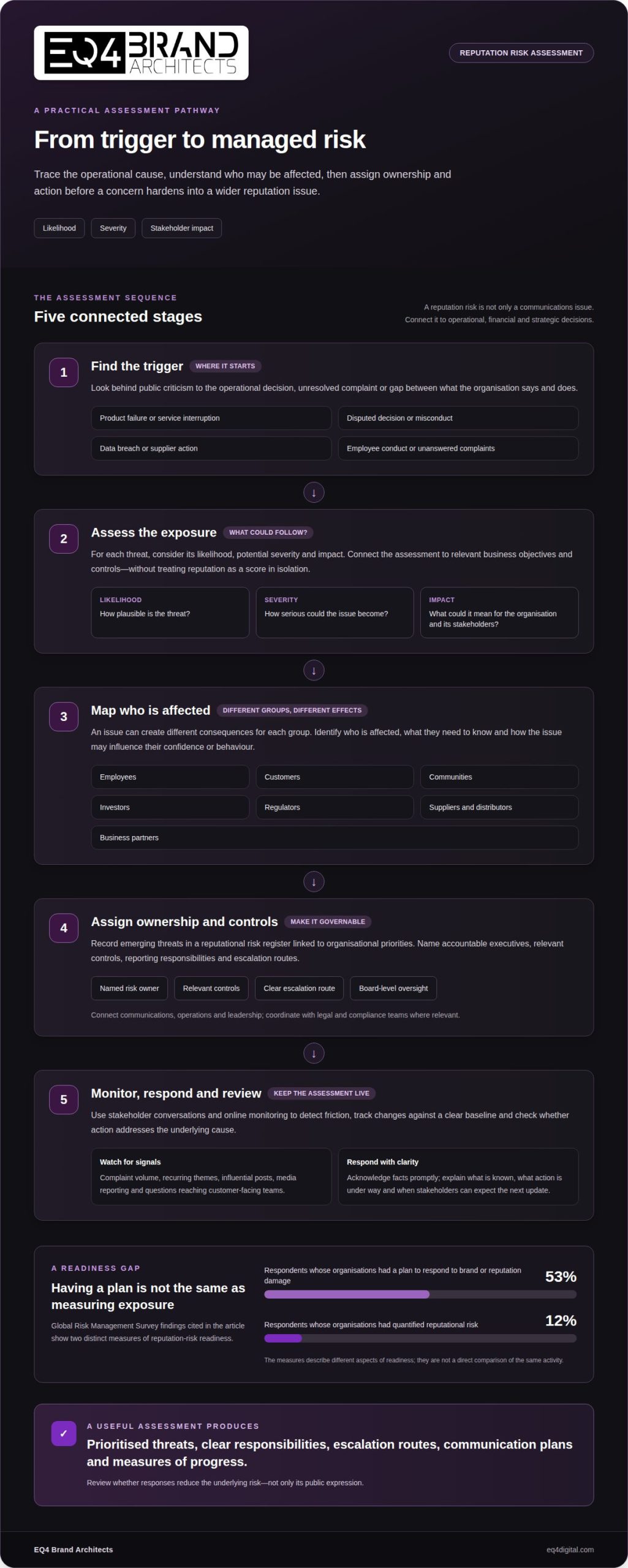
Clear governance makes the register useful. Deloitte recommends managing brand and reputation programmatically, with C-suite accountability. Board oversight can test whether ownership, reporting and decisions align with organisational priorities. The Global Risk Management Survey found that 53% of respondents said their organisations had a plan to respond to damage to reputation or brand. A plan needs named owners and a route for escalating material changes in exposure.
Organisations that make commitments about employment or environmental practice need to connect those commitments with conduct. Decisions across procurement, leadership and operations can reinforce or undermine what the organisation says. Build reputation considerations into those decisions so responsible teams understand how their actions may be perceived. Where a mission-driven brand sits within a larger corporate structure, governance arrangements can help protect its purpose from short-term financial pressure.
Measurement should inform management choices, not simply count communication activity. Establish who needs to report, what evidence is relevant and how findings will influence decisions. For example, a board report might distinguish stakeholder confidence from campaign exposure, then connect each concern to a business owner and a response. The Global Risk Management Survey reported that 12% of respondents had quantified reputational risk, underscoring the difference between recording a threat and estimating its implications.
Choose indicators that reflect the organisation’s commitments and operating context. Measures might show whether employees understand a policy, affected communities can access clear information, or partners’ concerns are being resolved. Agree on definitions across teams before reporting, so different functions do not describe the same issue in conflicting ways. Review whether actions address the underlying cause, not just its public expression.
Fragmented ownership, inconsistent information and competing priorities can weaken the process. Address these challenges by assigning senior accountability, connecting reputation reporting to existing enterprise processes and reviewing third-party exposure alongside internal decisions. When leaders need to align governance with stakeholder communication, reputation management and communications planning can provide a practical focus for that work.
3. What are some of the most common brand and reputation risks in transformations today?
Transformation can create reputation risk when a new process works differently from what stakeholders expect. A revised customer portal, changed service channel or restructuring may create practical friction, even when the intended outcome is better service. Customers may struggle with familiar tasks, employees may be unsure about changed responsibilities, and suppliers may need to adapt to new procedures. These experiences can shape perceptions of the organisation’s reliability and competence.
Stakeholder engagement can reveal where plans diverge from lived experience. Identify the groups affected by a change, what will differ for each group and what information they need to act. For a service migration, gather feedback from customers, staff and delivery partners before wider implementation. Use the findings to adjust guidance, support and decisions. A concern that seems minor to a project team may create a substantial barrier for someone relying on the service.
Social media monitoring can shed light on public questions, but online commentary needs context. Assess recurring themes alongside service enquiries, employee feedback and operational reports. Questions about accessing a changed service, for example, may point to a communication gap, while reports of failed transactions may indicate a system issue. Distinguishing between these causes helps teams respond appropriately instead of treating every critical post as the same problem.
In South Africa, transformation-related data handling and customer-facing practices may raise legal as well as reputational considerations. The South African Government publishes the Protection of Personal Information Act, which organisations should consider when changes affect personal information. The Consumer Protection Act is also relevant to the assessment of customer-facing changes and claims. Include appropriate legal and compliance expertise when evaluating how these laws apply to a specific change.
To score and prioritise risks, assess likelihood and severity separately, then record the evidence behind each judgement. Consider potential harm, affected stakeholders, speed of escalation and the strength of existing controls. A less likely risk may still warrant attention if its consequences could be serious. Set priorities according to exposure and the action required, not the volume of online discussion alone.
Monitoring tools can help teams identify patterns across social media, news, reviews and internal reporting. Automated sentiment needs human interpretation, especially when context, irony or language choice changes a post’s meaning. During a rollout, compare digital signals with feedback from affected stakeholders and operational evidence. Record emerging concerns, decisions and follow-up actions so leaders can assess whether the transformation is working as intended and where adjustments are needed.
4. Assessing impacts on customers, vendors, distributors and regulators
Reputational risk is the possibility that an event will weaken confidence in an organisation and affect its relationships or ability to operate. To assess impact, trace a trigger to the people affected, the consequences they experience and the decisions needed to address them. Negative publicity may be one signal, but service disruption, employee uncertainty, partner concerns and regulatory scrutiny can reveal broader effects.
Consider a South African public institution changing how residents access an essential service. If the new process is difficult to use, residents may lose confidence, frontline employees may face unanswered questions and contractors may need to adapt their delivery. This illustrative scenario is not a claim about a specific institution or incident. It shows why an assessment should consider access, communication and operational dependencies together.
Customers and communities may experience the immediate effects, while vendors and distributors face changed requirements, delays or uncertainty about ongoing work. Map each group’s relationship to the affected service and identify what could interrupt it. If a supplier’s system supports customer transactions, for example, assess whether disruption could affect service availability, data handling or the supplier’s ability to respond to complaints.
Regulators may scrutinise an incident that raises questions about compliance, consumer treatment or organisational controls. Identify the relevant internal compliance owners and establish how verified facts will be recorded and communicated. Do not assume that an incident will lead to a particular regulatory outcome. Clear responsibilities help leaders distinguish confirmed impacts from emerging concerns and coordinate an appropriate response.
Financial consequences may arise through disrupted operations, lost sales, legal action, compensation or weakened partner confidence. Assess each route by recording the affected activity, stakeholders exposed and dependencies that could prolong disruption. In a service-access scenario, longer processing times could affect customer retention and increase pressure on frontline teams. Show how these effects connect without assigning unsupported monetary estimates.
Use a consistent sequence: identify affected groups, describe the impact, assess its likely duration and reach, map dependencies, and assign an owner for corrective action. For South African organisations, consider differences in access, language needs and reliance on local delivery partners where relevant. Then monitor whether the response resolves the practical problem and addresses stakeholder concerns. This keeps the assessment focused on lived impact, not reputation as a communications issue alone.
5. Assessing reputational risk
A useful assessment turns a threat into a decision: what could happen, who may be affected and what should change? For each entry, record the trigger, existing controls, likelihood, severity, stakeholder groups and potential organisational consequences. A data breach, for example, may threaten customer confidence, disrupt services and draw attention to information-handling practices. Separate evidence from assumptions so leaders can see what supports each rating.
Different assessment approaches serve different purposes. A likelihood-and-severity matrix helps prioritise incidents for action, while a stakeholder-perception baseline shows whether confidence is changing. A reputation scorecard tracks which dimensions an event affects over time. Used together, the matrix supports immediate triage, the baseline provides context and the scorecard helps monitor longer-term change.
Start with a baseline of existing perceptions across relevant groups, such as employees, customers, suppliers and regulators. Use consistent questions and evidence sources, then compare results over time. If a service failure triggers complaints, assess whether concern is limited to that service or has shifted towards broader expectations of governance and reliability. Incidents involving other organisations can also reveal overlooked triggers, but their impact should not be assumed to match your organisation’s exposure.
Assess likelihood and severity separately for each risk before setting a priority. Consider how quickly the event could spread, the scale and duration of potential harm, the number and vulnerability of affected stakeholders, and the strength of current controls. A less likely breach involving sensitive information may still warrant attention if its consequences could be severe. Record why the rating was chosen, who owns mitigation and what evidence would prompt reassessment.
Connect the assessment to indicators that show both attention and consequences. Track stakeholder concerns, complaint themes, service disruption, employee feedback and progress against corrective actions. If negative coverage rises while affected customers report that the problem is being resolved, that distinction matters. Clear communication about actions and expectations can support a credible response, but measures should also test whether underlying conduct has changed. Review the scorecard after material incidents and during major organisational changes, then adjust controls when evidence reveals gaps.
A practical framework links each risk to an owner, an agreed response, an evidence source and a review point. This turns assessment into ongoing risk management rather than a static register. To apply this approach to your organisation’s reputation challenges, discuss a reputation risk assessment.
EQ4 Brand Architects: Reputation Management
EQ4 Brand Architects helps organisations turn reputation concerns into clear communication priorities, stakeholder actions and consistent response plans. Its Reputation Management and Communication Strategy work can support leaders who need to connect risk insight with organisational purpose, governance and stakeholder confidence. Public Relations (PR) can help shape accurate, timely communication when an issue requires a public response, while Brand Activations can bring an organisation’s commitments to life through purposeful audience experiences.
This support is most useful when reputational concerns cross teams, affect stakeholder relationships or reveal a gap between stated values and day-to-day conduct. The focus is not simply on managing attention. It is on aligning communication with the decisions and actions that matter to people.
If your organisation is reviewing its reputation risks or response approach, contact EQ4 Brand Architects to discuss the challenge.
Make reputation part of the next decision
A useful next step is to make reputation a live consideration in decisions that shape people’s experience of your organisation. A brand reputation risk assessment can inform planning for a major change, a new public commitment or a shift in service delivery, helping leaders identify where stakeholder expectations and organisational actions may diverge.
That work is most effective when insight leads to clear ownership and visible action. EQ4 Brand Architects brings reputation management, Public Relations (PR) and Brand Activations into a strategic communications approach, connecting what an organisation says with the experience it creates. The right emphasis depends on the challenge: a governance concern calls for a different response from a stakeholder-confidence issue or a change that needs public explanation.
If your organisation is ready to strengthen how it anticipates and responds to reputation risks, contact EQ4 Brand Architects to discuss your challenge. A considered conversation can help clarify where to focus next and how communication can support the action ahead.
Frequently Asked Questions
What triggers Reputation Risk?
Reputation risk can start when organisational decisions conflict with stakeholder expectations. A procurement choice that seems unfair, an executive’s public remarks or a service promise customers do not experience may each prompt questions. The trigger may be internal before it becomes visible externally. Review decision points, complaints and recurring questions together to establish whether a concern reflects an isolated misunderstanding or a pattern that needs leadership attention.
What are some of the most common brand and reputation risks in transformations today?
During transformation, risks often emerge when people experience change differently from how leaders planned it. A revised service channel may be harder to use, a restructuring may leave staff unsure about responsibilities, or a new process may delay partners. These practical disruptions can undermine confidence in the wider programme. Test assumptions with affected groups during implementation and bring their concerns into decision-making rather than dismissing them as resistance.
Why is reputational management important?
Reputation management helps leaders understand how organisational decisions shape confidence and future choices. Stakeholders who doubt an organisation’s reliability may reconsider working with it, recommending its services, joining its workforce or supporting its programmes. This work also creates a way for concerns to reach decision-makers before they become entrenched. For South African organisations, it means considering how trust is built among employees, customers, communities, funders and institutional partners.
What are the main risks to brand reputation?
Common risks include poor products or services, misconduct, weak governance, unmet commitments, harmful workplace conditions and irresponsible supplier conduct. Data handling and public disputes can also raise questions about how an organisation manages its responsibilities. Exposure differs by organisation: a service provider may face a loss of confidence after repeated failures, while an impact organisation may face scrutiny if its public claims do not reflect beneficiaries’ experiences. Assess each risk in the context of actual stakeholder relationships.
How do you conduct a brand reputation risk assessment step by step?
Begin by defining the decision or change being assessed, then identify the stakeholders who may experience its effects. Gather evidence from operational teams, stakeholder feedback and public commentary. Describe each plausible risk, its causes and likely consequences, then record current controls and accountable owners. Agree on what new evidence would change the priority. Finish by assigning actions, review dates and reporting routes so the assessment informs decisions rather than remaining a static document.
What metrics and tools are used to measure brand reputation risk?
Useful measures combine stakeholder perceptions with evidence of behaviour and operational impact. Track recurring concerns, complaint resolution, employee confidence, partner feedback and changes in service enquiries. A stakeholder survey can test trust and understanding; media analysis can show which issues attract attention and how coverage is framed. Connect these signals to risk owners and corrective actions in a scorecard. Raw reach alone does not show whether confidence or organisational outcomes have improved.
How can businesses monitor online reviews, social media, and news for reputation risks?
Set up consistent monitoring for the organisation’s name, key services, senior spokespeople and recurring issue terms across review platforms, social media and news. Include common spelling variations and relevant local-language terms, then group results by topic, stakeholder and urgency. Compare online signals with customer service enquiries and operational reports. Assign someone to verify emerging claims, escalate credible risks and record the response so reporting leads to informed action.