





What if the moment that draws a crowd is only the beginning of a successful activation?
An impressive event or interactive experience can earn attention, but attention alone doesn’t guarantee a lasting brand connection or a business result. A brand activation campaign South Africa audiences remember starts with a clear understanding of who you want to reach and what you want them to feel, know or do.
If you’re weighing up formats, creative ideas and channels, you’re not alone. Connecting strategy, production, communications and measurement involves several moving parts, especially when a concept spans physical and digital touchpoints. Treat the activation as a connected audience journey rather than a one-off spectacle.
This article will help you define a concept around a specific audience and objective, choose formats and touchpoints with purpose, and set practical measures for evaluating participation and outcomes. You’ll also see how clear communications and considered creative execution can work together, so each interaction expresses your brand consistently and supports the wider goal.
Key Takeaways
- Build a brand activation campaign South Africa around a defined audience and objective, so the experience invites meaningful participation.
- Use a five-step planning process to turn the campaign brief into practical decisions that guide each stage of delivery.
- Compare experiential, sampling, event-based and digital formats against your goals, audience interaction needs and operational demands.
- Plan ownership, approvals, production milestones and participant needs before launch to keep the rollout aligned.
- Choose measures in advance to distinguish attention and participation from sentiment and intended business outcomes.
What makes a brand activation campaign meaningful in South Africa?
A memorable activation isn’t meaningful simply because it’s large, novel or visually striking. It gives a defined audience a reason to take part, expresses the brand clearly and supports an objective the business can assess. That’s the difference between attention as an end in itself and attention that begins a useful relationship.
A brand activation is an intentional experience that invites audience participation, makes a brand’s meaning tangible and is designed to support a measurable objective. It sits within the broader practice of experiential marketing, but its value comes from connecting the experience to a specific audience need and business purpose.
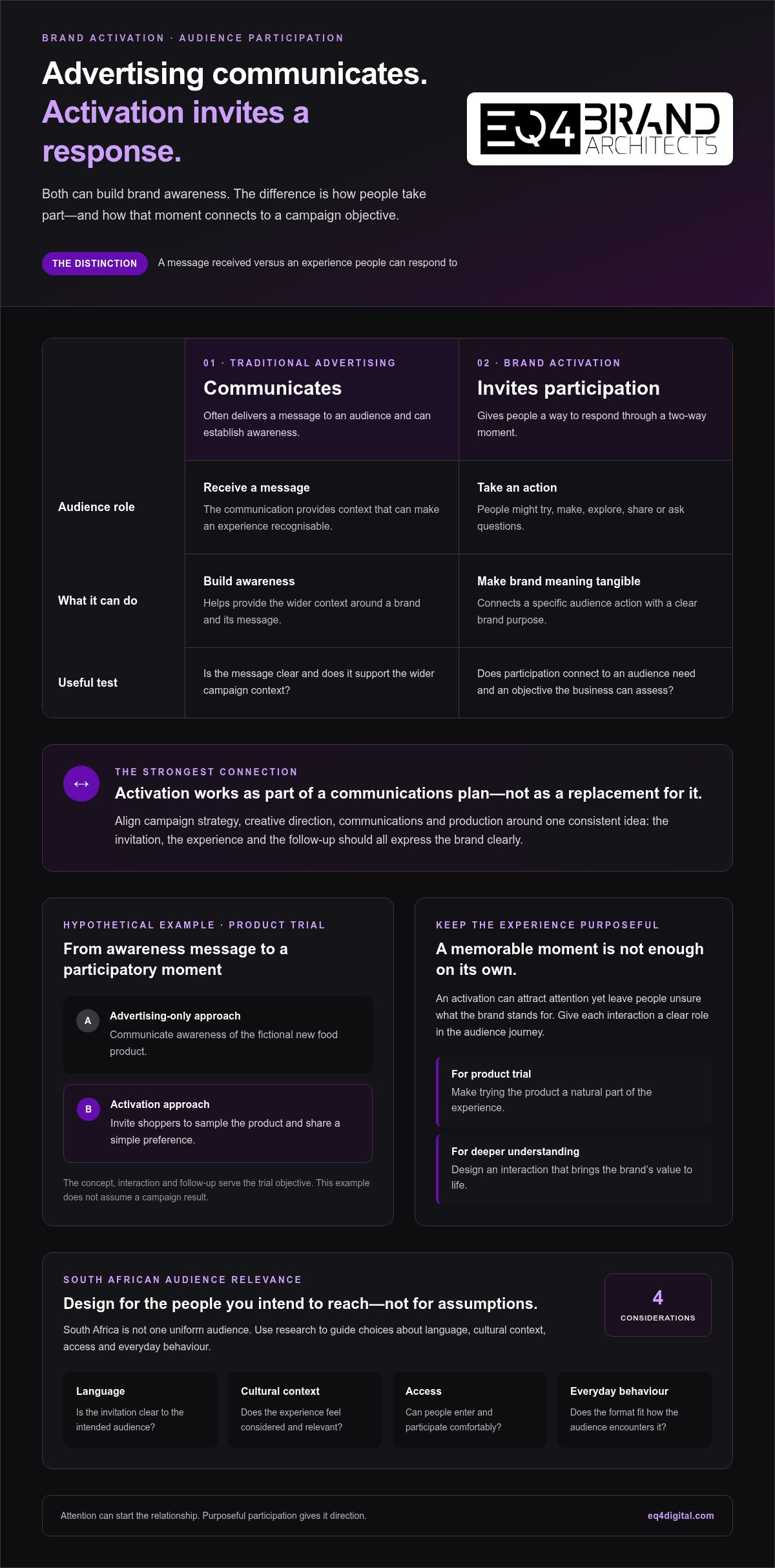
Start with the objective, not the spectacle. If the goal is to encourage product trial, make trying the product a natural part of the experience. If the priority is to deepen understanding, design an interaction that brings the brand’s value to life. A striking concept may attract attention, but without a clear role in the audience journey, it can leave people entertained without knowing what the brand stands for or what to do next.
How does brand activation differ from traditional advertising?
Traditional advertising often communicates a message to an audience; an activation gives people a way to respond. That response might involve trying, making, exploring, sharing or asking questions. Participation creates a two-way moment, while advertising can establish awareness and provide the wider context that makes the experience recognisable.
Activation works best as part of a connected communications plan, not as a replacement for broader brand activity. Campaign strategy, creative direction, communications and production can align the invitation, the experience and the follow-up around one consistent idea.
Hypothetical example: A fictional food brand wants to introduce a new product. Rather than relying only on an awareness message, it could invite shoppers to sample the product and share a simple preference. The concept, interaction and follow-up would all serve the trial objective. This example doesn’t assume a campaign result.
What makes an activation relevant to South African audiences?
South Africa isn’t one uniform audience. Research should guide decisions about language, cultural context, access and everyday behaviour for the people a campaign intends to reach. A format that feels intuitive to one group may create friction for another, so test whether the invitation, setting and participation process feel clear and welcoming.
Use local insight to inform creative choices without reducing people to assumptions. Consider how participants will encounter the activation, what would make taking part worthwhile, and whether the experience respects their time and context. These details shape more than tone: they influence where the experience fits, how people engage and what a useful outcome looks like. A purposeful brand activation campaign South Africa can connect audience insight with creative expression, so participation feels considered rather than imposed.
How to design a brand activation campaign: a five-step process
A clear sequence connects the business aim to the audience experience and the practical work of delivery. For a brand activation campaign South Africa, define the intended outcome before choosing the format or developing the creative idea.
Set a specific activation objective before creative development begins. It gives each idea a clear purpose and a way to be assessed.
- 1. Set objectives. Decide what business outcome the campaign should support, such as encouraging product trial or strengthening understanding of a brand benefit. Record the objective and how you’ll assess it. Attendance, interactions and content created are campaign outputs, not the business objective itself. This distinction also helps focus audience research.
- 2. Understand audiences. Identify who you want to reach, what matters to them and what might make participation easy or worthwhile. Use audience research to shape a practical audience profile and identify the behaviour or perception the campaign can influence. These insights give the creative team a grounded brief.
- 3. Develop the idea. Turn the brief into an experience built around a meaningful audience action. The concept should make the brand message tangible, rather than simply applying a decorative theme. Write a concise rationale linking the audience insight, action and objective. Use it to guide channel and production choices.
- 4. Plan delivery. Decide how people will discover, enter, experience and continue engaging with the campaign. Map touchpoints, owners, staffing, participant flow, approvals and contingencies. The delivery plan guides production and communications, while helping teams prepare for the participant experience.
- 5. Evaluate outcomes. Set measures before launch and decide how the team will gather and review them. Separate attention and participation from sentiment and intended business outcomes. A measurement plan makes post-campaign learning more useful and informs future activity.
How do you turn an objective into an activation idea?
Translate the business aim into something the audience can do or understand. If the aim is to encourage trial, build the idea around an invitation to experience the product. If it’s to clarify a benefit, let participants explore that benefit directly. Check that the action, brand message and overall experience reinforce one another.
How should campaign teams plan audience participation?
Think through the journey from first discovery to follow-up, including access needs, consent, staffing and how participants move through the experience. If collecting information, explain its purpose and build appropriate privacy safeguards into the process. These details help the invitation feel considered, not extractive.
Connecting strategy, creative direction, communications and production helps keep these decisions aligned. EQ4 Brand Architects brings these disciplines together through a collaborative process. Explore brand activation strategy and creative execution as connected parts of campaign planning.
Which brand activation format fits your campaign objective?
Choose the format by working backwards from the objective: what should people do, experience or understand? A brand activation campaign South Africa should suit its intended audience and the team’s ability to deliver a coherent experience, not simply follow the latest eye-catching trend. Compare formats by the interaction they invite and the support they need afterwards.
| Format | Suitable objectives | Audience interaction | Reach potential | Operational demands and follow-on communication |
|---|---|---|---|---|
| Experiential | Demonstration, discovery or deeper brand understanding | High; people explore, try or engage directly | Centred on those who encounter the experience, with sharing able to extend it | Requires considered venue access, participant flow and prepared staff. Follow up with relevant information or a next step. |
| Sampling | Product trial and informed first impressions | Direct and focused on trying a product | Depends on where and how sampling takes place | Requires product handling and a smooth handover. Provide a clear way to learn more after the interaction. |
| Event-based | Building a shared moment, launching an initiative or engaging a defined group | Can range from observation to active participation | Concentrated among attendees; event communications can carry the story further | Needs coordination across the programme, venue and audience journey. Plan post-event messages for attendees and wider audiences. |
| Digital extension | Supporting discovery, participation or continued engagement | Varies from viewing and responding to creating or sharing | Can reach beyond those present, depending on the channels and communications plan | Needs mobile-friendly content, clear calls to participate and a purposeful follow-up journey. |
These formats aren’t mutually exclusive. A live experience might invite discovery, while a digital extension helps people learn about it beforehand and revisit the message afterwards. Combine formats when each has a clear role in the audience journey. Adding channels without a shared purpose can fragment the experience.
When is an experiential activation the right choice?
Choose experiential when direct interaction, demonstration or product discovery is central to the objective. Before committing to the concept, consider whether the venue is accessible to the intended audience, how participants will enter and move through the experience, and whether staff can explain the brand message clearly. Extend a brief interaction with useful follow-up, such as more product information or a relevant next step, rather than an unrelated promotional message.
When should a campaign extend into digital and PR?
Digital touchpoints can help audiences discover an activation, take part remotely or continue engaging after it ends. Keep content suited to mobile viewing and make the next action clear. PR can add context, explain why the campaign matters and extend its story beyond attendees. For a considered approach to integrated communications, see this strategic PR agency selection guide.
How to prepare and measure a brand activation campaign rollout
A well-designed concept still needs a clear path from approval to participant experience. For a brand activation campaign South Africa, organise the rollout around named owners, decision points and production milestones. This helps keep creative, communications and delivery aligned as launch approaches.
What should a brand activation campaign checklist include?
Use a shared checklist to make responsibilities visible and surface gaps before they affect the experience. Include:
- Campaign foundation: audience, objective, key message and chosen format.
- Creative and production: approved designs, content, materials, production milestones and sign-off owners.
- Delivery: staffing, participant flow, responsibilities and communications before, during and after the activation.
- Participant needs: accessibility, clear instructions, appropriate safety planning and any relevant permissions.
- Contingencies: likely disruptions and agreed responses, with a person responsible for decisions.
- Measurement and privacy: ready-to-use measurement methods, participant information and data-handling processes.
Where personal information is collected, design the process with South Africa’s Protection of Personal Information Act (POPIA) in mind. Explain why information is requested, collect only what is needed, and obtain consent where appropriate and required for the chosen approach. Plan how the information will be kept secure, who can access it and how long it will be retained. Make participation clear without making unnecessary data capture a condition of taking part.
How can you evaluate a campaign after launch?
Set measures before launch and connect each one to the objective. Attendance or views can indicate attention; meaningful interactions show participation; feedback can help assess sentiment. Review intended business outcomes separately, using measures suited to the campaign aim. High attendance alone doesn’t establish that the objective was achieved.
Bring numbers and audience feedback together. Interaction counts can show how often people took part, while short responses or team observations may help explain what participants understood or found difficult. Compare findings with the original measures, note any limitations, and record practical recommendations for future brand communications.
Planning a rollout that connects strategy, creative and production? Discuss your brand activation campaign with EQ4.
How EQ4 brings strategy and creative execution together
A brand activation works best when its parts express one clear idea. EQ4 connects campaign strategy, creative direction, communications and production around the audience journey, shaping an experience that feels consistent from the first invitation through to the final interaction. For a brand activation campaign South Africa, that means grounding creative decisions in the organisation’s objectives and the people it wants to reach.
Collaboration begins with understanding the brief: the audience, intended business outcome, brand message and practical challenge the campaign needs to address. EQ4 then shapes a concept that gives people a meaningful way to engage and aligns communications and production to bring the experience to life coherently. Emotional intelligence and intentional strategy guide the choices, keeping the work attentive to both the brand and its audience.
What does an integrated activation campaign approach look like?
Strategy informs the central idea, the role participants play and the messages they encounter at each touchpoint. Design gives the idea a recognisable visual expression, while PR can provide context and communicate why the activation matters. Production connects those choices to the experience people actually meet, so the campaign feels joined up rather than like a series of separate assets.
Consistency matters beyond the activation itself. A campaign’s public expression contributes to how people understand and experience a brand, making reputation and communications closely connected. For a wider perspective, explore this corporate reputation management guide.
What are the next steps for planning a campaign with EQ4?
Begin with a simple outline of who you want to reach, what the organisation wants the campaign to achieve, the timing you’re working towards and the challenge you’re trying to solve. You don’t need a finished concept. A clear brief gives the conversation a useful starting point, while leaving room to shape a strategic and creative response around the project’s needs.
If you’re considering an activation, discuss your brand activation campaign with EQ4. Together, you can explore how strategy, creative direction, communications and production can support your audience journey and organisational objectives.
Turn a clear campaign purpose into meaningful action
A strong activation begins with a defined audience and business objective, then gives people a relevant reason to participate. To plan a brand activation campaign South Africa audiences can connect with, choose a format that serves the goal, map the journey from first encounter to follow-up, and decide in advance how you’ll assess attention, participation, sentiment and outcomes.
Keep the experience coherent at every touchpoint. Strategy should guide the creative idea, communications and delivery, while audience insight helps the campaign feel considered rather than imposed. Clear ownership, thoughtful participant planning and responsible measurement can turn a promising concept into a well-aligned rollout.
EQ4 brings brand activations together with communications, PR, design and production, combining emotional intelligence with intentional strategy. The team serves businesses nationally across South Africa and works collaboratively to shape an approach around your organisation’s audience and objectives.
Plan your brand activation campaign with EQ4. Start with the goal you want to achieve and the people you hope to engage. A purposeful experience can begin with that conversation.
Frequently Asked Questions
What is a brand activation campaign?
A brand activation campaign is a planned experience that invites people to interact meaningfully with a brand. It can bring people together in person, use connected digital touchpoints, or combine both. The format should follow the audience and campaign objective, whether that means encouraging product discovery or helping people understand a brand’s value. Unlike simply seeing an advert, participants take an active role. Set measures during planning so you can evaluate whether the experience supported its intended outcome.
How do you create a brand activation campaign in South Africa?
Start by defining the business objective, then research the intended audience and develop an idea that gives them a relevant reason to participate. Select a format, plan delivery and decide how you’ll evaluate outcomes. South African audience research should account for differences in language, cultural context and access needs without treating people as one uniform group. Connect the creative idea to the objective, and choose your measures before launch so the campaign can be assessed meaningfully.
What are the main types of brand activation?
Common options include experiential activities, product demonstrations or sampling, event-based engagement and digital extensions. These formats aren’t a fixed hierarchy: the right choice depends on the objective, audience behaviour and delivery context. A demonstration may suit product discovery, while a digital touchpoint could help people continue engaging after an event. Formats can also work together, carrying the experience from initial discovery to participation and follow-up when each has a clear role in the audience journey.
How do you measure the success of a brand activation campaign?
Begin with the objective, then choose indicators that show whether the campaign achieved its purpose. Depending on the goal, you might assess attention, participation, audience feedback or intended business outcomes. Attendance alone may show that people were present, but not whether they understood the message or took a meaningful next step. Agree measures before launch and, where appropriate, combine quantitative data such as interactions with qualitative feedback that helps explain what participants experienced.
How much does a brand activation campaign cost in South Africa?
The budget depends on the concept, format, production requirements, duration, locations and delivery needs. Without a defined scope, a price or general estimate may not reflect what your campaign requires. Start by clarifying the audience, objective and experience you want to create, then outline the practical elements needed to deliver it. EQ4 can discuss a project-specific approach to brand activations, shaped around your organisation’s objectives and campaign needs.
How can a brand activation campaign stay relevant to diverse South African audiences?
Use audience research to guide decisions about language, cultural context, accessibility and everyday behaviour. South African audiences aren’t a single group, so avoid relying on stereotypes or assuming one creative approach will resonate with everyone. Where practical, test concepts and communications with people who reflect the intended audience. Their feedback can help you refine the message, remove barriers to participation and make the experience more respectful and relevant before rollout.
Does a brand activation campaign need a digital component?
No. A digital component isn’t essential for every campaign; its role depends on the audience and objective. It can help people discover an activation, take part remotely or continue engaging afterwards. For example, a mobile-friendly page might provide practical information before an experience or offer a useful next step afterwards. Add digital touchpoints when they strengthen the journey, make participation easier or support meaningful evaluation, rather than including them simply because they’re available.