





What if your brand’s biggest perception gap isn’t in what you say, but in what people experience? For organisations exploring brand perception management South Africa, that distinction matters. Stakeholders may hold very different impressions, and isolated comments rarely tell the whole story.
Trust depends on more than polished messaging. When public promises and everyday interactions don’t align, even well-intended communication can feel unconvincing. A considered approach helps South African organisations understand what audiences notice, value and remember, rather than relying on guesswork.
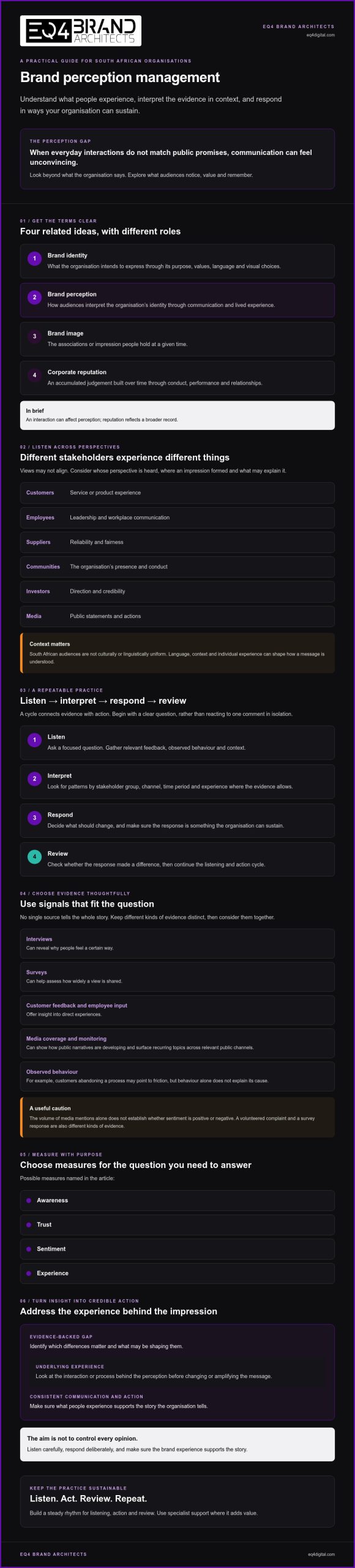
This article explains how brand perception differs from identity, image and corporate reputation, and how to select useful signals without interpreting them in isolation. It also explores how to turn audience insight into consistent, credible communication and action. The aim isn’t to control every opinion. It’s to listen carefully, respond deliberately and make sure the brand experience supports the story you’re telling.
Key Takeaways
- See how brand perception management South Africa can turn stakeholder signals into deliberate, consistent communication.
- Build a repeatable listening cycle that combines direct feedback, observed behaviour and context before decisions are made.
- Choose measures such as awareness, trust, sentiment and experience according to the question you need to answer.
- Focus on evidence-backed perception gaps, addressing the underlying experience before changing or amplifying your message.
- Create a sustainable rhythm for listening, action and review, with specialist support where it adds value.
What brand perception management means for South African organisations
Leaders can’t dictate what people think of an organisation. They can listen carefully, examine the experiences shaping those views and respond with intention. That is the practical foundation of brand perception management South Africa: understanding the beliefs, feelings and associations audiences form through an organisation’s communications and their interactions with it.
This work isn’t about persuading every stakeholder to share the same opinion. It’s about identifying where impressions come from, which differences matter and whether an organisation’s actions support the story it tells. For example, a message about dependable service may be undermined if customers receive inconsistent assistance or employees can’t deliver what has been promised.
How brand perception differs from reputation and brand identity
Brand identity is what an organisation intends to express through its purpose, values, language and visual choices. Perception is how audiences interpret that identity, based on communications and lived experience. A company may intend to appear accessible, yet its processes could leave customers feeling that it’s difficult to reach.
Brand image commonly describes the associations or impression people hold at a given time. It overlaps with perception, but perception management focuses on understanding and responding to how those impressions form. The wider practice of brand management also considers how a brand is developed and maintained. Corporate reputation, by contrast, is an accumulated judgement built over time through an organisation’s conduct, performance and relationships. One interaction can affect perception; reputation reflects a broader record.
Whose perceptions matter to a South African brand?
Different stakeholders encounter an organisation in different ways, so their views may not align. Customers may judge the service or product experience; employees may focus on leadership and workplace communication; suppliers may notice reliability and fairness. Communities may respond to an organisation’s presence and conduct, investors may consider its direction and credibility, and media may assess its public statements and actions.
Impressions can also vary across touchpoints. A customer’s experience with a website may differ from an in-person brand activation, just as an employee’s view of internal communication may differ from what the public sees. Listening across these groups helps organisations avoid treating one comment or channel as the whole picture.
South African audiences aren’t culturally or linguistically uniform. Language, context and individual experience can influence how a message is understood. Thoughtful brand perception management asks not only what people think, but whose perspective is being heard, where the impression formed and what may explain it.
How brand perception management works: listen, interpret and respond
Useful perception work is a cycle, not a one-off survey or a quick reaction to a comment. Start with a clear question: are customers confident in the organisation’s service, or do employees understand its stated values? Gather relevant signals, interpret them in context, decide what should change, then review whether the response made a difference. This gives brand perception management South Africa a practical foundation: evidence should inform behaviour, not simply produce reports.
Perception management is an ongoing discipline that connects evidence with action: listen to what people say, examine what they experience, and respond in ways the organisation can sustain.
Where to gather audience signals
Choose sources that fit the question. Interviews can reveal why people feel a certain way; surveys can help assess how widely a view is shared. Customer feedback and employee input offer insight into direct experiences, while relevant media coverage can show how public narratives are developing. Media listening and monitoring can surface recurring topics across relevant public channels, but the volume of mentions alone doesn’t establish whether sentiment is positive or negative.
Keep different kinds of evidence distinct. A volunteered complaint wasn’t prompted by a questionnaire; a survey response was. Behaviour, such as customers abandoning a process, may point to friction, but doesn’t explain its cause by itself. Together, these signals offer a fuller view than any single source.
How to interpret signals without overreacting
Look for patterns by stakeholder group, channel, time period and experience, where the evidence allows. If customers raise a similar concern after contacting support, that may suggest a service issue. A sharply critical public post may warrant attention, but it doesn’t prove that the same view is widespread. Ask who contributed, who may be missing and what was happening when the feedback was gathered.
Before acting, check for sample bias, missing context and unusually visible one-off comments. Separate an emerging theme from an isolated incident, and seek another source when the evidence is thin. This doesn’t mean dismissing an individual’s experience. It means responding with care without mistaking visibility for representativeness.
Handle personal or sensitive information with appropriate care. If research or monitoring involves personal information, consult current guidance from South Africa’s Information Regulator and consider how information is collected, accessed and used. Public visibility doesn’t remove the need for thoughtful handling.
Once a pattern is credible, identify the underlying experience or communication issue, assign a response and decide which signal will help assess progress. EQ4 Brand Architects’ media listening and monitoring, communication strategy and reputation management capabilities may support organisations seeking to connect audience insight with a coherent response.
Which brand perception measures reveal useful patterns?
Choose measures according to the decision they need to inform, not because a metric is familiar or easy to report. Awareness can indicate whether people recognise a brand; associations show what they connect with it. Trust, sentiment, consideration and experience each reveal a different part of the relationship. None should be treated as a substitute for the others.
No single metric captures every stakeholder’s view of a brand. A customer may know an organisation well but have little trust in its service, while an employee may trust its leadership but feel its public messaging doesn’t reflect workplace experience. For brand perception management South Africa, measurement should account for who is being asked, what they have experienced and what the organisation needs to decide.
Qualitative insight versus quantitative tracking
Interviews and open-ended responses help explain why people hold particular associations. They can reveal nuance, such as what “reliable” means to different audiences, but don’t automatically show how widespread a view is. Consistently designed surveys can track selected perceptions over time, provided questions, audiences and collection methods remain comparable. If those conditions change materially, treat the results as different evidence rather than a clear trend.
Choosing a balanced measurement set
Start with a defined audience, a decision and a baseline. Then pair perception measures with relevant experience evidence. For example, compare reported confidence in customer service with feedback about actual service interactions. The right mix depends on the question.
| Method or measure | Useful signal | Limitation |
|---|---|---|
| Awareness | Whether a defined audience recognises or recalls the brand. | Recognition alone doesn’t show favourability or trust. |
| Associations | Words, qualities or ideas people connect with the organisation. | Responses can vary with question wording and context. |
| Trust and sentiment | Stated confidence or expressed positive, neutral or negative feeling. | Sentiment can flatten nuanced views; stated trust may not match behaviour. |
| Consideration | Whether people would consider the organisation when making a relevant choice. | Intent isn’t the same as a completed decision. |
| Experience evidence | Feedback or behaviour connected to a specific interaction or journey. | It may describe one touchpoint, not the whole relationship. |
| Net Promoter Score (NPS) | Willingness to recommend, captured through a recommendation question. | It isn’t a complete brand perception score and doesn’t explain every reason behind a response. |
Use a manageable set of measures and interpret them together. A shift in one score is a prompt to investigate, not proof of its cause. Qualitative insight and experience evidence can help explain what changed.
How to improve brand perception without making promises you cannot keep
Improving perception doesn’t mean responding to every comment or rewriting the brand story at the first sign of criticism. Focus on a few evidence-backed gaps that matter to stakeholders and that the organisation can address. If people describe a service as confusing, for instance, first examine the instructions and support they encounter. A new message won’t resolve a problem that remains in the experience.
For brand perception management South Africa, credibility comes from aligning communication with what the organisation can genuinely deliver. Some gaps point to something changeable, such as unclear information or inconsistent service. Others may reflect an assumption that needs a calm, factual explanation. Distinguishing between the two helps teams choose a response that respects the audience without overpromising.
Turning perception gaps into credible action
Give each priority gap a clear owner. Communications teams can shape how an issue is explained, while the teams responsible for the relevant service, product or workplace experience may need to address its cause. Keep both sides involved so that a public response reflects real progress, not an intention that hasn’t yet been put into practice.
Use a simple action sequence:
- Insight: State the perception gap and the evidence behind it.
- Owner: Assign responsibility to the team able to influence the issue.
- Response: Record the experience change or communication action planned.
- Measure: Choose a relevant signal to check for movement.
- Review date: Set a point to assess what changed and what still needs attention.
Keep claims proportionate to the evidence and what the organisation can deliver. If an organisation is improving response times, for example, avoid promising a standard until it can demonstrate that the service consistently meets it. Honest progress is more credible than a polished claim that stakeholders’ experiences contradict.
Keeping communication relevant across South Africa
A recognisable brand can adapt how it communicates without changing its truthful core. Consider whether the language, channel and cultural context suit the audience rather than assuming one message will land equally well with everyone. Check that key materials are clear and consistent across touchpoints, including public communications and direct interactions.
Where advertising claims or industry codes may apply, verify current requirements and relevant guidance before publication. Don’t rely on assumptions about the Advertising Regulatory Board or a particular code. Check whether it applies to the communication and claims in question.
If your organisation needs to turn audience insight into a clearer, more consistent response, discuss a communication strategy with EQ4.
Building a sustained brand perception management practice
Brand perception management is most useful when it informs organisational decisions, not when a report surfaces once and then sits untouched. Give teams a dependable rhythm for gathering relevant feedback, discussing what it suggests, agreeing a response and checking what follows. Keep the process proportionate: a focused review that leads to action is more useful than collecting signals nobody has time to interpret.
Internal teams can coordinate routine feedback, bring customer or employee experience into discussions and track whether agreed communication is consistent. Specialist support may help when the organisation needs broader research, structured media listening, an impartial interpretation of complex signals or communications that need to align across teams. If you’re evaluating external support, understanding how to choose a media listening agency in South Africa can help you assess which partner brings genuine context and judgement to the signals, rather than simply delivering a stream of alerts. The aim is to complement internal knowledge, not replace the people closest to the work.
A practical starting plan for the first review cycle
Begin with one priority stakeholder group and one question that can guide a decision. For example, an organisation might ask whether suppliers understand how to raise an issue, rather than trying to measure every aspect of its reputation at once. Record the starting point clearly so the next review has something meaningful to compare.
Keep a short review record with:
- Audience and question: Whose perception are you exploring, and what do you need to learn?
- Baseline and evidence: What do you know now, and which sources support that view?
- Owner and review point: Who will coordinate the work, and when will the team revisit it?
- Learning: What changed after the response, and what should the next listening cycle test?
This record makes continuity easier, especially when responsibilities are shared. It also helps teams distinguish a genuine shift in audience understanding from a change in how feedback was gathered.
When external communications support can help
Consider a partner when listening, interpretation and response need to connect across disciplines, or when internal teams need added capacity or an independent perspective. Assess how a prospective partner approaches the strategic question, which relevant capabilities they can bring and how they’ll work with the people responsible for stakeholder experience. Look for a thoughtful process, not a promise to control what audiences think.
EQ4 offers reputation management, public relations, communication strategy and media listening and monitoring, alongside design and production capabilities. These services can be relevant when an organisation wants to connect stakeholder insight with coherent communication and creative execution, while keeping its response grounded in what it can deliver.
If you’re considering how to build a more consistent practice, explore EQ4’s strategic communications capabilities and start a conversation about your organisation’s needs.
Make your next step a more informed one
Strong brand perception management South Africa starts with curiosity, not control. Listen across stakeholder groups, interpret signals in context and choose measures that answer a clear question. Then turn the most meaningful insight into action people can experience, not just a message they hear.
A steady review practice helps your organisation understand what is changing and where attention is needed. It also keeps communication connected to the experience behind it, so your brand’s words remain credible and relevant to the people they reach.
EQ4 offers reputation management, public relations and communication strategy, alongside media listening and monitoring. If you’d like to explore how these capabilities could support your organisation’s communications, explore how EQ4 can support your brand communications.
Every thoughtful response is an opportunity to build greater clarity and trust. Start by listening to your audiences, then contact EQ4 to discuss your brand communications needs.
Frequently Asked Questions
What is brand perception management?
Brand perception management is the ongoing work of understanding how audiences interpret an organisation and responding thoughtfully to what shapes those views. The phrase brand perception management South Africa describes this practice in the local context, where organisations need to consider different stakeholder experiences and language contexts. It involves gathering relevant feedback, identifying credible patterns and aligning communication with the experience people actually have, rather than trying to dictate what they should think.
How do you measure brand perception?
Measure brand perception by matching each method to a clear question and audience. Surveys can track awareness, trust or consideration over time if their questions and collection methods remain consistent. Interviews and open responses can help explain why people hold particular views. Add relevant evidence about customer or employee experiences, and interpret media mentions carefully: the number of mentions alone doesn’t show whether sentiment is positive or negative.
What is the difference between brand perception and brand reputation?
Brand perception is the impression or interpretation an audience forms, which can shift with a particular message or interaction. Reputation is a broader judgement accumulated over time through an organisation’s conduct, performance and relationships. One customer’s experience may influence their perception without representing the organisation’s overall reputation. Looking at both helps teams understand immediate reactions as well as the longer-term view developing across stakeholder groups.
Can a business control how people perceive its brand?
No. A business can’t control every interpretation, but it can influence the conditions that shape perception. It can communicate clearly, listen to stakeholder feedback and address issues in the experience behind a concern. For example, if customers find a process confusing, improving the instructions may matter more than repeating a claim that the service is simple. Credible action can support trust, though each person’s view remains their own.
How often should a company review brand perception?
There isn’t one review schedule that suits every organisation. Set a rhythm that matches the decision, the audience and how quickly relevant conditions may change. Teams might review ongoing feedback routinely, then conduct a more focused assessment after a major change in service or communication. Record the baseline, evidence and review point so results can be compared meaningfully, and revisit sooner if credible signals point to an emerging issue.
Which tools can help monitor brand perception in South Africa?
Useful tools include surveys, interview records, customer feedback channels, employee input and media listening or monitoring systems that track relevant public coverage. A simple, organised dashboard or spreadsheet can help teams compare themes by audience, channel and time period. Each source has limits: monitoring public mentions won’t capture every stakeholder’s view. EQ4 offers media listening and monitoring as a service, alongside reputation management and public relations.
How can a brand respond to negative audience feedback?
Start by acknowledging the feedback and checking the context before deciding what to say or change. Look for a recurring issue, consider whose experience is represented and involve the team responsible for the underlying touchpoint. Respond plainly, explain what can be done and avoid promising more than the organisation can deliver. If feedback includes personal or sensitive information, handle it with care and use appropriate internal processes.