

What if the biggest shift in animation isn’t how a film looks, but how purposefully its motion works across a brand? In 2026, an animation studio is increasingly creating adaptable, strategy-led content rather than treating every project as a standalone film.
It’s understandable to feel cautious amid the pace of change. AI and real-time tools are opening new creative possibilities, but speed alone doesn’t make a story distinctive or effective. The opportunity is to use new methods in service of strong ideas, clear communication and considered craft.
This article explores the shifts that matter, from AI-assisted workflows and hybrid 2D and 3D techniques to tactile visual styles and short-form motion. It also looks at how animation can make complex ideas easier to grasp and help a brand communicate consistently. You’ll find practical considerations for deciding which trends suit your goals and briefing a creative partner.
Key Takeaways
- Plan motion as a connected set of communications, not simply a single finished film.
- An animation studio can turn a brief into moving-image work shaped around your communication goals.
- Use AI to support production tasks, while keeping concept, tone and creative judgement human-led.
- Consider aspect ratio, duration, captions and viewing context when adapting motion for different channels.
- Clarify the goal and story before choosing a visual style or production format.
What is changing for animation studios in 2026?
Animation is moving beyond the idea of one finished film. Brands can plan motion as a connected communication system: a central story can be adapted for a presentation, website or social channel, with each version shaped for its setting. The aim isn’t to produce more content for its own sake, but to help an idea travel clearly between audiences and moments.
An animation studio is a creative production partner that develops moving-image work from a brief, shaping the concept and visual approach through to the finished piece. For a grounding in the form’s history and techniques, see What is animation? The studio’s role isn’t simply to make images move. It’s to help decide how motion can serve the communication goal.
Why are brands paying attention to animation now?
Motion can make an unfamiliar process or abstract idea easier to follow by showing relationships, sequence and change. An animated diagram, for example, can reveal how parts of a service connect. A character-led story can give a human point of view to a less tangible message. A striking visual may attract attention, but attention alone won’t explain what a brand means or what its audience should understand.
Strategic animation uses motion to make a message clearer, more memorable or easier to act on. That purpose should guide decisions about style, pace and format, rather than letting a visual trend dictate the story.
Which shifts are shaping animation studios?
Three developments are worth understanding. Whether they suit a particular brief depends on the audience, message and production approach:
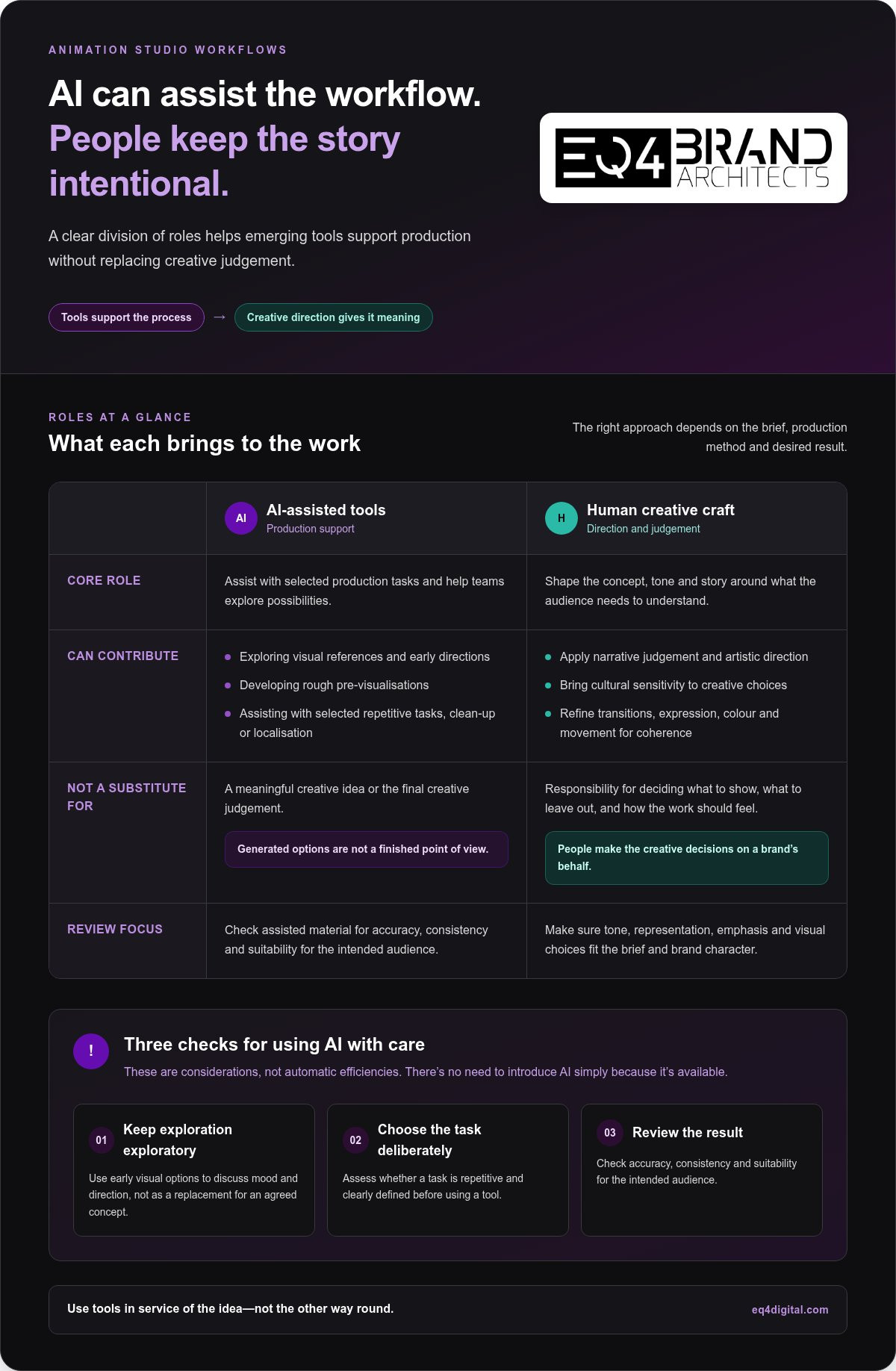
- AI-supported workflows: Tools can assist with concept exploration, pre-visualisation, clean-up or localisation. They don’t supply the meaningful idea or make the final creative judgement. People still shape the concept, tone and story.
- Real-time visualisation: Real-time rendering can help teams review visual choices as scenes develop, and is used in virtual production. Its relevance depends on the project’s needs and production approach.
- Adaptable motion assets: Planning related versions from the outset can help a central story work across different placements. Aspect ratio, duration, captions and viewing context all influence how an asset should be adapted.
These are shifts in production practice, not promises of faster or better work. The useful question for a brand is whether a technique improves the audience’s experience of the message. Start with the communication objective, then assess which tools and formats support it.
How are AI and human craft reshaping animation studio workflows?
AI can contribute to animation production, but it doesn’t arrive with a meaningful creative idea. A tool may generate visual options or assist with a task; deciding what the audience needs to understand, and how the story should make them feel, remains a creative responsibility. The challenge for an animation studio is to use emerging tools with care, not to mistake their output for a finished point of view.
That distinction matters because a polished image can still be wrong for the brief. A brand film about a sensitive subject, for instance, needs considered choices about tone, representation and emphasis, not just visual generation. Industry discussion continues to examine the opportunities and concerns around Generative AI in animation, including its implications for creative work.
Where can AI support animation production?
Depending on the brief and production method, AI may help a team explore visual references, compare early directions or develop rough pre-visualisations. It may also assist with selected repetitive tasks. These are possibilities, not automatic efficiencies: a workflow that suits a simple visual exploration may not suit a project requiring a distinctive, carefully controlled style.
- Use early explorations to discuss mood and visual direction, not as a substitute for an agreed concept.
- Assess whether a task is repetitive and clearly defined before using a tool.
- Review generated or assisted material for accuracy, consistency and suitability for the intended audience.
The right approach depends on the desired result. There’s no need to introduce AI simply because it’s available.
What does human craft contribute?
People bring narrative judgement, artistic direction and cultural sensitivity to decisions a tool can’t make on a brand’s behalf. They shape what to show, what to leave out and how the work should sound and feel. That includes considering whether characters, symbols, humour or visual references will land as intended with the audience.
Review and refinement also give a piece coherence. A creative team can question an awkward transition, adjust a character’s expression or bring colour and movement into line with the brand’s character. Creative direction turns AI-assisted options into animation with intention, meaning and a consistent point of view.
Think of AI as one possible instrument within a considered process, alongside animation, visual effects and video production. A motion brief that considers animation and visual effects as part of a wider communication approach can keep the story and its execution connected.
Why are adaptable animation assets becoming more useful to brands?
A single animation can do more than one job when it’s planned as a family of related assets. A central piece might introduce an idea, while shorter edits or supporting visual elements explain a detail or bring the same story into another communication setting. The key is to preserve the central message without assuming every audience needs the same version.
Start by defining the purpose of each placement. Aspect ratio affects composition, duration shapes how much context a story can carry, and captions can support understanding when sound isn’t available or appropriate. Safe areas, legibility and pacing also need attention early, so essential text or action remains easy to follow when the frame changes.
How can one animation idea work across different formats?
Imagine a fictional organisation introducing a new service. Its central animation could explain the service from problem to solution. A shorter cut-down might focus on one key benefit, while a supporting graphic could clarify a process step. The versions share a visual idea, but each is shaped around what its audience needs to take away in that context.
An animation studio can plan these variations during development rather than treating adaptation as a final technical step. This gives the creative team room to design for different frames, keep important details readable and adjust the rhythm without losing the story’s intent.
- Identify the core idea that every version needs to retain.
- Decide what each placement should help its audience understand or do.
- Consider framing, captions, legibility and pace before production is complete.
How can teams keep motion consistent with brand identity?
Consistency is more than repeating a logo. Colour, typography, movement and sound all contribute to how a brand feels. A considered creative direction sets out how these elements express the brand’s character, while leaving enough flexibility for each asset to suit its audience and purpose. Without that direction, variations can look disconnected even when they share the same message.
Developing branding and design principles alongside the motion brief helps teams make those choices deliberately. A clear foundation also gives reviewers a useful reference: does each adaptation feel recognisably on-brand, and does it still communicate the intended idea?
When planning motion for connected use, consider animation as part of your brand communication, with a creative direction that keeps the story coherent across formats.
How can an animation studio bring strategy and storytelling together?
A purposeful animation begins with a communication need, not a preferred format or production technique. The story, visual approach and final execution should follow from what the organisation needs its audience to understand, feel or do. This keeps creative decisions connected to the brief rather than letting a format lead the thinking.
An animation studio can guide that process through four connected stages:
- Clarify the goal. Define the communication challenge and the audience the work needs to reach.
- Shape the story. Identify the key message and choose a narrative that makes it meaningful to that audience.
- Choose the visual approach. Set a tone and style that suit both the subject and the brand.
- Produce with purpose. Select production methods and formats that support the story and its planned distribution.
The order matters. A brief that starts with “we need an animated video” may settle on an output before establishing the need. Starting with the objective lets the creative team consider what form of motion can serve the message most clearly.
What should a purposeful animation brief establish?
A useful brief gives the creative process a clear centre without dictating every frame. Set out the intended audience, communication objective, key message and desired tone. Then ask: What should viewers understand or feel after watching? The answer helps distinguish essential story elements from details that can be left out.
Include practical distribution requirements, such as where the work may appear, viewing conditions to consider and whether different versions are needed. These details inform creative and production choices, but shouldn’t become assumptions about a specific channel or deliverable before the message is clear.
How can animation connect with wider brand communication?
Animation can give a visual identity movement through graphic design, support PR with a clear explanation of an initiative, or add a story element to a brand activation. Combined with video production or visual effects, it can contribute to a coherent narrative across different forms of communication. A shared strategic direction helps each element feel connected without making every execution identical.
For projects involving compositing or the integration of visual elements, a strategic approach to visual effects can help clarify how VFX supports the story. EQ4 Brand Architects brings animation together with communication strategy, design, VFX and video production, shaping the creative approach around the brief.
For a communication challenge that could benefit from motion, explore EQ4 Brand Architects’ creative services as part of a connected approach to the story.
Give your next brand story room to move
Start by identifying one idea your audience needs to grasp, then consider whether motion can express it with greater clarity or feeling. A focused brief gives an animation studio a meaningful starting point: the change you want to make in your audience’s understanding, and the tone that will help the message resonate.
At EQ4, animation can form part of a wider creative response alongside visual effects, video production, communication strategy, design and brand activations. Connecting these elements to a shared purpose helps the work feel considered rather than assembled from separate tactics.
You don’t need every creative decision settled before beginning. A clear communication challenge is enough to start shaping the story, explore a visual direction and consider how motion could support your brand. Explore EQ4’s creative services and start a conversation about the story you want to tell.
Frequently Asked Questions
Is animation different from motion graphics?
Yes, although the terms overlap. Animation is the broader practice of creating moving images, while motion graphics usually focuses on moving text, shapes, symbols or data. A company explainer might use motion graphics to label stages in a process, then character animation to bring a customer scenario to life. Knowing the distinction can help you describe the visual language you have in mind without treating the approaches as mutually exclusive.
How much does animation production cost?
There isn’t one fixed cost for animation production; it depends on the scope and creative requirements. A simple sequence using existing brand assets involves different work from a detailed character-led story with custom environments, sound and several versions. The finished piece’s length, visual complexity, production method and review process can all affect the project. A useful first step is to define what the animation needs to achieve and include.
How long does it take to produce an animation?
Production time depends on the creative scope, the material needed and how quickly decisions can be made at each review stage. A project may involve briefing, script development, visual direction, storyboarding, animation, sound and final refinements. Delays can arise if key information or approvals arrive late, or if the story changes after production begins. Agreeing who will review the work, and when, helps teams plan the process with greater confidence.
Can animation help explain a complex business idea?
Yes. Animation can make an idea easier to follow by breaking it into clear stages, showing how separate parts relate, or illustrating a process that’s difficult to film. For example, an internal training piece could trace how information moves between teams, using labels and visual cues to clarify each handover. Keep the explanation focused: introduce unfamiliar terms, give each step room to register and check that viewers can follow the logic.
What should a business include in an animation brief?
Alongside the audience and intended message, include essential facts, existing brand guidelines, reference materials and practical distribution needs. Note who can approve the script and visuals, and identify any subject experts who should review technical details. It also helps to state what the animation must avoid, such as outdated terminology or imagery that doesn’t reflect the organisation. A focused brief gives the creative team useful boundaries without prescribing every visual choice.
Can animation be combined with visual effects and video production?
Yes. Animation can be integrated with filmed footage, with visual effects used to combine or enhance elements where the story calls for it. For instance, a live-action interview could sit alongside animated diagrams that clarify a process discussed on screen. The balance depends on the subject and desired tone. EQ4 offers animation, visual effects and video production, so these approaches can be considered together as part of a coherent creative direction.