





Negative publicity’s long-term impact is measured through sustained changes in stakeholder sentiment, brand perception, behaviour and organisational outcomes, compared with a credible baseline. Measuring the impact of negative publicity means looking beyond how widely a story travelled to whether trust, consideration or action changed over time.
A spike in coverage can feel like evidence that reputational damage is deepening, but volume alone cannot show how audiences interpreted the story or whether their behaviour changed. Attention is visible; shifts in confidence and intent require more deliberate measurement.
Assess these shifts through sentiment analysis, customer responses and reputation indicators, then set benchmarks that make comparisons meaningful. Positive word of mouth can also shape decisions, so interpret negative attention without assuming it tells the whole story.
Key Takeaways
- Look beyond coverage volume to assess whether stakeholder confidence, brand perception or behaviour changes over time.
- Interpret sentiment alongside the relevance, credibility and prominence of the coverage reaching your audiences.
- Set measurable objectives against a clear baseline, linking communication outcomes to organisational priorities.
- Compare negative attention with positive word of mouth before assuming criticism carries greater influence over consumer decisions.
- Use audience responses and reputation indicators to identify where a strategic communications response may be needed.
Long-term effects on reputation and brand perception
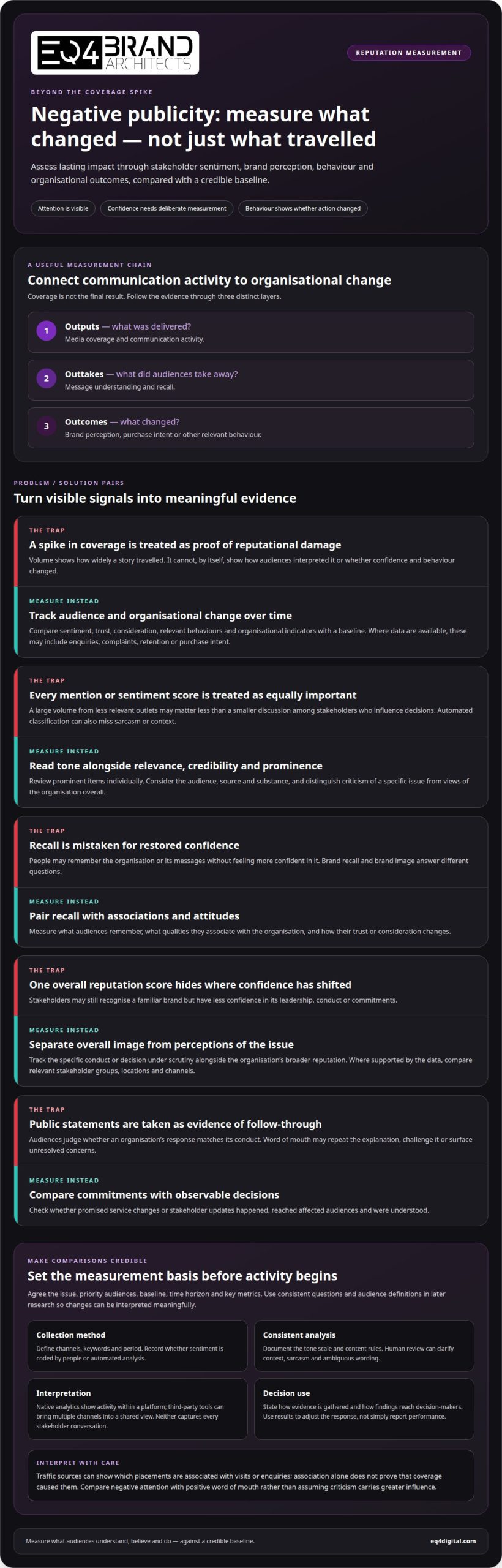
Measuring the impact of negative publicity means separating a brief attention spike from lasting changes in what stakeholders believe and do. A useful assessment follows three layers: communication outputs, audience outtakes and organisational outcomes. Media coverage is an output; message understanding and recall are outtakes; changed brand perception or purchase intent are outcomes. This distinction prevents activity counts from standing in for reputation.
Build a baseline before judging change. Record existing awareness, trust, brand associations, consideration and relevant behaviours among the audiences most affected. Use the same questions and audience definitions in later research. For example, if coverage questions an organisation’s service reliability, track whether stakeholders associate the brand with reliability, not just whether they remember the story. Consistent measures make shifts easier to interpret.
Long-term analysis should connect reputation measures to the issue itself. Separate the organisation’s overall image from perceptions of the specific conduct or decision under scrutiny. Stakeholders may still recognise a familiar brand but have less confidence in its leadership or commitments. Track these dimensions separately, alongside relevant indicators such as enquiries, complaints, retention or purchase intent, where data are available.
Brand recall and brand image are related, but answer different questions. Recall shows whether people remember the organisation or its messages; image captures the qualities they associate with it. A campaign may improve message recall without restoring confidence. Conversely, evidence of changed behaviour may emerge before broader perceptions shift. Pair recall questions with association and attitude measures to avoid mistaking visibility for reputational recovery.
Commitment matters because audiences judge whether an organisation’s response matches its conduct. Compare public statements with observable decisions, service changes or stakeholder follow-through. If a company promises clearer updates, for example, assess whether affected audiences receive them and understand what changed. Word of mouth can then reveal whether stakeholders repeat the organisation’s explanation, challenge it or share unresolved concerns.
Organisations and communications advisers should agree the measurement approach before activities begin. Define the issue, priority audiences, baseline, time horizon and key metrics together. Clarify who gathers media and audience evidence, how sentiment is coded, and how findings reach decision-makers. The AMEC framework provides a structure for linking activities to outputs, outtakes and outcomes, rather than treating coverage as the final result.
Use findings to adjust the response, not simply report performance. If recall rises but confidence remains weak, strengthen the evidence and stakeholder dialogue rather than relying on message frequency alone. If audiences respond differently, tailor communication to their concerns. A transparent record of methods and changes helps leaders distinguish persistent reputation effects from temporary attention and decide what organisational action should follow.
Sentiment analysis
Sentiment analysis classifies coverage and public reactions as positive, negative or neutral. Its value depends on context: the audience, source and substance matter as much as volume.
Native and third-party analytics tools
Native tools report activity within an individual platform, while third-party tools can bring multiple channels into a shared view. Together, they help distinguish where conversation occurs from how people respond. Platform analytics may show comments and shares, while media monitoring can identify relevant news coverage and recurring themes. Neither view alone captures every stakeholder conversation.
Set a consistent collection method before comparing results. Define the target audience, channels, keywords and period, then record whether people or automated analysis code sentiment. Automated tools can process large volumes, but human review helps clarify context, sarcasm or ambiguous wording. Document the tone scale and content rules so later reports use the same basis.
Limits of mentions and sentiment scores
Media mentions count attention, while a sentiment score summarises classified tone; neither proves a change in reputation or behaviour. A spike in coverage may appear positive until analysis shows that most mentions criticise the organisation. Conversely, a large volume from outlets with little relevance to the target audience may matter less than a smaller discussion among stakeholders who influence decisions.
Context can also distort scores. A neutral report may repeat an allegation without endorsing it, while a critical comment may discuss a response favourably. Review prominent items individually and distinguish the subject of criticism from the organisation’s wider reputation. Compare the tone, credibility, relevance, message delivery and prominence of coverage rather than treating every mention as equivalent.
Audience demographics and behaviour add meaning to sentiment. Where data are available, distinguish stakeholder groups, locations and channels. In South Africa, responses may differ across language communities or between customers, employees and institutional stakeholders; broad averages can conceal those differences. Interpret demographic patterns carefully, using only categories your data support. Then assess actions such as enquiries, complaints, site visits or changes in engagement.
Connect conversation data with web traffic and campaign reporting. Reviewing traffic sources can help identify which media placements are associated with visits or enquiries, but association alone does not prove that coverage caused them. A report should state the collection criteria, analysis method, tone scale, target reach and relevant audience profile. It should also explain what changed, which messages appeared and what response the evidence supports.
Use findings to adjust communication activities, not simply report a score. If negative discussion centres on a specific service issue, examine the evidence and stakeholders’ questions before changing the message. If sentiment improves but audience action does not, investigate whether communication reached the relevant people. Consistent definitions across reports make patterns clearer and give decision-makers a sounder basis for responding.
Benchmarks and measurable objectives
Establish a pre-crisis baseline using existing audience research, reputation tracking and business indicators. Record the audience, questions, collection method and reporting period so later results can be compared consistently.
Without that reference point, it is difficult to separate post-crisis change from established perceptions or normal variation. Keep the baseline specific to the issue and the stakeholders most likely to be affected.
Begin with the organisational decision the measurement must inform. A board may need to understand whether confidence in leadership is recovering; a customer-facing team may need to know whether complaints or enquiries are changing. Define the objective around that decision, not whichever data are easiest to collect.
Communications objectives should state who the programme intends to affect, what should change, when it should change and how much change is sought. For example, a public relations objective could focus on improving stakeholder understanding of a service change by a defined review point. Measure understanding, not merely campaign activity.
Choose benchmarks that reflect different stages of effect. Outputs show what communication activities delivered, such as relevant coverage or visits to an information page. Outtakes indicate whether audiences noticed, understood or recalled the message. Outcomes assess changes in awareness, attitude, confidence or behaviour. The AMEC framework helps organise these stages and connect them to organisational objectives.
Set starting values before a crisis where possible. Useful baseline measures can include awareness, trust, brand associations, purchase intent, complaints, enquiries and retention. Select only indicators linked to the issue and affected audience. If a crisis concerns service reliability, for instance, record existing perceptions of reliability alongside relevant service feedback.
Use comparable methods at each measurement point. Keep survey wording, audience definitions, collection channels and analysis criteria consistent; otherwise, an apparent shift may reflect a change in method. Report survey questions as asked, their order, the sampling approach, sample size and margin of error. For media analysis, document the content sources and collection criteria.
Benchmarks also need a clear time horizon. Attention may change before attitudes or behaviour, so align each review point with the effect being assessed. A campaign report can distinguish early message understanding from later shifts in confidence, consideration or action. This helps teams adjust communication without making premature claims of recovery.
Finally, connect communication outcomes to business objectives where evidence allows. Track relevant leads, enquiries, conversion rates or revenue alongside reputation measures, while recognising that several activities may influence results. Public relations, paid media, owned channels and operational changes can overlap. State the attribution method and its limits, then use findings to guide future investment and campaigns.
Comparing positive and negative word of mouth
Positive and negative word of mouth should be assessed as distinct signals, not opposite scores on a single scale. A recommendation may encourage someone to consider a brand, while a critical account may raise a specific concern or reinforce existing doubts. Meaning depends on the speaker, the subject and the listener’s relationship with the organisation.
Start by separating the content of each conversation. Positive comments may express satisfaction, recommend a service or describe a useful experience. Negative comments may report a failure, question an organisation’s conduct or repeat information heard elsewhere. These categories suggest different responses: a service complaint calls for investigation, while a recommendation may reveal which experience people value enough to share.
Compare like with like. Review positive and negative discussion about the same product, issue, audience and period, and distinguish first-hand accounts from general opinion. For example, compare customer comments about delivery experiences with comments about the organisation’s public response. Combining them could obscure whether people are evaluating the service itself or how the organisation handled criticism.
Examine how the conversation develops over time. A critical post may prompt questions, corrections or supportive accounts; a positive post may attract disagreement or further concerns. Track whether comments introduce new issues, repeat existing ones or describe a resolution. This helps identify whether discussion is broadening, narrowing or shifting to another aspect of the organisation’s conduct.
Then consider what each type of word of mouth calls on the organisation to do. Positive comments can reveal credible experiences that deserve wider attention, provided they are represented accurately. Negative comments can surface gaps between intended commitments and lived experience. If praise concerns helpful staff, for instance, compare it with recurring complaints about access or response times before shaping a public message.
Keep the underlying evidence visible in any comparison. Record the source, topic, audience relevance and whether the account describes direct experience. Note how the organisation responded and whether the conversation changed afterwards. This makes it easier to distinguish advocacy from simple approval, and criticism from evidence of a wider concern.
Use the comparison to guide decisions, not manufacture a favourable balance. If positive discussion is strong but a particular concern remains unresolved, amplify praise only where relevant and credible, while addressing the concern directly. If critical accounts reveal a repeated experience, communication alone will not resolve the underlying issue. The comparison is most useful when it shows both what stakeholders value and what requires action.
Consumer response to negative publicity
Negative publicity matters commercially when it changes what people believe, choose or continue buying. Measuring those responses means connecting public conversation with customer behaviour and business outcomes.
Sales, revenue and customer churn
Negative publicity can affect sales and revenue if customers delay purchases, choose another organisation or reduce spending. It can also contribute to churn when existing customers lose confidence or feel their concerns remain unanswered. Effects depend on the issue, the customer relationship and available alternatives, so coverage volume alone cannot quantify commercial impact.
Assess the connection using customer data alongside the timing and nature of the publicity. For example, compare enquiries, conversions, cancellations and retention before and after a specific issue. Segment results by affected product or audience where possible. This helps distinguish a broad change in demand from a concentrated response among customers directly affected.
Interpret changes carefully. A fall in sales during negative coverage may also reflect pricing, service availability or other market conditions. Compare relevant periods and customer groups, then document what else changed. The practical question is whether the pattern supports a link between publicity, customer response and revenue, rather than assuming every commercial movement has a single cause.
Measuring reputational damage
South African businesses can assess reputational damage by combining media and social media analysis with audience research and organisational indicators. This matters because local stakeholders may encounter an issue through different channels, languages and relationships, while a single overall score can conceal distinct responses.
Start by defining the issue and affected audiences, such as customers, employees, suppliers or community stakeholders. Track the volume and tone of relevant coverage, but also assess credibility, prominence and whether key messages appear. Use consistent criteria across media sources and social platforms, then compare findings with audience measures such as trust, understanding, confidence or intent.
Pair those measures with observable responses. Examples include customer complaints, service enquiries, cancellations, employee feedback or stakeholder participation. Each indicator answers a different question: complaints signal friction, while participation may show a willingness to remain engaged. Compare results with an appropriate baseline and record collection methods so later reporting reflects real changes, not altered measurement rules.
Interpretation should account for the setting and the issue’s reach among relevant communities. A widely shared post may attract attention without affecting customer decisions; a focused discussion among customers or employees may reveal an operational concern with greater consequences. Separate attention, audience sentiment, behaviour and business outcomes in reporting. This clarifies opportunities to respond, address underlying concerns and assess whether perceptions or actions shift over time.
When sales indicators move alongside declining confidence, investigate the customer experience and the organisation’s response together. Communication can clarify decisions and explain corrective action, but it cannot substitute for addressing a service or conduct problem. Tracking both public response and operational evidence gives leaders a firmer basis for deciding what needs to change.
EQ4 Brand Architects: Reputation Management
EQ4 Brand Architects helps organisations interpret reputational signals and shape a considered response through Reputation Management. When negative publicity raises questions about stakeholder confidence, customer behaviour or the credibility of an organisation’s commitments, this work can connect evidence with communication decisions.
Public Relations (PR) and Communication Strategy support a coherent response across audiences and channels, grounded in the issue and its organisational context. The goal is not simply to increase visibility, but to understand what stakeholders need and align communication with meaningful action.
If your organisation is assessing the longer-term effects of negative publicity, contact EQ4 Brand Architects to discuss the reputation challenge you’re facing.
Make reputation evidence part of the next decision
The value of measuring the impact of negative publicity lies in how leaders use the evidence. Identify where stakeholder concerns point to a communication gap, an operational issue or both. Then make reputation insight part of decision-making, rather than treating it as a report separate from the organisation’s response.
EQ4 Brand Architects offers Reputation Management and Public Relations (PR) to help organisations shape considered communication around reputational challenges. Brand Activations can also support purposeful audience engagement when they fit the strategic response. Each approach should serve a clear organisational need, with progress assessed through relevant stakeholder and business outcomes.
If your organisation is deciding how to respond to a reputational challenge, contact EQ4 Brand Architects to discuss the next step. A clearer view of the issue can help your team move forward with greater intention.
Frequently Asked Questions
How is Impact Calculated?
No single calculation can reliably assign reputational change to publicity alone. For a stronger estimate, compare the affected group’s pattern with a relevant group or period that experienced less exposure, then examine whether the difference aligns with the issue’s timing. Treat this as evidence of contribution, not automatic proof of cause, and record other major events that could explain the change.
Where to start with measuring impact?
Start by keeping a clear record of the issue as it develops. Create an incident log with dated developments, organisational responses, stakeholder questions and operational changes. This gives analysts a timeline to compare with later changes in public discussion or customer behaviour. It also helps distinguish the original criticism from later concerns about the response, which may require different decisions.
Which communications metrics matter?
Choose metrics that show whether communication is working as intended, not simply whether it was distributed. For a response explaining a service change, assess whether enquiries show persistent confusion, whether staff receive consistent questions, and whether the same misunderstanding keeps appearing. These signals can identify unclear wording or missing information and guide revisions to content and internal guidance.
How is the impact of negative publicity measured?
Assess the issue’s progression as well as its scale. Record whether the original allegation is repeated, challenged, corrected or replaced by a new concern, and note when the organisation’s response enters the conversation. This issue-level view helps leaders decide whether the priority is correcting inaccurate information, explaining a decision or addressing a substantive concern through organisational action.
What KPIs measure negative publicity’s impact on brand reputation?
Useful indicators can include confidence in the organisation’s decision-making, perceived openness and stakeholder willingness to engage with its representatives. Select indicators that reflect the specific reputational risk. For example, where criticism concerns governance, assess perceptions of accountability rather than relying only on general brand favourability. Keep measures distinct so leaders can see which aspect of reputation needs attention.
How do you measure changes in customer sentiment after negative publicity?
Use customer interviews or open-text feedback to understand the reasons behind a change, not only its direction. Ask respondents what shaped their view and what information would help them make a decision. Code responses by recurring concern, then compare those themes with customer-service records. This can reveal whether a shift reflects the publicity, a direct experience or both.
How do you track negative publicity across news, social media, and online reviews?
Set clear escalation rules for items requiring attention. For instance, route a credible allegation about service delivery to the team responsible for that service, while communications assesses its public spread and stakeholder implications. Record ownership and action taken. This connects monitoring with organisational response and reduces the risk of treating every mention as a communications-only issue.
What tools measure the reach and sentiment of negative coverage?
Select tools based on the sources and language patterns relevant to the organisation’s audiences. Test whether search terms capture local spelling variations, common abbreviations and relevant language use, then review sample results for missed or irrelevant items. Check how the tool estimates reach and classifies tone before using those outputs in reports. Tool selection should fit the monitoring question, not simply the volume of data.