





A crisis is not managed by a statement alone. A crisis management communication strategy sets out how an organisation verifies facts, informs affected people, coordinates its spokespeople and updates the public as events develop. Its purpose is to support a credible response and maintain stakeholder confidence, not to make difficult facts disappear.
Speed matters, but a fast response that is inaccurate or inconsistent can deepen confusion. Silence can do the same, especially when employees, communities, customers, media and other stakeholders need clear information. In South Africa, organisations must consider who needs to hear from them, which channels those audiences use and how messages can reach people in different contexts. A crisis management communication strategy helps organisations prepare public responses, choose channels and manage feedback. Openness, coordination and follow-through can protect reputation while the organisation addresses the underlying issue.
Key Takeaways
- Separate crisis communication from the operational response, then align both around accurate, timely information and stakeholder needs.
- Choose channels according to where each audience seeks updates, and prepare clear processes for handling questions and correcting confusion.
- Build readiness before a crisis with defined roles, adaptable message templates and realistic scenario exercises.
- Keep public updates factual and empathetic as information develops, while listening for concerns that need a considered response.
- Assess reputation through stakeholder confidence and meaningful action, then use lessons from the response to strengthen future planning.
What Is Crisis Communication?
Crisis communication coordinates accurate information for employees, stakeholders and the public during an event that threatens people, operations or reputation. In South Africa, assess messages involving personal information against POPIA and identify any industry-specific rules that apply. The details depend on the organisation and circumstances.
Identifying Risks and Preparing Messages
Risk identification means anticipating events that could disrupt operations or undermine stakeholder confidence, then preparing adaptable messages for them. This matters because agreed language and clear approval roles help teams respond without confusing known facts with assumptions.
Map plausible risks to affected audiences, operational consequences and information needs. A service interruption, for example, may require separate updates for employees, customers and suppliers. Prepare holding statements that acknowledge the issue, explain what is being checked and say when another update will follow. Treat each template as a starting point, not a script: verified facts must shape the final message.
The Deepwater Horizon oil leak in the Gulf of Mexico spilled some 134 million gallons of oil before it was fully capped, according to the National Oceanic and Atmospheric Administration. The scale of that event illustrates why plans should account for operational, environmental and community impacts, not only media attention. Review risk scenarios when operations, suppliers or stakeholder expectations change.
Setting Priorities and Focusing Messages
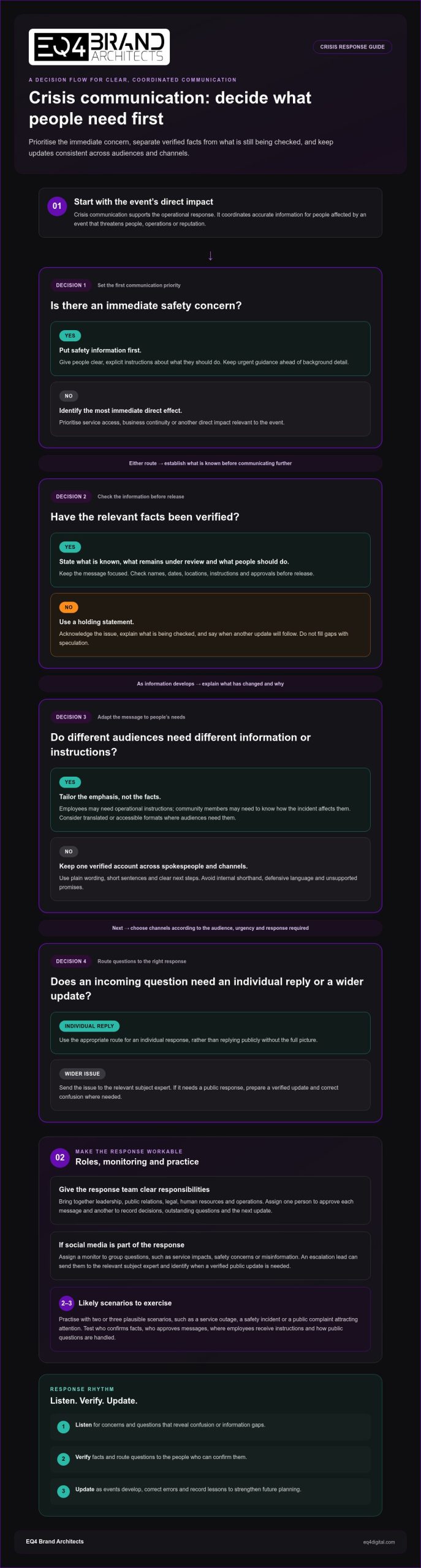
Prioritising means deciding which information people need first, based on immediate risks and the organisation’s response. A focused message helps audiences understand what has happened and what action to take, without burying urgent guidance in background detail.
Start with the most immediate concern: safety, service access, business continuity or another direct effect. Then state what is known, what remains under review and what people should do. For example, an organisation responding to a service disruption should distinguish confirmed impacts from uncertain restoration estimates. Avoid speculation, defensive language and claims that go beyond verified facts.
Give each message a clear purpose before drafting. A staff update may explain internal reporting routes, while a public notice may describe available support. Keep the core facts aligned. Before release, check names, dates, locations, instructions and approvals: even a small inconsistency can distract from the action people need.
Clear, Consistent and Audience-Specific Messaging
Audience-specific messaging presents consistent facts in language and formats suited to different stakeholders. It matters because employees, affected communities, customers and media may need different instructions, even when the underlying account is the same.
Use plain wording, short sentences and explicit next steps. Explain unfamiliar terms rather than relying on internal shorthand. Consider whether audiences need translated or accessible formats, and choose channels they can use. Pair empathy with accuracy: acknowledge disruption or concern without making unsupported promises or minimising the impact.
Maintain one verified account of events across every spokesperson and channel. Tailor the emphasis, not the facts: employees may need operational instructions, while community members may need to know how the incident affects them. When information changes, explain what changed and why. A communication strategy should also provide a route for questions, so teams can identify confusion, correct errors and refine later updates.
Choosing social media channels and managing responses
Choose channels according to the audience, urgency and response required. A crisis communication plan should also specify who monitors each channel and how questions reach decision-makers.
Crisis Response Team Roles
A crisis response team brings the people who can verify facts, make decisions and communicate them into one coordinated process. Clear roles matter because conflicting instructions can delay action and increase reputational damage.
Include leadership, public relations, legal, human resources and operations representatives. Operations can confirm service or safety information; human resources can guide employee updates; and public relations can prepare public messages. Legal input helps the team consider relevant risks, while leadership makes decisions within its authority. Assign one person to approve each message and another to record decisions, outstanding questions and the next update.
For social media, appoint a monitor and an escalation lead. The monitor can group questions about service impacts, safety concerns or misinformation, then send them to the relevant subject expert. The escalation lead can distinguish requests for individual replies from issues that require a verified public update. This reduces the risk of someone responding publicly without the full picture.
Response Drills and Timelines
Response drills rehearse how the team would communicate during plausible crises. They matter because a written plan cannot reveal unclear responsibilities, slow approvals or gaps between channels until people practise using it.
Choose two or three likely scenarios for exercises, such as a service outage, a safety incident or a public complaint attracting attention. Test who confirms facts, who approves messages, where employees receive instructions and how the team answers public questions. Repeat the exercise when roles, risks or channels change, then record decisions and improvements in the crisis communication plan.
One proposed timeline recommends acknowledging the crisis and sharing basic facts within 15 minutes, providing more detail by 60 minutes, and preparing for a press conference or further media engagement within 90 minutes. Treat these as planning benchmarks, not substitutes for verified information. If facts are still being checked, communicate what is known, what remains under review and when the next update is due.
Examples of Crisis Responses
Crisis response examples show how timely communication can help people act and reduce uncertainty. They matter because rehearsal should test actual delivery, not just the wording of a holding statement.
During a tornado response, Spartanburg Community College notified over 22,000 people within 10 minutes. The example highlights the value of having contact routes and approval processes ready before an urgent event. Organisations can test their own notification process by simulating who sends the message, which audiences receive it and how the team handles follow-up questions.
Social platforms need active monitoring as a crisis develops. Focus on two or three platforms where the organisation’s stakeholders are active, rather than spreading attention across every account. During a full-scale crisis, responding to every comment may require a 24/7 effort for a significant time. Set priorities for urgent safety questions, direct people to verified updates and correct material errors. A considered communications strategy for crisis response can help align channel choices, responsibilities and public messages.
Crisis communication planning, preparation and exercises
An effective plan connects communication decisions to operational continuity, stakeholder needs and clear governance. It should be a practical reference under pressure, not simply a document in a repository.
Key elements include stakeholder contacts, response protocols, message templates and communication channels. The plan should also define who verifies information, who approves updates and how internal and external audiences receive them.
Crisis Communication Planning and Preparation
Planning turns organisational responsibilities into a communication system that can work when normal processes are disrupted. An unavailable decision-maker or outdated contact list can leave teams without a reliable way to share information.
Record role-based contacts rather than relying on one named individual, and identify who can step in if that person is unavailable. Keep the plan accessible to the people who need it, including when usual systems are down. Specify where approved templates are stored, how revisions are authorised and how staff can identify the current version. These details make the plan easier to use under pressure.
Map dependencies as well. If a public notice relies on an operational team to confirm service status, specify how that information reaches the communications lead. If an external channel depends on a supplier or platform, identify an alternative route. Connect communication arrangements to continuity decisions rather than treating messages as separate from operational response.
Risk Assessment and Scenario Planning
Risk assessment considers the likelihood and potential impact of events that could affect the organisation and its stakeholders. It matters because communication preparation should reflect the organisation’s actual exposure, not generic assumptions.
Review the organisation’s activities, locations, suppliers, services and relationships to identify where disruption could create uncertainty. Consider who may be affected, what information they need and which internal teams hold it. A service interruption, for example, could raise different questions for employees, customers and community stakeholders. Record audience needs alongside each risk so planning links operational effects to communication priorities.
Scenario planning can expose overlooked dependencies. Consider whether a key channel, contact route or information source might be unavailable during an event. Note the alternative communication path and who is responsible for activating it. This connects risk analysis to the organisation’s ability to maintain continuity.
Elements of an Effective Plan
A useful plan combines contacts, protocols, templates and channel arrangements with clear ownership and maintenance. A document loses value when its information no longer reflects how the organisation works.
Use a simple contents structure so decision-makers can quickly find relevant response information. Record revisions, owners and approval dates, and update contact details when responsibilities change. Store sensitive information with appropriate access controls while ensuring authorised responders can reach the material they need.
Reviewers can test whether the plan is usable without repeating the same response drill. Ask them to locate a contact, find the current template or trace an approval route. Record missing information, unclear ownership or access barriers, then assign responsibility for fixing them. This tests the plan and turns findings into specific improvements.
Openness, speed and honesty in public communications
During a crisis, communicate promptly, share verified facts and explain what remains under review. Update stakeholders when the situation changes, and set a clear time for the next update if facts are still emerging. Assess effectiveness through audience feedback, understanding, useful action and shifts in public concerns, then adjust messages accordingly.
Communicating During Disasters and Health Emergencies
Public communication during a disaster or health emergency gives affected people practical information while response teams establish what is happening. In South Africa, severe weather, infrastructure failure or a public health incident may affect communities, employees and service users differently. Identify who faces immediate risk, what action they need to take and which trusted channels can reach them.
Use direct instructions, such as where to find a service update or how to report an urgent concern. Distinguish confirmed information from developing details. If the organisation cannot yet answer a question, explain how it is establishing the facts and when it will communicate again. This supports transparency without presenting uncertainty as certainty.
During a 24/7 news cycle, social media can carry both official updates and unverified claims. Assign someone to monitor public discussion, identify inaccurate information and route urgent concerns to the appropriate operational lead. A public update should correct material errors calmly, without amplifying rumours unnecessarily. Keep employees informed too, so their responses to external enquiries align with current information.
Early and Transparent Public Updates
Early updates acknowledge the situation, explain what the organisation knows and identify the next practical action. They matter because silence leaves space for speculation, while unsupported claims can weaken trust when facts change.
Communicate early, often and honestly, with the pace guided by meaningful developments. If an investigation is ongoing, say so plainly and give stakeholders a realistic time for the next update. When new information changes earlier guidance, explain what changed and why. Consistent updates help employees, communities and customers understand the organisation’s response rather than rely on conflicting accounts.
Monitoring makes updates more responsive. Review media coverage, public sentiment and questions received through social media or direct channels. Group feedback by issue, such as access, safety or service continuity, then direct each concern to the people who can address it. If several audiences misunderstand an instruction, revise its wording and distribution, not just its frequency.
Assess effectiveness using evidence of understanding and action. Check whether stakeholders received the information, whether instructions were followed and whether recurring questions reveal a communication gap. Record corrections, unanswered concerns and operational changes after each update. These feedback loops help organisations show empathy, maintain transparency and refine their response as situations develop.
Crisis communication and reputation protection
Reputation is shaped by an organisation’s choices under scrutiny, not messaging alone. For South African organisations, employees, customers, communities, public institutions and partners may each assess a response from a different position. Communication makes accountability visible: what the organisation accepts, what it is doing and how affected people can understand the implications.
Before a crisis, consider how an incident could affect trust in the organisation’s purpose and conduct. A disruption to a public-facing service, for example, may raise questions about access, fairness and responsibility as well as immediate operations. Connect those concerns to the decisions leaders must make. This keeps reputation work grounded in the practical changes stakeholders expect.
Assess the gap between stated commitments and observable action. If an organisation has made public commitments about safety, service or community impact, stakeholders may compare them with its response. Leaders should explain decisions in context, acknowledge where actions have fallen short and show how concerns are being addressed. Values language cannot replace specific accountability.
The choice of spokesperson also shapes credibility. Match the speaker’s authority and knowledge to the issue, and ensure they can explain both the organisation’s position and its practical response. A senior leader may need to address institutional accountability; a technical specialist may be better placed to clarify an operational matter. Messages should reflect actual decisions, not offer reassurance the response cannot yet support.
Reputation work continues after the immediate event. Track whether commitments are being fulfilled, whether stakeholder concerns remain unresolved and whether operational changes are understood. Review feedback from affected audiences alongside evidence of organisational action. Use the findings to adjust recovery communication and identify decisions that need further explanation. The test is not whether criticism disappears, but whether the organisation responds responsibly and learns from the consequences.
- Compare public commitments with actions taken, and address any gap plainly.
- Identify which stakeholder expectations are most affected by the incident.
- Match each spokesperson’s authority and expertise to the issue.
- Track commitments through recovery and use stakeholder feedback to guide follow-through.
EQ4 Brand Architects: Reputation Management
EQ4 Brand Architects helps organisations connect public responses with reputation, stakeholder confidence and purposeful action. Its Reputation Management and Communication Strategy work can support leaders when responsibilities are fragmented, messages conflict or a crisis exposes gaps between organisational commitments and practice. Public Relations (PR) can also help align media engagement with the wider response, while Brand Activations may support considered stakeholder engagement during recovery.
The focus is not simply on issuing statements. It is on building a more intentional, audience-aware approach that links communication to decisions and follow-through. If your organisation is reviewing its crisis readiness or reputation response, contact EQ4 Brand Architects to discuss the challenge.
Make readiness part of how you lead
A crisis can test more than the communications function. It can reveal how leadership decisions, organisational values and stakeholder expectations align under pressure. Use that insight in advance: consider where responsibility sits, how decisions will be explained and what meaningful follow-through looks like. A crisis management communication strategy is strongest when it informs everyday governance, not only the response to a high-profile event.
For senior leaders, a useful next step is to review how reputation risks are identified, who owns communication decisions and how stakeholder confidence is understood. This can turn reactive messages into a considered approach connected to organisational purpose and action.
If your organisation is reassessing its crisis readiness or reputation priorities, contact EQ4 Brand Architects to discuss your communications challenge. A clear, deliberate starting point can help your team prepare with greater confidence.
Frequently Asked Questions
What is a crisis management communication strategy?
A crisis management communication strategy is the decision framework an organisation uses when an event threatens people, services or trust. It connects communication goals to operational decisions, identifies who needs information and sets out how messages are approved and evaluated. For example, a transport disruption may require separate guidance for passengers, staff and business partners, all based on the same verified account.
What steps should organisations take to prepare for a crisis communication response?
Start by identifying credible risks and the stakeholders each could affect. Assign decision-making, fact-checking and communication responsibilities, then match audiences to suitable channels. Prepare adaptable holding messages and a contact directory, including back-up routes if usual systems fail. Rehearse a realistic scenario, record where approvals or information get stuck, and revise the plan to reflect actual working relationships and operational dependencies.
Who should speak for an organisation during a crisis, and how should spokespersons be trained?
The spokesperson should have authority and subject knowledge suited to the issue and audience. A technical incident may call for an operational specialist; a serious institutional matter may require an executive. Practise concise answers, difficult questions, camera or telephone interviews, and clear explanations of what remains unknown. Review recorded simulations for accuracy, composure, empathy and whether the speaker returns to the organisation’s central message.
Which communication channels are most effective for crisis updates, including social media?
The most effective channels are those the affected audience can access and already uses for relevant information. Pair public channels, such as an organisation’s website or social media, with direct routes such as staff email, customer messages or community notices where appropriate. Maintain a consistent source of current updates, then direct posts and replies to it. Choose channels based on audience access, urgency, privacy and the action required.
How should organisations communicate with employees, customers, media, regulators, and other stakeholders during a crisis?
Give each audience information suited to its decisions while keeping the core facts consistent. Employees may need instructions about service changes; customers may need to know how to access support; media need a clear route for enquiries. For regulators, use established reporting and review processes, involving relevant specialists. Consider privacy when messages refer to people or personal information, and avoid sharing details audiences do not need.
How can organisations respond to misinformation and negative social media coverage during a crisis?
First distinguish a verifiable error from criticism, speculation or a genuine complaint. Check the claim against the latest approved facts, then calmly correct material inaccuracies in the channel where they are circulating. Link to the organisation’s current update and explain what has changed, if anything. Route individual cases to the appropriate team, preserve relevant records and monitor whether the correction improves understanding or prompts further questions.
What are common crisis communication mistakes and reputational risks?
Common mistakes include publishing before checking facts, allowing teams to contradict one another, overlooking employees and making promises the organisation cannot fulfil. These choices can make a response appear evasive or poorly governed, even when the incident is being addressed. Compare public statements with actual decisions, record commitments and identify unresolved stakeholder concerns. Reputational risk often grows when conduct does not match words.
What South African laws and regulatory requirements affect crisis communications, including POPIA and industry-specific rules?
Assess messages involving personal information against POPIA and identify any industry-specific rules relevant to the incident. The applicable details depend on the organisation and circumstances.