





A purpose statement only matters when it changes a decision. So what does a purposeful brand strategy agency help an organisation do? It connects what the organisation stands for with how it positions itself, communicates and behaves, giving purpose a practical role beyond the words on a page.
If you’re unsure how purpose differs from mission, values or positioning, you’re not alone. When public claims feel disconnected from everyday behaviour, purpose-led communication can quickly sound performative. Credibility comes from making choices that support the message, not simply expressing good intentions.
This article explores the foundations of a purposeful brand strategy, how to make it credible and useful, and how to translate it into coherent communications. You’ll see how purpose can inform positioning, messages and creative direction, along with practical ways to bring what an organisation says closer to what it does. With emotional intelligence and intentional communication at the centre, purpose can guide strategic decisions and audience-aware storytelling.
Key Takeaways
- See how purpose differs from mission, vision, values and positioning, and how each contributes to clearer brand direction.
- Understand how a purposeful brand strategy agency can connect organisational intent and audience insight to meaningful communication choices.
- Learn to distinguish purpose supported by everyday decisions from claims that exist only in slogans.
- Explore a practical route from shared intent to audience-aware messaging and creative expression across channels.
- Discover how EQ4’s blend of emotional intelligence and intentional communication can inform brand development and creative direction.
What does a purposeful brand strategy agency help an organisation clarify?
A purposeful brand strategy connects an organisation’s reason for being with audience needs and the distinct choices that shape its brand. It clarifies what the organisation stands for, whom it serves and how that intent should guide decisions and communications.
A purposeful brand strategy agency helps bring these elements into focus, rather than treating purpose as a line of campaign copy or a statement on a website. The resulting direction can inform positioning, messaging, creative choices and the way an organisation acts. This work also connects with the role of a branding agency, which includes shaping strategic aspects of a brand, such as its purpose and values.
How does brand purpose differ from mission, vision and values?
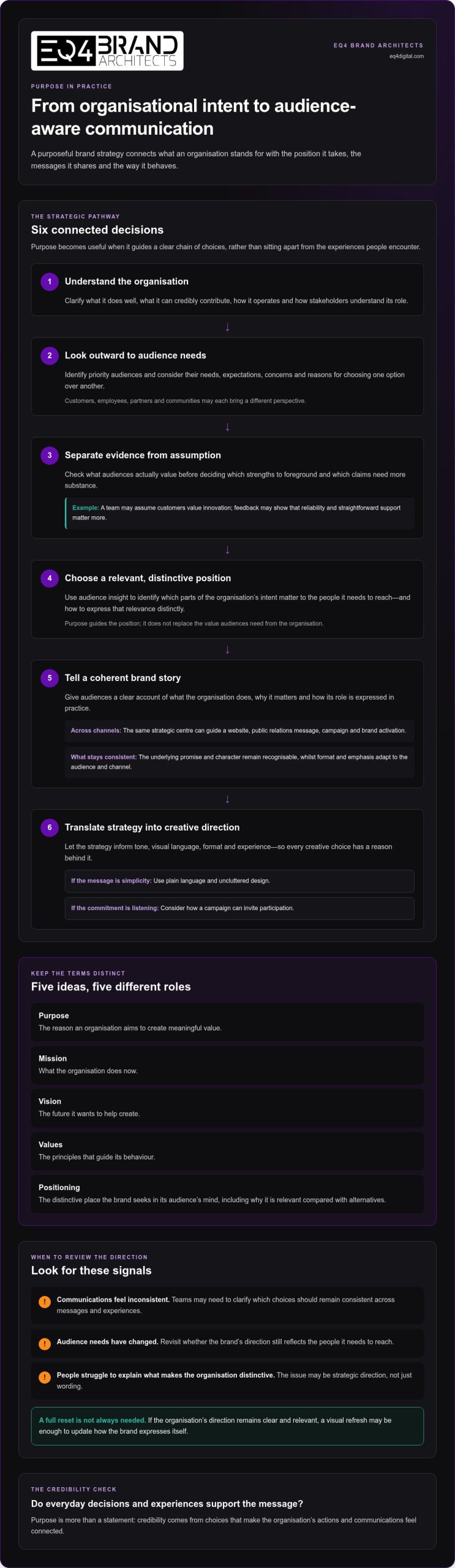
These ideas work together, but answer different questions. Purpose is the reason an organisation aims to create meaningful value. Mission describes what it does now; vision sets out the future it wants to help create; and values are the principles that guide its behaviour. Positioning clarifies the distinctive place the brand seeks in its audience’s mind, including why it is relevant compared with alternatives.
For example, an organisation might exist to make everyday services more accessible (purpose), provide those services to customers (mission), work towards a future where access is simpler (vision), and be guided by fairness and clarity (values). Its positioning then explains what makes its approach distinct and meaningful to the people it serves.
When should an organisation explore purposeful brand strategy?
Consider a strategic review if communications feel inconsistent, audience needs have changed, or people struggle to explain what makes the organisation distinctive. These may indicate that the brand’s direction needs clarifying, not just its wording. A purposeful strategy helps teams agree which choices should remain consistent across messages and experiences.
Not every challenge calls for a full strategic reset. If the organisation’s direction remains clear and relevant, a visual refresh may be enough to update how the brand expresses itself. For more context on how organisational communications support clear, consistent messaging, see this corporate communications agency guide.
The distinction matters: strategy clarifies what the brand should mean and guide; design and communications give that direction a recognisable, audience-aware expression.
How purposeful brand strategy connects insight, positioning and communication
Purpose becomes useful when it informs a chain of decisions, from understanding the organisation and its audiences to choosing a position and expressing it consistently. Without that connection, a purpose statement can sit apart from the messages, experiences and creative work people actually encounter.
Audience insight turns purpose into actionable positioning by showing which parts of an organisation’s intent matter to the people it needs to reach, and how the brand can express that relevance distinctly.
What should a brand understand before defining its purpose?
Begin with the organisation’s context: what it does well, what it can credibly contribute, how it operates and how stakeholders understand its role. Then look outward. Identify priority audiences and consider their needs, expectations, concerns and reasons for choosing one option over another. Customers may be one audience; employees, partners and communities can have different perspectives that also matter.
Separate evidence from assumption. A team might believe customers choose its service because it feels innovative, for example, but audience conversations or feedback may reveal that reliability and straightforward support matter more. That distinction affects which strengths to foreground and which claims need more substance. EQ4 brings these perspectives into communication strategy and brand development, helping organisations base strategic choices on audience insight rather than internal preference alone.
How does purpose shape positioning and brand storytelling?
Purpose can help a brand choose a position that feels distinctive and relevant, but it doesn’t replace the value audiences need from the organisation. If an organisation aims to improve access to an essential service, its positioning might centre on making the experience clearer and easier to use. That idea becomes credible when the service itself supports it, not when it is simply repeated in advertising.
Storytelling connects the choices. It gives audiences a coherent account of what the organisation does, why it matters and how its role is expressed in practice. The same strategic centre can guide a website, a public relations message, a campaign and a brand activation, while the format and emphasis adapt to each audience and channel. The language may shift, but the underlying promise and character should remain recognisable.
Creative direction translates the strategy into decisions about tone, visual language, format and experience. A message about simplicity, for instance, might call for plain language and uncluttered design, while a commitment to listening could influence how a campaign invites participation. Each execution has a reason behind it, rather than relying on a purpose statement as decoration.
For a deeper look at how narrative approaches are evolving, explore brand storytelling shifts shaping 2026. EQ4’s communication strategy connects audience insight with intentional communications.
How can organisations tell purposeful branding from performative claims?
A brand’s stated purpose is only one part of the picture. To assess whether it feels credible, trace the commitment through the organisation: does it shape decisions, appear consistently in communications and match what audiences experience? The standard isn’t perfection. It is clarity about the commitment, evidence of meaningful action and honesty about where progress still needs work.
Purpose expressed through evidence
- The commitment connects clearly to the organisation’s work and priorities.
- Decisions and behaviour give the message practical support.
- Communications use specific language and explain what the organisation is doing.
- Different audiences encounter a recognisable commitment across relevant touchpoints.
Purpose expressed only through slogans
- Broad promises could apply to almost any organisation.
- Campaign language isn’t reflected in everyday choices or stakeholder experience.
- Claims rely on uplifting words without clear examples or context.
- The message changes between channels, audiences or moments of public attention.
Use the comparison as a prompt for investigation, not a scorecard. For example, if an organisation says it makes a service more accessible, consider whether its service choices and communications show how that commitment takes shape. If the evidence is unclear, narrow the claim or explain what is still being developed.
What are the signs that a brand purpose feels credible?
Look for a clear link between intent and action. The organisation should be able to explain why the commitment matters to its work, which choices it influences and how it communicates those choices to relevant audiences. Evidence might include a documented decision, a change in how a service is presented or a consistent approach to responding to stakeholder feedback. Transparency helps: precise wording is easier to understand than an expansive claim without explanation.
Consistency matters, too. The expression can adapt for a website, public relations activity or campaign, but the underlying commitment should remain recognisable. EQ4’s communication strategy and reputation management work connects what an organisation says with what people encounter, so the message is grounded in more than words alone.
What makes purpose-led communication feel performative?
Purpose can feel like a campaign overlay when promises are broad, interchangeable or disconnected from the organisation’s work. The gap becomes more apparent if a polished public message conflicts with stakeholder experience or observable behaviour. Adding more purpose-themed creative may make that gap louder, rather than resolving it.
Instead, revisit the strategy. Clarify the commitment, examine which decisions support it and adjust the communication to match what can be shown. Credible purpose doesn’t require an organisation to claim it has everything right. It calls for a message grounded in action, expressed consistently and open to honest reassessment.
How to put purposeful brand strategy into practice across communications
Purpose takes shape through the choices people make when they plan, write and create. A practical approach moves from shared intent to useful guidance, then checks whether that guidance is visible in communications. The aim isn’t to repeat the same line everywhere. It is to make each expression feel connected to the same strategic centre.
What are the first steps for applying purpose across a brand?
Start by bringing relevant decision-makers together. Align on the organisation’s intent, the audiences it needs to reach and the realities that shape what it can credibly communicate. Include people close to delivery as well as those responsible for strategy; their perspectives can reveal where a promise meets day-to-day experience.
Then translate the shared direction into practical tools:
- Positioning: Define the organisation’s relevant, distinctive place for priority audiences.
- Key messages: Set out what each audience needs to understand, supported by clear reasons to believe.
- Creative principles: Describe how the strategy should influence tone, visual choices, formats and audience interaction.
Test these tools against real communications, such as a website page, a public relations message or a campaign asset. Ask whether each one reflects the agreed intent, speaks to its audience and makes the organisation’s role clear. Gaps can point to a need for revised guidance, a different creative approach or a deeper strategic discussion. EQ4 develops communication strategy and creative direction to turn broad intent into guidance teams can use.
How can teams keep brand communication consistent without making it repetitive?
Keep the foundation stable, but let the expression respond to its context. An employee communication may explain what a commitment means internally, while a customer-facing message may focus on the value or experience most relevant to that audience. The emphasis changes; the central idea and character remain recognisable.
Give teams concise messaging and creative guidance they can apply across touchpoints, including examples of preferred language and principles for adapting it. Assign an owner to maintain the guidance and coordinate reviews. Before publication, teams can check whether a communication is relevant to its audience, consistent with the strategic intent and supported by what the organisation can demonstrate.
Review audience response and organisational changes as inputs for refinement, not automatic reasons to rebrand. For related context on choosing strategic public relations support, see EQ4’s strategic PR agency selection guide. EQ4’s communication strategy brings intentional messaging and creative direction together.
How EQ4 brings emotional intelligence to purposeful brand strategy
Purposeful communication needs more than a clear idea. It also calls for attentiveness to how people understand, experience and respond to that idea. EQ4 Brand Architects brings emotional intelligence together with intentional communication strategies, considering both the organisation’s direction and the people it needs to reach.
Why does emotional intelligence matter in purposeful brand communication?
Emotional intelligence encourages teams to listen closely, recognise different audience perspectives and consider how messages may land. That attentiveness can help shape communication that feels considered and relevant, rather than generic or detached from people’s concerns. It can also inform thoughtful decisions about tone, timing and creative expression.
Empathy is not a substitute for evidence or accountability. Audience understanding needs to sit alongside organisational context, research and a clear view of what the organisation can stand behind. Practical execution matters, too: a carefully considered message still needs to be carried through consistently in the channels and experiences people encounter.
For a purposeful brand strategy agency, this balance is central. Emotional understanding can inform the work, while strategic intent gives it direction. Together, they can guide brand development, campaign strategy and creative direction without treating audience connection as a guaranteed outcome.
What can a purposeful strategy inform beyond a purpose statement?
A strategic centre can guide choices across a range of communications. Positioning clarifies the brand’s place and relevance; public relations and reputation management shape how it communicates and responds; brand activations offer ways to express the direction through audience experiences. These choices should relate to the same intent, even when the format and emphasis differ.
Creative work can carry that direction into graphic design, web design, animation and production. For example, a brand’s agreed character and message can inform how a web page is structured, how a campaign is expressed visually and how a story comes to life through video or sound. The work doesn’t need to look or sound identical across every touchpoint. It should feel connected by a recognisable purpose and considered creative choices.
EQ4 Brand Architects’ capabilities span communication strategy, public relations, reputation management, brand activations, design and production. This brings strategic thinking together with the communications that make it tangible, with emotional intelligence and intention informing the process.
If your organisation is working through a brand or communication challenge, EQ4 Brand Architects can help connect strategic direction with audience-aware communication through brand development, campaign strategy and creative direction.
Give your brand purpose a clear direction
Purpose earns its place when it guides choices, not just language. A credible brand strategy connects organisational intent with audience understanding, shapes a distinctive position and helps teams communicate consistently. It also leaves room for honest review: commitments should be clear and supported by behaviour, without claiming perfection or promising outcomes.
A purposeful brand strategy agency can turn that direction into practical communications, from messaging and public relations to design and production. EQ4 brings emotional intelligence together with intentional communication strategies, with capabilities spanning communication strategy, public relations, reputation management, design and production.
If your organisation is considering how purpose can better inform its brand and communications, explore EQ4’s approach to purposeful brand communication and start a conversation about your strategic direction.
Frequently Asked Questions
What is a purposeful brand strategy?
A purposeful brand strategy connects an organisation’s intent with audience needs and the choices that shape its brand. It clarifies why the organisation aims to create meaningful value, who it serves and how that direction can inform positioning, communication and creative work. EQ4’s communication strategy and brand development work can turn these ideas into practical guidance, so purpose informs decisions and audience experiences rather than appearing only in a statement or campaign.
How is brand purpose different from a mission statement?
Brand purpose describes why an organisation aims to create meaningful value, while a mission statement explains what it does in the present. They’re related, but answer different questions. For example, a purpose might be to make a particular service more accessible, while the mission describes the service the organisation provides. Vision sets out the future it wants to help create, and values guide the principles and behaviour behind its work.
Can a small or growing organisation benefit from purposeful brand strategy?
Yes. A small or growing organisation can use purposeful brand strategy to clarify what it stands for, which audiences it needs to reach and how to communicate its distinct value. The work can be shaped around the organisation’s needs; it doesn’t have to begin with a large campaign or a complete visual overhaul. Clear strategic guidance can help teams make more consistent choices as the organisation, its audiences and priorities develop.
How do you know if a brand’s purpose is authentic?
Look for a clear connection between the purpose a brand communicates and its decisions, behaviour and audience experience. Specific explanations and observable examples make a commitment easier to understand than broad claims that could fit any organisation. Consistency across relevant communications also matters. Authenticity doesn’t mean claiming perfection; it means being clear about the commitment, showing how it informs the organisation’s work and communicating honestly where progress is still needed.
Does purposeful brand strategy include visual identity and design?
It can guide visual identity and design, but it isn’t limited to them. Strategy establishes the intent, positioning and principles that creative choices should express. These can inform elements such as visual language, tone, website design and campaign materials. A visual refresh may be suitable if the organisation’s strategic direction remains clear and relevant. If that direction is uncertain, clarifying the strategy first can give design work a more considered foundation.
How can an organisation put its brand purpose into practice?
Start by aligning decision-makers on the organisation’s intent, audiences and practical realities. Translate that shared understanding into positioning, key messages and creative principles, then review real communications to identify gaps. Adapt messages for each audience and channel while keeping the strategic centre recognisable. Assign someone to maintain the guidance, and use audience feedback and organisational changes to inform ongoing refinement rather than assuming every shift calls for a rebrand.
What should a purposeful brand strategy agency help with?
A purposeful brand strategy agency should connect organisational intent and audience understanding to clear brand choices and coherent communications. This can include clarifying positioning and messages, shaping creative direction and considering how purpose should be expressed across relevant touchpoints. EQ4 combines emotional intelligence with intentional communication strategies, with capabilities including communication strategy, public relations, reputation management, brand activations, design and production. The focus is on connecting strategic direction with audience-aware expression.