





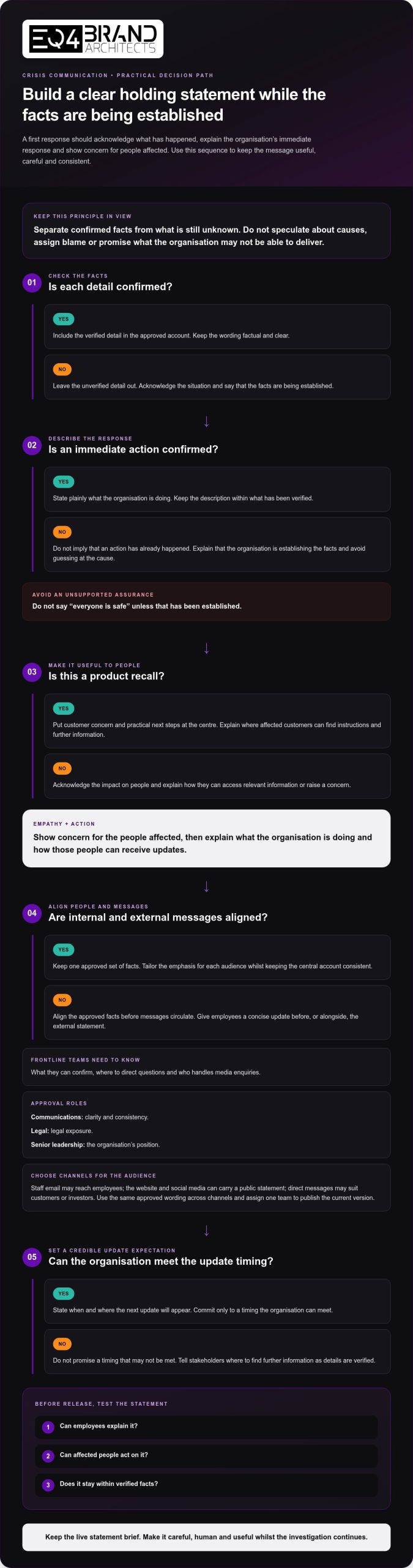
A holding statement should acknowledge what has happened, explain the organisation’s immediate response and show concern for people affected. Knowing how to write a holding statement for a crisis means separating confirmed facts from what is still unknown, avoiding speculation and telling stakeholders where to find further information. For a product recall, include clear next steps for affected customers.
It can be tempting to wait until every detail is known, but silence leaves employees, customers and the media without a reliable account of what the organisation is doing. A brief, considered response offers clarity while the facts are established.
These practical steps cover confirming the facts, aligning internal and external messages and preparing a recall response. They show how to keep the statement concise, communicate with care and plan updates the organisation can deliver.
Key Takeaways
- Separate verified facts from assumptions so your first response is clear, credible and careful.
- Acknowledge the impact on people and explain what the organisation is doing, without sounding defensive.
- Align messages and approvals across leadership, communications, legal and the teams speaking to stakeholders.
- Prepare adaptable scenario templates, then keep the live statement brief and set a realistic expectation for updates.
- For a product recall, make customer concern and practical next steps central to the response.
1. What is the definition of a holding statement?
A holding statement is a brief communication issued while an organisation establishes the facts of a crisis. It acknowledges the situation, sets out immediate actions and directs stakeholders to further information. After a service failure, for example, the organisation could confirm it knows customers are affected, describe its response and say where updates will appear.
To understand how to write a holding statement for a crisis, follow three steps: confirm what is known, explain what the organisation is doing, then give a contact route or update timing. Ground every point in verified information. If a product recall is under review, acknowledge the concern and explain where affected customers can find practical instructions.
Taking responsibility means describing the organisation’s response plainly, not speculating about causes or assigning blame. If a facility has closed after an incident, say so and explain the immediate action being taken. Acknowledge the impact on people, including customers who may have used a recalled product or employees involved in a safety incident.
Avoid unverified claims, defensive language and promises the organisation may not be able to keep. Don’t say “everyone is safe” unless that is established, or suggest a cause before the facts support it. A professional tone can still show empathy: “We are concerned about the people affected and are working to establish what happened.”
Before publication, the statement should be reviewed by Communications, Legal and senior leadership. Each has a distinct role: Communications checks clarity and consistency, Legal reviews legal exposure, and leadership confirms the organisation’s position. In a fast-moving incident, an agreed approval protocol helps reviewers focus on material accuracy rather than rewriting every sentence.
Give readers a practical route to information. Name a monitored contact channel or relevant team, and state when or where the next update will appear. For example, direct customers to the organisation’s information page and say an update will be posted there when details are verified. Set a timing commitment only if the organisation can meet it.
For South African audiences, use language that is clear to the people who need to act on the message. Consider whether employees, customers or communities need versions in different languages, and have each version checked for meaning and tone. Keep essential instructions, such as where to report a concern, consistent across versions.
Empathy should reflect the impact, not replace action. Acknowledge the concern, say what the organisation is doing and explain how affected people can receive updates. Mention authorities only when their involvement is confirmed. This keeps the first response human, professional and useful while the investigation continues.
2. Aligning internal and external communications
During an incident, employees may hear about it before customers or journalists. Without approved information, they may repeat rumours or offer conflicting explanations. Give employees a concise internal update before, or alongside, the external statement. Tell frontline teams what they can confirm, where to direct questions and who handles media enquiries.
Start with one approved set of facts, then tailor the emphasis for each audience. Customers need practical information about services or products; employees need guidance for their roles. Investors, regulators and the media may have different concerns. Keep the central account consistent while making each communication useful to its audience.
Prepare separate internal and external crisis communication templates for scenarios such as a safety incident, service outage or data exposure. An internal template can include an incident summary, staff instructions, an escalation contact and the next update point. An external template can include a confirmed summary, immediate action, an expression of concern and an information channel. Replace all prompts with verified details before release.
For a legal investigation, acknowledge that the matter is being investigated and say the organisation is cooperating with authorities, if accurate. Avoid conclusions about responsibility, evidence or likely outcomes. In South Africa, relevant legislation depends on the issue: the Protection of Personal Information Act may apply to personal information, the Consumer Protection Act to consumer product matters, and the Occupational Health and Safety Act to workplace safety. Identify the relevant area before approving the statement.
Agree an approval route before an emergency arises. Communications checks clarity and consistency; Legal reviews sensitive claims; senior leadership confirms the organisation’s position. Assign a decision-maker for urgent releases and a deputy if that person is unavailable. A clear route helps prevent teams from circulating drafts with conflicting facts or unapproved commitments.
Choose channels based on who needs the information and how they can access it. Staff email may reach employees, while the organisation’s website and social media can carry a public statement. Direct messages may suit customers or investors. Use the same approved wording across channels, and assign one team to publish the current version.
Set an update rhythm the organisation can maintain. If the investigation is continuing, say when the next update will appear rather than promising a resolution. Record the release time, channel and approved version. If facts change, update internal teams and external audiences from the same source so frontline responses and public communications remain aligned.
Before release, test the message with three questions: can employees explain it, can affected people act on it, and does it stay within verified facts? This check helps the organisation communicate promptly without creating avoidable contradictions.
3. Definition and purpose of a holding statement
A holding statement is an initial message issued while an organisation gathers information about a crisis. It gives stakeholders a verified account of what the organisation knows and is doing, without trying to explain every detail. After an accident, for example, the organisation might confirm that an incident occurred, say it is responding and identify where further information will appear. The statement is temporary, but its first words can shape the response that follows.
A media holding statement gives journalists a clear, attributable response for reporting. It should identify the organisation, acknowledge the issue and state where further information will appear. In response to a media enquiry about a service disruption, a spokesperson could confirm that the organisation is investigating and direct journalists to an official update channel. This gives reporters something usable without turning an early response into a full account.
Timing matters because silence can leave space for speculation on social media and elsewhere. The guidance in the research for this article recommends issuing an initial statement within the first hour after a crisis has been identified, even if all details are not available. It also notes that some studies suggest organisations may feel pressure to respond within 15 minutes. These figures describe urgency, not permission to publish unverified claims.
A holding statement lets the organisation respond before a complete investigation is possible. It can confirm immediate steps, such as pausing a service, supporting affected people or working with authorities. In a suspected security breach, for example, an initial message could acknowledge the issue and say investigation and response actions are underway. Do not claim information is safe or compromised until the facts support that statement.
Speed alone does not define an effective response. The research notes that organisations affected by a crisis usually take an average of 21 hours to respond. An early statement can bridge that gap, but it must not become a substitute for substantive updates. Set a realistic next update point, then publish when promised or explain what has changed. A short, accurate message is more useful than a polished narrative that outruns the evidence.
Structure the statement as a sequence: acknowledge the issue, share confirmed information, describe immediate action, then identify the next update channel. Use the same core message across the website, social media and media responses. Tailor details for each audience, but keep the facts consistent. An accident update for employees may include operational instructions; the public version may focus on affected people and where to find information.
A disciplined first response signals that the organisation is aware, taking action and willing to communicate as facts develop. Its purpose is not to answer every question, but to establish a credible starting point for the fuller response stakeholders will need.
4. Keeping statements brief and prepared
A prepared holding statement gives the response team a reliable starting point, not a script to publish unchanged. Organisations are advised to identify their top 10 risks or potential crises and prepare adaptable responses for those scenarios. A product recall, workplace accident and service failure each need different facts, actions and audience instructions.
Build a separate template for each priority scenario. Mark the fields that must be replaced, such as the incident, confirmed impact, immediate action, contact channel and next update point. Keep these prompts visible so a rushed editor does not overlook them. A service outage template, for instance, must not imply that a product has been recalled.
Keep the public statement to a few paragraphs, each with one purpose. The opening acknowledges the issue; the next section gives confirmed information and immediate action; the final section directs affected people to support or updates. This structure helps readers find what they need without wading through background detail.
Use plain words and short sentences. Replace “we are undertaking a comprehensive investigation into the circumstances” with “we are investigating what happened”. Remove technical terms unless affected people need them to act. Put essential safety instructions in clear sentences, not beneath corporate context.
A useful template also sets boundaries. Use prompts such as “[insert confirmed service impact]” instead of filling gaps with assumptions. Add an internal note beside each prompt identifying who supplies or approves the information. For a suspected data breach, for example, the investigation team must provide confirmed facts before the statement describes the impact.
Review prepared wording when operations, services, contact channels or response responsibilities change. Assign an owner to check each template and remove details that no longer apply. A phone number that no longer reaches the response team can frustrate affected people; an outdated service description can create confusion during an emergency.
Make the approved version easy to find during a crisis. Keep a controlled set of templates in a shared location, identify the current version and restrict editing to designated roles. Staff should know which file is approved and how to submit proposed changes. This helps prevent competing drafts from circulating internally.
Test each template against a realistic scenario. Ask someone unfamiliar with the draft to identify what happened, what the organisation is doing and what affected people should do next. If they cannot answer those points quickly, revise the wording. A brief statement is not just short; it makes crucial information easy to understand and use.
5. Holding statements for product recalls
A recall statement should help customers identify whether their product is affected. Use the exact product name and, where relevant, model, batch, lot or serial identifiers. Explain where to find those details, such as on the packaging or product label. If only certain batches are involved, distinguish them clearly from unaffected versions to avoid unnecessary uncertainty.
Keep product identifiers consistent across the statement, customer-service scripts and retailer guidance. A mismatch between a batch code in a public notice and the details used by a helpline can leave customers unsure what to do. Before publishing, compare every identifier with the approved product information and use the same wording in each customer-facing channel.
Make the requested customer action specific and easy to follow. State whether customers should stop using the product, separate it from other items, return it or follow another approved instruction. Explain how to find the next step, including the relevant contact channel or information page. Avoid vague directions such as “take appropriate precautions”, which leave people to interpret the risk themselves.
Plan for different customer circumstances. Someone may have discarded the packaging, bought the product through a retailer or received it as part of a larger purchase. Explain what information customers should provide when seeking assistance. If the process differs by sales channel or product version, set out the distinctions in plain language.
Retailers and distributors also need usable guidance. Give them the approved product identifiers, customer-facing wording and a clear route for escalating questions they cannot answer. Align this information with the public statement before it is issued. Otherwise, customers may receive different instructions from the organisation, a shop or another distribution point.
Acknowledge the disruption and concern a recall can cause. Pair a direct expression of concern with practical information, rather than offering a polished apology that leaves customers without a next step. Avoid claims about safety, cause or the number of affected products until the organisation has established the relevant facts.
As the response develops, record each statement version and the changes made. If new product identifiers are added, explain what has changed so customers can distinguish the updated notice from earlier guidance. Correct material errors openly and ensure customer-facing teams receive the revision at the same time as external audiences.
Before release, test the notice with someone unfamiliar with the recall process. Ask them to identify the affected product, locate its identifier and describe the requested action. If they cannot do this from the statement alone, clarify the instructions. A useful recall message is one customers can understand and act on.
EQ4 Brand Architects: Reputation Management
EQ4 Brand Architects can help leaders connect crisis communication with broader organisational priorities and stakeholder confidence. Its Reputation Management, Public Relations (PR) and Communication Strategy capabilities support organisations seeking a more intentional approach to reputation risk, public messaging and decision-making. Brand Activations can also support engagement when a response needs to reach audiences through a planned experience.
Consider strategic communications support when responsibilities are unclear, leaders need to align on a response or reputational issues extend beyond a single public statement. The aim is purposeful, coordinated communication, guided by the organisation’s context and the people affected.
If your organisation is strengthening its reputation approach or managing a communications challenge, contact EQ4 Brand Architects to discuss the next step.
Build readiness into your communications practice
A holding statement is not a substitute for decisive organisational action. Its value depends on leaders connecting what they say with what teams are doing, and keeping stakeholders informed as the situation develops.
Knowing how to write a holding statement for a crisis is part of a wider reputation responsibility: prepare people to communicate with care, consistency and sound judgement. This matters beyond the immediate incident, helping organisations protect stakeholder confidence while they address the underlying issue.
EQ4 Brand Architects brings this perspective through Reputation Management and Public Relations (PR), with Brand Activations supporting audience engagement when appropriate. The focus is on aligning communication with organisational priorities, not treating a statement as an isolated message.
If your organisation is strengthening its crisis readiness or addressing a live reputation challenge, contact EQ4 Brand Architects to discuss the communications support you need. Clear preparation gives your team a stronger foundation for the decisions ahead.
Frequently Asked Questions
What is the definition of a holding statement?
A holding statement is an organisation’s initial public response while it establishes the facts of an emerging issue. It gives people a reliable starting point without presenting an incomplete investigation as final. A transport operator, for example, could acknowledge a service disruption, tell passengers where to find operational notices and reserve explanations of the cause until those details are established.
What is a crisis holding statement?
A crisis holding statement is a short, early communication for an event that could affect people, operations or confidence in an organisation. It makes the organisation’s position visible while a fuller response takes shape. In a workplace incident, for example, it can acknowledge the event and direct staff to the approved internal information channel.
What should a crisis holding statement include?
Include the organisation’s name, a concise description of the issue, confirmed information, the immediate response and a clear route to further information. Add an update time only if the organisation can meet it. For a public service disruption, identify the affected service and where users can check its status. Leave out details that do not help readers understand or act.
How long should a crisis holding statement be?
Keep the statement to a few short paragraphs, each with a clear purpose. Readers should be able to identify the issue, the organisation’s immediate response and the next information point without searching through background detail. For example, put a customer action near the beginning of a recall message, not after a lengthy explanation of the organisation’s history or process.
What are examples of effective crisis holding statements?
For a service disruption: “We’re aware that customers are experiencing difficulty accessing our service. Our team is investigating, and we’ll share a further update through our status page.” For a safety incident: “We’re concerned for those affected and are supporting the response. We’ll provide further information when details are verified.” Adapt these illustrative examples to the actual event and confirmed actions.
How quickly should an organisation issue a holding statement during a crisis?
Issue an initial statement promptly after identifying the crisis, even if the full picture is still developing. The first message should be limited and accurate, not an unverified explanation. For example, an organisation can acknowledge a suspected service failure and say it is investigating, then share confirmed details through its chosen update channel as they become available.
How can you express empathy without admitting legal liability?
Focus on people’s experience and the organisation’s immediate support, not declarations about what caused the event or who was responsible. “We’re concerned about the disruption customers have experienced” recognises the impact without claiming to know who is at fault. In a sensitive incident, have Legal review the wording alongside Communications so the response combines care for affected people with factual discipline.
How should a holding statement be updated as more facts emerge?
Publish a revised statement when new information changes what people need to know or do. Mark the update clearly, correct any earlier inaccuracies and keep the current version available on the organisation’s main information channel. For a recall, an update might clarify which product identifiers are affected or revise customer instructions. Align internal teams with the new wording before sharing it externally.