





What if your crisis plan is accurate on paper, but no one knows who can approve the first message? A crisis communication plan template 2026 should do more than list channels and draft holding statements. It should help leaders make timely decisions, assign clear responsibilities and keep communication consistent while facts are still emerging.
If your existing plan feels generic, out of date or detached from how decisions are made, it may offer little help under pressure. South African organisations need to account for their own governance, risks and stakeholder relationships rather than rely on a plan built for another context. Unclear approval routes and conflicting updates can deepen uncertainty when confidence matters most.
This guide sets out a practical structure to adapt to your organisation. It covers decision rights, escalation, spokesperson responsibilities, audience-aware messages and review. It also explains why rehearsal matters: a usable plan helps people align on responsibilities and messages before pressure rises.
Key Takeaways
- Use a crisis communication plan template 2026 to define decision rights, escalation routes and stakeholder priorities, then adapt it to your organisation’s governance and risks.
- Build the plan around activation, roles, audiences and channels, with a clear way to separate approved facts from information still being established.
- Assess relevant risks, assign an accountable owner and test the plan before relying on it during a live issue.
- Keep messages clear by distinguishing confirmed information, unverified reports and unknowns, and setting a responsible expectation for updates.
- Record follow-up actions from exercises and real incidents so contacts, approval routes and working copies stay current.
Why a crisis communication plan template matters before a crisis
A crisis puts two things under pressure at once: an organisation’s ability to act and its ability to explain what is happening. If leaders are unsure who can approve a message, teams may wait for direction while employees, customers or communities look elsewhere for answers. If different parts of the organisation communicate separately, updates can conflict and deepen uncertainty.
A crisis communication plan is a decision and communication framework that helps an organisation assess an issue, assign authority, share verified information with affected stakeholders and review its response. It prepares people to make decisions. It cannot predict every event or guarantee that trust will be preserved.
A crisis communication plan template 2026 is useful when it prompts leaders to clarify responsibilities and escalation routes, not simply fill in blank spaces. It should connect communication choices to operational decisions: what is known, what action is under way, who needs to know, and who is authorised to speak. This is different from reactive publicity, which focuses on issuing statements after attention has turned to the organisation. The framework should put communication principles into practice within the organisation’s own governance and stakeholder relationships.
What a crisis communication plan is designed to do
During an issue, the framework should help the organisation assess what has happened, decide whether to activate the response, approve communication, choose suitable channels and review what needs to change as facts develop. Operational and communication leads need to keep one another informed. For example, a service interruption may require an operational decision about continuity alongside clear updates on what customers can expect. Communication cannot substitute for action, and action without clear communication may leave stakeholders uncertain about its purpose or progress.
Pre-written statements can help teams respond quickly, but they are not a plan. A usable framework defines who gathers information, who approves messages, who communicates with each audience and how updates are reviewed. It also gives teams room to adapt language to the facts instead of issuing wording that no longer fits the situation.
Why South African organisations need context-aware preparation
Stakeholders do not all need the same information. Employees may need guidance on immediate workplace decisions; customers may need practical service updates; communities may want to understand local effects; and public institutions may require accurate information through appropriate channels. The order, channel and language of communication should reflect the issue and the people affected, rather than default to one generic message.
South African organisations work amid varied political, cultural, economic and reputational pressures. These should not be reduced to assumptions about how any audience will respond. Map who may be affected, what they need to know and how they can access updates. Consider language, accessibility and existing stakeholder relationships when preparing channels and messages. Applicable legal obligations depend on the incident and should be reviewed against authoritative sources with appropriate expertise. Context-aware preparation helps leaders make considered operational choices and communicate clearly, without promising a particular outcome.
What to include in a crisis communication plan template
A useful template makes responsibilities and decisions visible before an issue demands them. Treat it as a working document and adapt its fields to your organisation’s governance, risks, operating model and stakeholder relationships. Keep the structure simple enough for responders to find essential information quickly, while allowing teams to tailor prompts to different incidents.
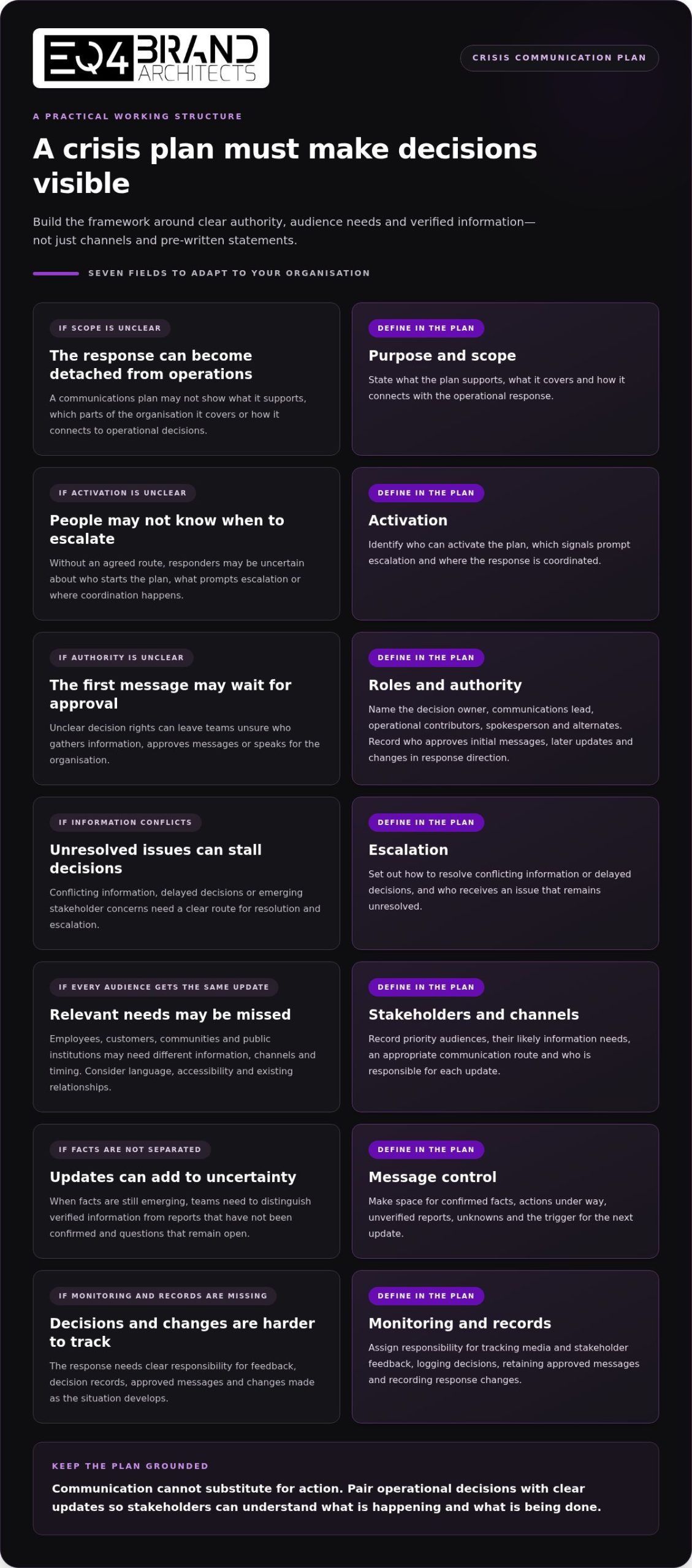
Use these fields as a starting structure, not a universal checklist:
- Purpose and scope: State what the plan supports, which parts of the organisation it covers and how it connects to the operational response.
- Activation: Identify who can activate the plan, what signals prompt escalation and where the response is coordinated.
- Roles and authority: Name the decision owner, communications lead, operational contributors, spokesperson and alternates. Record who approves initial messages, later updates and changes in response direction.
- Escalation: Set out how to resolve conflicting information, delayed decisions or emerging stakeholder concerns, including who receives an unresolved issue.
- Stakeholders and channels: Record priority audiences, their likely information needs, the appropriate communication route and who is responsible for each update.
- Message control: Create space for confirmed facts, actions under way, unverified reports, unknowns and the trigger for the next update.
- Monitoring and records: Assign responsibility for tracking media and stakeholder feedback, logging decisions, retaining approved messages and recording changes to the response.
For known issues, add prompts rather than predictions: What could be affected? Which audiences may face direct consequences? What information would they need first? Make fields easy to locate and ensure authorised responders can access the current working copy. Account for the organisation’s operating contexts and stakeholder relationships rather than treating a generic template as a complete answer.
Roles, authority and escalation in a crisis communication plan template 2026
Use named roles or clear job titles, not broad labels such as “management”. Specify who gathers operational facts, who drafts communications and who gives final approval. Name an alternate for key roles and set out how to escalate if approvers disagree or are unavailable. Clear authority helps people act under pressure while leaving room to change direction as verified information develops.
Stakeholders, messages and channels
Map audiences by exposure, needs and appropriate communication route, rather than relying on a fixed ranking. Employees may need operational instructions; customers may need service information; communities or public institutions may need relevant details. Align internal and external updates on the same verified facts, then adapt the language, detail and channel to each audience. A message prompt can ask: What is confirmed? What action is under way? What remains unclear? What will prompt the next update?
Record who authorised each message, where it was issued and what new information requires a review. This gives the response team a practical record for coordinating communications and identifying gaps as the situation develops.
Adapting a Crisis Communication Plan for Your Organisation
A template becomes useful only when it reflects how your organisation works: its risks, governance, audiences and decision-making capacity. Treat scenario categories as prompts for assessment, not a forecast or a complete list of what could happen. The aim is to prepare a response method that can adapt when an actual issue differs from the examples in the document.
Start with risks, audiences and decision-making
Bring operational risk knowledge together with stakeholder concerns and existing risk processes. A corporate organisation may focus on service disruption or supplier issues; a public-sector body may also consider public confidence and continuity of services. These are prompts for assessment, not predictions. Record who can evaluate potential impact and who has authority to activate or escalate the plan.
- Review the organisation’s risk picture. Draw on existing risk assessments, operational knowledge and stakeholder feedback. Identify plausible issues and note which teams would hold the first reliable information.
- Set practical severity criteria. Assess potential harm, the number and nature of stakeholders affected, and how quickly decisions or communication may be needed. A useful classification helps determine the level of leadership attention and coordination required, but it should not replace judgement about the incident.
- Confirm ownership and decision rights. Name who assesses the issue, who can activate the response and who leads communication. Map operational subject-matter contributors, approval authority and escalation routes. Make clear what to do if information conflicts or a decision remains unresolved.
- Tailor prompts to your context. Adapt scenarios and audience questions to the organisation’s mandate, services, regulatory environment and stakeholder relationships. For a social-impact programme, consider who may be directly affected and what information they need to make informed decisions. Do not treat the scenario list as exhaustive.
- Draft and test the working plan. Use plain language, named responsibilities and fields that a responder can complete quickly. Run a tabletop exercise using a plausible scenario. Ask participants to follow the steps, identify missing information and note where approvals, assumptions or handovers create bottlenecks.
- Approve and maintain the controlled version. Record the plan owner, approving authority, version date and review triggers in the document. State where the current working copy is held and how changes are recorded, so teams do not rely on conflicting versions.
Draft, test and approve the working version
Testing should examine decisions as well as wording. Can the team identify what is known, who must validate it and who authorises an update? Capture each gap, assign a follow-up owner and revise the plan before approval. If a scenario raises possible legal or regulatory obligations, confirm the requirements for that specific situation using current primary sources and appropriate expertise. A crisis communication plan template 2026 is a starting point; accountable adaptation makes it relevant to your organisation.
How to communicate during a crisis without adding confusion
When information is changing, clarity depends on separating what the organisation knows, what it has heard and what it still needs to establish. Put each point in the right category before drafting an update. This helps prevent an unverified report from being repeated as fact or an unknown from being mistaken for reassurance.
- Confirmed: Information checked with an accountable source. State it plainly and record who verified it.
- Unverified: Reports received but not validated. Do not present them as fact; assign someone to assess their reliability.
- Unknown: Questions the organisation cannot yet answer. Acknowledge the gap and identify what information is being sought.
Keep this distinction in the working message record and use it to brief spokespeople and employees. It gives teams a shared basis for answering questions, even when they need to say an answer is not yet available. Prioritise communication by considering who is directly exposed, what decisions they need to make, how urgent the information is and what responsibilities the organisation has towards them. The right sequence depends on the incident, not a fixed audience list.
Use a holding statement responsibly
A holding statement should acknowledge the issue, share verified action and explain where or under what conditions an update will follow. For example: “We’re aware of [issue]. We’re [verified action]. We’re establishing [specific unknown] and will share an update through [channel] when we have further confirmed information.” Avoid speculation, blame, unsupported reassurance or wording that implies the matter is resolved. Set a review point so the statement can change when facts or actions change.
Do not promise a precise update time unless the organisation can meet it and it suits the situation. Timing depends on the facts, the incident and any applicable obligations. If there is no new verified information at the review point, communicate that carefully rather than filling the gap with conjecture.
Coordinate spokespersons, employees and public channels
Identify authorised spokespersons and brief employees on what they can share, where to direct enquiries and how to raise new information. A shared, approved source should inform media responses, stakeholder messages, website updates and social channels. Tailor the detail to each audience, but keep the facts and organisational position aligned. Monitor questions and coverage for emerging misinformation, unanswered concerns or signs that a message is not being understood.
Use the crisis communication plan template 2026 to record who approves each update, where it appears and what new information triggers a review. EQ4 Brand Architects’ crisis communication support brings response messaging, spokesperson preparation and monitoring into the wider communications response.
Keep the crisis communication plan current, tested and accountable
A plan loses value when its contact details, decision routes or assumptions no longer match the organisation. Assign a named owner to maintain it, with responsibility for checking key roles, approval routes, scenario prompts and access to current working copies. The owner can coordinate updates, while leaders remain accountable for decisions within their authority.
Review readiness through exercises and learning
Review the plan when the organisation changes, new issues emerge, an exercise exposes a gap or a real incident provides lessons. Test more than the document itself: can decision-makers find the current version, understand their roles and reach the people needed to assess an issue? A tabletop exercise can reveal unclear handovers, missing information and approval delays without treating the exercise as a pass-or-fail test.
After each exercise or incident, record decision points, what worked, where teams hesitated and which assumptions proved inaccurate. Assign each corrective action an owner and track it through to completion. An observation without follow-up may recur when pressure is real.
Readiness is easier to improve when it is assessed consistently. Consider tracking:
- Role clarity: Can participants describe their responsibilities and decision authority without relying on informal assumptions?
- Access and escalation: Can the right decision-makers be reached through the documented route, and can responders access the current plan?
- Message consistency: Do updates across teams and channels reflect the same approved facts, even when the detail is adapted for different audiences?
- Learning completed: Are actions from exercises and incidents assigned, resolved and reflected in the plan?
These measures are most useful when they lead to a specific improvement, such as clarifying an approval handover or updating an outdated contact. Set review triggers and assess progress over time rather than treating a single exercise as proof of readiness.
Connect strategic advice with communication delivery
Plan maintenance is also a chance to check that the response fits the organisation’s purpose, governance and stakeholder relationships. Stakeholder analysis clarifies who may be affected and what they need; response messaging turns verified information into useful updates; escalation planning connects communication decisions to operational judgement. Together, these disciplines support a coherent response rather than a collection of disconnected statements.
A crisis communication plan template 2026 should remain a working governance tool, not a document filed away after approval. Its value depends on whether people can use it, decisions have clear owners and learning informs the next version. Reputation considerations belong alongside practical response planning, while public relations choices should follow the organisation’s objectives, audiences and circumstances.
If your organisation is reviewing its crisis readiness or facing a reputation challenge, consider how its communication roles, approval routes and stakeholder needs fit together.
Make preparedness part of leadership practice
Give crisis readiness a place in ordinary governance rather than waiting until a concern becomes urgent. Decide when leaders will revisit the plan, who will report on readiness and how lessons will inform future decisions. That commitment recognises communication as part of managing risk and stakeholder confidence, not simply a response once public attention arrives.
A crisis communication plan template 2026 can provide a useful foundation, but its value comes from how people apply it. EQ4 combines senior strategic communications advice with integrated execution, including reputation and issues advisory, crisis preparedness, response messaging and escalation. The focus is a considered approach that connects decisions, stakeholder needs and communication delivery to the organisation’s context.
Discuss your organisation’s crisis preparedness with EQ4, from strengthening the response framework to addressing a current reputation challenge.
Frequently Asked Questions
What is the difference between a crisis communication plan and a business continuity plan?
A business continuity plan focuses on maintaining or restoring critical operations; a crisis communication plan focuses on how the organisation informs and engages people affected by an issue. The plans should work together. If a service is disrupted, for example, continuity arrangements guide operational decisions, while communications explain the practical impact and where customers can find reliable updates. Both plans should show how information moves between operational leads and communicators.
Can one crisis communication plan template work for every organisation?
No. A crisis communication plan template 2026 can provide a useful structure, but it needs to reflect your organisation’s decision-making, risks, services and stakeholder relationships. A public institution, regulated business and social-impact organisation may face different questions and approval processes. Adapt the roles, audience prompts and escalation route to your context, then test whether the people responsible for the response can use the document as written.
Who should own a crisis communication plan?
A senior leader should be accountable for the plan’s authority and alignment with organisational governance. A designated communications lead can coordinate its maintenance, while operational and subject-matter leaders contribute information about risks and response processes. A data-related issue, for example, may require input from people responsible for technology, privacy, operations and communications. Make ownership explicit so updates do not depend on informal assumptions.
Should an organisation issue a public statement during every crisis?
No. A public statement is not automatically the right response to every internal or contained issue. Consider who is affected, whether they need information to take action, whether the matter is already public and what the organisation can responsibly confirm. A direct message to employees or affected stakeholders may be more useful than a broad announcement. Ensure the response is consistent with operational decisions and any applicable obligations.
How often should a crisis communication plan be reviewed?
Set a planned review cadence that suits the organisation, and revisit the plan whenever a meaningful change could make it unreliable. Changes to leadership, approval authority, services, communication channels or stakeholder relationships may all warrant a review. Review it after an exercise or real incident as well. Record the review date, changes made and outstanding actions so leaders can see whether the document reflects current practice.
What should employees be told when an issue is still developing?
Tell employees what is confirmed, what they should do now and where to direct questions. Be clear about what remains unknown, and do not ask staff to repeat unverified reports or offer personal explanations on the organisation’s behalf. For example, give customer-facing teams a short approved response and a clear route for passing new information to the response team. This helps employees act consistently without implying that every answer is already available.