





What if your brand didn’t need to show up everywhere to be seen by the right people? A considered brand visibility strategy South Africa businesses can use starts with a clearer question: where do your audiences pay attention, and what should they recognise about you when they do? When activity across channels lacks a shared purpose, more posts, placements or campaigns can add noise without building familiarity or trust.
It’s understandable to want visibility to lead directly to engagement or sales, but these are related, distinct outcomes. Visibility helps the right audiences discover and recognise your brand; engagement reflects how they respond, while reputation and sales develop through broader experiences over time. Knowing the difference makes it easier to choose useful measures and make better decisions.
This practical guide explores the building blocks of a coherent visibility strategy, from defining your audience and message to selecting channels that suit audience behaviour and communication objectives. You’ll also learn how to assess progress and refine your approach over time. Whether your brand relies on earned, experiential or owned touchpoints, the aim is the same: connect strategic communications with creative execution so each encounter contributes to a recognisable, trusted presence.
Key Takeaways
- Build a brand visibility strategy South Africa audiences can recognise by aligning your objectives, audience insight and core message.
- Choose earned, owned, paid and experiential channels according to their roles, audience fit and the signals they can provide.
- Shape communications for South Africa’s diverse audiences, considering language, cultural context, accessibility and media habits.
- Set a relevant measure for each objective, from reach and branded search to media mentions and message recognition.
- Review results regularly and refine channel roles and creative direction so each touchpoint strengthens a coherent brand presence.
What does a brand visibility strategy mean in South Africa?
Brand visibility is the extent to which relevant audiences can encounter and recognise a brand across the channels and contexts they use. A brand visibility strategy sets out how to create those opportunities deliberately, so each appearance supports a consistent and meaningful presence. For a brand visibility strategy South Africa organisations can apply, that means connecting audience insight, communication objectives and channel choices instead of treating activity as a collection of unrelated posts or campaigns.
Visibility is one part of a broader communications picture. It creates opportunities for people to notice a brand, but it isn’t the same as awareness, which describes what an audience recognises or recalls. Engagement reflects how people interact; reputation concerns the judgements and associations they form; conversion is a specific action, such as making an enquiry or purchase. These outcomes can influence one another, but none is guaranteed by visibility alone. A brand may be widely seen without being remembered, trusted or chosen.
This distinction connects visibility to brand management, which considers how a brand’s tangible and intangible qualities shape perception. Visibility works best when repeated encounters express the same considered identity, rather than simply increasing the number of times a name appears.
How is brand visibility different from brand awareness?
Visibility is the opportunity to encounter a brand; awareness is the recognition or recall that may follow. Imagine someone sees the same clearly branded organisation at an industry event, in a relevant news story and on its website. The consistency can make the name and visual identity easier to recognise later. Exposure alone, however, doesn’t demonstrate trust, preference or commercial impact. Those require their own signals and should be assessed separately.
Why does visibility need a clear audience and purpose?
A channel can attract attention and still be a poor fit if it reaches the wrong people or carries a message that doesn’t matter to them. Before planning activity, clarify three things:
- Priority audiences: Which people or groups does the brand need to reach?
- Desired perceptions: What should they understand, recognise or associate with the brand?
- Business context: What communications need or organisational priority should visibility support?
These questions matter in South Africa, where audiences aren’t uniform. Language, cultural context, access and media habits can shape how people encounter and interpret a message. Avoid assuming that one channel or creative approach will suit everyone. Use audience research and media listening to test your assumptions, identify gaps and refine your understanding. This gives visibility a clearer purpose and helps ensure that greater exposure is relevant rather than simply more frequent.
How do brand visibility channels work together?
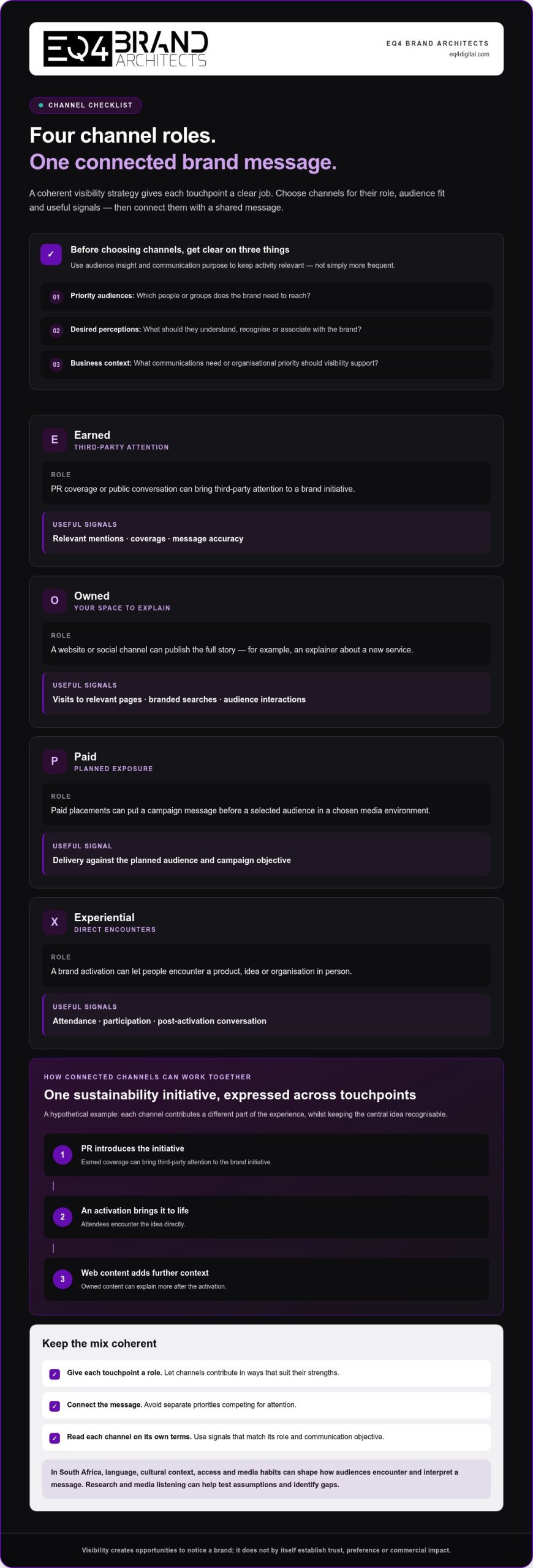
A strong channel mix gives each touchpoint a role. Earned coverage can introduce a brand through third-party stories or conversation; owned channels give the organisation space to explain its offer; paid media can place messages in selected contexts; and experiential activity creates direct encounters. These routes work best when they carry a connected message rather than competing for attention with separate priorities.
| Channel | Role and practical example | Useful signals |
|---|---|---|
| Earned | PR coverage or public conversation can bring third-party attention to a brand initiative. | Relevant mentions, coverage and message accuracy. |
| Owned | A website or social channel can publish the full story, such as an explainer about a new service. | Visits to relevant pages, branded searches and audience interactions. |
| Paid | Paid placements can put a campaign message before a selected audience in a chosen media environment. | Delivery against the planned audience and campaign objective. |
| Experiential | A brand activation can let people encounter a product, idea or organisation in person. | Attendance, participation and post-activation conversation. |
What roles do earned, owned and paid channels play?
Each channel offers a different level of control and context. A brand can shape information on its own website, whilst earned coverage depends on independent editorial choices and public response. Paid media offers a planned route to exposure, but placement alone doesn’t establish credibility or audience interest. Research on integrating social media brand communication offers a useful academic perspective on coordinating social media with broader brand communication.
Where do activations and creative assets fit?
Consider a hypothetical activation built around a brand’s sustainability initiative. PR can introduce the initiative, an activation can bring it to life for attendees, and web content can provide further context afterwards. Design, video, animation and sound can give the message a recognisable visual and sensory expression, adapted to each setting without losing its central idea.
For a brand visibility strategy South Africa organisations can sustain, channel choices should reflect audience behaviour, communication objectives, available budget and the team’s capacity to create and maintain content. A smaller, coherent mix may be more practical than a broad plan with insufficient resources behind it. EQ4 Brand Architects’ integrated communication strategy connects strategic thinking with creative execution across relevant touchpoints.
How should South African brands choose where to build visibility?
Choose channels by starting with the people you need to reach, not the platforms attracting the most attention. A practical decision framework connects five considerations: audience, objective, message, channel fit and delivery capacity. Together, they help a team decide not only where to appear, but what each appearance should achieve and whether the activity can be sustained.
- Audience: Which groups matter, and how do they access information?
- Objective: Are you aiming to introduce the brand, build recognition, support credibility or express a particular idea?
- Message: What should people understand or remember?
- Channel fit: Where is that message most useful and appropriate?
- Delivery capacity: Can your team create, coordinate and maintain the activity?
This sequence keeps channel decisions grounded in strategy. A route that creates initial discovery may differ from one that reinforces recognition or helps build trust. For example, a PR story may introduce an organisation to a new audience, while consistent website content and visual identity help people understand and recognise it afterwards. A brand communication strategy guide offers further context for aligning those choices with wider communications priorities.
Which visibility channels fit different objectives?
For awareness, consider channels that can place a message in relevant audience contexts, including PR, social content or a brand activation. Credibility may call for relevant earned media and consistent corporate communications, supported by clear information on owned channels. To express a brand’s character, graphic design, video, web content or an activation can bring its identity to life. These are starting points, not fixed rules: research should guide the final mix.
Map each selected channel to a purpose. If a channel is meant to introduce the brand, assess whether it creates relevant opportunities for discovery. If it should deepen recognition, look for consistency in the message and creative expression. This distinction prevents activity from being judged by a single measure.
How can brands stay relevant across South Africa?
South African audiences differ in language preferences, cultural context, accessibility needs and media habits. Avoid assuming that a single language, channel or creative treatment will resonate nationally. Research priority groups, then test message relevance with representative audience groups before a wider rollout. Their feedback can reveal unclear wording, cultural nuances or practical barriers, allowing the brand to adapt without losing its central message.
For a brand visibility strategy South Africa organisations can develop with intention, balance relevance with delivery: select channels that suit the audience and objective, then focus effort where the team can communicate consistently and learn from the response.
How can you plan and measure a brand visibility strategy?
A useful plan links each visibility objective to an audience, a channel and a way to assess progress. For a brand visibility strategy South Africa teams can refine with confidence, use a five-step sequence:
- Set objectives: Decide whether the priority is discovery, recognition, credibility or stronger expression of the brand.
- Define audiences: Specify who needs to encounter the message and what you want them to understand or remember.
- Select channels: Choose touchpoints that suit audience behaviour, the objective and your team’s capacity to deliver consistently.
- Establish measures: Pair each objective with one or more indicators, and record a baseline before activity begins.
- Review and refine: Compare results over a consistent timeframe, then adjust the channel mix or creative execution where the evidence supports a change.
Keep the measures connected to the objective. Reach and impressions can indicate exposure; branded search may help show whether more people are actively looking for the brand; relevant mentions can indicate that it is entering public conversation; and audience research can test message recognition. No single indicator tells the whole story.
Which brand visibility metrics are useful?
Reach and impressions describe opportunities for exposure, not whether people remember or understand a message. Pair them with complementary signals, such as branded search trends, relevant media mentions and audience recognition. Quantitative data can show the direction of change, whilst interviews, open-ended feedback or media analysis can help explain why it happened. Visibility indicators are not, on their own, proof of commercial impact.
Interpret every result against a baseline and a consistent reporting period. A rise in mentions, for example, needs context: consider whether the coverage was relevant, whether it carried the intended message and whether activity or external events changed during the same period.
How often should a visibility strategy be reviewed?
Set a review rhythm that fits the campaign’s duration, the availability of reporting and the organisation’s objectives. At each review, compare results with the original baseline and note any changes in audience, message or channel. Avoid reacting to one unusual result; look for patterns across comparable periods and indicators before changing course. Audience feedback can help explain what the numbers alone cannot.
Clear measurement depends on sound communications planning. Develop a more considered visibility measurement approach with EQ4, aligning objectives, creative direction and meaningful indicators.
How can integrated communications build lasting brand visibility?
Visibility becomes more coherent when strategy and execution are planned together. Audience insight helps shape the message; creative direction gives it a recognisable expression; and each channel has a clear role in bringing it to people. PR, reputation management, brand activations and creative production can then contribute to one brand presence rather than appearing as disconnected activities.
This connection matters because repeated exposure is most useful when it reinforces a clear idea. A brand visibility strategy South Africa organisations can build for the long term should also consider how visibility relates to trust. Consistent communication can support a brand’s reputation, whilst listening and responsive communication help it understand how audiences interpret what they see. For a deeper look at this relationship, explore the corporate reputation management guide.
What does integrated brand visibility look like in practice?
Imagine a hypothetical organisation introducing a new community initiative. It develops one central message and adapts it for different settings: PR introduces the initiative to relevant media, a brand activation gives participants a direct experience, and owned creative content explains the idea and shares updates. The details vary, but the core message and visual identity remain recognisable.
Integration continues after launch. Media listening can reveal questions, recurring reactions or misunderstandings. The team can use those signals to refine wording, creative assets or channel choices, then assess whether the updated communication is clearer. This creates a considered feedback loop, not a claim that every mention or response will be positive.
When can a strategic communications partner help?
Support can be valuable when messages feel fragmented, channel roles are unclear or audience response is difficult to interpret. Strategic direction helps connect communication objectives with audience insight and channel choices; creative production then translates that direction into relevant assets across touchpoints. Together, they make it easier to maintain a coherent presence whilst adapting execution to each context.
EQ4 brings strategic communications and creative execution together across capabilities such as PR, reputation management, brand activations, design and media production. If you’re considering how those elements could work in concert for your organisation, take a look at EQ4’s strategic communications and creative capabilities.
Make every brand encounter count
A lasting brand presence isn’t built by appearing everywhere. It grows when the right audiences encounter a clear, consistent message in places that suit their needs, and when each channel has a purposeful role. A practical brand visibility strategy South Africa organisations can build should begin with audience insight, connect objectives to channel choices, and use relevant measures to learn what’s working.
Keep discovery, recognition and trust distinct, but connected. Review reach alongside signals such as branded searches, relevant mentions and audience feedback, then use that evidence to refine the message or creative execution. A coherent approach helps each interaction contribute to a more recognisable brand over time.
EQ4 brings strategic communications together with creative execution, drawing on capabilities including PR, reputation management, brand activations, design and media production. If you’re ready to align those elements around your organisation’s objectives, explore EQ4’s strategic communications and creative capabilities. Thoughtful, connected choices can give your brand a stronger foundation for being discovered, recognised and trusted.
Frequently Asked Questions
What is a brand visibility strategy?
A brand visibility strategy is a coordinated plan for helping priority audiences encounter and recognise a brand across relevant channels. It connects audience insight, communication objectives, messages and channel choices, then uses suitable indicators to review progress. Visibility creates opportunities for attention, but it doesn’t show by itself that people trust the brand, prefer it or will buy from it. Those outcomes need separate evidence and develop through broader audience experiences.
How can a business improve brand visibility in South Africa?
Start by researching priority audiences across South Africa, including their language preferences, communication needs and media habits. Set a clear objective, such as introducing the brand or strengthening recognition, then shape a message and select channels that fit both the audience and the goal. Review relevant indicators alongside audience feedback. This helps identify what to refine without assuming that one channel or creative approach will suit everyone.
Which channels are best for improving brand visibility?
The best channels depend on the audience, objective, message and capacity to deliver consistently. Earned channels, such as relevant media coverage, can offer third-party exposure. Owned channels, including a website or social accounts, let a brand publish and shape its information. Paid media can place messages in selected contexts, whilst experiential activity creates direct encounters. A balanced mix gives each channel a clear role rather than expecting one to do everything.
How do you measure brand visibility?
Measure exposure with indicators such as reach or impressions, then add branded search, relevant media mentions and audience recognition to build a fuller picture. Set a baseline before activity starts and compare results over consistent timeframes. Pair quantitative measures with audience feedback and qualitative analysis to understand what people noticed or remembered. Exposure indicators can show opportunities to encounter a brand, but they don’t prove trust or commercial impact on their own.
What is the difference between brand visibility and brand awareness?
Brand visibility describes opportunities for people to encounter a brand; brand awareness reflects whether they recognise or recall it. A person may see a brand in a media story or on a website without remembering it later. Consistent exposure can support recognition, but the two measures aren’t interchangeable. To understand whether visibility is building awareness, pair exposure data with research that tests recognition or recall amongst relevant audiences.
Can public relations improve brand visibility?
Yes. Public relations can contribute to visibility by creating opportunities for relevant coverage and third-party exposure. A clear, useful story may help introduce a brand to audiences in an editorial context, while consistent communication supports recognition across other touchpoints. PR is one part of a broader visibility strategy, not a substitute for it. Its role should connect to the audience, message and objective, with relevant coverage and message accuracy among useful signals to review.
How long does it take to build brand visibility?
There’s no fixed timeline for building brand visibility. Progress depends on factors such as the starting point, priority audience, chosen channels, message consistency and how regularly the organisation can deliver activity. Set an initial baseline, choose a review rhythm suited to the campaign and compare results over consistent periods. Look for patterns across exposure, recognition and audience response rather than expecting one early result to establish lasting visibility.