





What if stronger engagement begins with listening, not posting more? DataReportal counted 29.1 million active social media users in South Africa in October 2025, but activity across platforms does not automatically create meaningful connection. An audience engagement strategy South Africa teams can put into practice starts by understanding who they are speaking to, what matters to those people and where they are most receptive.
When an audience is spread across social media, messaging groups, events and other touchpoints, creating a joined-up experience takes planning. Likes and reach are easy to report, but they do not always show whether people are responding in ways that matter. The right message and format will also vary between audiences, making careful listening essential.
This guide shows how to understand audience needs before choosing content, channels or activations, then create a consistent, culturally attentive experience across relevant touchpoints. You will learn how to measure meaningful responses, use what you discover to refine your approach and connect strategic communication with creative execution. The aim is simple: make each interaction more relevant and every measure more useful.
Key Takeaways
- Distinguish audience exposure from genuine participation and the ongoing relationships an engagement strategy aims to build.
- Combine audience feedback, existing interaction data and media listening to understand needs, perceptions and influence before choosing channels.
- Choose owned, earned, social, live or experiential formats according to audience fit and the purpose of each interaction, rather than simply adding more channels.
- Build an audience engagement strategy South Africa organisations can learn from by connecting clear objectives to relevant signals, reviewing evidence and adjusting over time.
- Put research into action through a practical sequence, with communication strategy, PR, activations and creative production supporting different stages.
What an audience engagement strategy means for South African organisations
Being seen is not the same as being heard. Exposure means an audience encounters a message; participation means people respond or take part. An ongoing relationship develops when those interactions stay relevant and earn attention over time. A strong audience engagement strategy for South African organisations connects these stages to a clear purpose, rather than treating activity as the goal.
An audience engagement strategy is a planned approach to creating relevant, two-way interactions that help an organisation and its audiences build understanding and move towards a shared objective. That objective might be improving understanding, inviting feedback, strengthening trust or encouraging a specific next step. The wider concept of customer engagement also recognises cognitive, emotional and behavioural dimensions, a useful reminder that interaction is about more than clicks.
A campaign can generate views without changing what people know, feel or do. Define the intended outcome first, then decide what kind of participation matters and what evidence would indicate progress. A like or view can be useful, but on its own it does not prove that someone understands a message, trusts an organisation or wants to continue the relationship.
What does meaningful audience engagement look like?
Meaningful engagement might involve listening to a customer’s concern and responding clearly, inviting employees to contribute to a change, involving partners in a discussion or giving a community space to share its perspective. It can also mean people return to a conversation, event or communication channel because they find it useful. The right action depends on the audience and the organisation’s objective.
For customers, a valuable exchange might answer a question. For employees, it could make feedback part of a decision. Partners may need shared information and a route to collaborate, while communities may value respectful participation and visible follow-through. Engagement is reciprocal: organisations make room to hear people, then show how their input is understood or acted on.
Why does South African context matter?
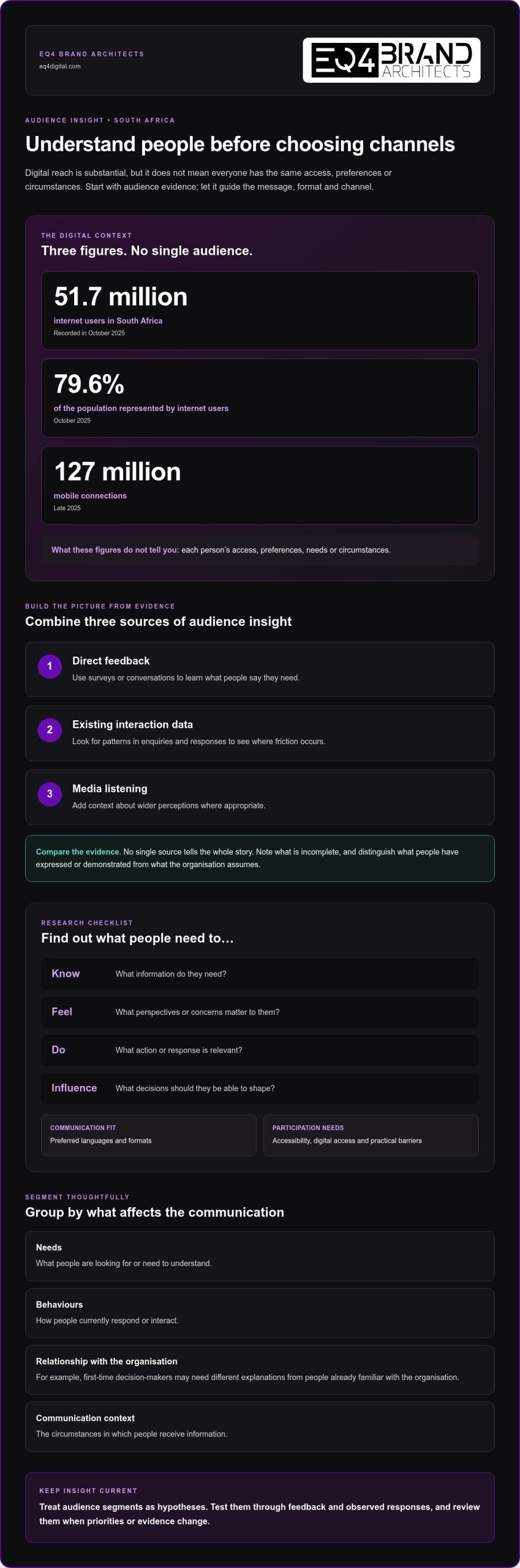
Language, cultural context, access and everyday needs all shape whether a message feels relevant and easy to respond to. DataReportal recorded 51.7 million internet users in South Africa in October 2025, representing 79.6% of the population, and 127 million mobile connections in late 2025. These figures indicate substantial digital reach, but do not mean everyone has the same access, preferences or circumstances.
There is no single national audience with one shared expectation. Research specific groups through direct feedback, observed interactions and appropriate media listening before settling on language, format or channel. This helps make communication more accessible and culturally attentive, while grounding engagement in real audience needs rather than broad assumptions.
Understand South African audiences before choosing engagement channels
A channel should follow audience insight, not dictate it. To develop an effective audience engagement strategy, South African organisations need to understand the groups they want to reach, what each group needs, how people currently perceive the organisation and which decisions they can influence. This keeps communication grounded in people’s realities rather than internal assumptions about what will attract attention.
Audience insight should guide the message, format and channel together. Build that understanding by combining direct feedback, existing interaction data and media listening where appropriate. A survey or conversation can reveal what people say they need; patterns in enquiries or responses can show where friction occurs; media listening can add context about wider perceptions. No single source tells the whole story, so compare the evidence and note where it is incomplete.
How can you segment audiences without relying on stereotypes?
Group people by factors that affect the communication objective: their needs, behaviours, relationship with the organisation and the context in which they receive information. For example, people making a first-time decision may need different explanations from those already familiar with the organisation. Treat this as a hypothesis, then test it through feedback and observed responses. Review segments when priorities or evidence change instead of assuming they remain fixed.
What should audience research uncover?
Research should clarify what people need to know, feel, do or be able to influence. It should also explore preferred languages and formats, accessibility requirements, digital access and practical barriers to taking part. Separate what people have expressed or demonstrated from what the organisation assumes. This distinction helps teams make careful choices without treating language, age or background as a shortcut for individual preferences.
South African audience context is varied, and digital habits are only part of the picture. The University of Oxford’s Reuters Institute Digital News Report: South Africa provides a useful reference on news use, trust and platforms. Pair sector-level findings with research among the specific people you need to reach. A channel that works for news discovery may not suit a sensitive service update or an invitation to participate.
Before selecting a channel, make a simple evidence check: record what the audience has said, what interaction data suggests, what media listening indicates and what remains uncertain. Then choose a message and format that respond to the clearest needs, and make space to learn from the response. A considered communication strategy connects audience understanding to consistent choices across touchpoints.
Choose engagement channels and formats for the people you want to reach
More channels do not automatically create more meaningful engagement. Each one adds a point to manage, and a message repeated everywhere may still miss the people it is meant for. An effective audience engagement strategy selects channels based on audience insight and the response an organisation wants, not simply because a platform is popular or trending.
Start with the objective. If people need a clear explanation, a well-organised website page or direct communication may help. If the goal is dialogue, a social platform or facilitated discussion may make it easier to respond. Consider whether the channel is accessible to the intended audience, supports the interaction required and suits the sensitivity of the subject. If digital access or data use could be a barrier, provide a suitable alternative rather than assuming everyone can take part in the same way.
How do you match a channel to an engagement objective?
Start by identifying what participants need to do: notice, understand, ask, contribute or give feedback. Then choose a format that makes that action straightforward. A coherent experience matters too. Someone may discover an organisation through earned media, look for details on its website and continue the conversation on social media. Keep the core message and next step clear across those touchpoints, while adapting the format to each setting.
| Format | Interaction type | Suitable objective | Example measurement signal |
|---|---|---|---|
| Owned channels, such as a website or newsletter | Read, explore or respond directly | Explain information or guide a next step | Relevant enquiries or completed actions |
| Earned media, such as editorial coverage | Encounter and discuss a story | Build awareness or understanding | Quality of coverage and resulting discussion |
| Social channels | Comment, share, ask or reply | Invite dialogue and gather feedback | Substantive responses, not just reactions |
| Live formats | Ask questions or contribute in real time | Clarify an issue or involve participants | Questions asked and themes raised |
| Experiential activations | Take part in a designed experience | Encourage direct, memorable participation | Participation and follow-up responses |
When can activations and live experiences deepen participation?
A brand activation or event can be valuable when people benefit from trying, discussing or shaping something together. Live Q&A, voting or event apps can support participation when they suit the audience and purpose; they are options, not requirements. The experience should not end when the event does. Follow-up communication can answer remaining questions, acknowledge contributions and help the team learn what to carry into future engagement.
Choose a focused mix of formats, give each a distinct role and make movement between them feel considered. This lets channel variety support a connected experience instead of creating fragmented activity.
Measure audience engagement with signals that lead to better decisions
Measurement is most useful when it shows whether communication is moving towards its purpose. To improve an audience engagement strategy South Africa brands rely on, look beyond a single dashboard number. Reach can show how widely content was distributed; it cannot, by itself, reveal whether people understood, responded to or acted on it.
Use a clear review cycle:
- 1. Define the objective. Decide what the engagement should help people know, feel, do or influence.
- 2. Choose signals. Select measures that can indicate progress towards that specific objective.
- 3. Review the evidence. Bring together quantitative results, audience comments and other relevant feedback.
- 4. Learn and adjust. Record what changed, what the evidence suggests and what the next test will explore.
Which engagement metrics are useful for different objectives?
Match each measure to the question you need to answer. Attention signals, such as reach or views, indicate potential exposure. Interaction signals, such as replies, questions or event participation, show that people took part. Feedback can reveal understanding, concerns or sentiment, while intended-action measures help assess whether engagement supported the objective, such as completing a relevant next step or returning to a communication.
There is no universal scorecard. If the goal is to hear concerns, the quality and themes of responses may matter more than their volume. If the aim is to invite participation, track who took part and whether the format enabled useful contributions. A high number of reactions is not proof of positive sentiment; interpret comments and context before drawing conclusions.
How should teams turn engagement data into action?
Numbers show patterns, but comments can help explain them. Review both: a rise in questions may indicate active interest, or that key information was unclear. Note what the team changed, what audience evidence followed and what remains uncertain. Then set a focused next test, such as refining a message or adjusting the format, and compare the response against the same objective.
Handle audience information thoughtfully. Consider what data is genuinely needed, who can access it and how feedback can be reviewed responsibly. If personal information is involved, check current authoritative guidance on POPIA and relevant data-handling practices before collecting or using it.
Measurement earns its place when it changes a decision, not merely when it fills a report. EQ4 Brand Architects’ communication strategy connects engagement objectives with listening and practical measures.
Build a sustained audience engagement strategy, from insight to action
Turn audience understanding into a repeatable practice, not a one-off campaign. A practical audience engagement strategy follows a clear sequence: research, objective, audience promise, channel, delivery and review. Each step informs the next, so creative choices serve a purpose and audience responses can shape what happens afterwards.
- Research: Clarify who needs to be involved, what they need and what current feedback or media conversations reveal.
- Set an objective: Define the change you want to support, such as improving understanding, inviting input or strengthening trust.
- Make an audience promise: Be clear about why participation is worthwhile and what people can expect from the interaction.
- Select channels and formats: Choose ways to communicate that suit the audience, the message and the response you are inviting.
- Deliver and review: Coordinate the experience, listen to what follows and use the evidence to refine the next interaction.
What belongs in a practical engagement plan?
Keep the plan useful at working level. Include audience groups, objectives, key messages, channels and formats, responsibilities, and how you will evaluate progress. Set a realistic cadence for sharing information, inviting dialogue and reviewing feedback. For every planned interaction, state its purpose and the appropriate next step, whether that is answering a question, sharing an update or making it easier to contribute.
Different capabilities can support different stages. Communication strategy brings the objective, audience and message into alignment. Public relations can help shape communication with relevant external audiences, while brand activations can create opportunities for direct participation. Graphic design, video production, animation and other creative production can express the message in formats suited to the experience. Media listening and monitoring provide an ongoing view of relevant conversations, helping teams notice questions and adjust communication thoughtfully.
How can an organisation keep engagement human and consistent?
Consistency does not mean sending the same words everywhere. Keep the core narrative and tone recognisable, then adapt the language, format and level of detail to the audience and context. Make listening part of delivery: note recurring questions, respond with care and close the loop where feedback informs a decision. Clear ownership helps too, so people know who will respond and how insights reach the team shaping future communication.
Over time, this rhythm makes engagement more coherent: people encounter a clear purpose, have a meaningful way to participate and see that their responses are considered. EQ4’s strategic communications approach brings these elements together.
Make every interaction a step towards stronger connection
A lasting audience relationship is not built by adding more activity. It grows when organisations listen to distinct audiences, choose channels and formats that fit their needs, and give each interaction a clear purpose. A considered audience engagement strategy South Africa organisations can sustain also measures responses that inform decisions, not just exposure that looks good in a report.
Keep the process connected: begin with audience insight, align messages and experiences with an objective, then review what people say and do. Use those signals to make thoughtful adjustments over time. Consistency matters, but so does adapting communication to the people and context in front of you.
EQ4 brings strategic communications and creative services together, with capabilities including PR, brand activations, media listening and monitoring, design and production. These disciplines can help turn audience understanding into relevant communication and participation. Explore EQ4’s strategic communications approach to consider how a more connected approach could support your organisation.
Start with one audience, one meaningful objective and a genuine willingness to listen. Each considered interaction can help build a stronger connection.
Frequently Asked Questions
What is an audience engagement strategy?
An audience engagement strategy is a planned approach to creating relevant, two-way interactions with the people an organisation needs to reach. It connects audience understanding to clear objectives, suitable messages and formats, and ways to learn from responses. Engagement might involve listening to feedback, inviting participation or answering questions. The aim is not simply to generate activity, but to build understanding and relationships that support meaningful organisational outcomes.
How do you create an audience engagement strategy in South Africa?
Build an audience engagement strategy South African organisations can use by starting with research, not a platform choice. Identify the groups you need to reach, their needs, existing perceptions and the decisions they influence. Set an objective, shape a relevant audience promise, then select suitable messages, channels and formats. Assign responsibilities, invite an appropriate response and review evidence so you can adjust communication to audience feedback and context.
Which audience engagement channels work best in South Africa?
No single channel works best for every South African audience or objective. Consider whether the people you want to reach use and can access the channel, and whether it supports the interaction you are seeking. A website may help explain information, social channels can support dialogue, PR can share a story through media, and a live activation can invite participation. Choose based on audience insight, then make the experience coherent across touchpoints.
How do you measure audience engagement effectively?
Begin with the objective, then select signals that indicate progress towards it. Reach and views show potential exposure; replies, questions and participation indicate interaction; feedback can reveal perceptions, while relevant next steps or repeat interactions may point to outcomes. Review figures alongside comments and other qualitative evidence. Note what changed, what you learned and what you will test next. Handle any personal information responsibly and consult current authoritative guidance where needed.
What is the difference between audience engagement and reach?
Reach estimates how many people may have encountered a message; engagement concerns how they respond and whether an interaction supports a meaningful objective. A view can indicate attention, while a question, considered comment or contribution shows a form of participation. Neither automatically proves trust or lasting connection. Interpret each signal in context: high reach may help awareness, but it will not tell you on its own whether people understood or acted on a message.
Can a small organisation build an audience engagement strategy?
Yes. A small organisation can begin with a focused plan for one audience group and one clear objective. Use existing conversations, enquiries and feedback to identify what people need, then choose a manageable channel and a response the team can sustain. Keep responsibilities clear and review the signals that matter to the objective. A deliberate, consistent approach can be more useful than trying to maintain numerous channels without enough time to listen and respond.
How often should an audience engagement strategy be reviewed?
Set a review rhythm that fits the objective, communication activity and pace of audience feedback. Check operational signals while an initiative is active, then review the wider approach at planned milestones or after a significant change in audience needs, context or organisational priorities. Do not wait for a calendar date if feedback points to a problem that needs attention. Record decisions and learning so each review informs the next round of engagement.