





What if your brand sounded different wherever people encountered it? A brand communication strategy for businesses connects the promise you make with the people, messages and channels that bring it to life. Without shared direction, even thoughtful communications can feel fragmented, and activity can become reactive rather than tied to business priorities.
If your teams are working hard to communicate but aren’t sure whether their efforts are building trust or recognition, you’re not alone. Consistency doesn’t mean repeating the same words everywhere. It means expressing a clear purpose in ways that suit each audience and channel.
This guide shows you how to shape a practical strategy around your business purpose and audience needs, align communication across teams and channels, and review what’s working. You’ll explore the foundations of a credible brand message, how to connect planning with creative execution, and which quantitative and qualitative signals can show whether communication is making a difference. The aim is a coherent approach, grounded in intention and able to adapt as you learn.
Key Takeaways
- Build a brand communication strategy for businesses around purpose, audience insight and a message people can recognise across touchpoints.
- Connect business purpose, audience understanding, messaging, channel choices and learning so each element informs the next.
- Choose owned, earned, shared and paid media according to audience, purpose, format and capacity, rather than popularity alone.
- Use an audit, audience listening and a clear baseline to set practical objectives, deliver activity and review what to refine.
- Bring an agreed narrative to life through creative execution, from public relations and brand activations to design and production.
What is a brand communication strategy, and why does a business need one?
As a business grows, its audiences, teams and communication channels tend to multiply. A website, public relations activity, social posts and customer-facing conversations may all describe the same organisation, yet leave people with different impressions if they aren’t guided by a shared idea. The challenge isn’t simply to say more. It’s to communicate with purpose and coherence.
A brand communication strategy is a plan that connects a business’s intent with its audiences, messages and the ways those messages are delivered. It sets direction for how the business wants to be understood and experienced over time. That direction draws on the principles of brand management, including the role of positioning and brand elements in shaping how people recognise and interpret a brand.
A strategy is not the same as a campaign, a promotional offer or a visual identity. A campaign has a defined objective and timeframe; a promotion communicates a particular offer. Visual identity provides recognisable design elements, such as a logo and colour palette. Strategy connects these expressions to a broader business purpose, so individual activity feels related without needing to look or sound identical.
How is brand communication different from marketing communication?
Brand communication shapes how people understand and experience a business across their interactions with it. Marketing communication usually focuses on a more specific objective, such as explaining a service, promoting an offer or inviting people to take a particular action.
The two work together. For example, a campaign introducing a new service can explain its practical value whilst reinforcing the business’s wider commitments and character. The campaign has a specific job; the brand narrative gives that job context. Marketing activity supports the strategy when it contributes to a coherent picture, rather than becoming the entire story.
What does a clear strategy help a business do?
A shared direction gives teams a reference point when they create communications or respond to questions. It can help reduce contradictions, such as presenting a business as highly personal in one setting and distant in another, without requiring every message to use identical wording. Consistency comes from a recognisable purpose and character. Tone can still adapt to the audience, channel and situation.
For instance, a business might explain its service in practical terms on its website, offer more context in a media statement and speak conversationally during a brand activation. Each expression can be distinct whilst supporting the same central idea.
A strategy guides decisions; it doesn’t replace judgement or listening. Audience needs can change, and a message that feels clear internally may not land as intended. Treat the strategy as a considered foundation, then pay attention to responses and use what you learn to shape future communication.
The five elements that make a brand communication strategy coherent
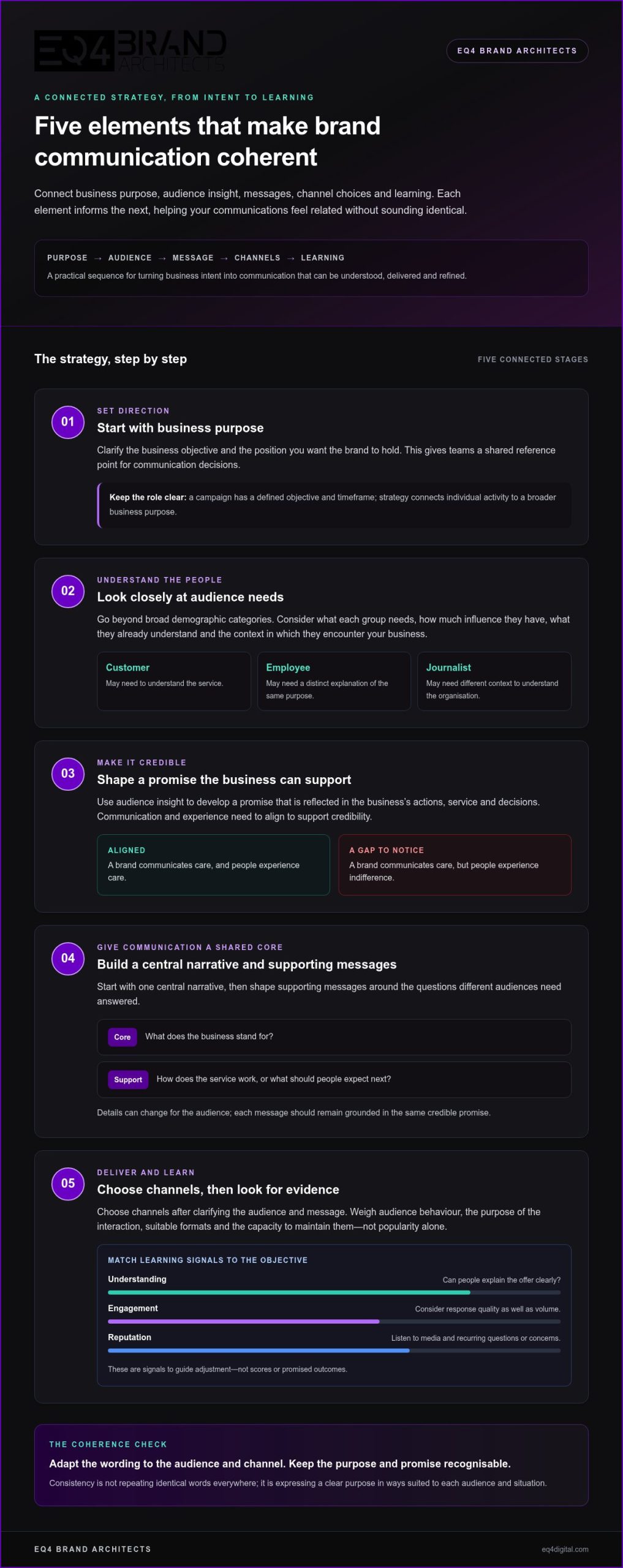
A coherent brand communication strategy for businesses brings five connected elements into view: business purpose, audience insight, message, channel choices and learning. They aren’t boxes to tick in isolation. Purpose clarifies what communication needs to support; audience insight helps shape a relevant message; the message guides where and how to share it; and learning shows whether the approach is landing as intended.
Start with purpose, audience and the promise
Begin with the business objective and the position you want the brand to hold. Then look beyond broad demographic categories. Consider what different groups need, how much influence they have, what they already understand and the context in which they encounter your business. A customer, an employee and a journalist may each need a distinct explanation, even when they’re responding to the same organisational purpose.
Use those insights to shape a promise the business can credibly support through its actions, service and decisions. If a brand communicates care but its audience experiences indifference, the gap can weaken credibility. PRSA’s discussion of building trust through consistent branding offers a useful perspective on why a brand’s communication and experience need to align.
Turn the message into a channel and learning system
Develop a central narrative, then create supporting messages that respond to different audience questions. One group may need to understand what the business stands for; another may want to know how a service works or what to expect next. The details can change, but each message should remain grounded in the same credible promise.
Choose channels after you’ve clarified the audience and message, so delivery serves the communication rather than dictating it. Consider audience behaviour, the purpose of each interaction, suitable formats and the capacity to maintain them. A channel is useful when it helps the right people receive and understand a relevant message, not simply because it’s popular.
Decide what evidence would help you learn. For an understanding objective, look for signs that people can explain the offer clearly. For engagement, consider the quality of responses as well as their volume. For reputation, combine media listening with attention to recurring questions or concerns. These signals give the team a reason to adjust, not just a record of what was published.
In practice, the elements form a loop: purpose informs the promise, audiences shape its expression, channels carry it, and learning helps refine the next decision. Explore strategic communication support as you consider how planning and creative execution can work together.
How to choose messages and channels without losing brand consistency
A channel should earn its place in your plan. Consider who needs the message, what they need to understand or do, which format will serve that purpose, when they’re most likely to engage and whether your team can sustain the activity. Broad reach alone doesn’t make a channel useful if it doesn’t suit the audience or objective.
How should a business match a channel to its audience?
Start with audience research. Map where different groups look for information, what questions they bring and which formats are accessible to them. Language preferences, cultural context, data access and communication accessibility can vary across audiences. Treat these as questions to explore, not assumptions to make. A format that works for one group may create barriers for another.
Then assess the role each channel can play. A website might offer detailed information, whilst a media statement may provide a clear, attributable update. A brand activation can create a direct experience, while social content may invite ongoing conversation. The right mix depends on the people you need to reach, the message and the capacity to maintain each channel.
How can messages adapt while the brand stays recognisable?
Set a few shared principles before adapting content: the central idea, the tone, the facts that must remain accurate and any claims the business can substantiate. Consistency means a recognisable core, not identical wording everywhere. For instance, if the central idea is “clear guidance at every step”, a website could explain the process, a short social post could answer one common question, and a media statement could set out a relevant update. Each format changes; the underlying commitment stays intact.
For a practical channel map, distinguish the media types by who controls or carries the communication:
| Media type | What it means | Example |
|---|---|---|
| Owned | Channels the business manages | Website or newsletter |
| Earned | Coverage or attention received from others | Editorial media coverage |
| Shared | Content circulated or discussed by audiences and communities | People sharing a brand post |
| Paid | Placement the business pays to distribute | Sponsored content |
Use this as a planning aid, not a checklist requiring every category. A brand communication strategy for businesses should reflect audience needs and available capacity, rather than pressure to appear on every channel. Where communications involve personal information or advertising claims, review relevant current guidance, including POPIA or Advertising Regulatory Board guidance, as appropriate.
How to build, implement and measure a business communication strategy
A useful strategy needs to work beyond the planning document. Give it a practical cycle: audit what exists, listen to audiences, define objectives, plan the work, deliver it and review what you learn. Each stage informs the next, helping the team focus effort and adjust when messages or circumstances change.
What should a communication strategy audit include?
Start by gathering current messages and reviewing the channels where they appear. Look for inconsistent claims, gaps between what the business says and what audiences experience, and questions that communications aren’t answering. Include feedback from customers, employees and other relevant groups, alongside available media listening or channel analytics.
Map how work gets done, too. Record who owns each channel, who approves messages and where delays or capacity constraints affect delivery. Then note what evidence is available and where better listening or measurement is needed. An audit isn’t about criticising past activity; it gives the team a grounded starting point.
Which measures help assess communication effectiveness?
Set a baseline before choosing targets. This might include existing audience feedback, relevant channel data, recurring enquiries or current themes in media coverage. Use that picture to define objectives that are specific, realistic and time-bound. For example, if the objective is to improve understanding of a service, establish how people currently describe it, then choose a review point to see whether their understanding has changed.
Match measures to the objective:
- Awareness: consider relevant brand searches, reach or audience recognition.
- Understanding: gather feedback on whether people can explain the message or offer accurately.
- Engagement: review meaningful responses and interactions, not just publication volume.
- Reputation: monitor recurring themes in audience feedback and media coverage.
Published content shows what a team did; audience response offers evidence of what people noticed, understood or felt. Outputs, such as posts, statements or activations delivered, are useful records of activity. They don’t by themselves show whether communication met its objective. Pair appropriate analytics with qualitative feedback, and set regular review points to interpret both.
Use those reviews to refine the plan, not simply to report results. A change in audience questions or context may call for a different message, format or delivery rhythm. A considered communication strategy review can help connect objectives, implementation and learning.
How EQ4 connects brand communication strategy with creative execution
A strategy becomes tangible through the choices people encounter: the language in a public statement, the experience of a brand activation, or the visual rhythm of a video. These expressions work best when they serve an agreed narrative rather than compete for attention. Connecting strategic intent with creative craft helps keep communication considered across formats and audiences.
Why align strategic thinking with creative craft?
Shared direction gives creative teams a foundation for making choices about tone, imagery, format and detail. It doesn’t mean every asset must look or sound the same. It means each expression has a clear relationship to the brand idea and the audience it’s intended to reach.
Audience insight and emotional intelligence matter here. A message about organisational change, for example, may need a different level of reassurance and detail for employees than for the wider public. The central facts and intent should remain aligned, whilst the form responds to the audience and context. The right approach depends on the situation, the strategy and the quality of execution; no creative format can guarantee a particular response.
When can an external communications partner help?
An external partner can be useful when communication involves several stakeholder groups, reputation priorities or a range of formats that need to feel connected. EQ4 Brand Architects brings communication strategy together with public relations, reputation management and brand activations, linking planning to the way a business communicates and is experienced.
Creative disciplines can then give the agreed narrative form. Graphic design can establish a visual expression; animation and video production can communicate ideas through movement and story; sound design and visual effects can support the intended experience. The choice of craft should follow the communication purpose, audience and practical context, not the other way around.
This integrated perspective is one way to think about the role of an agency: not simply producing individual assets, but connecting strategic decisions with purposeful execution. Businesses exploring agency roles can learn more in a guide to strategic communication agencies.
A thoughtful brand communication strategy for businesses makes room for both clarity and creative judgement. If you’re considering how those disciplines could work together, explore how EQ4 Brand Architects approaches purposeful brand communication.
Make your next communication decision more intentional
A coherent brand communication strategy for businesses connects what the business stands for with what audiences need to understand and experience. Start with a credible promise, shape messages for the people you need to reach, then choose channels that suit the purpose and your capacity. Review audience response as well as activity, and refine the approach as you learn.
Strategy and creative execution are strongest when they work together. EQ4 brings communication strategy alongside public relations and reputation management, with design, animation, visual effects and video production to help express an agreed narrative across formats.
Explore EQ4’s approach to purposeful brand communication and consider how a more connected approach could support your business. Start a conversation with EQ4 about connecting your communication strategy and creative execution.
Frequently Asked Questions
What is a brand communication strategy?
A brand communication strategy is a plan for expressing a business’s purpose and promise to the people it needs to reach. It connects business objectives, audience insight, key messages, channel choices and learning. Rather than prescribing identical wording for every situation, it establishes a recognisable direction that teams can adapt across touchpoints. The strategy also guides how communication is reviewed, so future decisions can reflect audience responses and changing needs.
Why does a business need a brand communication strategy?
A business needs a brand communication strategy to give its teams and channels shared direction. It can help reduce contradictory messages and make the brand easier to recognise, whilst allowing communication to respond to different audience needs and contexts. The aim isn’t to repeat one message everywhere. It’s to ensure that each interaction supports a credible central promise, and that the business listens when people’s questions or expectations change.
How do you create a brand communication strategy for a small business?
Start by auditing the messages and channels you already use, then listen to customers and other relevant audiences. Clarify the business objective, the people you need to reach and the promise you can support. Develop a central message, choose a manageable set of channels that fit your audience and capacity, and assign clear owners. Establish a baseline, set realistic time-bound objectives, then review responses and refine the plan as you learn.
What is the difference between brand communication and marketing communication?
Brand communication shapes how people understand and experience a business over time, whilst marketing communication usually supports a specific offer, product or campaign objective. For example, a campaign might invite people to try a service; brand communication provides the wider context for what the business stands for and how it approaches its work. Marketing activity can reinforce that narrative, but an individual campaign doesn’t replace an enduring communication strategy.
Which channels should a business include in its brand communication strategy?
Choose channels according to audience needs, communication objectives, suitable formats and the capacity to maintain them. A business might use its website for detailed information, public relations to communicate with media, social channels to share updates, or a brand activation to create a direct experience. These are possibilities, not a required checklist. Research where your audiences seek information and consider language, access and context before deciding which channels deserve attention.
How can a business measure whether its brand communication strategy is working?
Measure progress against the objective, using a baseline and a defined review point. Separate outputs, such as published content or delivered activations, from outcomes, such as audience understanding, engagement or shifts in reputation. Relevant channel analytics can show patterns in reach or interaction, whilst interviews, feedback and media monitoring add context. No single measure tells the whole story, so use evidence that reflects what the strategy set out to achieve.
Can a brand communication strategy change over time?
Yes. A brand communication strategy should provide a steady direction whilst making room to adapt. Audience feedback, new business priorities, changes in the operating context or emerging communication needs may call for revised messages, channels or objectives. Review the evidence regularly and distinguish between a change that supports the core promise and one that would create confusion. Thoughtful adjustments help keep communication relevant without losing the recognisable ideas that connect it.